The 2026 Backlash Wave Is Coming: What Prediction Markets Are Telling Us About Your Portfolio
Prediction markets have a long track record of being smarter than pundits. Right now, with over $31.6 million in trading volume across the relevant contracts, they're telling a very clear story about 2026: a Democratic wave is building, and the investment implications are significant.
Bettors are pricing an 86% chance that Democrats take control of the House in 2026. The Senate is essentially a coin flip, with Democrats at 51% and Republicans at 49%. Even Texas, a state that hasn't elected a Democratic senator since 1988, is showing a surprisingly competitive race at 45% Democratic / 55% Republican. And the 2028 Democratic presidential nomination field is extraordinarily fragmented, with Gavin Newsom leading at just 29%, followed by AOC at 8%, Josh Shapiro at 5%, Pete Buttigieg at 5%, and Andy Beshear at about 4%. When that many candidates think the nomination is worth fighting for, it tells you something about where the party believes it stands.
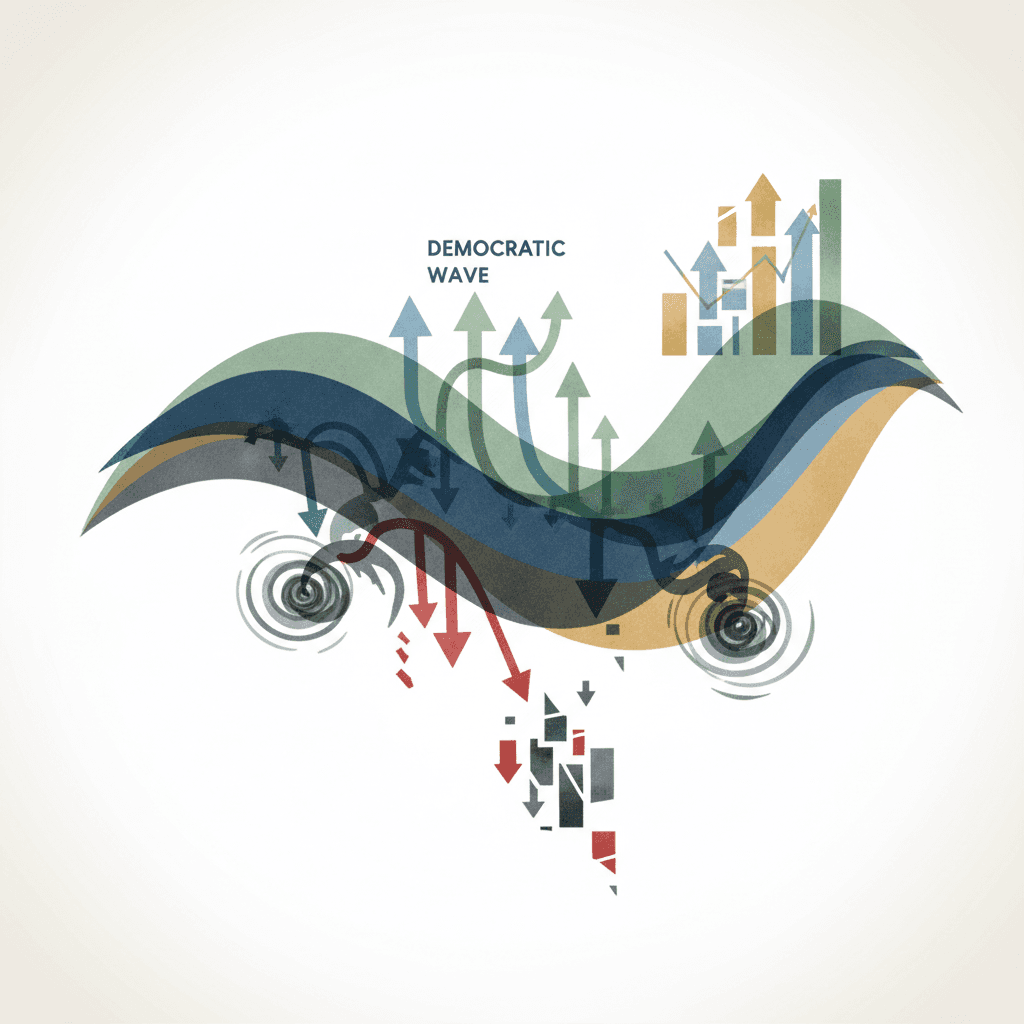
This isn't random noise. It's a pattern that the legendary investor Ray Dalio would recognize as part of his "economic machine" framework, where political cycles are just as mechanical as credit cycles. Periods of perceived excess and government dysfunction create backlash. Shutdown fatigue, economic malaise hitting Main Street, and partisan gridlock all generate the kind of voter frustration that historically produces wave elections in the midterms. What we're watching unfold in the prediction markets is the backlash phase of that cycle, and it has real consequences for anyone with money in the stock market.
The Self-Reinforcing Backlash Cycle
Think of it as a chain reaction:
- Government dysfunction (shutdowns, internal party fights) erodes public confidence.
- Economic pain, whether from tariffs, inflation, or stagnant wages, amplifies voter frustration.
- Frustration converts into midterm turnout against the party in power.
- Markets begin pricing divided government, which changes which sectors win and lose.
- The incoming congressional majority shifts legislative and oversight priorities, creating new winners and losers in the economy.
- Those economic shifts feed into the next cycle of public sentiment heading toward 2028.
The prediction markets are currently pricing the combined probability of a full Democratic sweep (both chambers) at 48%, a split government with a Democratic House and Republican Senate at 38%, and Republicans holding both chambers at just 14%. That means bettors see an 86% chance that Democrats control at least the House, which is the number that matters most for your portfolio.
What This Means for Markets
A Democratic House, even with a Republican Senate and White House, fundamentally changes the legislative environment. Historically, divided government means no major tax legislation gets passed, regulatory oversight increases through committee investigations, and government funding happens through bipartisan compromise rather than one-party reconciliation bills. That's bearish for sectors counting on deregulation and tax cuts, and bullish for sectors that benefit from policy stability or bipartisan consensus spending.
The Trades
Clean Energy: Buy ICLN (Confidence: 72%)
Clean energy stocks have been beaten down under the current administration's anti-renewables rhetoric. But an 86% probability of a Democratic House creates what amounts to a legislative shield around existing clean energy subsidies and Inflation Reduction Act provisions. Democrats wouldn't need to pass new legislation. They'd just need committee control to block any repeal efforts. The market hasn't fully priced in this protective effect, which creates asymmetric upside. You're not betting on new green laws passing. You're betting that existing ones survive.
Healthcare: Weak Buy XLV (Confidence: 65%)
Healthcare finds itself in what you might call "Goldilocks gridlock." A Democratic House protects ACA subsidies and Medicaid expansion from Republican cuts. A Republican Senate blocks aggressive drug pricing reform. The result is a sweet spot for healthcare incumbents: protected revenue streams with limited new regulation. Managed care companies and hospital systems particularly benefit from this kind of policy stability. It's the classic "who wins regardless" scenario.
Regional Banks: Sell KRE (Confidence: 70%)
Regional banks are the most exposed sector to a Democratic House. They surged on deregulation expectations, lighter capital requirements, reduced Consumer Financial Protection Bureau oversight, and loosened lending standards. A Democratic House means none of that continues legislatively. Instead, you get aggressive oversight through Financial Services Committee investigations and potential rule-tightening through reauthorization fights. Layer on the fundamental headwinds already hitting regionals, like tariff-driven stagflation and rising consumer credit stress, and you have a double negative. Political AND economic winds are blowing against them.
The Shovel Sellers: Infrastructure Plays That Win Regardless
During the California Gold Rush, most miners went broke. The people who sold them shovels got rich. The same logic applies to political transitions. Instead of betting on which party's agenda wins, you can invest in the companies that profit from political activity itself.
Cybersecurity: Buy HACK (Confidence: 75%, Infrastructure Score: 72/100)
Cybersecurity spending is one of the few areas with genuine bipartisan consensus. A Democratic House will hold hearings on election security, critical infrastructure protection, and government IT modernization, all of which drive budget allocation toward cybersecurity firms. The HACK ETF provides a diversified basket of pure-play cybersecurity companies, reducing single-company risk. Crucially, this spending is non-discretionary and grows under both parties.
Booz Allen Hamilton: Buy BAH (Confidence: 78%, Infrastructure Score: 82/100)
This is the highest-conviction shovel-seller play in the entire pattern. Booz Allen is a government consulting and analytics firm whose entire business model feeds on political activity of any kind. When Democrats take the House, they launch investigations, demand data analytics on government programs, and require audits, all of which generate consulting revenue. When Republicans control the Senate and White House, defense and intelligence spending continues. BAH has grown revenue through every political transition in the last 15 years. Political friction is literally their fuel.
T-Mobile: Buy TMUS (Confidence: 70%, Infrastructure Score: 63/100)
Regardless of which party controls what, the populist wave driving this backlash will demand affordable connectivity and rural broadband expansion. T-Mobile's 5G network investment and rural coverage strategy position it as an infrastructure beneficiary. A Democratic House would likely protect and expand FCC programs like the Affordable Connectivity Program and rural broadband subsidies that directly benefit T-Mobile's subscriber growth. The defensive revenue profile also provides protection in a stagflationary environment.
CBRE Group: Weak Buy CBRE (Confidence: 62%, Infrastructure Score: 55/100)
When neither party can pass its preferred agenda, infrastructure and construction projects become the compromise vehicle. CBRE, the world's largest commercial real estate services firm, provides the facilities management, project management, and real estate services that any building boom requires. If economic malaise is what drives the political backlash, fiscal stimulus via infrastructure spending is the bipartisan pressure valve. The relevance to the political pattern is moderate, but the risk/reward looks favorable given beaten-down commercial real estate sentiment.
Microsoft: Weak Buy MSFT (Confidence: 68%, Infrastructure Score: 58/100)
Microsoft is the infrastructure layer of government operations through Azure GovCloud, Office 365 across federal and state agencies, and defense contracts. In divided government, IT modernization is consensus spending that survives partisan gridlock. Government digital transformation is irreversible at this point. The thesis is more about downside protection than explosive upside. MSFT is a safe harbor when political uncertainty rises, with roughly 15-20% of revenue coming from government and regulated industries.
The Risks (And They're Real)
Every one of these trades has meaningful risks that deserve honest consideration.
For ICLN, clean energy stocks have structural problems beyond politics. Competition is fierce, the ETF includes international holdings subject to different political dynamics, and rising interest rates hurt capital-intensive renewables regardless of who controls Congress. A Republican Senate, which still has a 49% chance, could block any expansion of green subsidies.
For XLV, drug pricing reform has bipartisan support and could advance even in divided government. Executive actions on drug importation don't require Congress at all. Medicaid enrollment normalization after COVID is a headwind no matter what. And healthcare stocks are already richly valued.
For KRE on the short side, regional banks are already down significantly and may have priced in the bad news. Fed rate cuts could boost net interest margins. M&A activity could provide a floor on valuations. And the executive branch still controls most banking regulation through the OCC, FDIC, and Fed appointments. Short squeeze risk in heavily shorted financials is always present.
For the shovel sellers, HACK faces stretched valuations after the AI-driven rally. BAH could get caught in DOGE-style government efficiency initiatives that target consulting spend, and its concentrated government customer base means budget sequestration is an existential risk. TMUS operates in a capital-intensive, rate-sensitive business where the Affordable Connectivity Program already expired and reinstatement is uncertain even with a Democratic House. CBRE is more correlated with real estate cycles than political cycles, and commercial real estate fundamentals are independently weak. MSFT is a mega-cap where government revenue, while significant, barely moves the needle on a company this large, and antitrust scrutiny has bipartisan support.
Why This Matters for Your Money
If you have a 401(k) or any investment account, you're exposed to these dynamics whether you realize it or not. Most target-date retirement funds hold significant positions in financial stocks, healthcare, and big tech. The shift from unified to divided government doesn't just change what bills get passed. It changes which sectors of the economy have tailwinds and which face headwinds for the next two to four years.
The broader point is that political cycles are as predictable as they are uncomfortable to talk about at dinner. Backlash waves happen after periods of perceived excess and dysfunction. The prediction markets, where people put real money behind their beliefs rather than just sharing opinions on social media, are telling us this wave has an 86% probability of delivering at least a partial power shift. You don't have to agree with the politics to position your portfolio for the reality.
Analysis based on prediction market data as of April 6, 2026. This is not investment advice.
How This Story Evolved
First detected Mar 20 · Updated daily
The headline was updated to include a specific probability (86%) instead of just saying "a Democratic wave." The article's opening was rewritten to lead with a broader explanation of political backlash cycles before introducing the prediction market data, rather than starting with the trading volume statistic.
Read latest →The article removed the specific 86% probability figure from the headline, replacing it with the vaguer phrase "Democratic Wave." The body was also updated with slightly higher trading volume ($33 million vs. $30 million) and rewritten with a new opening that emphasizes prediction markets as an early warning tool.
Read this version →The headline was updated to include the specific 86% probability figure instead of just mentioning a "Democratic wave." The article's opening was rewritten to lead with a cause-and-effect political cycle idea before introducing Ray Dalio, and the betting volume figure changed from $32.9 million to nearly $30 million.
Read this version →The new version opens with a reference to Ray Dalio's "economic machine" framework instead of jumping straight into the prediction market data. It also slightly updated the trading volume figure from $32.7 million to $32.9 million.
Read this version →The article's opening was rewritten to remove the reference to Ray Dalio and his "economic machine" concept, replacing it with a simpler pendulum metaphor. The update also added more specific betting market details upfront, including the exact 86% probability figure and updated volume numbers ($32.7 million, up from $30 million).
Read this version →The article was rewritten to lead with a broader explanation of political cycles and Ray Dalio's "economic machine" concept, rather than opening with the specific 86% prediction market figure. The key probability number moved from the headline into the body of the article, and the total trading volume cited dropped slightly from $31.6 million to $30 million.
Read this version →The article was rewritten to lead with prediction markets' credibility and specific trading volume data ($31.6 million) instead of a general analogy about political reactions. The new version also added Senate odds and a mention of Texas right away, making the opening feel more data-driven and specific.
The article added a reference to economist Ray Dalio's ideas about political and economic cycles to help explain why a Democratic wave might be coming. It also removed the specific detail about $32.7 million in betting market volume from the opening.
Read this version →