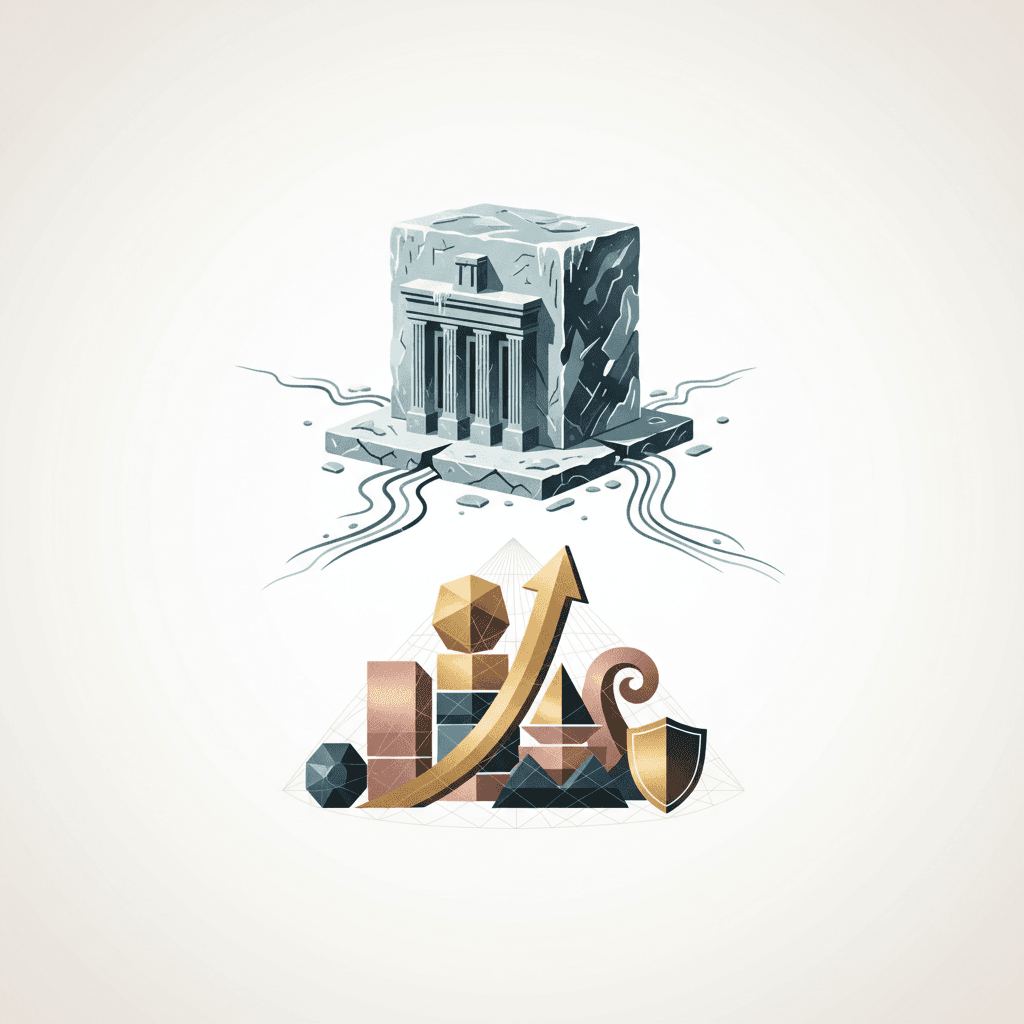
The Fed Is Frozen and the Economy Is Slowly Breaking Down. Here's What That Means for Your Money.
Imagine your car is overheating, but you can't pull over because you're stuck in bumper-to-bumper traffic. You can see the temperature gauge climbing, but there's nothing you can do except sit there and watch. That's roughly where the Federal Reserve finds itself right now, and prediction markets are putting hard numbers on just how stuck things are.
The Machine Is Jammed
Prediction markets are pricing a 98.5% chance that the Fed holds rates steady at its April 2026 meeting. No cut, no hike, nothing. Looking further out to June, there's only a 8.5% chance of even a modest 25-basis-point cut (a basis point is one hundredth of a percent, so 25 basis points means a quarter-point reduction). And for the entire year? There's a 40% probability that the Fed delivers zero rate cuts through December 2026.
If this were just a story about the Fed being cautious, it wouldn't be very interesting. The problem is what's happening on the other side of the ledger. Prediction markets put the probability of a recession in 2026 at 29%, roughly a one-in-three chance. Unemployment has a 38% chance of hitting 5% or higher before 2027. And tech layoffs are expected to accelerate, with an 83.4% probability that 2026 sees more tech job cuts than 2025.
This combination is what makes the current moment so unusual and so dangerous. The economy is weakening, but the Fed can't lower interest rates to stimulate growth because inflation concerns are still too present. It's the monetary policy equivalent of having both hands tied behind your back while someone asks you to catch a falling plate.
Here's how the self-reinforcing loop works:
- Inflation concerns keep the Fed frozen at current rates.
- High rates put pressure on businesses, especially in tech, leading to layoffs.
- Rising unemployment weakens consumer spending and economic growth.
- Weaker growth increases recession risk, which should normally trigger rate cuts.
- But inflation is still too sticky, so the Fed stays frozen. Back to step one.
This is what Ray Dalio calls a late-cycle dynamic where the central bank loses its primary tool. Interest rates, normally the thermostat that the Fed adjusts to heat up or cool down the economy, stop working because turning the dial in either direction makes something worse.
A Hawkish Future Makes It Worse
Adding to the gridlock, prediction markets show a 96.7% probability that Kevin Warsh will be confirmed as the next Fed Chair. Warsh is widely considered more hawkish than the current leadership, meaning he'd lean toward keeping rates higher for longer rather than cutting at the first sign of economic softness. This essentially extends the paralysis timeline, making it even less likely that the Fed rides to the rescue anytime soon.
Meanwhile, the S&P 500 has roughly a coin-flip chance of finishing 2026 above 6845. That's not a disaster forecast, but it's also not the kind of setup where growth stocks and cyclical companies (those whose profits depend heavily on a strong economy) tend to thrive. And there's a meaningful 16% probability that the Nasdaq drops below 19,000, a fat-tail risk that shouldn't be ignored.
The word for this economic environment is stagflation: not enough weakness to force emergency rate cuts, not enough strength to give anyone confidence. It's the worst of both worlds.
Selling Shovels During a Slow-Motion Storm
During the California Gold Rush, the people who made the most reliable money weren't the ones panning for gold. They were the ones selling shovels, pickaxes, and denim jeans to the miners. The same logic applies in uncertain markets. Instead of betting on which direction the economy breaks, you can own the companies and assets that profit regardless of the outcome.
GLD (SPDR Gold Shares) — Strong Buy, 85% confidence. Gold is the ultimate shovel in a stagflationary setup. When confidence in monetary policy deteriorates, which is precisely what Fed paralysis represents, gold tends to shine. It benefits from negative real interest rates (when inflation runs hotter than the rate the Fed is paying), from accelerating central bank purchases worldwide as countries diversify away from the dollar, and from the general uncertainty premium that comes with political pressure on the Fed. Gold has already had a strong run, which is a risk, but the fundamental case is about as clean as it gets for this environment.
BRK.B (Berkshire Hathaway) — Buy, 82% confidence. Berkshire is infrastructure for economic uncertainty itself. The company sits on over $180 billion in cash earning north of 5% in today's high-rate environment. Its insurance businesses reprice higher during periods of uncertainty. Its holdings span railroads, energy, and consumer staples, all of which keep generating revenue whether the economy is growing or shrinking. Berkshire's entire model is built for exactly this moment: accumulate cash during uncertain times and deploy it when distressed assets go on sale. Whether we get recession, stagflation, or a muddle-through scenario, Berkshire is positioned for all three.
USFR (WisdomTree Floating Rate Treasury Fund) — Buy, 80% confidence. If rates are going to stay frozen at current levels, which is the most likely outcome, then floating-rate Treasuries are the pickaxe for this specific environment. USFR earns roughly the current federal funds rate (around 5%+) with virtually zero duration risk, meaning you don't lose money if interest rates move unexpectedly. Think of it as a high-yield parking lot for your cash while you wait to see how things play out.
XLU (Utilities Select Sector SPDR) — Buy, 75% confidence. Utilities are the textbook late-cycle defensive play. People pay their electric bills in good times and bad. These are regulated, dividend-paying, essential-service businesses. If the economy deteriorates enough to eventually force rate cuts, utility dividend yields become even more attractive relative to falling bond yields. And the ongoing AI data center buildout provides a secular demand tailwind that keeps utility revenues growing even during a downturn.
COST (Costco) — Buy, 74% confidence. Costco is the shovel seller for consumer downtrading. In every slowdown, consumers shift their spending toward value, and Costco's membership model captures that behavioral shift. The tech layoffs angle is especially relevant here. When six-figure earners suddenly become cost-conscious, Costco is exactly where they go. That 83.4% probability of increasing tech layoffs feeds directly into Costco's customer acquisition pipeline.
WM (Waste Management) — Buy, 73% confidence. Trash gets generated regardless of who's winning or losing in the economy. Waste Management operates in a near-duopoly with Republic Services, holds long-term municipal contracts with built-in inflation escalators, and has the kind of high barriers to entry that make competition nearly impossible. It's about as "regardless of outcome" as a business can get.
SH (ProShares Short S&P 500) — Buy, 72% confidence. This is the direct hedge. SH moves inversely to the S&P 500, so if the index falls, SH rises. With the market itself pricing roughly a coin flip on whether the S&P finishes the year higher, a modest inverse position makes sense as insurance. This is a hedge, not a conviction short. The grinding-slowdown scenario favors small, measured inverse exposure rather than leveraged bets.
TLT (iShares 20+ Year Treasury Bond ETF) — Weak Buy, 58% confidence. Long-duration Treasuries are the classic flight-to-safety trade if recession odds climb from 29% toward 40-50%. The asymmetry is interesting: limited downside if rates stay flat, significant upside if recession materializes and the market starts pricing in eventual cuts. But the stagflation angle is the key problem. If inflation stays sticky while growth weakens, long bonds get stuck too. And a hawkish Warsh appointment could cap gains further. Confidence here is moderate for good reason.
The Risks You Need to Know
No honest analysis skips the ways things could go wrong.
A surprise Fed pivot to cuts would blow up the entire thesis. If inflation drops faster than expected, the Fed could start easing, which would send growth stocks surging and make defensive positioning look foolish. A tariff rollback or fiscal stimulus package could reignite economic confidence overnight. Nominal GDP growth from inflation can lift stock prices even when the real economy is stalling, meaning equities could grind higher in dollar terms even in a stagflationary environment.
For gold specifically, a sharp dollar rally on safe-haven flows could paradoxically cap gains. Gold has already run up significantly, and crowded positioning increases the risk of a sharp pullback. For long bonds, massive Treasury issuance to fund government deficits could push yields higher regardless of economic weakness.
Berkshire faces succession risk as Greg Abel, Buffett's designated successor, is untested at the scale of running the full conglomerate. Costco already trades at over 50 times earnings, which limits upside potential even if the business executes perfectly. And SH, as an inverse ETF, suffers from decay drag if held too long in a choppy, sideways market.
Why This Matters for Your Money
If you have a 401(k), a savings account, or just a grocery budget, this pattern touches your life directly. A frozen Fed means your savings account rate stays relatively attractive for now, but it also means the mortgage rate you've been hoping would come down probably won't. Rising unemployment and tech layoffs mean the job market is getting more competitive, especially for white-collar workers. And the general stagflationary vibe means your groceries and rent might keep getting more expensive even as the economy slows, a combination that squeezes household budgets from both directions.
The broader message from prediction markets is that we're in a period of unusual uncertainty where the traditional playbook of "the Fed will save us" simply doesn't apply. The machine that normally self-corrects is jammed. That doesn't mean panic. It means preparation, positioning in assets that work regardless of which direction the jam eventually breaks.
Analysis based on prediction market data as of April 14, 2026. This is not investment advice.
How This Story Evolved
First detected Mar 20 · Updated daily
The headline was updated to focus on what betting markets are saying instead of what the situation means for your money. The opening car analogy was also tweaked to better explain the Fed's specific problem — that it can't cut rates because inflation is still too high — before diving into the prediction market numbers.
Read latest →The article swapped out the thermostat analogy for an overheating car analogy to describe the Fed's situation. The section heading also changed from "The Numbers Behind the Freeze" to "The Machine Is Jammed," and the headline shifted focus from betting markets to personal finance advice.
The article swapped out the overheating car analogy for a stuck thermostat analogy to explain the Fed's situation. The new version also jumps straight into specific betting market numbers, like a 98.5% chance the Fed holds rates steady, rather than building up to them gradually.
Read this version →The article swapped out its opening analogy from a broken thermostat letting in cold air to a car overheating in traffic. The new body also jumps straight into explaining the Fed's predicament rather than leading with specific betting market statistics.
Read this version →The article kept the same key facts but changed its opening comparison — instead of a broken thermostat in a house with uneven temperatures, it now uses the image of a thermostat stuck while the whole house slowly gets colder. This shift suggests a more unified economic slowdown rather than a mixed hot-and-cold picture.
Read this version →The article swapped its opening metaphor from a car stuck in mud to a broken thermostat that can't control different room temperatures at once. The new headline also replaced the phrase about "betting markets" and what to do with a "coin flip" framing, suggesting less focus on actionable advice and more on market uncertainty.
Read this version →The article shifted its focus from what betting markets predict about the Fed's next moves to what investors should actually buy given the Fed's inaction. It also changed its opening metaphor from a broken thermostat to a car stuck in traffic, and reframed the economic situation as a two-sided problem of both weakness and inflation rather than just a slow decline.
Read this version →