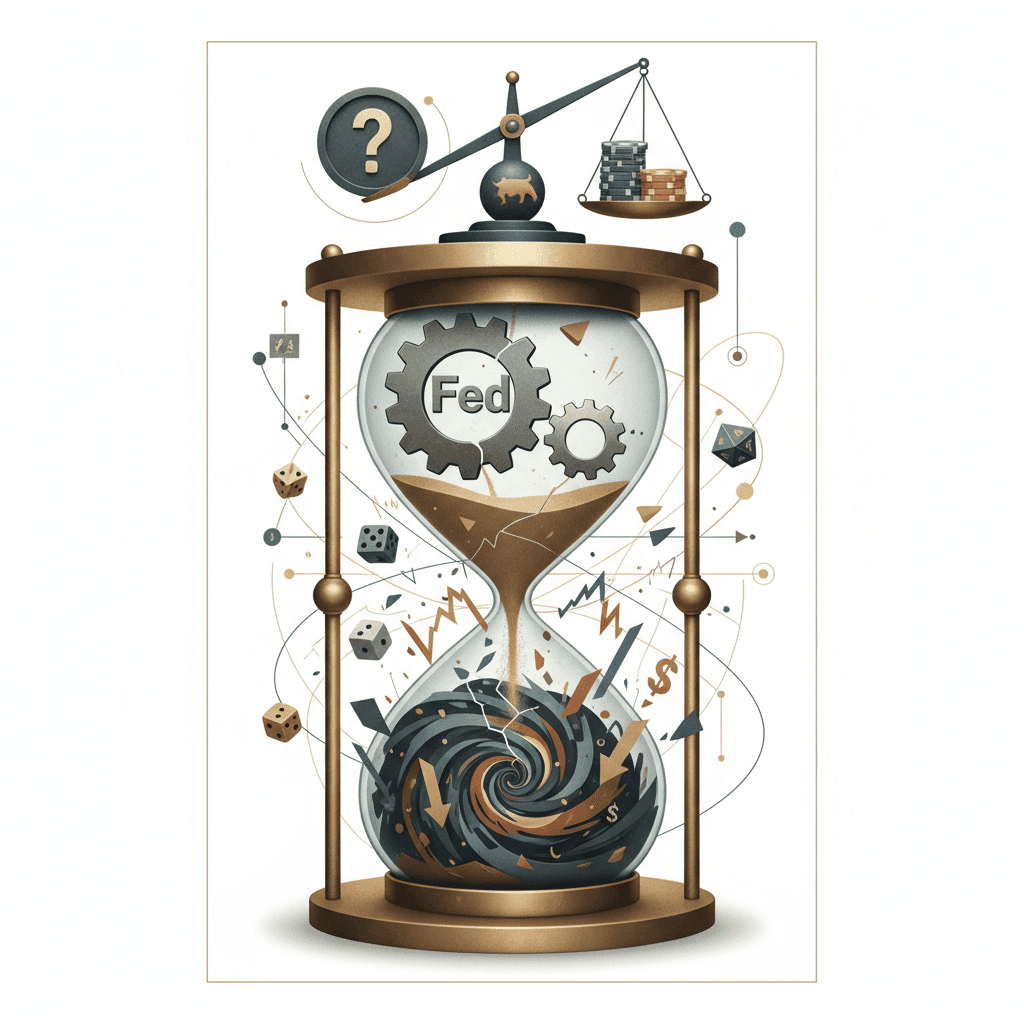
The Fed Is Getting a New Boss During the Worst Possible Time. Here's What the Betting Markets Say — and How to Position.
Prediction markets are telling us something remarkable right now: the Federal Reserve, the institution that essentially controls the price of money in America, is about to undergo a leadership change during one of the most stressful economic periods in recent memory. And the odds are not subtle.
Kevin Warsh, a former Fed governor and hedge fund advisor, has a 95.5% chance of being confirmed as the next Fed Chair. Jerome Powell, the current chair, has a 61.5% chance of leaving the Fed Board entirely before August 2026. Meanwhile, heterodox candidates like Judy Shelton, who has advocated for a return to the gold standard, sit at just 2.5%. The market is pricing an orderly but deeply significant institutional transition.
At the same time, the Fed appears frozen in place. There's a 94.5% probability the Fed holds rates steady at its April 2026 meeting. The chance of zero rate cuts for the entire year of 2026 sits at 33.5%, with one cut at 21% and two cuts at 20.5%. The economy is weakening underneath this rate freeze, creating what economists call stagflation: the painful combination of stagnant growth and persistent inflation. Think of it as driving with one foot on the brake and the other on the gas. Nothing good happens to the engine.
This matters because it represents what billionaire investor Ray Dalio calls a "central bank credibility" inflection point. The Fed's power doesn't just come from the interest rates it sets. It comes from the market's belief that the Fed will act independently, based on economic data rather than political pressure. When that belief erodes, the ripple effects touch everything from your mortgage rate to the price of groceries.
The Self-Reinforcing Loop
The danger with this kind of institutional transition is that it can create a cycle that feeds on itself:
- Powell's departure during economic stress raises questions about whether the Fed is being reshaped for political reasons.
- Markets demand higher compensation (called a "term premium") for holding long-term government bonds, because they're less sure about future Fed behavior.
- Higher long-term interest rates tighten financial conditions, slowing the economy further.
- A weaker economy puts more political pressure on the new Fed chair to cut rates or ease policy.
- That political pressure reinforces the perception that the Fed is no longer independent, sending us back to step one.
Warsh is generally considered a hawkish, establishment-friendly pick. He's not some wild card. But even a credible new leader creates uncertainty during the transition itself, and uncertainty is the one thing bond markets hate most.
The Trades: Directional Bets
The market implications point clearly toward bearish pressure on long-term Treasuries and medium-term headwinds for the U.S. dollar, with increased volatility throughout the transition.
TBT — BUY (72% confidence). This is a 2x leveraged inverse bet on 20+ year Treasury bonds, meaning it goes up when long-term bond prices go down (and yields go up). The thesis is straightforward: a Fed leadership change during stagflationary stress increases the term premium that investors demand for holding long-duration government debt. A politicized Fed, even if nominally hawkish, creates uncertainty about how the institution will react to future crises. The triple threat of institutional transition, stagflation, and governance chaos all point to wider term premia. One important caveat: TBT is a leveraged product that decays over time. It works as a medium-term tactical position, not something to buy and forget.
TLT — WEAK SELL (62% confidence). This is the unleveraged version of the same thesis. TLT holds long-term Treasury bonds directly, making it the cleanest instrument to underweight if you believe institutional uncertainty will push long-term rates higher. The Warsh confirmation at 95% during economic stress historically compresses bond prices as markets reprice credibility risk. Confidence is lower here because a sudden recession could trigger a flight-to-safety rally in Treasuries that temporarily overwhelms the thesis.
UUP — WEAK SELL (55-62% confidence). The dollar faces medium-term headwinds from eroding perceptions of Fed independence. The dollar's special status as the world's reserve currency rests partly on the belief that the Fed operates without political interference. If that belief cracks, so does some of the dollar's premium. But this is the lowest-conviction piece of the puzzle. Dollar dynamics are complex. If global investors panic about anything, they still tend to rush into dollars out of pure habit and liquidity needs. The euro and yen have their own credibility problems, limiting alternatives. The 33.5% probability of zero cuts all year is actually somewhat dollar-supportive, since higher-for-longer rates attract capital. Small position only, if any.
GLD — BUY (74-78% confidence). This is the highest-conviction leg of the entire thesis. Gold is the canonical hedge against central bank credibility erosion. It has been for thousands of years, and that hasn't changed. Every scenario embedded in this pattern is gold-positive. Fed politicization erodes confidence in paper money. Stagflation is the historical gold bull case. Negative real rates persist during a hold cycle. Institutional uncertainty drives central banks themselves to diversify reserves into gold, and global central bank gold buying is already at record levels. Gold doesn't need the thesis to be precisely right. Any deterioration in confidence acts as a tailwind. The alternative to GLD is IAU (72% confidence), which holds the same physical gold but charges slightly lower fees, making it a better choice for a longer-term hold. Don't own both. Pick one.
The Shovels: Infrastructure Plays
During the California Gold Rush, the people who most reliably made money weren't the miners. They were the ones selling shovels, picks, and denim pants. The same logic applies here. Some companies profit from the uncertainty itself, regardless of which direction markets move.
CME — BUY (78% confidence, infrastructure relevance score: 85/100). CME Group owns the interest rate futures market. Fed Funds futures, Treasury futures, SOFR contracts — all of it runs through CME's platforms. Think of CME as the toll booth on the highway of rate speculation. Any change in Fed leadership, policy expectations, or rate path uncertainty directly translates into trading volume, and CME collects a fee on every transaction. The Warsh transition plus held rates plus stagflation uncertainty equals massive hedging demand. Interest rate products make up roughly 40-50% of CME's revenue, and this pattern drives that segment directly.
CBOE — BUY (80% confidence, infrastructure relevance score: 82/100). Cboe Global Markets is the purest shovel-seller in this entire pattern. Cboe owns the VIX, Wall Street's "fear gauge," and profits from volatility itself regardless of direction. Fed leadership transitions, stagflationary uncertainty, and policy incoherence all generate the one thing Cboe monetizes: options and volatility product trading volume. It doesn't matter whether the Fed transition goes well or badly. The uncertainty surrounding it drives hedging demand.
RGLD — BUY (74% confidence, infrastructure relevance score: 72/100). Royal Gold is the shovel-seller within the gold thesis. It's a royalty and streaming company that collects revenue from gold production without actually operating mines. If central bank credibility concerns drive gold higher, RGLD benefits with amplified upside but without the operational risk of digging holes in the ground. It profits regardless of which gold miner succeeds. GDX (60% confidence) offers a similar leveraged play on gold through a basket of mining stocks, but miners face real margin pressure during stagflation because their input costs (energy, labor) rise alongside gold prices.
TIP / TIPS — BUY to WEAK BUY (60-67% confidence). Treasury Inflation-Protected Securities are government bonds whose value adjusts with inflation. If the new Fed chair, under political pressure, is slower to fight inflation, then inflation expectations (called "breakevens") rise, and TIPS outperform regular Treasuries. You don't need to pick whether Powell or Warsh wins. You just need inflation expectations to remain elevated. The catch: TIPS still carry duration risk, meaning if interest rates rise faster than inflation expectations, they can lose money in absolute terms.
FLOT — WEAK BUY (58% confidence). Floating rate bonds are the defensive play. Their interest payments adjust with prevailing rates, so in a hold-rates-high scenario (94.5% April hold, 33.5% zero cuts all year), they preserve capital better than fixed-rate bonds. This isn't a home run trade. It's a portfolio stabilizer during institutional transition.
WFC — WEAK BUY (58% confidence). Banks are the transmission mechanism of monetary policy, and Wells Fargo would benefit from a steepening yield curve where long-term rates rise while short-term rates stay put. A Warsh Fed might also adopt a friendlier regulatory posture. But stagflation is terrible for banks because credit losses rise while loan demand falls. This is a lower-conviction, indirect play.
SGOL — WEAK BUY (63% confidence). This is physical gold stored in Swiss vaults rather than U.S. ones. If you're specifically worried about U.S. institutional credibility, holding gold outside U.S. custodial infrastructure adds a layer of diversification. This is the most targeted hedge to the erosion thesis, though it's redundant with GLD or IAU for most investors.
The Risks — And They're Real
No thesis survives contact with reality unscathed. The honest risks here are significant:
- Powell might stay. There's a 39% chance he doesn't leave before August 2026. If he stays, the transition risk discount evaporates.
- Warsh could prove surprisingly credible and independent. He might restore bond market confidence and compress the term premium, which would hurt the short-Treasury and gold trades simultaneously.
- A deep recession triggers flight-to-safety. If the economy falls off a cliff, investors pile into Treasuries regardless of who chairs the Fed, crushing the TBT trade and rallying TLT.
- Deflationary shock. Tariff-induced demand destruction could overwhelm inflation fears entirely, flipping the script on gold and TIPS.
- Gold may already reflect this. With gold near all-time highs, much of the Fed credibility concern might already be baked into the price.
- Leveraged ETF decay. TBT loses value over time even in flat markets due to the math of daily rebalancing. If the move is slow and choppy rather than directional, returns erode.
- The transition proves boring. If Warsh's confirmation is smooth and uneventful, volatility collapses, and the shovel-sellers (CME, CBOE) see volumes normalize.
Why This Matters for Your Money
You might not trade Treasury futures or own gold ETFs, but this pattern affects you. If the Fed loses credibility, long-term interest rates rise, which means higher mortgage rates, higher car loan rates, and higher borrowing costs for businesses that eventually pass those costs to consumers. Stagflation means your grocery bills stay high while your job security weakens. And if the dollar loses its special status even slightly, imports get more expensive, which includes a surprising amount of what Americans buy every day.
For anyone with a 401(k) heavily weighted toward bonds, the message from prediction markets is worth hearing: the combination of a Fed leadership change, sticky inflation, and frozen monetary policy creates real risk for long-duration fixed income. Diversification toward inflation-protected assets, gold, and the companies that profit from uncertainty itself might be prudent.
The prediction markets aren't saying the sky is falling. They're saying the institution responsible for keeping it up is changing hands during a storm.
Analysis based on prediction market data as of March 20, 2026. This is not investment advice.