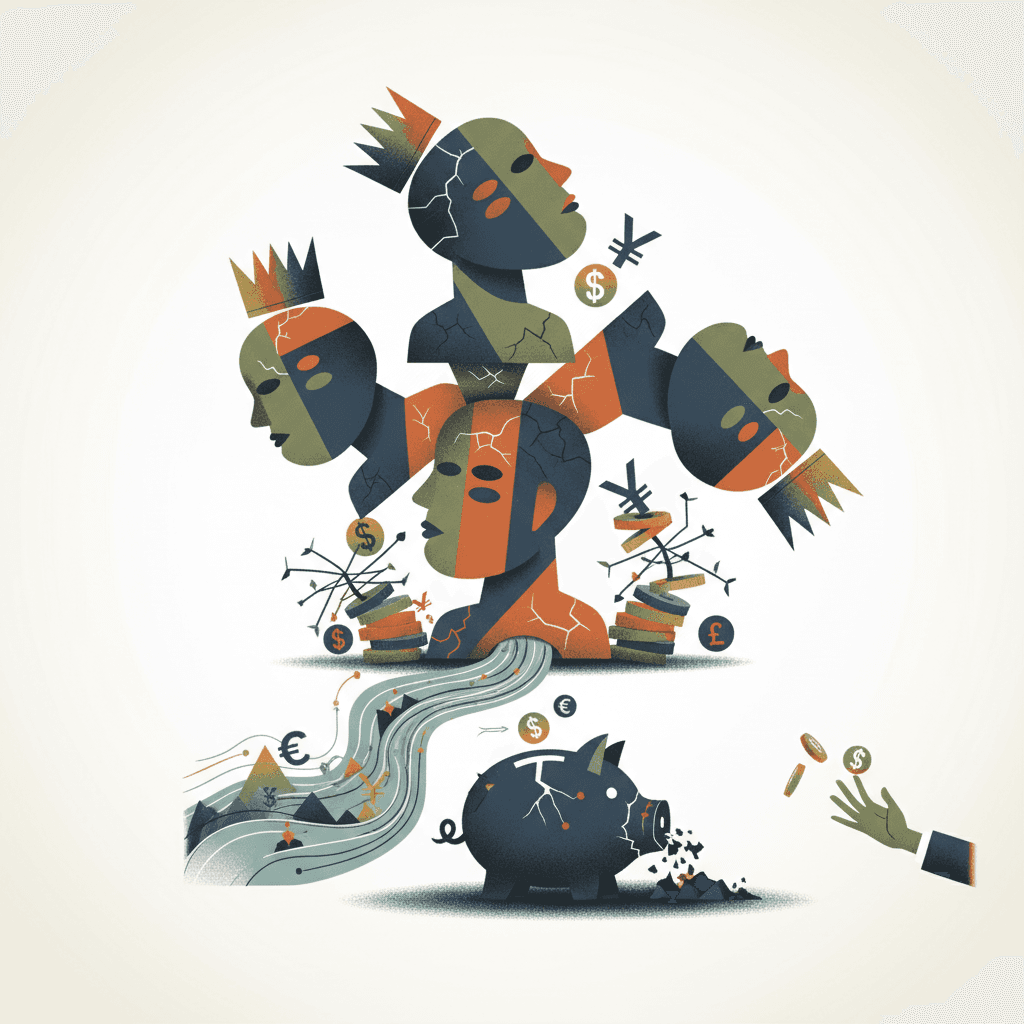
The World's Leaders Are All Wobbling at Once, and Markets Are Noticing
Prediction markets are pricing something unusual right now: a wave of leadership turnover hitting multiple countries at the same time. Not one or two surprise elections, but a synchronized pattern of political instability stretching from London to Budapest to Caracas to Jerusalem. When this many governments are shaky simultaneously, the consequences ripple far beyond politics and into your portfolio.
Let's walk through what the betting markets are actually saying, why it matters for the global economy, and which investments stand to benefit from a world where nobody knows who's in charge.
The Numbers Tell a Story
Prediction markets currently give Keir Starmer a 56.5% chance of leaving his post as UK Prime Minister before January 2027, with a 27.5% chance he's gone as soon as July 2026. In Hungary, Viktor Orbán has only a 34% chance of remaining PM after the 2026 parliamentary election, while opposition figure Péter Magyar sits at 66.5%. Benjamin Netanyahu carries a 32.5% probability of leaving office as Israel's PM before 2027. Even Xi Jinping, the leader of an authoritarian state where transitions are supposed to be tightly controlled, shows an 8.4% chance of departure, which is remarkably elevated for someone with his grip on power. In Venezuela, the market gives Delcy Rodríguez a 71.5% chance of being head of state by year-end, signaling the anticipated end of the Maduro era (Maduro himself sits at just 13.5%). And Donald Trump? He's at 15.5% to be out before 2027.
These aren't random, unrelated coin flips. Ray Dalio, the billionaire investor and economic historian, has written extensively about how internal political instability in great powers tends to cluster during periods of economic stress and social polarization. That's exactly what we're seeing. Nearly $9 million in volume has flowed through these leadership-related contracts, suggesting real conviction behind these probabilities.
Why Simultaneous Instability Is Worse Than the Sum of Its Parts
Think of international diplomacy like a group project. If one member of the group is distracted or absent, the rest can pick up the slack. But when half the group is dealing with their own problems at the same time, the whole project falls apart. That's the dynamic at play here.
When multiple major nations face leadership transitions simultaneously, the risk of miscalculation, broken agreements, and policy whiplash increases in a way that isn't just additive. It's multiplicative. A new leader in Hungary might renegotiate NATO commitments. A post-Netanyahu Israel could shift its approach to Iran. A post-Maduro Venezuela creates uncertainty in global oil markets. And a weakened Starmer government compounds the uncertainty that has hung over the UK since Brexit.
The self-reinforcing cycle works like this:
- Leadership uncertainty in one country makes it harder to sign long-term agreements with other countries.
- That diplomatic paralysis increases economic uncertainty for all trading partners.
- Economic uncertainty fuels domestic discontent, which further destabilizes the leaders who are already wobbling.
- Weakened leaders in multiple countries simultaneously means there's no stable anchor to calm things down.
- The cycle feeds on itself until new leaders are firmly established and able to make credible commitments.
This is particularly dangerous when layered on top of existing Middle East tensions and U.S. governance dysfunction. The result is elevated geopolitical risk premiums across nearly every asset class.
Trade Signals: Where the Money Flows When Trust Erodes
Gold: The Original Safe Haven
GLD — BUY (78% confidence)
Gold thrives when trust in institutions erodes. When multiple governments are in flux, the reliability of sovereign debt, fiat currencies, and international treaties all degrade. Gold benefits from this trust deficit directly. Central banks are already accumulating gold at record pace, which creates a structural floor under the price, like a thermostat that prevents the temperature from dropping below a certain point. The clustered nature of this instability, hitting the UK, Hungary, Israel, Venezuela, and even nudging China, creates a nonlinear increase in tail-risk scenarios where gold has historically outperformed.
Lockheed Martin: New Leaders Need to Show Strength
LMT — BUY (75% confidence)
New leaders often feel pressure to demonstrate strength or renegotiate security arrangements. A post-Orbán Hungary might shift its NATO stance. Whoever follows Netanyahu will inherit an active security crisis. Ongoing conflicts in Ukraine and the Middle East, combined with bipartisan U.S. support for defense spending, create robust demand for Lockheed's F-35 fighters, missile defense systems, and hypersonic weapons. Even if specific leaders change, the direction of global rearmament is structurally entrenched. The world isn't getting less dangerous.
Mid-Term Volatility: The Slow Burn
VIXM — WEAK BUY (58% confidence)
VIXM tracks mid-term VIX futures with 4-to-7-month expiry dates. These capture the sustained uncertainty of leadership transitions playing out over 12 to 18 months rather than short-term panic spikes. When multiple countries face political upheaval at once, the compounding effects on supply chains, trade agreements, and security arrangements create persistent volatility. But VIXM is a structurally decaying instrument, meaning it's built in a way that loses roughly 30-50% of its value annually in normal conditions due to something called contango, where future prices are higher than spot prices and the fund constantly sells low to buy high. This is a hedge, not a core position.
The Dollar as Plumbing
UUP — WEAK BUY (60% confidence)
When non-U.S. countries face simultaneous instability while the U.S. remains comparatively stable (Trump's departure odds are only 15.5%), capital flows toward dollar-denominated assets. Sterling weakens from Starmer instability, the Hungarian forint weakens from the Orbán transition, and the Israeli shekel faces uncertainty from Netanyahu's status. The dollar index fund UUP acts as the plumbing through which these safe-haven flows move.
The Shovels-Not-Gold Plays
During the California Gold Rush, the people who reliably made money weren't the miners. They were the ones selling pickaxes, shovels, and denim jeans. The same logic applies to geopolitical instability. Rather than betting on specific outcomes, you can invest in the infrastructure that benefits regardless of who wins or loses.
Royal Gold: The Gold Rush's Shovel Seller
RGLD — BUY (76% confidence)
Royal Gold is a streaming and royalty company, meaning it finances gold miners in exchange for the right to buy their gold at below-market prices. It captures upside from rising gold prices without the operational headaches of actually running a mine: no labor strikes, no permitting nightmares, no cost overruns from diesel fuel or explosives. It sits alongside Franco-Nevada (FNV) and Wheaton Precious Metals (WPM) as one of three major streaming companies. Its gold price correlation runs around 70-80%, giving it meaningful exposure with built-in downside protection.
Leidos: The Intelligence Infrastructure Layer
LDOS — BUY (74% confidence)
Leidos provides IT, cybersecurity, intelligence analysis, and mission-critical services to the U.S. government and allied nations. When leadership transitions create uncertainty, demand for intelligence and surveillance capabilities increases regardless of who takes power. New leaders in the UK, Hungary, and Israel all need intelligence infrastructure. Leidos is deeply embedded in long-term government contracts spanning 5 to 10 years, contracts that survive leadership changes by design. It benefits from instability itself, not from any particular outcome.
Kratos Defense: The Drone Revolution's Component Maker
KTOS — BUY (70% confidence)
Kratos builds target drones, tactical unmanned aerial vehicles, satellite communications, and missile defense subsystems. These are components sold to multiple prime contractors like Lockheed, Northrop Grumman, and Raytheon, so Kratos wins regardless of which prime contractor gets the big contract. When nations face political uncertainty, they increasingly lean on autonomous systems rather than committing troops, because deploying soldiers requires political capital that transitional leaders don't have. Israel's Iron Dome and similar systems use Kratos subsystems, making the Netanyahu transition directly relevant.
Carrier Global: The Supply Chain Rebuilder
CARR — WEAK BUY (62% confidence)
This is the least obvious play. When leadership transitions create trade policy uncertainty, companies restructure their supply chains. They nearshore production, build new facilities, and reconfigure logistics. All of that physical infrastructure requires climate control, security systems, and cold-chain refrigeration, which is exactly what Carrier provides. Its recent Viessmann Climate Solutions acquisition gives it European exposure right where the Hungarian and UK transitions will reshape energy and building policy. The connection to the core thesis is more indirect, so the confidence here is lower.
A Note on What We Passed On
We considered AGOL, another physical-backed gold ETF, but passed. GLD already covers this exposure more efficiently with better liquidity. Stacking duplicative gold positions would create unnecessary concentration risk without adding new information to the portfolio.
The Risks Are Real
Every one of these trades can go wrong, and intellectual honesty demands we lay that out clearly.
For gold and Royal Gold, the biggest threat is rising real interest rates. If central banks keep rates elevated, the opportunity cost of holding a non-yielding asset like gold increases. Gold is also already at elevated levels, meaning much of the uncertainty may already be baked into the price. And if leadership transitions resolve peacefully and quickly, the geopolitical premium evaporates.
For the defense names (Lockheed, Kratos, Leidos), the risk cuts two ways. Government efficiency initiatives could target defense spending and service contracts. Kratos in particular has historically struggled with profitability and cash flow, and as a small-cap defense company, it can be volatile and illiquid. Paradoxically, leadership transitions could lead to diplomatic breakthroughs that reduce the perceived threat level.
For the dollar play through UUP, Trump's tariff policies and fiscal expansion could actually weaken the dollar through twin deficit dynamics, where both the budget deficit and trade deficit expand simultaneously. Fed rate cuts would also erode the dollar's yield advantage. And there's an internal tension in this portfolio: a strong dollar thesis and a strong gold thesis partially contradict each other, since gold is priced in dollars. Both can work in certain scenarios, but they're unlikely to both work fully at the same time.
For VIXM, the contango decay problem is severe. This instrument is designed to lose money slowly unless volatility spikes hard enough to overcome the structural drag. Equity markets have a well-documented habit of shrugging off political uncertainty, which could leave this hedge as dead weight.
For Carrier, the connection to geopolitical instability is genuinely tenuous. Commercial real estate weakness could dominate, and the high debt load from the Viessmann acquisition limits financial flexibility if things go sideways.
Why This Matters for Your Money
You don't need to be a geopolitics junkie for this to affect your life. If you have a 401(k), you're exposed to the companies and governments navigating these transitions. If you buy groceries, you're affected by supply chain disruptions that leadership changes can trigger. If you have savings in dollars, the relative stability of the U.S. government compared to its peers is directly supporting your purchasing power.
The core insight is straightforward: when the world's leaders are all wobbly at the same time, the ability of governments to make and keep promises degrades. That means more volatility, more risk premiums, and more demand for assets and companies that benefit from uncertainty rather than stability. The picks-and-shovels companies, the ones selling intelligence infrastructure, drone components, and gold royalty streams, tend to do well in these environments because they profit from the instability itself rather than from any specific political outcome.
Nobody knows exactly which leaders will fall and which will survive. But the pattern of synchronized political fragility is clear, and it has investment implications that go well beyond any single election.
Analysis based on prediction market data as of April 9, 2026. This is not investment advice.
How This Story Evolved
First detected Apr 8 · Updated daily
The headline changed "Shuffle" to "Shake-Up," and the opening of the article was rewritten to use a building/load-bearing walls analogy to explain global political instability, while also broadening the scope from specific named countries to "every continent." The new version focuses more directly on how this affects everyday investors' portfolios.
Read latest →Global political uncertainty remains a key market concern, but investors are now leaning more toward defense stocks and gold as safe havens, while pulling back from some previous volatility and dollar-focused bets. Confidence in Lockheed Martin strengthened notably, suggesting markets see lasting demand for defense spending amid the ongoing leadership instability.
Read this version →The headline was updated to focus on markets reacting to global instability, rather than what it means for personal money. The opening was rewritten to be more direct and specific, naming actual cities and framing the instability as a "synchronized pattern" instead of a "global leadership instability cascade."
The article was updated to use more technical financial language, like "global leadership instability cascade" and "safe-haven assets," instead of the simpler, more personal tone that mentioned grocery bills and savings. The headline also shifted from a general observation to promising specific money advice.
Read this version →