Prediction Markets Are Pricing in the Longest Government Shutdown in U.S. History. Here's What That Means for Your Portfolio.
Prediction markets are flashing a signal that's hard to ignore: there's a 96.5% chance the current government shutdown stretches past 50 days, a 68.5% chance it exceeds 55 days, and a 32.5% chance it blows past 60. The probabilities for truly extreme scenarios, shutdowns lasting 70, 80, even 100 days, have surged 58-100% in just the last 24 hours. For context, the longest government shutdown in American history was 35 days, back in 2018-2019. The betting markets are saying we're about to shatter that record, and it probably won't even be close.
At the same time, the Department of Homeland Security funding bill keeps slipping. There's only a 32.5% chance it passes before April 8, rising to 69.5% before April 15 and 88.5% before April 22. Every missed deadline extends the pain. And the political fallout is already showing up in the 2026 midterm markets: Democrats are given an 85.6% chance of winning back the House, while the Senate sits at essentially a coin flip (49.3% Democrat, 50.4% Republican). Voters are punishing the party in charge, and that punishment is being priced in real time.
This isn't just a Washington story. It's a money story.
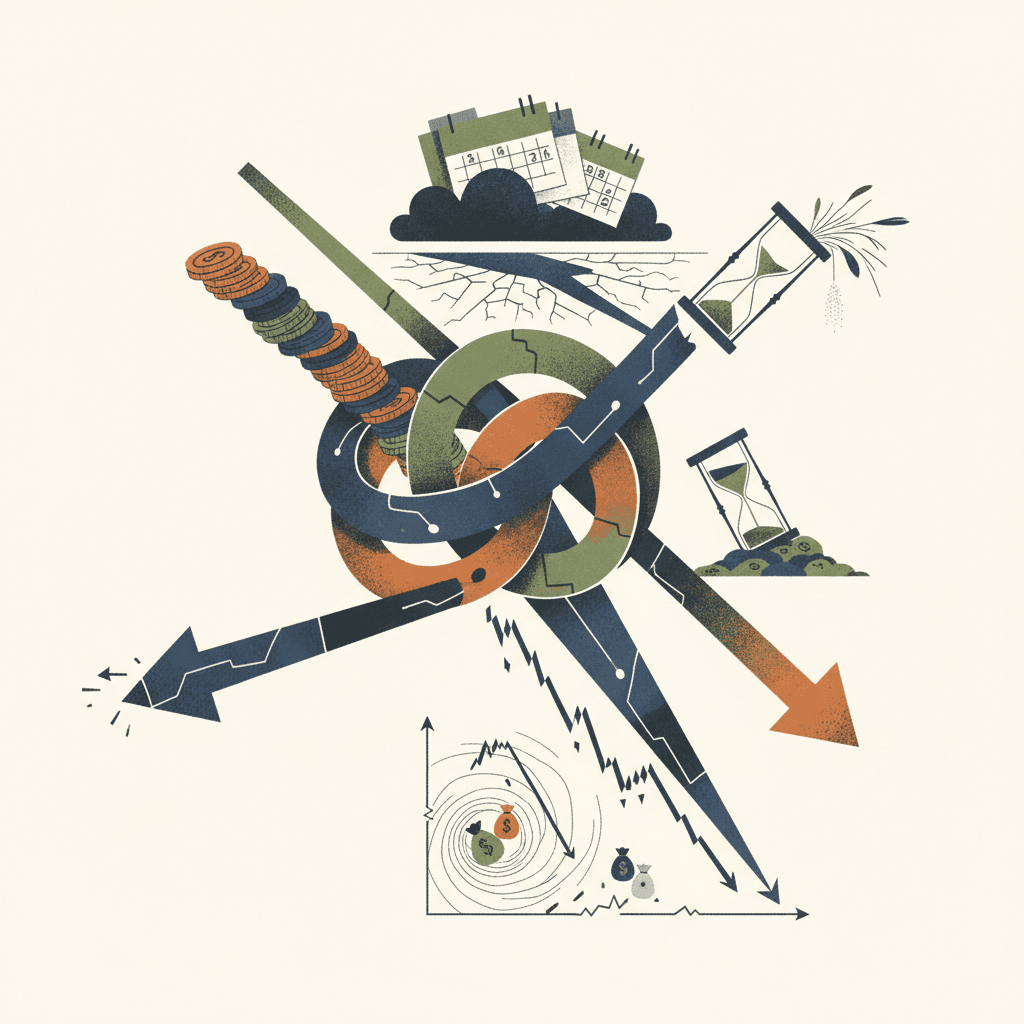
The Doom Loop
Ray Dalio, the founder of the world's largest hedge fund, has spent years warning about what he calls political fragmentation leading to fiscal paralysis. What prediction markets are pricing right now is exactly that pattern, and it works like a self-reinforcing cycle:
- Deep political divisions make it impossible to pass basic funding bills.
- The resulting shutdown drags on the economy, historically shaving 0.1-0.2% off GDP for every week it lasts.
- Economic pain makes voters angrier, deepening political divisions.
- The prospect of divided government after 2026 (a Democratic House with a Republican Senate) means the dysfunction doesn't end with this shutdown. It becomes the new normal.
- Return to step 1.
The compounding element this time is unprecedented. You don't just have a shutdown. You have a shutdown plus debt ceiling risk plus the chaos of DOGE-driven government restructuring all happening at once. No prior playbook covers this combination.
The Trades
Gold is the center of gravity for this thesis. Unlike stocks or even Treasury bonds, gold benefits from both shutdown uncertainty and debt ceiling fears. It's the asset people buy when trust in governance erodes. GLD, the most popular gold ETF, is a BUY at 72% confidence. If the 2026 midterms deliver divided government (which prediction markets strongly expect), fiscal dysfunction becomes a multi-year condition, not a temporary disruption. Gold thrives in that world.
For investors who want to take the gold thesis one step further, PHYS, the Sprott Physical Gold Trust, offers something different. It holds actual allocated gold bars in Canadian vaults, outside the U.S. financial system. During a debt ceiling crisis, the distinction between paper gold held by a U.S.-regulated entity and physical gold sitting in another country's jurisdiction starts to matter. This is a BUY at 70% confidence, though it comes with wider bid-ask spreads and occasional premiums or discounts to the actual gold price.
The "shovels during the Gold Rush" play here is RGLD, Royal Gold. This is a royalty and streaming company, meaning it collects a cut of gold production from dozens of mines worldwide without actually operating any of them. Think of it like owning the toll road instead of the trucks. If government dysfunction drives gold prices higher, Royal Gold captures the upside with lower operational risk than companies digging holes in the ground. It doesn't matter which specific gold miner succeeds. Royal Gold gets paid on every ounce produced. BUY at 68% confidence.
On the broader market, SH, the ProShares Short S&P 500 ETF, serves as a hedge against equity declines. This is a BUY but at a more moderate 62% confidence, and it's important to understand why. Historically, government shutdowns have not crushed the stock market. The 2018-2019 shutdown saw the S&P 500 recover quickly. The difference this time is the compounding effect of multiple crises at once. This is a hedge, not a high-conviction directional bet.
TLT, the long-term Treasury bond ETF, is a WEAK BUY at only 55% confidence, and the reasoning is genuinely conflicted. Shutdowns typically drive investors into Treasuries as a safe haven. But if the shutdown spirals into a debt ceiling crisis, Treasuries become the risk asset, since they're literally the IOUs of a government that might not pay its bills. The inflationary tariff environment adds another complication, potentially keeping interest rates elevated regardless of shutdown dynamics. This one could go either way.
The Contrarian Plays: Selling the Shovels When the Mine Closes
The "shovels" framing works in both directions. Sometimes the best trade is betting against the companies that supply a broken system.
BAH, Booz Allen Hamilton, derives roughly 97% of its revenue from U.S. government contracts. A 50-to-70-day shutdown directly freezes contract awards, delays payments, and creates massive uncertainty for their entire business pipeline. Add DOGE-driven restructuring on top, and the 85.6% probability of a Democratic House in 2026 signaling a dramatic shift in the defense and intelligence consulting landscape, and you have a company facing pressure from multiple directions. WEAK SELL at 65% confidence.
SAIC, Science Applications International Corporation, runs a similar playbook. About 95% of revenue comes from government IT, engineering, and mission support contracts. DHS is a major customer, and the DHS funding bill slippage hits them directly. WEAK SELL at 60% confidence.
An interesting second-order play is CBRE, the world's largest commercial real estate services firm. They manage significant federal property portfolios. When shutdowns end, there's a surge of deferred maintenance, lease renegotiations, and facility reopenings. They profit from the chaos and the cleanup. WEAK BUY at 58% confidence, though the honest caveat is that interest rate expectations move CBRE's stock far more than anything happening with government operations.
One note on transparency: MNST (Monster Beverage) was considered as a defensive consumer rotation play, but the connection to government shutdowns is too thin to recommend. It's rated NEUTRAL at 45% confidence. Not every pattern deserves a full portfolio of trades, and forcing connections that don't exist is how people lose money.
The Risks (And They're Real)
This thesis has meaningful vulnerabilities that deserve honest treatment:
- Markets have historically shrugged off shutdowns. The 2018-2019 shutdown, the longest ever at the time, barely left a mark on equities. Broad market hedges like SH could easily bleed money if this pattern repeats.
- A last-minute continuing resolution could deflate the entire thesis overnight. Congress has a long history of stumbling to deals at the final hour. If that happens, inverse positions and safety trades unwind fast.
- Fed policy and corporate earnings still matter more. Government dysfunction is one input into market pricing. Interest rate decisions and quarterly results are bigger ones.
- Inverse ETFs like SH suffer from daily rebalancing decay. Holding them for weeks or months creates a drag that eats into returns even if the market does decline.
- Gold is already at elevated levels. Much of the dysfunction story may already be baked into the price. Dollar strength during a global risk-off event could cap gold's upside.
- Government contractors have survived every prior shutdown. Booz Allen and SAIC have backlogs that provide revenue visibility, and essential contracts continue even during shutdowns. These stocks may already reflect the risk given months of DOGE headlines.
- The debt ceiling tail risk cuts both ways for Treasuries. The very scenario that makes TLT attractive as a safe haven could also make it dangerous.
Why This Matters for Your Money
If you have a 401(k), a savings account, or just a grocery budget, the inability of the U.S. government to fund its own operations ripples outward. Delayed tax refunds. Paused small business loans. Frozen regulatory approvals that hold up everything from drug launches to housing permits. Each week of shutdown shaves a measurable fraction off economic growth.
The deeper concern is what prediction markets are telling us about the next few years, not just the next few weeks. An 85.6% chance of a Democratic House combined with a coin-flip Senate means divided government is the overwhelming favorite after 2026. Divided government means more shutdown risks, more debt ceiling fights, more fiscal brinksmanship. The structural inability to govern doesn't resolve after one deal. It becomes the background condition for every investment decision you make.
The market is not pricing in a crisis that passes. It's pricing in a new normal.
Analysis based on prediction market data as of April 2, 2026. This is not investment advice.
How This Story Evolved
First detected Mar 20 · Updated daily
The headline was updated to emphasize that markets are predicting the longest shutdown in U.S. history, rather than just a 100-day shutdown. The new body also adds important context by mentioning that the previous record was 35 days (in 2018-2019), making the current predictions seem even more dramatic.