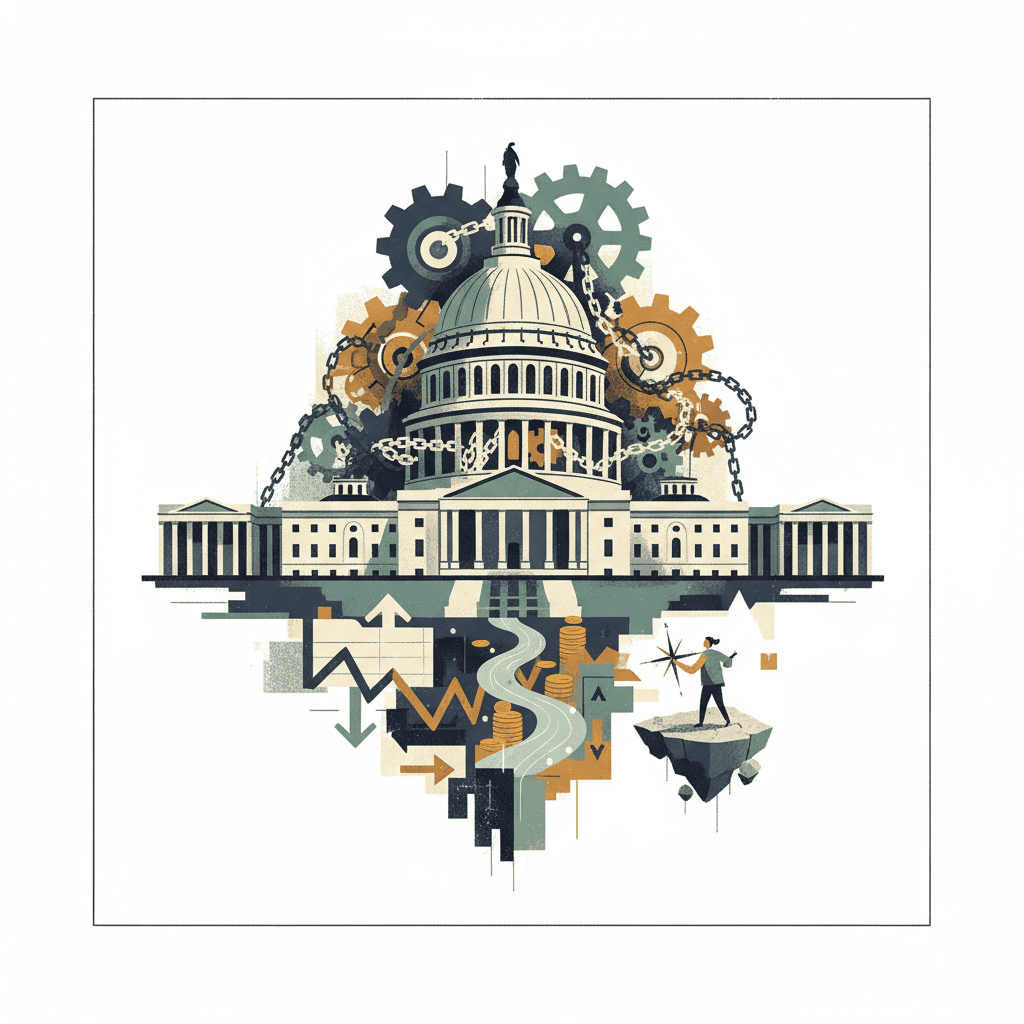
Washington Is Seizing Up — And Prediction Markets Are Nearly Certain It Gets Worse
Prediction markets are flashing something remarkable right now: a 99.5% chance the current government shutdown lasts at least 40 days, an 88.5% chance it stretches past 43 days, and a 55.5% chance it drags beyond 50 days. There's even a 24% chance it blows past 60 days. These aren't fringe bets. This is a consensus view from people putting real money on the line, and it paints a picture of a federal government that has effectively stopped functioning.
But the shutdown is just one piece of a bigger puzzle. Stack it alongside the rest of the prediction market data, and you get a portrait of political machinery grinding to a halt across the board.
The Full Picture of Dysfunction
Think of the federal government like a factory with multiple assembly lines. Right now, almost every line is jammed.
The SAVE Act, a major legislative proposal, has only a 10.5% chance of passing. A separate election reform bill sits at an even more dismal 3.5%. Funding for the Department of Homeland Security by April 1 is essentially a coin flip at 54.5%. And the market for total bills passed in March is pricing near zero, meaning betting markets see virtually no chance of Congress accomplishing anything at all this month.
Meanwhile, prediction markets give Democrats an 84.4% chance of taking control of the House in 2026, compared to just 15.7% for Republicans holding it. That means even if the current shutdown eventually resolves, the country is likely headed toward divided government starting in January 2027, which extends the paralysis timeline by years, not months.
This creates a self-reinforcing cycle that matters for your money:
- The shutdown drags on, creating direct economic drag estimated at 0.1-0.2% of GDP per week.
- Legislative paralysis means Congress has no tools to respond if the economy weakens.
- The absence of new fiscal policy makes Federal Reserve rate cuts more likely, but also more necessary.
- Growing voter frustration accelerates the Democratic House takeover, which locks in divided government.
- Divided government guarantees more gridlock from 2027 onward, keeping uncertainty elevated for the foreseeable future.
This loop is why the pattern carries a 92% confidence rating from the underlying analysis. Each piece reinforces the others.
What This Means for Markets
The overall signal is bearish for stocks and risk assets in the near-to-medium term. Government shutdowns impose real economic costs. Federal workers miss paychecks, contractors stop getting paid, permits and approvals freeze, and consumer confidence takes a hit. When that shutdown coincides with total legislative gridlock, meaning no emergency spending bills, no stimulus, no backstop, the economy loses its safety net right when it might need one most.
This setup is generally bullish for safe-haven assets like gold and Treasury bonds, though both come with important caveats we will get to.
The Trades
Gold: Buy — GLD gets a buy signal with roughly 72-80% confidence. Gold is the classic hiding place when governments look unreliable. A shutdown measured in months, combined with legislative paralysis and the prospect of divided government through 2027 and beyond, all increase demand for assets that don't depend on any single government functioning properly. The catch is that gold has already rallied significantly and sits near all-time highs, so a good chunk of this safe-haven premium may already be baked into the price.
Long-Term Treasuries: Weak Buy — TLT gets a cautious nod at 58-62% confidence. The logic is straightforward: shutdown drags GDP, GDP weakness makes rate cuts more likely, rate cuts push bond prices up. But this trade is genuinely conflicted. The same political dysfunction that makes Treasuries a safe haven also raises the specter of another U.S. credit rating downgrade, which would hurt Treasuries. It's like hiding from a storm in a building whose foundation you're not entirely sure about. A broader Treasury fund like GOVT offers a more balanced risk profile with intermediate duration, earning a weak buy at 60% confidence.
Inverse S&P 500: Weak Buy — SH, the ProShares Short S&P 500 ETF, gets only 55% confidence as a tail-risk hedge. The honest truth is that historical shutdowns have not reliably caused sustained stock market declines. The 2018-2019 shutdown lasted 35 days, and the market actually rallied during it. Inverse ETFs also suffer from daily rebalancing decay, which means they lose value over time even if the market goes sideways, making them expensive to hold for weeks.
The Shovels-and-Gold Rush
During the California Gold Rush, the people who most reliably made money weren't the miners. They were the ones selling pickaxes, shovels, and denim jeans. The same logic applies here. When political dysfunction creates market chaos, certain companies profit no matter which direction investors run.
The biggest winners from volatility itself:
CME Group, the world's largest derivatives exchange, is the highest-conviction infrastructure play here with a buy signal at 68% confidence. CME literally collects a fee on every futures and options trade made by investors hedging against political risk. Treasury futures volumes surge when bond traders scramble, FX futures spike when the dollar gets uncertain, and equity index options go through the roof when portfolio managers buy downside protection. A 99.5% probability of a 40+ day shutdown doesn't represent a one-day volatility spike. It represents weeks of sustained elevated trading volumes, which is exactly how CME makes money.
ICE, the Intercontinental Exchange, runs a similar playbook at 65% confidence. It operates exchanges, clearing houses, and data services that generate more revenue when volatility rises. Every trade made in response to political dysfunction, whether someone is buying gold, selling stocks, or hedging interest rates, flows through ICE's infrastructure.
The biggest losers from government paralysis:
BAH (Booz Allen Hamilton) gets a sell signal at 75% confidence, the strongest conviction call among government contractors. With approximately 98% of its revenue coming from U.S. government contracts, Booz Allen is the inverse of a shovel seller. It's more like a mining company that can't operate because the mine is closed. Prolonged shutdowns delay contract awards, halt new task orders, and disrupt cash flow.
LDOS (Leidos) earns a sell at 72% confidence. About 87% of its revenue comes from federal contracts across defense, intelligence, civil, and health segments. The DHS funding probability of only 54.5% is particularly relevant since Leidos has significant Department of Homeland Security work. Its civil government exposure is directly vulnerable to shutdown effects.
SAIC rounds out the government contractor sells at 70% confidence. With approximately 95% or more of revenue from the U.S. government and a smaller, more concentrated business than Booz Allen or Leidos, SAIC is arguably the most fragile of the three during a prolonged shutdown.
The more speculative infrastructure plays:
MCO (Moody's) and SPGI (S&P Global) both get weak buy signals at 60% and 58% confidence respectively. The thesis is that credit rating agencies benefit when sovereign and municipal credit risk spikes, because institutional investors pay more for credit analysis during crises. But both face a tricky dynamic: political pressure not to downgrade U.S. debt could actually suppress their ability to monetize the situation.
VRSK (Verisk Analytics) gets a weak buy at 55% confidence on the theory that political chaos increases demand for risk analytics. The connection is real but indirect.
CSGP (CoStar Group) gets a weak sell at 65% confidence. Government shutdowns freeze federal real estate activity, lease renewals, and GSA operations, which ripples through commercial property markets, especially in the Washington, D.C., Northern Virginia, and Maryland corridor where CoStar has significant exposure.
MNST (Monster Beverage) gets a weak buy at just 50% confidence as a contrarian rotation play. Zero government revenue exposure means it's theoretically a safe harbor, but the connection to the thesis is thin.
The Risks You Need to Understand
This analysis wouldn't be worth much without honest risks, and there are several big ones.
The shutdown could end tomorrow. An emergency deal, a continuing resolution, or a political compromise could collapse the entire thesis overnight. The 50+ day probability dropped 10.5 percentage points in just 24 hours recently, showing how quickly sentiment can shift.
Historical precedent is mixed. Past shutdowns have not reliably caused sustained market damage. The economy and stock market are driven by global forces, corporate earnings, and Federal Reserve policy far more than by whether Congress can pass a budget.
Gold and Treasuries may already reflect this. Gold is near record highs. The flight-to-safety trade is well-known and crowded. Much of the safe-haven premium may already be in the price.
A credit downgrade could backfire on Treasury holders. If political dysfunction gets bad enough, it could trigger a U.S. credit rating downgrade, which would paradoxically hurt the very Treasuries people are buying for safety. We saw echoes of this during the 2011 debt ceiling crisis.
Government contractors have playbooks for this. Booz Allen, Leidos, and SAIC have all survived prior shutdowns. Existing contract backlogs provide revenue buffers, and post-shutdown spending surges often create catch-up demand. Their stocks may already be discounted for shutdown risk.
Inverse ETF decay is real. Holding SH for weeks costs money even in a flat market. The daily rebalancing mechanism works against you over time.
The Fed matters more. If the Federal Reserve signals dovish policy in response to economic weakness, that could support equity markets regardless of what Congress does.
Why This Matters for Your Money
Even if you never trade a single one of these tickers, the shutdown-plus-gridlock pattern affects you. If you have a 401(k) heavy on U.S. stocks, extended political dysfunction adds a layer of uncertainty that can weigh on returns. If the economy weakens and Congress can't respond with fiscal policy, the adjustment falls entirely on the Fed, which means interest rate decisions will carry even more weight than usual for your savings accounts, mortgages, and car loans. And government workers, contractors, and the businesses that serve them in the D.C. metro area face real financial stress that can ripple outward.
The prediction market data is telling a clear story: Washington is broken, it's likely to stay broken for a while, and the political configuration coming in 2027 makes it worse, not better. Whether you act on that information or simply factor it into your planning, the signal is hard to ignore.
Analysis based on prediction market data as of March 27, 2026. This is not investment advice.
How This Story Evolved
First detected Mar 20 · Updated daily
The new version leads with a sharper, more organized rundown of the prediction market numbers upfront, making the data feel more concrete and credible right away. It also shifts the framing from broad warnings about "consequences rippling through markets" to building a case that the shutdown is just one piece of a bigger breakdown — hinting the story is about to zoom out beyond just the shutdown itself.
The story shifted from a general warning about political dysfunction to a more specific focus on a prolonged government shutdown, prompting a big shake-up in trade signals — defensive volatility and short-term bond plays were dropped in favor of longer-duration bonds and financial data companies like ICE and MCO. The outlook on government contractors got more negative, with Leidos (LDOS) moving from a weak sell to an outright sell signal, while gold's appeal as a safe haven weakened slightly.
Read this version →The story's framing got sharper — prediction markets are now front and center as evidence of Washington dysfunction — and the trade signals shifted meaningfully, with defense contractors like SAIC and BAH getting downgraded to sells while gold and volatility plays stayed in focus. CBOE held on as a buy but lost some of its earlier conviction, and short-term bonds replaced longer-duration ones as the preferred safe-haven trade.
Read this version →The story's outlook on Washington dysfunction got more nuanced, with several defense contractors like Boehringer Ingelheim Aeronautics Solutions and Leidos flipping between buy and sell signals, suggesting growing uncertainty about who wins or loses from government gridlock. Safe-haven plays like short-term Treasury ETFs dropped off the radar, while gold's conviction weakened a bit and volatility hedges lost some of their urgency.
Read this version →The article shifted its focus from simply predicting how bad things will get to giving readers advice on how to invest during the crisis. It also added context by comparing the current shutdown to the longest one in U.S. history (35 days in 2018-2019).
Read this version →