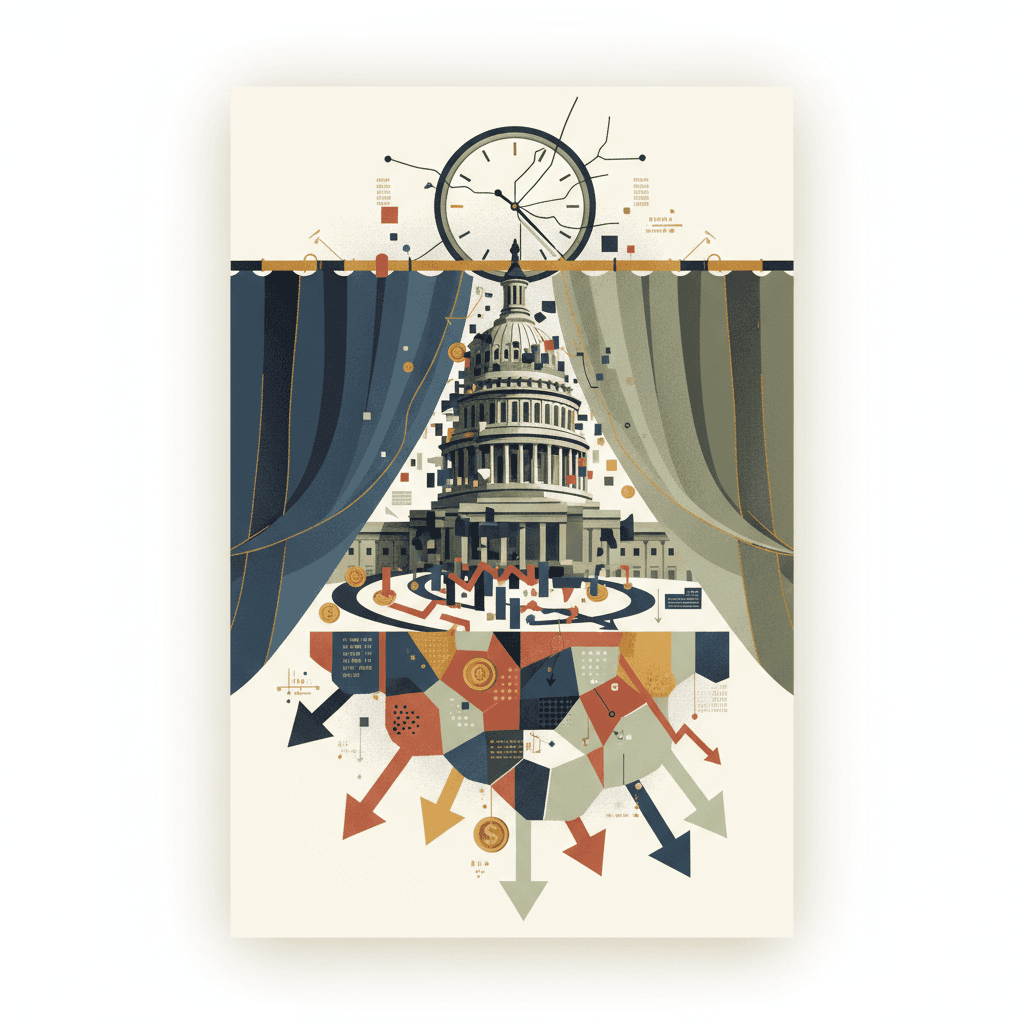
Prediction Markets Are Pricing a Historic Government Shutdown. Here's What It Means for Your Portfolio.
The U.S. government is broken, and the betting markets have receipts.
Prediction markets are now pricing a 99% chance that the federal government will be shut down for at least 55 days between February 7 and December 31, 2026. A 91% chance of 60 or more days. A 57% chance of 70+ days. And there's a 22% probability the shutdown stretches past 100 days, which would shatter every record in American history.
These aren't fringe bets. The combined trading volume across the shutdown duration contracts alone tops $10 million, and when you factor in the related DHS funding bills, the SAVE Act, House control, and the Attorney General departure market, total dollar volume across this pattern exceeds $19 million. That kind of money doesn't flow into political prediction markets unless people with real conviction are behind it.
What makes this particularly striking is the pattern that emerges when you look at all these contracts together. It's not just a shutdown. It's a full-blown fiscal paralysis, and the market is connecting the dots to a political earthquake in 2026.
The Doom Loop of Dysfunction
Think of it as a self-reinforcing cycle:
Congress can't pass basic spending bills. DHS funding legislation had a 0% chance of becoming law by April 8 and only a 6% chance by April 15. Even by April 22, the odds were just 28%. The SAVE Act, a Republican priority bill, sits at a meager 11% chance of becoming law before January 2027.
The shutdown drags on and on. Without appropriations, the government stays closed. Federal workers get furloughed. Services freeze. Contracts stall. The longer it goes, the harder it gets to restart because the political entrenchment deepens.
Executive branch instability compounds the problem. Attorney General Pam Bondi has a 94% probability of leaving her position before mid-April. When leadership is in flux at both ends of Pennsylvania Avenue, the chances of a negotiated deal drop further.
Voters punish the party in charge. Prediction markets give Democrats an 85% chance of winning the House in 2026. That's a landslide-level expectation, and it's being driven in large part by the visible inability of the current governing majority to keep the lights on.
The expectation of a power shift reduces incentives to compromise now. If Democrats believe they're about to take the House, why bail out Republicans with a deal? And if Republicans know they're losing the House anyway, internal party discipline collapses. The doom loop tightens.
This is the kind of pattern that makes you feel smarter once you see it, because each piece reinforces the others. The shutdown makes the election forecast worse, the election forecast makes the shutdown harder to resolve, and everyone with money on the line is positioning accordingly.
What This Means for Actual Investments
Government shutdowns, historically, haven't caused lasting market damage. The 2018-2019 shutdown lasted 35 days and barely left a mark on the S&P 500. But we're talking about something potentially two or three times longer than anything in history. At some point, "the market shrugs off shutdowns" stops being a reliable rule of thumb, the same way "the levees will hold" stops being reassuring when the storm is twice as big as any on record.
The core thesis breaks into three buckets: safe-haven assets that benefit from institutional trust erosion, government-dependent companies that get hurt directly, and currency plays that reflect global confidence in U.S. governance.
Gold and the Shovel Sellers
GLD is the straightforward safe-haven play. Gold benefits when trust in government institutions erodes, when the dollar weakens, and when credit rating agencies start making uncomfortable noises. A 90-plus day shutdown would be unprecedented, and the inability to pass basic appropriations bills feeds directly into concerns about whether Congress can handle the debt ceiling, which is a far more consequential fight. Confidence level: 82%.
GDXJ, the junior gold miners ETF, is the "shovels during the Gold Rush" version of this trade. If gold prices rise for any reason, whether it's institutional trust erosion, central bank buying, or plain old retail fear, the companies pulling gold out of the ground benefit with leverage. Junior miners typically deliver two to three times the price movement of gold itself. They don't care why people want gold. They just profit from the demand. Confidence level: 75%.
The Anti-Shovel Sellers
If gold miners are the shovel sellers, government contractors are the anti-shovel sellers. When the gold mine shuts down, the people selling pickaxes go hungry.
BAH (Booz Allen Hamilton) derives over 97% of its revenue from government contracts. When Congress can't fund the government, Booz Allen's customers stop paying, procurement freezes, and the government employees who manage those contracts get sent home. This is as direct a short against government dysfunction as you can find in public markets. Confidence level: 78%.
LDOS (Leidos) is in a similar boat. As a top-five defense IT contractor with meaningful DHS and civilian agency exposure, Leidos gets hit specifically by the DHS funding crisis that prediction markets are flagging as the most problematic bottleneck. Extended shutdowns delay contract awards, payments, and new program starts across its business. Confidence level: 70%.
CBRE is a subtler second-order play. The commercial real estate services giant has significant government leasing business through GSA (the General Services Administration, which manages federal buildings and office space). During extended shutdowns, lease negotiations and government real estate decisions freeze. That said, government work is a minority of CBRE's total revenue, so this is a lower-conviction signal. Confidence level: 62%.
Bonds, the Dollar, and Safe-Haven Currencies
TLT, the long-term Treasury bond ETF, gets a weak sell signal. This feels counterintuitive because Treasuries are supposed to be the ultimate safe haven, but the 2011 playbook is instructive. When S&P downgraded U.S. debt after the last major fiscal standoff, long-duration bonds took real damage. If this shutdown bleeds into debt ceiling brinksmanship, long bonds carry asymmetric downside. The tricky part: flight-to-safety flows could offset this, which is why conviction here is lower at 68%.
SCHO, a short-term Treasury ETF, is the capital preservation play. Think of it as the parking lot for nervous money. Everyone needs a place to put cash during government dysfunction, regardless of their political leanings or market outlook, and short-duration Treasuries avoid the rate risk that threatens their longer-dated cousins. This isn't a play to generate returns. It's a play to avoid losing money. Confidence level: 80%.
UUP, the U.S. dollar index ETF, gets a sell signal at 72% confidence. Structural governance breakdown erodes global confidence in the dollar over time. Foreign central banks diversifying their reserves away from USD is a slow-moving trend, but prolonged shutdowns accelerate it. The 85% prediction market probability of Democrats winning the House suggests markets expect prolonged political warfare stretching well into 2027, which isn't great for dollar stability.
FXF, the Swiss franc ETF, is the flip side of the dollar weakness trade. When institutional money flows out of USD, it needs somewhere to land, and the Swiss franc is one of the traditional destinations. This is a lower-conviction idea at 65%, partly because the Swiss National Bank actively manages franc strength (think of it as a thermostat that kicks on when the currency gets too hot) and partly because other safe havens like the Japanese yen could capture more of those flows.
The Risks: Why This Could Be Wrong
Honesty about risks is what separates analysis from cheerleading, and there are real reasons this pattern might not play out as the prediction markets suggest.
Government shutdowns have historically had limited lasting market impact. Every previous shutdown has been resolved, back pay has been authorized, and markets have moved on. Betting that "this time is different" is one of the most expensive phrases in investing.
Gold is already at elevated levels. Much of this dysfunction may already be priced into safe-haven assets. A sudden deal in Congress could cause a sharp pullback in gold and gold miners.
The dollar smile theory. There's a well-documented pattern where the U.S. dollar strengthens during both economic booms and severe crises, because global investors still treat it as the ultimate safe haven when things get truly scary. The dollar could go up even as governance falls apart.
Rising real interest rates could cap gold's upside even in a chaotic fiscal environment. If the Fed keeps rates elevated, the opportunity cost of holding non-yielding gold increases.
Defense and classified contracts often continue through shutdowns. Companies like Booz Allen and Leidos have essential work that doesn't stop just because Congress is fighting. Their backlog provides revenue visibility that could cushion the impact.
Prediction markets for shutdown duration could be mispriced or illiquid. These are relatively new markets, and the price discovery might not be as reliable as more established financial instruments.
Junior gold miners can underperform gold in risk-off environments because they're still equities, and equity correlation can drag them down even when gold is rising. Input cost inflation could also squeeze their margins.
Why This Matters to You
If you have a 401(k), a government job, a business that contracts with federal agencies, or just a general interest in whether the country is functioning, this pattern matters. Federal workers who get furloughed don't spend money at local restaurants. Government contractors that don't get paid cut their own suppliers loose. The economic ripple effects of a 90-day shutdown would touch communities far beyond Washington, D.C.
And the political feedback loop, where dysfunction drives voter backlash that makes dysfunction harder to resolve, isn't just an abstract market signal. It's a preview of what governance might look like for the next two years. The prediction markets are saying, with remarkable clarity, that the people in charge can't do the basic job of keeping the government open, and voters are going to make them pay for it.
Whether you're repositioning your portfolio or just trying to make sense of the headlines, the message from the betting markets is unusually unified: the U.S. government is stuck, the stalemate could last months, and the financial consequences are real.
Analysis based on prediction market data as of April 8, 2026. This is not investment advice.
How This Story Evolved
First detected Mar 20 · Updated daily
The outlook shifted toward more defensive and cautious positions, with gold mining stocks and short-term bonds now seen as safer bets, while the US dollar weakened in appeal and long-term government bonds moved from a modest buy to a sell. Several previously favored investments — including volatility plays and precious metals royalty stocks — were dropped from the recommended list entirely.
Read latest →The updated article changed the opening to lead with a broader claim about "structural paralysis" before presenting the statistics, rather than jumping straight into the numbers. Some of the probability figures were also updated, with the 55-day estimate rising slightly to 96% and the 90-day scenario getting a new figure of 21%.
Read this version →The article was updated to include specific shutdown probability percentages from prediction markets, such as a 99% chance of a 55-day shutdown and a 22% chance of a record-breaking 100-day shutdown. The headline also shifted from broadly saying "the government is broken" to focusing specifically on a potential historic government shutdown.