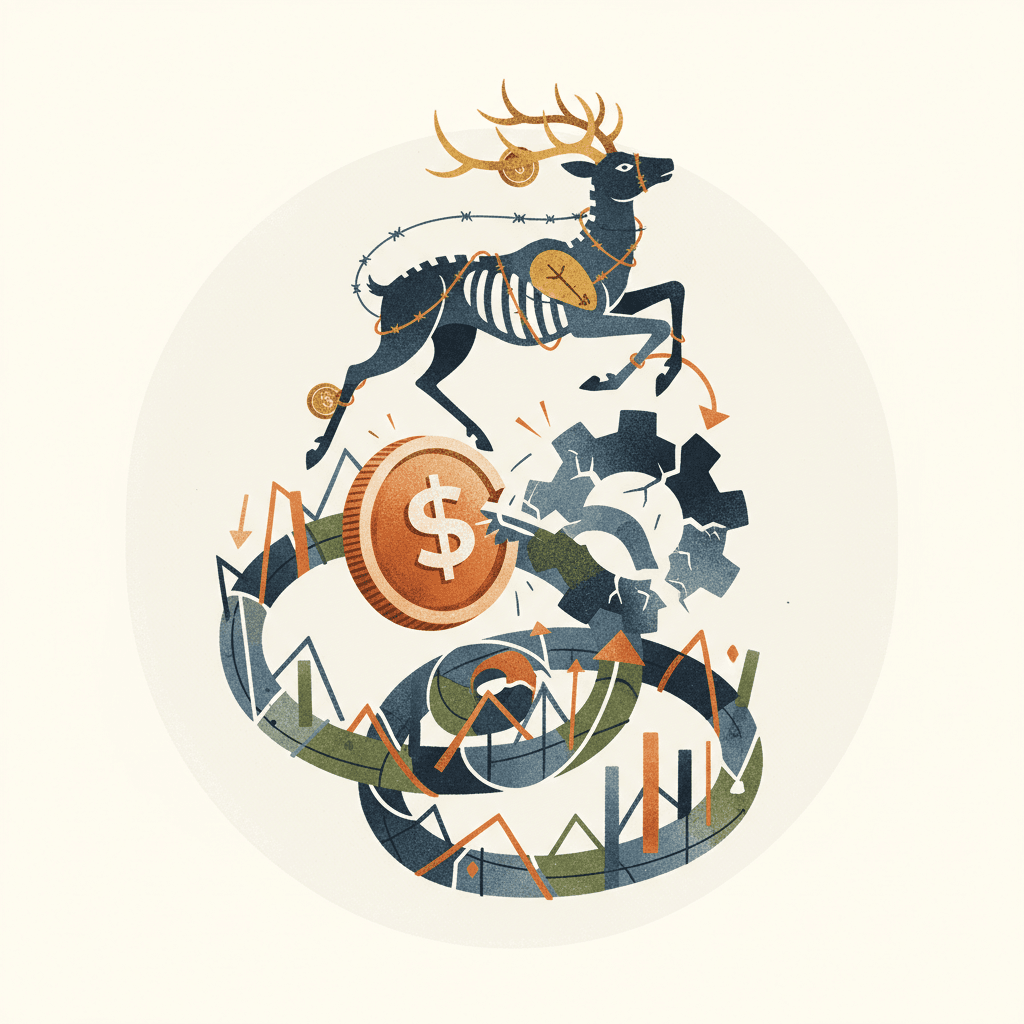
The Stagflation Trap: Prediction Markets Are Pricing an Economy Stuck Between Inflation and Recession
Imagine your car stuck in mud. You press the gas and the wheels spin. You let off and the car sinks deeper. That's roughly what prediction markets are telling us about the U.S. economy right now. Inflation is too hot for the Federal Reserve to cut interest rates, but the economy is too weak for them to keep squeezing without risking a recession. The Fed is stuck, and so are we.
This pattern, called stagflation, is one of the ugliest words in economics. It means rising prices and slowing growth happening at the same time. It last showed up in the 1970s, and it punished almost every traditional investment. Today, multiple prediction markets are converging on a set of probabilities that look uncomfortably similar.
Let's walk through the numbers.
The Numbers That Tell the Story
Prediction markets currently give a 33% probability that the Fed delivers zero interest rate cuts in all of 2026. Only a 15% chance of more than 25 basis points (a quarter of a percent) in total cuts. And there's a 94.5% chance the Fed holds rates steady at its April meeting. Translation: the Fed is frozen in place.
Meanwhile, inflation is running sticky. CPI, the Consumer Price Index that measures how fast prices are rising year over year, is tracking near 3% for mid-2026. That's well above the Fed's 2% target. Think of 2% as the speed limit. The economy is doing 50 in a 35 zone, and the cop in the car (the Fed) can't pull it over without causing a pileup.
On the energy front, gasoline prices above $4.10 per gallon carry an 80-87% probability through March. There's a 30.5% chance that WTI crude oil (the main U.S. oil benchmark) hits $150 per barrel before year-end, and a 17.5% chance it touches $180.
At the same time, the probability of a recession as defined by the NBER (the official scorekeepers) sits at 35-36%. Unemployment breaching 5% is essentially a coin flip at 50%. And the S&P 500 finishing above its current level by December? Also barely a coin flip at 52%.
When you layer all of these probabilities on top of each other, they paint a picture of an economy caught in what the investor Ray Dalio calls a "deleveraging" trap. The Fed can't ease because inflation is sticky. It can't tighten more because the economy is already cracking. Real returns, meaning your investment gains after subtracting inflation, get compressed from both sides.
The Self-Reinforcing Loop
This isn't a random collection of bad numbers. These signals feed into each other in a cycle that makes the problem worse:
- Tariffs and supply disruptions push up energy and input costs (cost-push inflation).
- Higher energy costs flow into food prices, transportation, and manufacturing, keeping CPI elevated.
- Sticky inflation forces the Fed to hold rates high.
- High interest rates squeeze borrowers, slow business investment, and raise unemployment.
- Rising unemployment and recession risk weaken consumer spending, but NOT enough to kill inflation because the cost pressures are coming from the supply side, not demand.
- The Fed remains stuck. Repeat.
This is the key insight: in demand-driven inflation, the Fed can raise rates and cool things off. But when inflation comes from supply-side shocks like energy prices and tariffs, rate hikes don't fix the problem. They just add economic pain on top of rising prices.
Shovels, Not Gold: Where the Infrastructure Plays Are
During the California Gold Rush, most prospectors went broke. The people who got rich were the ones selling pickaxes, shovels, and denim pants. The same principle applies in stagflation. Instead of trying to guess which specific commodity spikes the most, you can own the companies that supply essential inputs to everyone else. They get paid regardless of which sector suffers.
Energy producers are the toll collectors. XLE, the Energy Select Sector ETF, captures diversified exposure to the companies that ARE the cost-push. With gas above $4.10 at 80% probability and oil at $150 carrying a 30% chance, energy producers generate enormous free cash flow. They benefit from inflation rather than suffering from it. Confidence here is 75%, the highest among the trade signals.
XOM (ExxonMobil) and CVX (Chevron) are the individual heavyweights. Exxon's Permian Basin assets break even around $35 per barrel, meaning it stays profitable even if oil pulls back significantly. It also benefits from refining margin expansion when crude-to-product spreads widen. Chevron offers a similar thesis with geographic diversification through its Tengiz expansion in Kazakhstan and Gulf deepwater assets, plus a roughly 4.5% dividend yield that provides income in a slow-growth world. One important caveat: the two trade in near-lockstep with a correlation around 0.95, so holding both is essentially doubling down on the same bet.
MPC (Marathon Petroleum) offers a different angle as a pure-play refiner. Refiners profit from the spread between what they pay for crude oil and what they sell gasoline and diesel for. Marathon operates the largest refining system in the U.S. by capacity. In an environment where product prices stay elevated, that spread can be very lucrative.
OIH, the Oil Services ETF, captures the literal shovel sellers to oil producers. Companies like Halliburton, Schlumberger, and Baker Hughes provide the drilling rigs and services. When oil prices are high, every exploration company increases drilling activity, and they all need these services. OIH profits from the activity level, not the commodity price directly.
Fertilizer is the chokepoint for food inflation. MOS (Mosaic) produces phosphate and potash fertilizers, critical inputs for all agricultural production worldwide. When energy prices are high, fertilizer costs spike because natural gas is a key input in production. Farmers must buy fertilizer regardless of which crop they plant. Mosaic is to agricultural inflation what ASML is to semiconductors: the supplier everyone depends on. Confidence: 70%.
DBA, the agricultural commodities ETF, and WEAT, a wheat-specific ETF, offer more direct commodity exposure. Food inflation is sticky and politically sensitive, and it benefits from the same energy cost pass-through that drives the broader pattern.
Gold is the hedge against the entire system breaking. GLD benefits from negative real interest rates (when inflation runs above what you earn on safe investments), central bank credibility concerns, recession fears, and geopolitical uncertainty, all at once. Central banks globally have been accumulating gold. The asymmetry is attractive: if stagflation deepens, gold soars; if the Fed somehow threads the needle, gold merely consolidates at high levels. Confidence: 78%. NEM (Newmont Mining), the world's largest gold miner, provides leveraged exposure since miners typically move 2-3x gold price moves, though with added operational and integration risk from its Newcrest acquisition.
Cash earns its keep for once. BIL, the short-term Treasury bill ETF, is the ultimate defensive play. When the Fed holds rates high, T-bills yield roughly 4-5% with virtually zero duration risk. In a world where both stocks and long-term bonds are struggling, earning a safe yield while you wait is a legitimate strategy. This is Dalio's "cash is king in a deleveraging" play. Confidence: 80%, the highest of any signal in the pattern.
The Bearish Bets
On the other side of the ledger, selling long-term bonds through TLT (the 20+ Year Treasury Bond ETF) carries 72% confidence. Long-duration bonds are the classic victim of stagflation. They get hit from both ends: no rate relief from the front end because the Fed is frozen, and persistent inflation eroding the value of those fixed coupon payments. Even if a recession hits hard and the Fed eventually cuts, fiscal deficits and supply dynamics may keep long-term yields elevated anyway.
SH, the inverse S&P 500 ETF, appears twice in the signals. At 62% confidence it serves as a hedge against equity weakness in a stagflationary environment, and at a weaker 52% confidence as a more tactical position. The S&P finishing the year higher is only a 52% probability, which means the risk-reward for equities is roughly symmetric at best. But inverse ETFs suffer from daily rebalancing decay over time, making them suitable for tactical hedging rather than long-term positions.
Smaller positions round out the list: VTLE (Vital Energy), a mid-cap Permian Basin producer with higher leverage to oil prices but significantly more balance sheet risk, at 55% confidence. USO, direct oil price exposure, at 62% confidence. And PDBC, a broad commodity basket ETF that acts as a diversified inflation hedge without concentration in any single commodity, at 58% confidence.
The Risks You Need to Know
Every probability listed above has a flip side, and intellectual honesty demands walking through the ways this thesis could fall apart.
Trade war de-escalation is the biggest single risk. If tariff tensions resolve, the cost-push inflation mechanism weakens, energy prices could drop, and equities could stage a sharp relief rally. Every bearish and commodity-long position in this pattern would take a hit simultaneously.
The Fed could surprise. A 33% chance of zero cuts also means a 67% chance of at least some easing. A dovish pivot would boost long-term bonds and growth equities, punishing the short-TLT and short-equity positions.
Recession could overwhelm inflation. At 35% probability, a deep recession would cause demand destruction across commodities, including oil and agricultural products. In that scenario, the safe-haven bid for Treasuries could overwhelm inflation concerns, making the TLT short painful.
OPEC+ could flood the market. A surprise output surge could collapse oil prices 20-30% rapidly, devastating the entire energy allocation from XLE to OIH to XOM to VTLE.
Commodity ETF decay is a structural headwind. Funds like USO, WEAT, and PDBC roll futures contracts forward each month. When future-dated contracts cost more than near-term ones (a condition called contango), each roll erodes returns. These are not buy-and-forget instruments.
Gold may already be priced in. Gold is near all-time highs. A hawkish Fed maintaining high nominal rates creates an opportunity cost for holding a non-yielding asset. And the precedent is mixed: gold actually performed poorly during the 2022 rate-hiking cycle despite inflation running hot.
Corporate earnings keep surprising. Bears have been wrong about corporate margins for years. If companies continue passing costs to consumers without demand falling, equity markets could grind higher despite the macro headwinds.
Why This Matters for Your Money
If you have a 401(k) invested in the default target-date fund, you're almost certainly holding a mix of U.S. stocks and long-term bonds, the exact combination that stagflation punishes most. Both lose purchasing power when inflation runs above the risk-free rate and growth slows.
At the grocery store, you're already living this pattern. Food prices reflect the energy costs embedded in farming, transportation, and refrigeration. When gas is above $4 and fertilizer costs are elevated, those prices don't come back down just because the economy slows.
The uncomfortable truth about stagflation is that there's no painless exit. The Fed can tolerate higher inflation and risk losing credibility, or it can crush the economy to bring prices down. Prediction markets are telling us that right now, the most likely path is neither. The Fed just sits there, stuck, while prices stay elevated and growth weakens. Your investments and your grocery bill both feel the squeeze.
The playbook for navigating this kind of environment isn't glamorous. It favors the companies that supply essential inputs over the companies that consume them. It favors real assets over financial assets. It favors short-duration income over long-duration promises. And it favors humility about how long the trap can last.
Analysis based on prediction market data as of March 20, 2026. This is not investment advice.