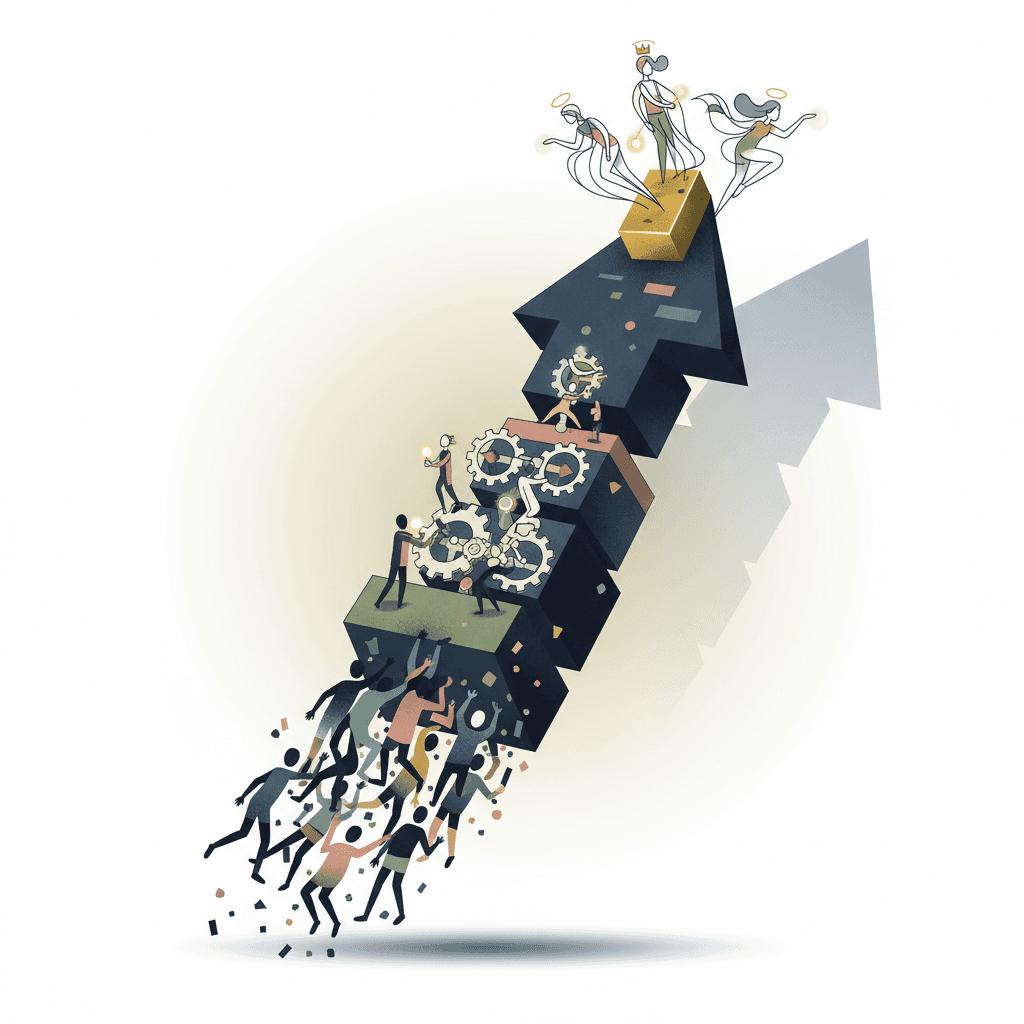
The AI Paradox: Prediction Markets See 88% Chance of Accelerating Layoffs While AI Winners Pull Away From Everyone Else
Prediction markets are painting a picture of the tech economy that should make you uncomfortable and opportunistic at the same time. There's an 87.8% probability that tech layoffs in 2026 will exceed 2025 levels. At the same time, the companies building AI are racing ahead faster than ever, with Anthropic given a 44% chance of having the best AI model by year-end, SpaceX at an 88% chance of going public before 2027, and Elon Musk sitting at 69% odds of becoming a trillionaire.
This is what economists call a productivity-displacement paradox. Technology is getting dramatically better, but it's destroying more jobs than it creates during the transition. The wealth is concentrating at the very top while the pain is spreading across the broader labor market. Think of it like a city that builds a gleaming new highway: the neighborhoods along the route benefit enormously, but the old businesses on the bypass road wither.
The numbers tell a story that's hard to ignore. Betting markets put the probability of a full multi-factor economic crisis at 25.6%, with recession odds at 34% and a 51.5% chance that unemployment peaks above 5% by 2027. Meanwhile, the SpaceX IPO has a 57.5% chance of happening by July 2026, which would be one of the largest wealth-creation events in market history. Tesla's Optimus humanoid robot has only a 24% chance of being sold before the end of 2026, which tells us the physical AI revolution is moving much slower than the software AI revolution.
This is a K-shaped cycle, meaning the economy is splitting into two directions like the letter K. The top arm, the AI winners, is rocketing upward. The bottom arm, mid-tier software companies and the broader tech workforce, is sliding down.
The Self-Reinforcing Loop That Drives This Pattern
Once you see the cycle, you can't unsee it:
- AI capabilities improve rapidly (Anthropic, Google DeepMind, OpenAI, and xAI all racing for dominance)
- Companies adopt AI tools to automate work previously done by humans
- Tech layoffs accelerate (87.8% probability of exceeding last year)
- Laid-off workers reduce spending, putting pressure on the broader economy
- Companies facing weaker demand cut costs further by adopting more AI
- Demand for AI infrastructure (chips, networking, power, data centers) increases
- AI companies get richer, invest more in R&D, and the cycle restarts at step 1
This loop explains why the winners keep winning and why the pain keeps spreading. It also points directly to where investors should look.
Selling Shovels in the AI Gold Rush
During the California Gold Rush, most miners went broke. The people who got reliably rich were the ones selling pickaxes, jeans, and supplies. The same principle applies here. You don't need to guess whether Anthropic at 44%, Google DeepMind at 27%, OpenAI at 13%, or xAI at 13% will win the AI race. You need to own the companies that sell to all of them.
NVDA is the ultimate shovel seller in this story. Whether Anthropic or Google wins, every single contender runs on NVIDIA GPUs. The company's data center business now accounts for roughly 87% of its revenue, and its CUDA software ecosystem is a moat that competitors have been trying to cross for a decade. Every company that replaces a human worker with AI needs more compute, which means more NVIDIA hardware. The 87.8% layoff probability actually accelerates NVIDIA demand. Confidence here is high at 82.
AVGO is the shovel seller one layer deeper. Broadcom designs custom AI accelerator chips for Google, Meta, and ByteDance, and makes the critical networking chips that connect GPU clusters together. When companies build massive AI data centers, Broadcom supplies components that go into nearly every rack regardless of whose logo is on the building. Its VMware acquisition adds enterprise software diversification. Confidence at 80.
ANET provides the high-speed networking switches that serve as the invisible backbone of AI infrastructure. Every 100,000-GPU cluster needs ultra-low-latency networking, and that networking spend typically runs 15-20% of total cluster cost. Arista's Ethernet-based solutions are winning AI networking contracts across hyperscalers. Whether it's Anthropic, Microsoft, Meta, or xAI building the data center, they all need Arista switches. Confidence at 75-76.
VRT addresses what might be the most underappreciated bottleneck in AI: power and cooling. Every GPU cluster generates enormous heat and consumes extraordinary electricity. Vertiv makes the power management and liquid cooling systems that keep these data centers running. This is a genuinely asymmetric trade because even if AI investment slows, existing power and cooling infrastructure doesn't vanish. Confidence at 75.
CEG is the purest nuclear power play for AI. Nuclear is the only power source that can credibly deliver 24/7, carbon-free, gigawatt-scale electricity that hyperscalers need. Microsoft's 20-year power purchase agreement at Three Mile Island was a turning point, and now every major tech company is competing for nuclear contracts. Constellation Energy operates the largest nuclear fleet in the United States, and new nuclear plants take over a decade to build, making these assets essentially irreplaceable. Confidence at 73.
VST is a diversified power generator with nuclear, natural gas, and renewable assets concentrated in Texas and other high-growth data center markets. Its Comanche Peak nuclear facility is especially valuable as tech companies sign long-term power agreements. Confidence at 71.
EQIX operates over 270 data centers globally as the world's largest colocation provider, essentially the physical real estate of the AI revolution. Its REIT structure, which means it's organized as a real estate investment trust and pays out most of its income as dividends, provides some defensive income in a portfolio otherwise tilted toward growth. Long-term leases also offer partial protection if a downturn materializes. Confidence at 63-68.
The Platform Giants at the Top of the K
MSFT sits at the top of the K-shaped cycle. Azure hosts OpenAI workloads, GitHub Copilot is embedded in developer workflows everywhere, and the entire Office 365 suite is integrating AI features. The 87.8% layoff probability is, paradoxically, good for Microsoft. Every laid-off developer becomes a GitHub Copilot upsell opportunity. Every cost-cutting CFO becomes a prospect for Azure automation. As mid-tier SaaS companies contract, their workloads consolidate onto hyperscalers, not away from them. Confidence at 72.
GOOGL holds a 27% probability of having the best AI model by year-end through DeepMind, making Alphabet one of the top two AI platforms. But the real value is that Alphabet functions as both a platform play and an infrastructure play simultaneously. Google Cloud is the third hyperscaler benefiting from enterprise AI migration, and Gemini's integration across Search, YouTube, and Workspace creates a monetization flywheel. At a lower price-to-earnings ratio than Microsoft, Alphabet arguably offers better value for the same K-shaped cycle benefit. Confidence at 68-78.
PLTR occupies the enterprise AI deployment layer. As companies accelerate AI adoption to justify those layoffs, they need platforms to actually operationalize AI in their daily workflows. Palantir's AIP platform sits at that intersection. It benefits from both government and commercial AI spending regardless of which foundation model wins. The catch is that the stock trades at over 50 times forward revenue, which is historically unprecedented for an enterprise software company. Confidence is lower at 62.
TSLA is rated neutral despite Musk's 69% odds of becoming a trillionaire. The Optimus robot's 24% probability of commercial sale before 2027 suggests the robotics narrative is overhyped near-term. Tesla's core auto business faces margin compression from Chinese competitors like BYD and brand erosion from Musk's political activities. The SpaceX IPO could even be negative for Tesla if Musk redirects his attention. Too binary and too priced for perfection. Confidence at just 55.
ORCL is a quiet AI infrastructure beneficiary. Oracle Cloud Infrastructure is growing rapidly as a cloud platform for AI training, with major contracts from OpenAI, xAI, and Cohere. Smaller AI labs that can't build their own data centers need cloud GPU access, and Oracle is winning that business on price and performance. Confidence at 65.
On the bearish side, QTWO represents the vulnerable mid-tier SaaS profile. Q2 Holdings serves regional banks and sits squarely in the part of the tech economy that gets squeezed in a K-shaped cycle. This is a weak sell with only 58 confidence because bank digital transformation spending is stickier than most software budgets, and an M&A bid could turn this short into a loss overnight.
The Risks You Need to Take Seriously
The biggest risk across this entire thesis is that AI spending turns out to be a bubble. If the return on AI investment disappoints corporate buyers, capital expenditure budgets get slashed and every infrastructure play in this portfolio takes a hit. The 25.6% probability of a multi-factor economic crisis is not trivial, and data center capex is not immune to recession. Historically, it gets cut within a few quarters of any downturn.
For the platform giants, antitrust risk is real and growing. The court's ruling against Google's search monopoly is legally binding and could force structural changes. Microsoft faces similar bundling scrutiny in the EU. Alphabet's YouTube advertising revenue is also vulnerable if consumer spending weakens from tech layoff spillover.
For the infrastructure plays, the threat of custom silicon deserves attention. Google's TPUs, Amazon's Trainium, and Microsoft's Maia chips could erode NVIDIA's GPU monopoly over a 3-5 year horizon. Broadcom's custom chip customers could eventually insource their designs. Arista faces Cisco competing aggressively and has dangerous customer concentration, with Microsoft and Meta representing over 35% of revenue combined.
The power plays face regulatory risk. Vertiv and Vistra are exposed to ERCOT and Texas grid reliability concerns. Constellation faces nuclear relicensing risks and the reality that any nuclear incident anywhere in the world, even at an unrelated plant, triggers sentiment-driven selloffs.
And the China wildcard hangs over everything. US export controls on NVIDIA chips permanently reduce a significant revenue stream. Geopolitical tensions add compliance costs for Alphabet and regulatory uncertainty for all multinationals.
Why This Matters for Your Money
If you have a 401(k) with broad market index funds, you're already exposed to this pattern, but perhaps not in the right proportions. The companies at the top of the K, the mega-cap AI platforms and their infrastructure suppliers, are likely to outperform. The companies on the bottom arm, smaller software firms and those dependent on broad tech employment, face real headwinds.
The 87.8% layoff signal also has second-order effects on everyday life. High-income tech workers losing jobs means less spending at restaurants, slower housing markets in tech hubs, and weaker consumer confidence. If you live in a city like San Francisco, Seattle, or Austin, the effects will be visible.
The broader question is whether this AI transition creates enough new jobs and wealth to offset the displacement. History suggests it will eventually, but "eventually" can be a painful five to ten years for the people caught in the middle. The prediction markets are telling us that 2026 is the year the displacement accelerates, not the year it resolves.
Analysis based on prediction market data as of March 23, 2026. This is not investment advice.
How This Story Evolved
First detected Mar 20 · Updated daily
The article was rewritten to lead with a simpler, more dramatic contrast between job cuts and wealth creation, dropping the detailed prediction market statistics on Anthropic and SpaceX from the opening. The new version uses plainer language to hook readers with the core tension before explaining it, while the old version led with specific probability numbers right away.
Read this version →