The World Is Getting Riskier in Every Direction at Once. Here's What the Betting Markets Are Pricing In.
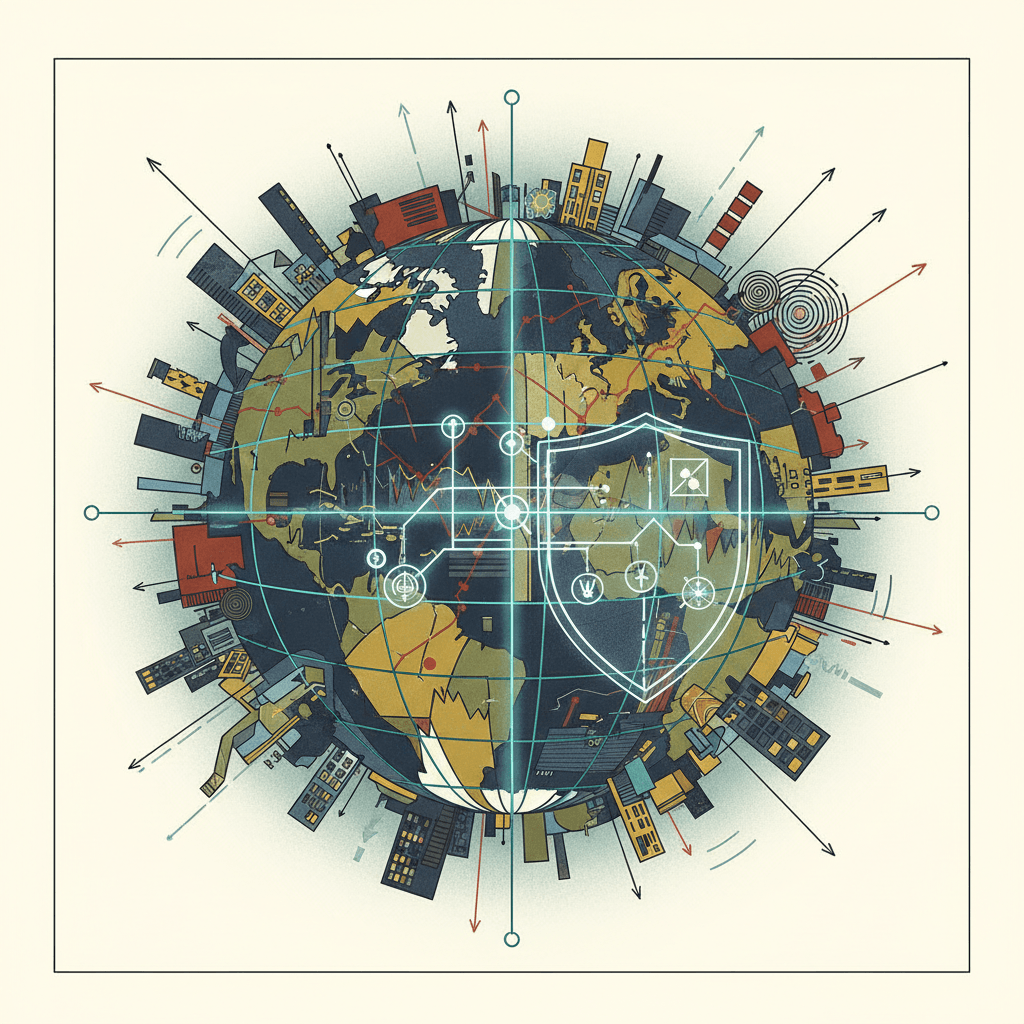
Prediction markets are flashing warning signs across almost every geopolitical hotspot on the map at the same time. This isn't about one crisis. It's about a pattern of escalating friction in the Middle East, the Caribbean, Latin America, and even the Arctic, all happening simultaneously. When you zoom out and look at the full picture, the message is striking: the cost of doing business in a messy world is going up, and certain investments are positioned to benefit.
Let's walk through what the betting markets are actually saying, what it means for your money, and which specific trades make sense if this pattern holds.
A Map of Trouble
Start with Iran. Prediction markets give only a 54% chance that the U.S. and Iran reach a new nuclear deal at all this year, and only 11% by May and 40% by August. Flip those numbers around and you get a 46% chance of no deal whatsoever. No deal means sanctions stay in place, Iranian oil stays constrained, and the Middle East stays tense. Adding to the intrigue, markets price a 17% chance that Reza Pahlavi, the exiled son of the former Shah of Iran, visits Iran before 2027, with an 11% chance he becomes head of state. Those are small probabilities, but the fact that regime change scenarios are being actively traded at all tells you something about the range of outcomes people are considering.
Then there's oil. Prediction markets show a 31% chance that WTI crude oil, the U.S. benchmark price, hits $140 per barrel or higher by the end of 2026. A 25% chance it touches $150. An 18% chance of $160. And 17% for $180. These aren't base cases, but they're far from negligible. For context, oil hasn't been above $120 since 2022, and the last time it sustained levels near $140 was in 2008.
Now look at the Western Hemisphere. Betting markets give a 32% chance that Trump "takes back" the Panama Canal before 2029. There's a 27% chance the U.S. buys Greenland outright, and a broader 35% chance the U.S. acquires any part of Greenland's territory. Cuba's leader Miguel Díaz-Canel has a 61% chance of leaving power before 2027. In Venezuela, Delcy Rodríguez has a 71% probability of being head of state by the end of 2026, while opposition leader María Corina Machado sits at just 14%, suggesting the regime holds but the situation stays fluid.
Put it all together and you don't have one crisis. You have what the investor Ray Dalio calls a "big cycle" pattern, where a dominant power starts projecting force more aggressively across multiple fronts as the global order shifts. Whether or not any single scenario plays out, the compound effect of all these simmering conflicts raises the cost of global trade, energy, and uncertainty for everyone.
The Self-Reinforcing Loop
This pattern feeds on itself in a way that's worth understanding:
- Geopolitical tensions keep oil supply constrained (Iran sanctions, Middle East instability, Latin American uncertainty).
- Higher oil prices feed inflation, which keeps interest rates elevated.
- Elevated rates and inflation make governments more aggressive about securing resources and trade routes (Greenland minerals, Panama Canal shipping lanes).
- That aggression creates more geopolitical tension, which feeds back into step one.
This is the kind of cycle where the general environment of risk matters more than any single headline. Even if the Iran deal happens, Panama Canal talk fizzles, and Greenland stays Danish, the fact that all of these balls are in the air at once creates a persistent risk premium that financial markets have to price in.
What to Buy: The Core Plays
GLD (SPDR Gold Trust) — Confidence: 78%
Gold is the oldest hedge against a messy world, and this is exactly the environment where it shines. Central banks globally are buying gold at record pace as countries diversify away from holding U.S. dollars, a trend called de-dollarization. When you have territorial ambitions, regime changes, and energy disruptions all being priced simultaneously, gold benefits from the compound uncertainty. It doesn't need any single crisis to escalate. It just needs the general temperature to stay high. Gold is already near all-time highs, which limits the explosive upside you'd get from buying it cheaply, but the structural backdrop supports further gains.
LMT (Lockheed Martin) — Confidence: 75%
Lockheed is the largest U.S. defense contractor, building everything from F-35 fighter jets to missile defense systems to naval platforms. In a world where the U.S. is posturing toward the Panama Canal, eyeing Greenland, navigating Middle East tensions, and watching Latin American regimes wobble, the common thread is military capability. Defense budgets are rising structurally regardless of which specific crisis heats up. Lockheed is the direct beneficiary of a country that needs to look credible across multiple theaters at once.
XLE (Energy Select Sector SPDR) — Confidence: 72%
This broad energy ETF holds the major integrated oil companies and exploration and production firms that would see massive earnings growth if oil prices spike. With a 46% chance of no Iran deal and a 31% chance of $140 oil, the risk premium in energy is real. Even if oil doesn't hit extreme levels, persistent geopolitical uncertainty keeps a floor under prices that supports energy company profits.
The Shovels Play: Selling Picks During the Gold Rush
During the California Gold Rush, the people who got reliably rich weren't the miners. They were the ones selling shovels, picks, and blue jeans. The same logic applies here. Instead of betting on which specific crisis escalates, you can own the companies that provide essential infrastructure no matter which scenario plays out.
NOC (Northrop Grumman) — Confidence: 74%, Infrastructure Score: 80
Northrop builds the B-21 stealth bomber, missile defense systems, surveillance platforms, and space systems. Whether the U.S. projects power toward Panama, Greenland, Iran, or anywhere else, it needs Northrop's intelligence, surveillance, reconnaissance, and cyber capabilities. This is the foundational infrastructure of a multi-theater military posture.
HAL (Halliburton) — Confidence: 70%, Infrastructure Score: 74
Halliburton is the shovel seller of the oil price thesis. If energy security becomes paramount and countries rush to increase domestic production, every oil company needs oilfield services to drill and complete wells. Halliburton profits from the activity level regardless of which oil company wins. It's one of the three major oilfield services firms globally, with particular strength in North American operations.
KTOS (Kratos Defense) — Confidence: 68%, Infrastructure Score: 72
Kratos makes the drones, satellite communications systems, missile defense targets, and electronic warfare tools that modern militaries consume like ammunition. In a multi-theater world, unmanned systems and affordable mass production become critical. Kratos makes the target drones that train every missile defense system and the tactical drones for forward deployment. These get used up regardless of which theater is active.
TDG (TransDigm) — Confidence: 73%, Infrastructure Score: 68
TransDigm makes thousands of proprietary, sole-source aerospace components, meaning it's often the only company that makes a specific part for a specific aircraft. When military aircraft fly more hours due to elevated tensions, TransDigm sells more replacement parts. Its moat is the switching cost: you can't just go buy the part from someone else. It's truly platform-agnostic, benefiting from increased flight hours across all defense platforms.
PSCE (S&P Small Cap Energy ETF) — Confidence: 62%, Infrastructure Score: 65
Small-cap energy companies have the most operating leverage to oil price spikes because their cost structures are relatively fixed. If WTI hits $140, a small producer's earnings can multiply several times over while a large integrated major might see a 30-40% bump. This is the leveraged version of the energy bet. In an energy security environment, small domestic producers also become strategically important.
FLOT (iShares Floating Rate Bond ETF) — Confidence: 60%, Infrastructure Score: 45
This is the "don't lose money" play. Floating rate bonds, which are loans whose interest payments adjust upward when rates rise, provide income with minimal sensitivity to interest rate changes. If geopolitical escalation triggers inflation through oil spikes and supply chain disruptions, rates stay higher for longer, and floating rate instruments benefit. It's not exciting. It's a parking lot for capital while you wait for clarity.
The Risks (and They're Real)
The biggest risk to this entire thesis is a global recession. If the world economy contracts sharply, demand destruction for oil overwhelms any supply disruption, energy prices fall, and the "risk premium" thesis collapses. Defense stocks might hold up, but everything energy-related could get crushed.
Trump could also pivot hard toward deal-making. A surprise Iran nuclear agreement would rapidly deflate the oil premium. Diplomatic resolution of multiple crises simultaneously would remove the geopolitical risk premium across the board. OPEC+ also holds significant spare capacity and could release it to cap prices.
For the specific tickers, the risks compound. The $140+ WTI scenario is only a 31% probability, meaning the majority outcome is that prices stay lower. Defense stocks like LMT and NOC already trade at stretched valuations and price in elevated spending. Budget-cutting rhetoric from government efficiency initiatives could temporarily pressure defense appropriations. Small-cap energy names in PSCE carry serious volatility risk and could drop 30% or more in a demand shock. Gold is near record highs with everyone already positioned for geopolitical hedging, making it a crowded trade. TransDigm's commercial aviation exposure could actually get hurt if geopolitical tensions reduce international air travel, and the company carries a highly leveraged balance sheet. Kratos is still a mid-cap company investing heavily in growth, with lumpy contract timing that can produce disappointing quarters. And floating rate bonds in FLOT could see credit spread widening in a severe crisis.
Prediction market probabilities for extreme oil prices may also reflect thin liquidity and tail-risk speculation rather than base case expectations. These are markets with real money at stake, over $13 million in combined dollar volume across these contracts, but they're not infallible.
Why This Matters for Your Everyday Life
If you have a 401(k), you probably own some mix of U.S. stocks and bonds. A world where geopolitical risk premiums expand across multiple theaters means your portfolio's international exposure faces headwinds while energy and defense holdings benefit. It also means higher gas prices at the pump, more expensive groceries (oil prices feed into food transportation costs), and potentially higher interest rates on your mortgage or car loan if inflation stays elevated.
The practical takeaway isn't to panic. It's to recognize that the world's major betting markets are pricing in a sustained period of elevated friction, not one crisis but many overlapping ones. Portfolios that tilt toward the companies selling essential infrastructure into that environment, the shovel sellers, are positioned to benefit whether the specific headlines get better or worse. The general temperature is what matters.
Analysis based on prediction market data as of April 14, 2026. This is not investment advice.
How This Story Evolved
First detected Apr 6 · Updated daily
The article was updated to add the Panama Canal as a specific risk hotspot and to introduce a new theme: that the U.S. is acting more aggressively on the world stage than it has in a long time. The headline was also changed to more directly connect the global risks to readers' personal investments.
Read latest →The article was rewritten to be more specific and direct, naming actual regions like the Middle East, the Caribbean, and the Arctic instead of using a vague highway driving analogy. It also added a clearer focus on how these risks affect investing.
The article expanded the number of crises mentioned from "a half-dozen" to "a dozen" and added a car analogy to help explain the idea of compounding global risk. The headline also shifted focus to emphasize prediction markets more directly, rather than the idea of having a "playbook" to respond to chaos.
Read this version →The headline was simplified to sound more conversational, and the opening was rewritten to be more specific, mentioning "a half-dozen crises" and adding a new subheading called "The Signal: Compound Geopolitical Risk." The new version also moves more quickly into listing actual examples, like an Iran nuclear deal probability.
Read this version →The headline was updated to specify "prediction markets" as the source of the chaos pricing, replacing the vaguer phrase "the world." The article's opening was rewritten to be more vivid and descriptive, adding a new section header called "The Map of Global Risk" and framing the multiple crises as rising "friction costs" for everyone.
Read this version →The headline was updated to emphasize that chaos is happening everywhere at once, rather than just describing markets as "on fire." The article's opening also became more direct and data-focused, quickly jumping into specific statistics like the 42% chance of an Iran nuclear deal instead of building up slowly with background explanation.
Read this version →