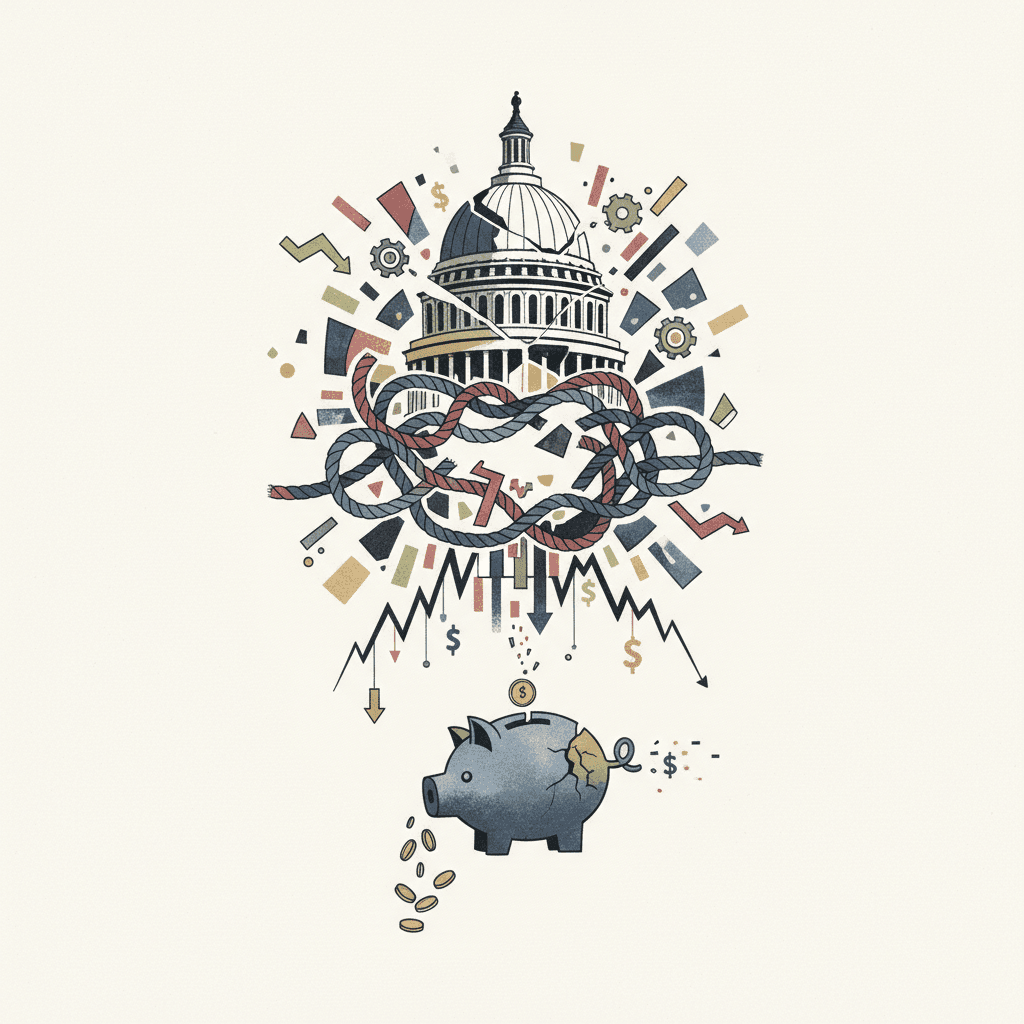
Washington Is Broken: What a Record Government Shutdown Means for Your Portfolio
The federal government isn't just dysfunctional right now. It's dysfunctional in a way that prediction markets say we haven't seen in modern American history, and the ripple effects are starting to show up in places that matter for anyone with a 401(k), a savings account, or a grocery bill.
Betting markets currently price a 99% probability that the 2026 government shutdown will exceed 35 days. The odds of it stretching past 40 days sit at 95%. Past 43 days? 83%. Past 50 days? 63%. And there's a coin-flip 52% chance it drags beyond 60 days. For context, the longest government shutdown in U.S. history was 35 days back in 2018-2019. We're not just breaking that record. We're obliterating it.
But the shutdown is only one piece of a much uglier puzzle. The DHS funding bill has a 0% chance of passing by March 20 and only a 31% chance of passing by April 1. The SAVE Act, a piece of election-related legislation, has just a 10% chance of becoming law. Prediction markets give Kristi Noem a 98% probability of leaving DHS by year-end, and multiple other cabinet departures are being priced in, with Pete Bondi at 49%, Howard Lutnick at 34%, and Keith Patel at 37% odds of leaving their posts.
This isn't a single crisis. It's a cascade of governance failures happening simultaneously.
The Self-Reinforcing Cycle of Institutional Decay
Investor Ray Dalio has written extensively about what he calls the "big cycle," the idea that empires and economies go through long phases where internal conflict and institutional rot gradually undermine the capacity to govern, which in turn erodes fiscal credibility and economic coordination. What prediction markets are pricing right now looks like a textbook example of that cycle in action:
- Legislative gridlock prevents basic funding bills from passing, leading to a prolonged shutdown.
- Cabinet turnover creates leadership vacuums at critical agencies like DHS, making it harder to negotiate or implement policy.
- The shutdown itself delays government contracting, regulatory decisions, and economic data releases, creating more uncertainty.
- That uncertainty makes it even harder for lawmakers to build consensus, because nobody knows what baseline they're working from.
- Markets begin demanding higher compensation for holding long-dated U.S. debt, since the government issuing that debt can't even keep its own lights on.
- Higher borrowing costs make the fiscal situation worse, which feeds back into more gridlock about how to address the deficit.
This loop is what makes the current moment different from a typical shutdown. It's not just a temporary inconvenience. It's a signal about the structural capacity of the U.S. government to manage its own finances.
The Market Playbook
Historically, individual government shutdowns have had modest market impact. Stocks dip a bit, then recover once the lights come back on. But the combination of a record-length shutdown, cabinet instability, failed agency funding, and the emerging probability of divided government in 2027 (prediction markets price an 84% chance of a Democratic House) creates something more serious: a prolonged policy vacuum that undermines confidence in U.S. sovereign credibility.
That environment is bearish for anything dependent on government contracts, regulatory clarity, or fiscal stimulus. It's bullish for safe-haven assets as institutional trust erodes. And it's bearish for the dollar and long-term Treasury bonds as the world slowly reconsiders the creditworthiness of a government that can't pass a spending bill.
Gold and Safe Havens: The Core Trade
Gold is the most direct way to express the thesis that institutional trust is eroding. GLD, the SPDR Gold Trust, gets a BUY signal at 82% confidence. The reasoning is straightforward: when the government that backs the world's reserve currency can't fund its own departments, people look for alternatives. Gold has served that role for thousands of years.
The same thesis supports IAU, the iShares Gold Trust, which is essentially a lower-fee version of GLD. It earns a BUY at 70% confidence. Using both funds lets you build a position without concentrating in a single vehicle.
For capital preservation with meaningful yield, SGOV, the iShares 0-3 Month Treasury Bond ETF, gets a BUY at 75% confidence. Short-duration Treasury bills, meaning government debt that matures in weeks rather than decades, are the rational parking spot during a policy vacuum. You collect yield, maintain liquidity, and keep your options open. Even in a sovereign credibility crisis, the shortest-dated government paper is the last thing to face pressure.
The Shovels, Not the Gold
During the California Gold Rush, the people who made the most reliable money weren't the miners. They were the ones selling shovels, pickaxes, and blue jeans. The same logic applies here. If gold is going up because of institutional decay, the companies that profit from gold production without actually swinging a pickaxe are the "shovel sellers" of this trade.
RGLD (Royal Gold) is the ultimate shovel seller. It's a royalty and streaming company, meaning it collects a percentage of gold production revenue from mines without bearing the cost of actually running those mines. When gold prices rise, Royal Gold's margins expand almost automatically. It gets a BUY at 78% confidence. Royal Gold is one of only about five major royalty/streaming companies, giving it a near-oligopolistic market position.
WPM (Wheaton Precious Metals) operates a similar model as the largest precious metals streaming company globally. It provides upfront capital to miners in exchange for discounted future metal deliveries, profiting from price appreciation without mining risk. BUY at 76% confidence. The embedded operational leverage in this model means it can outperform physical gold in a sustained rally.
GDXJ, the VanEck Junior Gold Miners ETF, provides leveraged exposure to gold prices through a basket of smaller mining companies. The trade-off is higher volatility and operational risk. It gets a BUY at 75% confidence as a primary trade and a separate WEAK BUY at 58% confidence as an infrastructure play, reflecting the tension between its upside potential and its inherent riskiness. If the governance crisis thesis plays out, junior miners could outperform physical gold by 2-3x, but that leverage cuts both ways.
GDX, the VanEck Gold Miners ETF holding senior miners like Newmont, Barrick, and Agnico Eagle, is the more conservative version of the same idea. WEAK BUY at 62% confidence. These larger companies have expanding margins in rising gold environments but carry less operational risk than their junior counterparts.
What to Avoid: Government Contractors in the Blast Zone
BAH (Booz Allen Hamilton) derives roughly 97% of its revenue from U.S. federal government clients. An extended shutdown directly disrupts contract awards, payment timelines, and new business development. Combine that with the DHS leadership vacuum from Noem's near-certain departure, and you have a company sitting in the blast zone of governance dysfunction. SELL at 74% confidence.
SAIC (Science Applications International Corporation) faces the same headwinds, with 95%+ of revenue coming from government contracts across defense, intelligence, and civilian agencies. Extended shutdowns delay new contract awards and create cash flow pressures, and SAIC has specific DHS exposure that makes the funding failure particularly painful. SELL at 71% confidence.
Structural Bearishness on Long Bonds and the Dollar
TLT, the iShares 20+ Year Treasury Bond ETF, gets a WEAK SELL at 60-68% confidence. The logic follows Dalio's debt cycle framework: when creditors start losing faith in a government's ability to manage its finances, they demand higher yields (meaning lower prices) to hold long-dated bonds. Moody's has already downgraded U.S. sovereign credit. A 60-day shutdown combined with DHS funding failure and cabinet turnover only accelerates that repricing. The "term premium," which is the extra yield investors demand for locking up their money for 20+ years, should rise in this environment.
UUP, the Invesco DB US Dollar Index Bullish Fund, gets a WEAK SELL at 62% confidence. Fiscal governance crises are long-term negative for the dollar's reserve currency status. But the dollar has many structural supports including energy independence, technological dominance, and the simple fact that other currencies have their own problems. This is a lower-conviction call.
CSGP (CoStar Group), the dominant commercial real estate data and marketplace company, gets a WEAK SELL at 60% confidence. The GSA (General Services Administration) is one of the largest tenants in U.S. commercial real estate. Government shutdown freezes leasing decisions, and extended policy uncertainty chills the broader CRE transaction market that CoStar enables. That said, CoStar's subscription model provides revenue stability, and its Homes.com expansion gives it secular growth that partly offsets the headwind.
What NOT to Trade on This Thesis
Two tickers were specifically flagged as poor fits. BOIL (ProShares Ultra Bloomberg Natural Gas) gets a NEUTRAL at just 35% confidence. Natural gas prices are driven by weather and LNG exports, not U.S. governance. The connection is too tenuous, and leveraged commodity ETFs destroy value in sideways markets through daily rebalancing decay. CIVI (Civitas Resources) also gets a NEUTRAL at 40% confidence. While domestic energy producers might theoretically benefit from a regulatory vacuum during shutdowns, oil prices dominate all other factors for exploration and production companies. These were included specifically to illustrate the limits of the thesis.
The Risks You Need to Know
No analysis is worth reading if it doesn't tell you what could go wrong. There are several important risks to this entire framework.
Gold is already near all-time highs. Much of the institutional distrust narrative may already be priced in. If the shutdown resolves faster than expected, gold could correct sharply, and the miners would correct even more sharply.
Treasuries can rally during political crises. This is the single biggest risk to the TLT short. Flight-to-safety dynamics mean investors often buy Treasury bonds during periods of fear, even when the fear is about the government itself. The short-term reaction and the long-term structural repricing can move in opposite directions.
Government contractors usually get paid eventually. After past shutdowns, companies like BAH and SAIC received retroactive payments. Long-term contracts provide some revenue visibility. The sell thesis requires the dysfunction to be genuinely different this time.
The dollar has powerful structural supports. Reserve currency status, energy independence, and tech dominance don't disappear because of a shutdown. And tariff policies could actually strengthen the dollar in the near term, even as governance deteriorates.
Timing is extremely difficult. The structural repricing of sovereign credibility can take years to play out. Being right about the direction but wrong about the timing is the same as being wrong, at least for your portfolio.
Prediction market probabilities may already be reflected in asset prices. If everyone knows the shutdown will last 50+ days, that information is likely already embedded in the price of gold, government contractor stocks, and Treasury bonds.
Why This Matters for Everyday Investors
You might be thinking that government shutdowns are just political theater and that markets always bounce back. That has historically been true. But the scale of what prediction markets are pricing right now, a record-shattering shutdown combined with leadership chaos across multiple agencies and legislative paralysis on basic funding, suggests something qualitatively different.
If you have a 401(k) with broad stock market exposure, you probably have some indirect exposure to government contractors and sectors that depend on regulatory clarity. If you hold long-term bonds through a target-date retirement fund, you're exposed to the term premium repricing that comes with fiscal credibility erosion. And if you're saving in dollars, you're exposed to the slow erosion of purchasing power that accelerates when the government can't coordinate basic economic policy.
The core message from prediction markets is simple but uncomfortable: the U.S. government's ability to function is deteriorating in measurable, quantifiable ways, and the assets that benefit from institutional trust are increasingly risky, while the assets that benefit from institutional distrust, gold, short-term bills, royalty companies, deserve a closer look.
Analysis based on prediction market data as of March 20, 2026. This is not investment advice.
How This Story Evolved
First detected Mar 19 · Updated daily
The article was updated to reflect that the shutdown is still ongoing rather than already past 40 days, and the headline now emphasizes a "record" shutdown instead of focusing on prediction markets. The new version also adds more specific probability milestones for how long the shutdown might last.