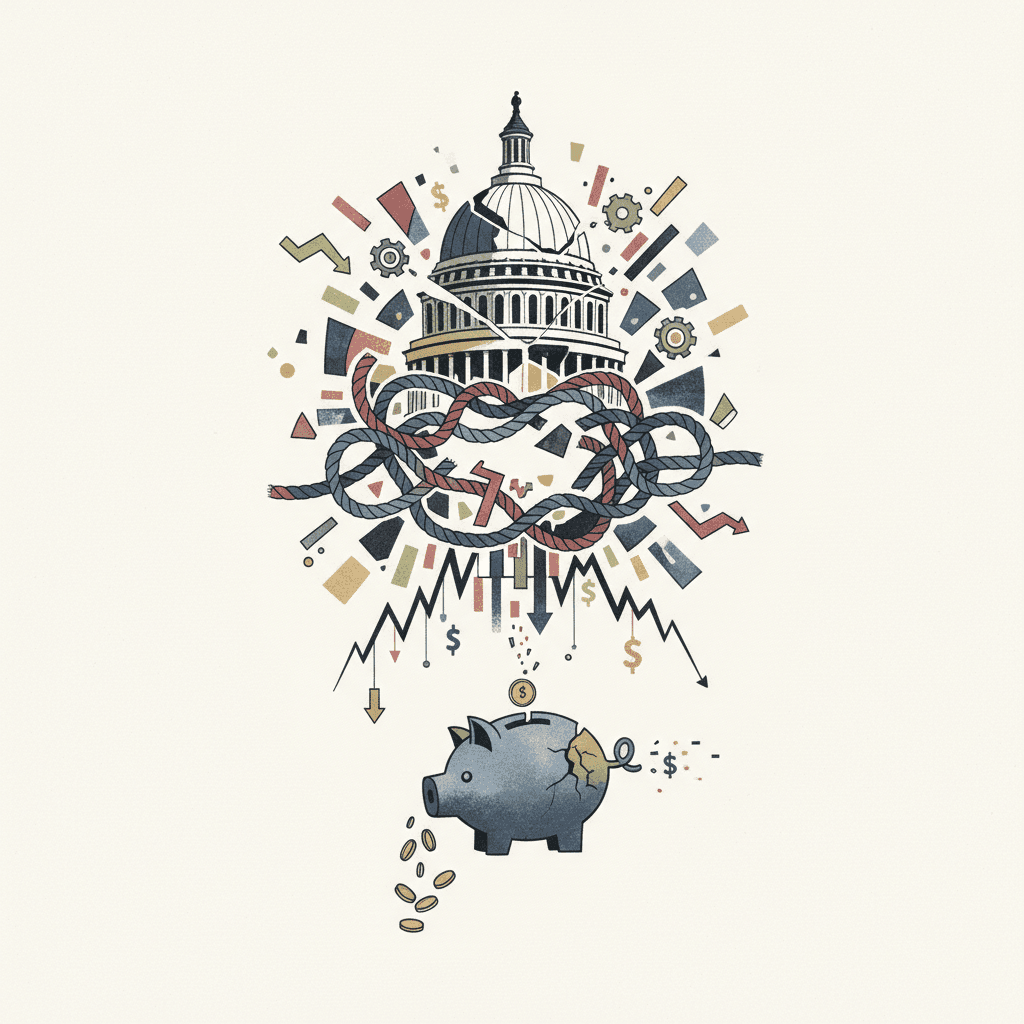
Washington Is Broken and Prediction Markets Are Pricing It In. Here's What It Means for Your Money.
The federal government has been shut down for over a month, and prediction markets say it's probably going to stay that way for a while. Betting markets currently assign a 99% probability that the 2026 shutdown will last more than 35 days, 95% for 40+ days, 83% for 43+ days, 63% for 50+ days, and 52% for 60+ days. There's even a 24.5% chance it stretches past 90 days, which would shatter every record in modern American history.
But the shutdown itself is only one piece of a much uglier puzzle. The Department of Homeland Security funding bill has a 0.5% chance of passing by March 20 and only a 31.5% chance by April 1. The SAVE Act, a piece of election-related legislation, carries just a 10.5% chance of becoming law. Kristi Noem has a 98.5% probability of leaving DHS by year-end. Other senior officials are following her out the door, with prediction markets pricing Pam Bondi's departure at 49%, Howard Lutnick's at 34%, and Kash Patel's at 36.5%. And looking further down the road, prediction markets see an 84% chance that Democrats take the House in 2027, suggesting the electorate is already signaling its verdict on the current governing coalition.
Add all of this together and you get something more significant than a typical government shutdown. You get a system-wide governance failure: bills that can't pass, agencies that can't be funded, a cabinet that can't stay together, and a legislative body that can't agree on anything. The investor Ray Dalio has written extensively about what he calls the "big cycle," a pattern where internal political conflict and institutional decay gradually erode a country's capacity to govern, which then undermines its fiscal credibility and ability to coordinate economic policy. What prediction markets are describing right now looks a lot like that pattern playing out in real time.
What This Means for Markets
The conventional wisdom about government shutdowns is that they don't matter much. Historically, stocks dip a bit, government workers miss paychecks, national parks close, and then Congress reaches a deal and everything returns to normal. That track record is why most Wall Street strategists wave off shutdown headlines.
This time looks structurally different. The combination of an extended shutdown with simultaneous cabinet instability, legislative paralysis across multiple bills, and the strong probability of divided government emerging in 2027 creates what amounts to a policy vacuum. This is bearish, meaning it pushes prices lower, for any company that depends on government contracts, regulatory clarity, or fiscal stimulus. It is bullish, meaning it pushes prices higher, for safe-haven assets like gold, because when people lose trust in institutions, they tend to park their money in things that don't require trusting anyone.
The Gold Trade: Shovels, Not Just Nuggets
The most direct expression of this thesis is gold. GLD, the SPDR Gold Trust, benefits from every dimension of the governance crisis: dollar erosion, institutional distrust, and safe-haven demand. The analysis carries 82% confidence as a buy, though with an important caveat: gold is already near all-time highs, which means a lot of the crisis premium may already be baked into the price. IAU, the iShares Gold Trust, offers similar exposure with a slightly lower expense ratio and is rated as a buy with 70% confidence. For investors specifically concerned about U.S. institutional custody risk, SGOL, which stores physical gold in Swiss vaults, is rated a weak buy at 58% confidence, though its lower liquidity means wider trading spreads.
But the more interesting plays follow what you might call the "shovels during a gold rush" principle. During the California Gold Rush, the people who got reliably rich weren't the miners. They were the people selling shovels, pickaxes, and denim jeans. The miners took on enormous risk for uncertain reward. The suppliers made money regardless of which mines panned out.
In the precious metals world, the modern shovel-sellers are streaming and royalty companies. WPM, Wheaton Precious Metals, is the textbook example. Instead of actually mining anything, Wheaton finances mining companies in exchange for the right to buy their gold and silver production at fixed low prices. When gold prices rise, Wheaton's margins expand dramatically, but they don't bear the operational risks of actually digging holes in the ground. They don't deal with cave-ins, labor disputes, or permits. They just collect. This is what's known as the Sam Brannan model, named after the merchant who got rich selling supplies to Gold Rush prospectors rather than prospecting himself. The analysis rates WPM as a buy at 78% confidence, noting it is one of the largest and most established streaming companies globally, giving it an oligopoly-like market position.
RGLD, Royal Gold, operates a similar royalty and streaming model, collecting payments on gold production from mines it doesn't operate. It's rated a buy at 74% confidence. The company holds royalty interests across a diversified portfolio of mining operations, meaning no single mine's failure can sink the business.
GDXJ, the VanEck Junior Gold Miners ETF, offers a more aggressive play. Junior miners, meaning smaller and earlier-stage mining companies, provide leveraged exposure to gold prices because their cost structures are largely fixed. When gold rises, their profits can increase by a much larger percentage than the metal price itself. The analysis rates GDXJ as a buy at 75% confidence, but with a clear warning: many junior miners are pre-revenue or marginally profitable, and if gold pulls back, junior miners fall harder and faster.
The Losers: Companies That Need a Functioning Government
On the other side of the trade are companies whose business models depend on the government actually working. SAIC, Science Applications International Corporation, derives roughly 95% or more of its revenue from U.S. government contracts, primarily in defense and intelligence. Extended shutdowns directly impair contract execution, delay new awards, and create cash flow uncertainty. With DHS funding at a 0.5% probability of passing by March 20, SAIC faces real near-term operational disruption. The analysis rates it as a sell at 72% confidence.
CBRE, the commercial real estate giant, manages significant government facilities and real estate. Extended shutdowns mean contract delays and payment disruptions. However, government work is only one of CBRE's many business lines, making this a weak sell at 60% confidence rather than a full sell.
The Dollar and Bonds: It's Complicated
The dollar picture is genuinely tricky. UUP, which tracks the U.S. Dollar Index, is rated a weak sell at 55-62% confidence. The logic is straightforward: eroding sovereign credibility should weaken the currency. But the dollar has a strange superpower. During global crises, even ones caused by the U.S. itself, money often flows into dollars because it remains the world's reserve currency. There's also the uncomfortable fact that Europe, Japan, and China all have their own governance headaches. If everyone's house is on fire, nobody's currency benefits from the comparison.
Bonds present a similarly conflicted picture. TLT, which tracks long-term Treasury bonds, gets two competing signals. In the short term, shutdowns create flight-to-safety buying that pushes bond prices higher. But over the longer term, a government that can't pass appropriations bills or manage its debt issuance erodes the fiscal credibility that makes Treasuries "safe" in the first place. The 84% probability of a Democratic House in 2027 also signals fiscal expansion, not contraction, which means more government spending and more bond issuance ahead. The net result is a weak sell at 60% confidence. GOVT, a broader Treasury ETF, is rated neutral at 45% confidence and flagged primarily as a hedge monitor: if the governance crisis thesis turns out to be wrong, GOVT would rally sharply.
The Self-Reinforcing Cycle
The reason this pattern deserves attention beyond a typical shutdown is the feedback loop at work:
- Legislative gridlock prevents passage of funding bills, extending the shutdown.
- The extended shutdown creates operational chaos across federal agencies.
- Cabinet members depart, further weakening institutional capacity.
- Weakened institutions make legislative compromise harder to achieve.
- Markets begin pricing in governance dysfunction, eroding fiscal credibility.
- Eroded credibility raises borrowing costs and weakens the dollar.
- A weakened fiscal position makes future governance challenges even harder to solve.
Each step feeds into the next. This is why prediction markets are pricing such long shutdown durations: the mechanisms that normally end shutdowns (political pressure, public backlash, institutional negotiation) are themselves impaired.
Why This Matters for Your Everyday Finances
If you have a 401(k), a savings account, or you just buy groceries, this pattern matters. Government shutdowns delay tax refunds, pause federal loan processing, and disrupt services that millions of Americans depend on. But the deeper issue is what prolonged governance dysfunction does to the purchasing power of the dollars in your wallet. When the world's largest economy signals that it can't pass basic funding legislation, it slowly chips away at the premium the dollar commands as the global reserve currency. That premium is what allows the U.S. to borrow cheaply, which keeps mortgage rates lower than they'd otherwise be, which supports housing prices, which represents the biggest asset most American families own.
Gold near all-time highs is the market's way of saying that trust in paper currencies and the institutions behind them is fraying. You don't need to go out and buy gold bars. But understanding why gold is rising, and why prediction markets are so confident this shutdown will drag on, tells you something important about the trajectory of the institutions that undergird your financial life.
The Risks: What Could Go Wrong With This Thesis
Honesty about risks is what separates analysis from cheerleading, and there are real reasons this trade could go sideways.
For the gold and precious metals plays, the biggest risk is that gold has already rallied significantly. Much of the crisis premium may already be reflected in prices, and a surprise bipartisan deal could trigger a sharp reversal in safe-haven flows. The Federal Reserve tightening policy or a strengthening dollar could also pressure gold, regardless of what's happening in Congress. Junior miners in GDXJ carry operational and financing risks that can overwhelm even a bullish gold price environment, and a broad equity market selloff could drag miners down even as gold holds steady. For WPM and RGLD, both already trade at premium valuations, and their streaming agreements carry counterparty risk if underlying mines face problems.
For the short dollar thesis via UUP, the biggest risk is the dollar paradox: U.S. crises often strengthen the dollar in the short term as global capital seeks the relative safety of the reserve currency. There's also no viable alternative reserve currency ready to absorb a dollar decline. The euro zone has its own fiscal challenges, and the yuan isn't freely convertible.
For the sell signals on SAIC and CBRE, history says shutdowns eventually end and government contractors typically receive backpay and catch-up work. Defense spending has deep bipartisan support over long time horizons, and the market may have already priced in the shutdown's impact.
For the bond trade on TLT, recession fears could trigger genuine flight-to-safety buying that overwhelms fiscal credibility concerns. A Fed pivot to easier policy would dramatically reprice bonds higher regardless of shutdown dynamics. And shorting long-term Treasuries is a very crowded trade right now, creating significant squeeze risk.
Perhaps the most fundamental risk of all: historical shutdowns have had modest and short-lived market impacts. This thesis requires that this time is structurally different. That's always a dangerous assumption, even when the evidence is compelling.
Analysis based on prediction market data as of March 19, 2026. This is not investment advice.
How This Story Evolved
First detected Mar 19 · Updated daily
The article was updated to reflect that the shutdown is still ongoing rather than already past 40 days, and the headline now emphasizes a "record" shutdown instead of focusing on prediction markets. The new version also adds more specific probability milestones for how long the shutdown might last.
Read latest →