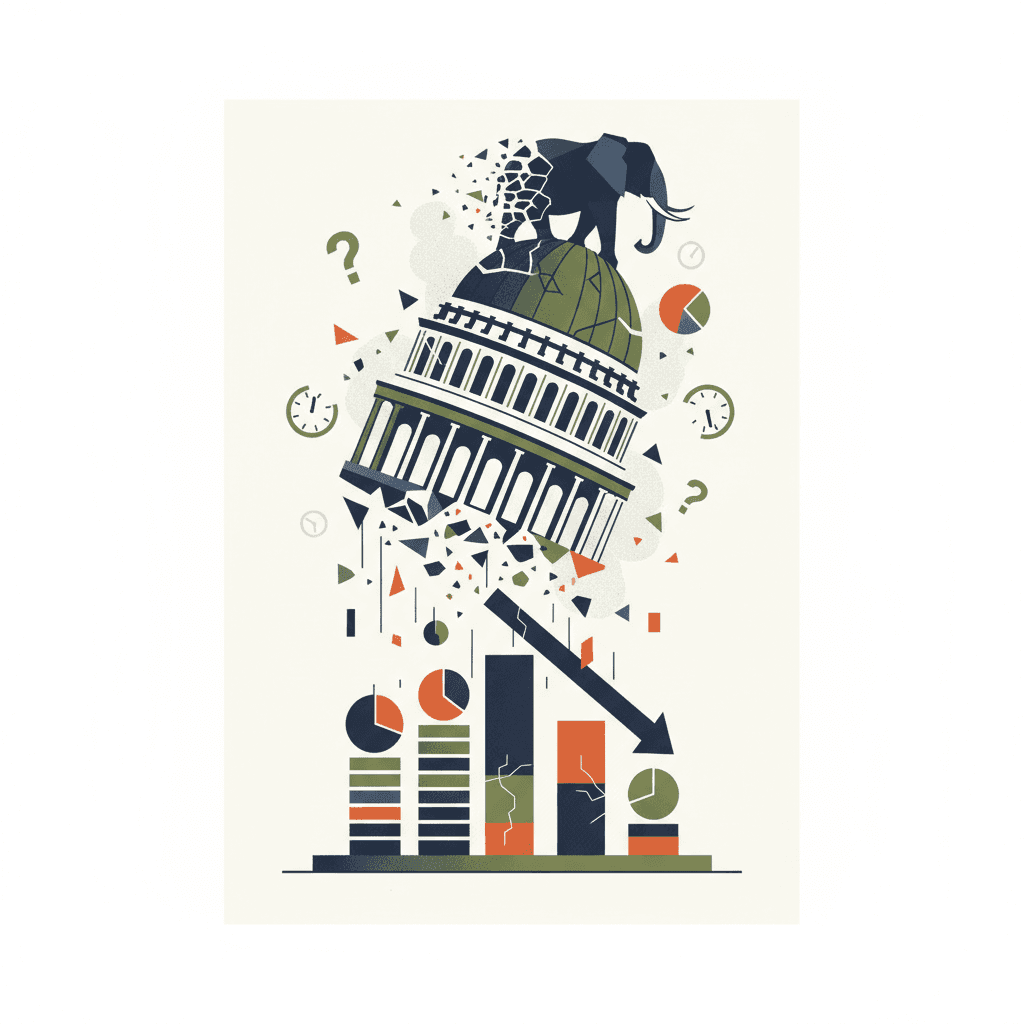
Prediction Markets Are Pricing In a Republican Governing Collapse. Here's What That Means for Your Portfolio.
Prediction markets are flashing something remarkable right now. Not a single warning sign, but an entire dashboard of red lights all blinking at once. The government shutdown is on track to become one of the longest in American history. Democrats are heavily favored to take the House in 2026. Key cabinet members are expected to leave. Trump himself has a meaningful probability of not finishing his term. And the Federal Reserve chair may be out the door by summer.
Taken individually, any one of these would be notable. Taken together, they paint a picture of a governing coalition that is coming apart at the seams.
The Numbers Tell a Story
Let's start with the government shutdown, which began in mid-February. Prediction markets currently give it a 99.5% chance of exceeding 35 days, a 97% chance of blowing past 40 days, a 72% chance of reaching 50 days, and a 50% chance of lasting beyond 60 days. There's even a 29% probability it drags past 90 days. For context, the longest government shutdown in U.S. history was 43 days during the October 2025 standoff, which itself broke the previous record of 35 days set during the 2018-2019 shutdown. Bettors are nearly certain the current shutdown will rank among the longest ever recorded.
But the shutdown is just one symptom. Prediction markets price Democrats at an 84% chance of winning control of the House in the 2026 midterms, with Republicans at just 15%. That kind of midterm wipeout typically signals deep voter dissatisfaction with the party in power.
Then there's the leadership chaos. Trump's probability of leaving office before January 2028 sits at 32%, and the probability he doesn't finish his full term at all is 42%. The odds of impeachment proceedings by January 2029 are 69%. Actual removal from office, which requires a Senate conviction, is priced at 22%, which sounds low until you remember that no president in American history has ever been removed this way.
The cabinet is hemorrhaging too. Kristi Noem is at 99% to depart by the end of 2026. Pam Bondi sits at 48%, and Kash Patel at 33%. Meanwhile, Fed Chair Jerome Powell has a 62% probability of leaving the Federal Reserve Board by August 2026, a scenario that would create its own category of market anxiety around central bank independence.
Why This Matters for the Economy
The investor Ray Dalio has written extensively about what he calls the "internal order" cycle, essentially the idea that when a country's political institutions lose cohesion, the economic engine suffers because the government loses its ability to respond to crises in a coordinated way. Think of it like a fire department where the firefighters are fighting each other instead of the fire.
That framework applies perfectly here. If the economy hits a rough patch, whether from inflation, a trade shock, or a financial accident, the normal response is for Congress and the White House to coordinate some kind of fiscal response. Tax adjustments, emergency spending, regulatory relief. But when the government is shut down, the president faces impeachment, the cabinet is in flux, and the Fed chair might be ousted, that coordination capacity effectively drops to zero.
This is especially dangerous in a stagflationary environment, where the economy is slowing but prices are still rising. Stagflation is already the trickiest macro scenario to navigate even with a fully functional government. With a paralyzed one, it becomes genuinely dangerous.
The Shovel Sellers: Infrastructure Plays for Political Chaos
During the California Gold Rush, the people who most reliably made money weren't the miners. They were the people selling shovels, pickaxes, and denim jeans. The same logic applies to financial markets during periods of political turmoil. You don't have to correctly predict which specific crisis materializes. You just need to own the assets that benefit from uncertainty itself.
Here's how the self-reinforcing cycle works:
- Government shutdown drags on, creating fiscal uncertainty
- Cabinet departures and impeachment talk erode confidence in executive leadership
- Investors increase hedging activity across futures, options, and safe-haven assets
- Elevated volatility and trading volume benefit financial infrastructure companies
- Midterm losses further reduce the governing party's ability to resolve the dysfunction
- The cycle repeats, with each new headline feeding back into step one
With that framework, here are the trades that prediction market data supports, along with honest assessments of what could go wrong.
Gold is the classic institutional-breakdown hedge. GLD (confidence: 78%) and IAU (confidence: 67%) both offer exposure, with IAU carrying a lower expense ratio for longer holding periods. Gold benefits from every scenario in this pattern. Powell gets forced out? Fed credibility erodes, gold rises. Shutdown grinds on? Fiscal uncertainty, gold rises. Impeachment proceedings begin? Institutional crisis, gold rises. Gold doesn't care which specific domino falls. It profits from the falling itself.
CBOE (confidence: 74%) and CME (confidence: 72%) are the toll bridges of financial risk management. CBOE operates the VIX complex and S&P 500 options market. CME runs the futures exchanges for interest rates, currencies, equities, and commodities. They don't care whether markets go up or down. They profit from the transaction volume that spikes whenever investors rush to hedge. A historic shutdown combined with impeachment risk and Fed uncertainty is essentially a sustained volume event for these exchanges.
TAIL (confidence: 75%) holds U.S. Treasuries and out-of-the-money put options on the S&P 500, meaning options that pay off only if the market drops significantly. It's designed specifically for tail risk, those low-probability scenarios that sit in the far edges of the bell curve. What makes this moment unusual is that the tail risks aren't hypothetical anymore. A 42% chance the president leaves office and 69% impeachment probability means the tails are getting fat.
SPHD (confidence: 70%) offers high-dividend, low-volatility equities, the kind of defensive stocks that institutional money rotates into during uncertainty. VPU (confidence: 63%), a utilities ETF, follows similar logic. Utilities are regulated monopolies with predictable cash flows. A government shutdown doesn't make people use less electricity. And the 83% probability of a House flip actually helps utilities, because gridlock historically means less risk of aggressive new regulation.
BRK.B (confidence: 65%) is the fortress balance sheet play. Berkshire Hathaway sits on over $370 billion in cash and Treasuries, which means it can deploy capital into distressed assets if political chaos creates market dislocations. Its diversified earnings base is relatively insulated from paralysis in any single policy area.
For bond exposure, TLT (confidence: 52-58%) offers a flight-to-safety trade, but with serious complications. If Powell is forced out, the resulting Fed credibility crisis could actually hurt long bonds. GOVT (confidence: 60%) provides intermediate-duration Treasury exposure with less risk on either side. VTIP (confidence: 58%) offers inflation-protected Treasuries with short duration, hedging the possibility that governance breakdown makes inflation harder to fight without taking on the interest rate risk of longer bonds.
USMV (confidence: 55%) is a minimum-volatility equity fund that lets you stay invested in stocks while tilting toward companies with lower sensitivity to market swings. It's the middle ground between going fully defensive and staying fully exposed.
An Important Counter-Signal
The analysis also flagged SH, which provides inverse (short) exposure to the S&P 500. At a primary signal level, the bearish case gives it a 72% confidence rating. But the infrastructure analysis deliberately includes a counter-signal at 45% confidence with a WEAK_SELL rating, and it's worth understanding why.
The S&P 500 has historically shrugged off every government shutdown. The 2018-2019 shutdown saw equities recover strongly. Markets are remarkably good at climbing walls of worry, and political dysfunction has a weak historical correlation with equity performance. Inverse ETFs also suffer from daily rebalancing decay, meaning they lose value in choppy, sideways markets even if your directional bet is eventually correct. The analysis includes this counter-signal as an honest warning: the temptation to short the market based on political chaos is strong, but it is historically the trade most likely to be wrong.
The Risks You Need to Know
Several risks cut across all of these positions:
- Markets can climb a wall of worry. Political dysfunction doesn't always translate into equity declines. Corporate earnings could remain strong even as Washington burns.
- Prediction market probabilities could be wrong. These are betting markets with their own biases, liquidity constraints, and tendency toward dramatic narratives. The actual probability of impeachment or presidential departure could be meaningfully lower.
- A sudden resolution changes everything. If the shutdown ends tomorrow and political tensions cool, the safety trades unwind fast. Gold, Treasuries, and defensive equities would all give back gains.
- The stagflation problem. If inflation stays elevated, the Fed can't cut rates, and long-duration bonds become toxic. This creates a genuine tension between the flight-to-safety thesis (buy bonds) and the inflation thesis (sell bonds).
- Crowded trades. Many of these defensive positions are already widely held. If everyone runs to the same lifeboat, the lifeboat gets expensive.
- Gold is near all-time highs. Much political anxiety may already be reflected in the price.
Why This Matters for Your 401(k)
You don't need to be a political junkie to care about this. If you have a 401(k), a savings account, or a grocery bill, governing dysfunction touches your life. A prolonged shutdown means delayed tax refunds, disrupted government services, and reduced consumer confidence. Policy uncertainty makes businesses hesitant to hire and invest. If the Fed chair is forced out, the resulting questions about central bank independence could affect mortgage rates, car loans, and the value of every bond fund in your retirement account.
The core insight from prediction markets right now isn't that any single political event is guaranteed. It's that the probability of multiple governance failures happening simultaneously is unusually high. And when you layer a 99.5% historic shutdown on top of 69% impeachment odds, 84% midterm losses, 62% Fed chair departure, and a cabinet in open revolt, you get a governance environment unlike anything modern markets have priced before.
The shovel sellers, gold, exchange operators, defensive equities, and inflation-protected bonds, don't require you to predict which specific crisis hits hardest. They just need the uncertainty to persist. And right now, prediction markets are saying it will.
Analysis based on prediction market data as of March 23, 2026. This is not investment advice.
How This Story Evolved
First detected Mar 20 · Updated daily
The story shifted from general political uncertainty to a sharper focus on portfolio protection, with new buy signals added for defensive stocks and inflation hedges like utilities and dividend payers, while defense contractors and government-services firms were dropped entirely. Gold's appeal strengthened while volatility exchange plays like CBOE and CME cooled slightly, suggesting markets are now leaning more toward riding out the chaos than trading it.
The article was rewritten to open with specific shutdown probability numbers (99%, 97%, and 72% chances of the shutdown lasting 35, 40, and 50+ days) instead of a general list of warning signs. The new version also uses stronger language, describing the situation as a "fracturing of the Republican governing coalition" rather than just a series of red flags.
Read this version →