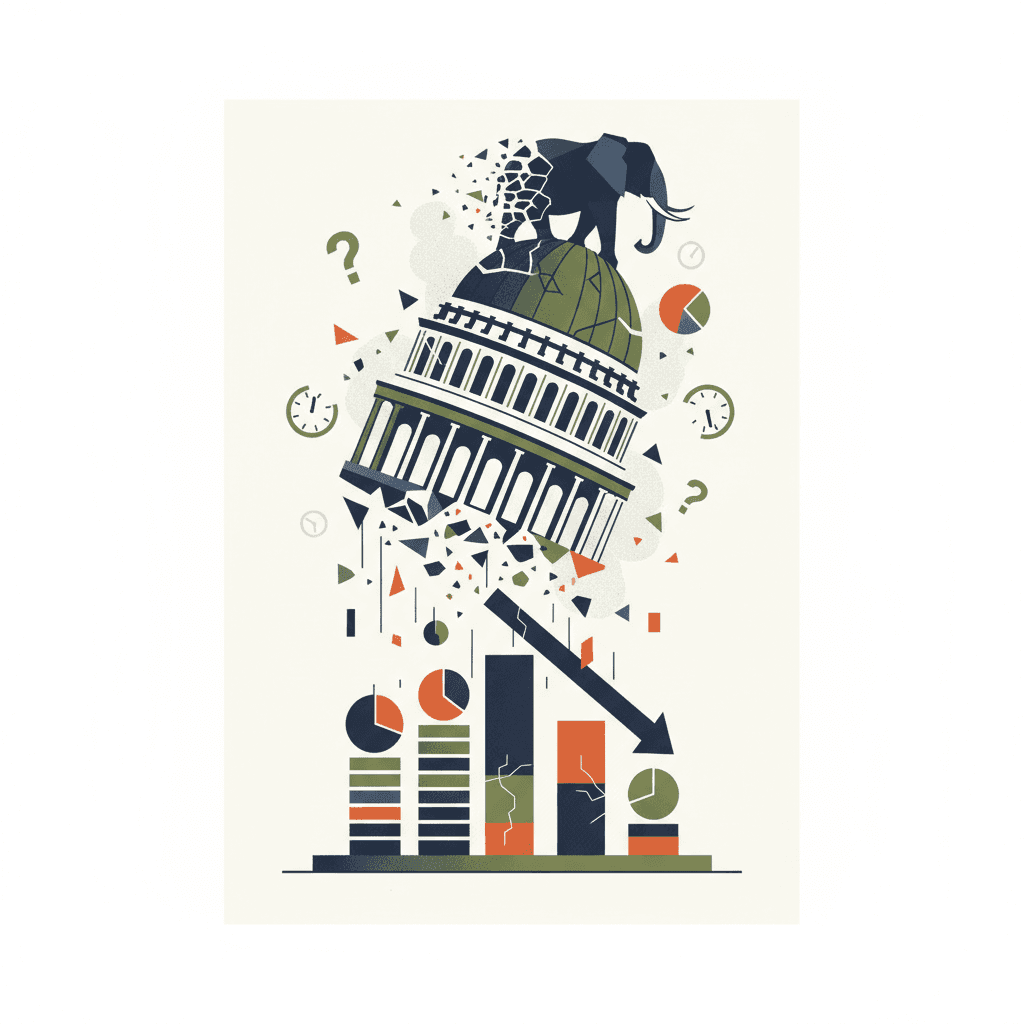
Prediction Markets Are Pricing a Full-Scale Republican Governing Collapse. Here's What It Means for Your Portfolio.
Something remarkable is happening across prediction markets right now. Not in one contract or two, but across dozens of them simultaneously, bettors are pricing in what amounts to the fracturing of the Republican governing coalition. And the numbers are staggering.
The government shutdown is 99% likely to exceed 35 days, 97% likely to exceed 40 days, and there's a 72% chance it blows past 50 days. That would make it the longest shutdown in American history by a wide margin. At the same time, Democrats are priced at 84% to take the House in the 2026 midterms, Trump's probability of leaving office before his term ends sits between 32% and 42% depending on the timeframe, and impeachment probability is 69%. Key cabinet members are expected to depart: Kristi Noem at 99%, Pam Bondi at 48%, Kash Patel at 33%. And Jerome Powell, the chair of the Federal Reserve, has a 62% chance of leaving the Fed Board by August 2026.
That is not one crisis. That is a cascade of crises, all hitting at the same time.
Why This Combination Matters More Than Any Single Event
Think of a government like a car. A flat tire is annoying but manageable. A cracked windshield is inconvenient. A sputtering engine is worrying. But if you have all three at once, plus the steering is loose and the brakes are soft, you don't just have a series of problems. You have a vehicle that cannot safely respond to anything unexpected on the road ahead.
That's the situation prediction markets are describing. Ray Dalio, the billionaire investor, has a framework he calls the "internal order" cycle. The idea is straightforward: when the institutions that run a country lose their ability to work together, the economic machine underneath them suffers. Not because any single policy fails, but because the government loses its capacity to respond to shocks at all. A historic shutdown, cabinet chaos, impeachment proceedings, a potential Fed leadership vacuum, and a looming midterm wipeout collectively drain the system of its ability to coordinate.
And the Senate is priced at essentially 50/50, which means even after the midterms, gridlock is the base case. No major fiscal stimulus. No regulatory clarity. No coordinated response to an economic downturn if one arrives.
The Self-Reinforcing Loop
These events don't just coexist. They feed each other.
- A historic government shutdown signals that the governing party cannot pass its own agenda, even with unified control.
- That inability demoralizes the party base and energizes the opposition, pushing House-flip probability higher (currently 84% for Democrats).
- Intra-party blame for the shutdown destabilizes cabinet members and party leadership, driving departures (Noem at 99%, Bondi at 48%).
- Weakened political standing emboldens impeachment efforts (69% probability), which further consumes legislative bandwidth.
- The resulting policy paralysis means the Fed is the only functioning institution left, but with Powell at 62% to leave, even that backstop is uncertain.
- All of this circles back to reinforce the original problem: a government that cannot govern.
This is the kind of cycle that Dalio warns about. Each piece makes the others worse.
What This Means for Your Money
The overall picture is bearish for sectors that depend on government policy clarity and bullish for assets that benefit from uncertainty itself. When a potential stagflationary economic environment (slowing growth plus sticky inflation) meets governance paralysis, the economy lacks the institutional tools to respond. That's profoundly negative for fiscal stimulus capacity, regulatory certainty, and investor confidence.
But rather than simply betting the market goes down, the smarter framework here borrows from Gold Rush history. During the California Gold Rush, most of the people who got rich weren't the miners. They were the people selling shovels, picks, and denim jeans. They profited from the activity itself, regardless of whether any individual miner struck gold.
The same logic applies to political chaos. Instead of betting on one specific outcome, the strongest positioning profits from the uncertainty itself.
Direct Hedges
SH provides inverse exposure to the S&P 500, the most straightforward hedge against broad equity weakness. Governance dysfunction of this magnitude, with a historic shutdown, cabinet chaos, impeachment risk, and a potential midterm wipeout, creates persistent policy uncertainty that weighs on how much extra return investors demand for holding risky stocks. When the governing coalition fractures this severely, the economic machine loses its ability to respond to surprises. Confidence here is moderate at 72%, because markets have an uncanny ability to climb walls of worry.
TAIL holds U.S. Treasuries and out-of-the-money put options on the S&P 500, meaning it's specifically designed for tail risk scenarios. A "tail risk" is a low-probability, extreme outcome, and what makes this moment unusual is that the low-probability scenario appears to be materializing across multiple dimensions simultaneously. When you have a 32-42% chance the President leaves office, 69% impeachment probability, and a historic shutdown, the range of possible outcomes has an unusually fat left tail. Confidence sits at 75%.
TLT offers long-duration Treasury exposure as a flight-to-safety trade. Extended shutdowns and impeachment proceedings historically drive demand for Treasuries. However, this one is genuinely complicated. If Powell is forced out (62% probability), the resulting crisis of confidence in the Fed could actually hurt long bonds. Fiscal dysfunction could raise fears of a credit downgrade, echoing the 2011 precedent. And a stagflationary environment, where inflation stays sticky while growth slows, means rates could stay elevated despite risk-off sentiment. Position sizing should be small. Confidence is split between two analyses at 58% and 52%, reflecting the genuine ambiguity.
The Shovel Sellers
This is where the infrastructure thesis gets interesting.
GLD and IAU are both gold exposure vehicles. IAU has a lower expense ratio for longer holding periods. Gold is the canonical hedge for institutional breakdown. When political institutions lose cohesion, currency debasement risk rises, investor confidence falls, and the classic store-of-value bid for gold intensifies. The critical point is that gold benefits regardless of which specific political crisis materializes. Powell departure undermines Fed credibility, which means gold goes up. Historic shutdown creates fiscal uncertainty, gold goes up. Impeachment proceedings trigger an institutional crisis, gold goes up. Gold is the ultimate shovel seller in this trade. GLD carries 78% confidence as an infrastructure play, IAU at 67%.
CBOE is the company that operates the VIX (the market's "fear gauge") and the SPX options market. They don't care whether markets go up or down. They profit from the transaction volume. A historic shutdown plus impeachment plus cabinet chaos equals sustained elevated volatility and options trading volume. They have a near-monopoly on VIX and SPX options. Confidence at 74%.
CME runs the futures and options exchanges for interest rates, currencies, equities, and commodities. Every dimension of this governance dysfunction pattern, from fiscal uncertainty (Treasury futures) to Fed credibility (interest rate futures) to economic policy paralysis (commodity and equity futures), drives hedging activity through CME's infrastructure. They are the toll bridge of financial risk management. Confidence at 72%.
SPHD holds low-volatility, high-dividend stocks. Regardless of which political outcome materializes, investors rotate toward defensive, income-generating equities during governance uncertainty. It benefits from any risk-off rotation, not just a specific political outcome. Confidence at 70%.
VPU provides utilities sector exposure. Utilities are regulated monopolies with predictable cash flows that are largely insulated from federal policy swings. A shutdown does not cut electricity demand. The 84% House-flip probability means gridlock is the base case, and gridlock is historically good for regulated utilities that fear aggressive new regulation. Confidence at 63%.
BRK.B, Berkshire Hathaway, sits on more than $300 billion in cash and Treasuries. It's essentially a fortress balance sheet that can deploy capital into distressed assets if the shutdown or impeachment causes market dislocation. Insurance operations benefit from higher rates, and diversified earnings are relatively insulated from policy paralysis in any single sector. Confidence at 65%.
Additional defensive positioning includes GOVT for intermediate-duration Treasury exposure (reducing the extreme duration risk of TLT), VTIP for short-term inflation-protected bonds (governance breakdown reduces the institutional capacity to fight inflation, and the 62% Powell departure probability is particularly relevant since Fed leadership uncertainty is inflationary), and USMV for minimum-volatility equity exposure that allows staying invested in stocks while defensively tilting toward lower-beta businesses.
An Honest Warning About the Bearish Trade
The analysis deliberately includes a counter-signal on SH as a cautionary note. The S&P 500 has historically been remarkably resilient to government shutdowns. The 2018-2019 35-day shutdown saw equities recover strongly. Daily rebalancing decay erodes SH returns in volatile or sideways markets. Corporate earnings may remain strong even during governance chaos. The temptation to short the market based on political dysfunction is strong but historically unreliable. Political dysfunction and equity performance are weakly correlated over time. This is the trade most likely to be wrong.
The Full Risk Picture
Every position here carries real risks that deserve honest acknowledgment:
- Markets climb walls of worry. Political dysfunction does not always translate to equity declines. Much of this dysfunction may already be priced in, since prediction markets reflect publicly available information.
- The Fed could pivot dovish, offsetting the governance drag on growth with lower interest rates.
- Gold is near all-time highs. Significant political anxiety may already be baked into the price. A rapid political resolution, such as the shutdown ending and Trump stabilizing, would reverse the gold bid sharply.
- Inverse ETFs suffer from daily rebalancing decay over longer holding periods, making timing critical.
- Tail risk hedges bleed value during calm periods. If the crisis unfolds slowly over 6-12 months rather than as an acute shock, options decay works against you.
- A strong dollar during risk-off episodes can compete with gold's safe-haven bid.
- Rising interest rates are structurally negative for dividend-paying utilities and high-dividend stocks.
- If uncertainty becomes extreme enough that markets freeze in a genuine liquidity crisis, even the exchange operators (CBOE, CME) could see volume paradoxically drop.
- Prediction market probabilities may overstate actual risk. These markets can be illiquid, and prices can reflect sentiment more than calibrated probability.
Why This Matters for Everyday Investors
You don't need to be a trader to care about this. If you have a 401(k), the broad stock market exposure in your retirement account faces headwinds from sustained policy uncertainty. If you're paying attention to grocery bills, the combination of sticky inflation and a potential Fed leadership vacuum means the institutions designed to bring prices down may be unable to do their job. If you're saving money in a bank account, the silver lining is that the higher-rate environment means your savings earn more, but the value of those dollars is being eroded if inflation persists without an institutional response.
The core insight from prediction markets right now is not that any single bad thing will happen. It's that the probability of many bad things happening simultaneously has reached a level that demands attention. The governing coalition's fracture reduces the country's ability to respond to economic problems, and that inability compounds everything else.
The shovel-seller approach, owning the infrastructure of uncertainty rather than betting on any single outcome, remains the most robust way to position for a world where the governing machine is breaking down.
Analysis based on prediction market data as of March 23, 2026. This is not investment advice.
How This Story Evolved
First detected Mar 20 · Updated daily
The story shifted from general political uncertainty to a sharper focus on portfolio protection, with new buy signals added for defensive stocks and inflation hedges like utilities and dividend payers, while defense contractors and government-services firms were dropped entirely. Gold's appeal strengthened while volatility exchange plays like CBOE and CME cooled slightly, suggesting markets are now leaning more toward riding out the chaos than trading it.
Read latest →The article was rewritten to open with specific shutdown probability numbers (99%, 97%, and 72% chances of the shutdown lasting 35, 40, and 50+ days) instead of a general list of warning signs. The new version also uses stronger language, describing the situation as a "fracturing of the Republican governing coalition" rather than just a series of red flags.