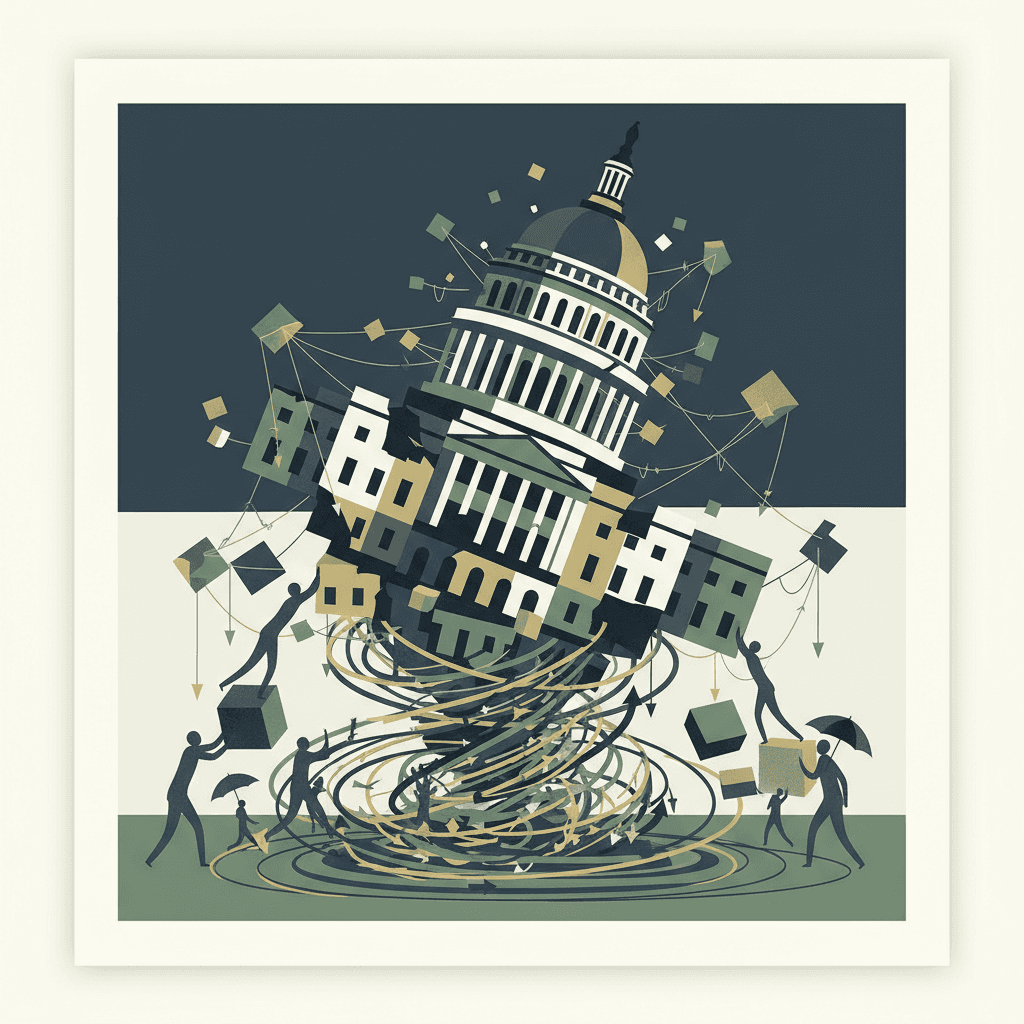
Washington Is Broken and the Markets Know It: How to Position for a Government That Can't Govern
Prediction markets are painting a picture of the U.S. government that should make anyone with a 401(k) pay attention. The numbers are stark: a 99% chance the current government shutdown extends past 35 days, a 74% probability it lasts beyond 40 days, and a 54% chance it drags past 60 days. Even a 90-day shutdown isn't some fringe scenario, sitting at 11%. Meanwhile, the odds of Congress passing a DHS funding bill by March 20th hit 0%, and the chance of meaningful election reform legislation passing by May is just 5%. The SAVE Act, another piece of legislation that's been floating around, has only a 10% chance of becoming law before January 2027.
This isn't just one bad week in Washington. This is a pattern of systemic dysfunction that touches every branch of government and both parties. Prediction markets also give Democrats an 83% chance of taking back the House in 2026, which means the second half of the current presidential term is almost certainly heading toward total legislative gridlock. And layered on top of all this, there's a 60% probability of the Insurrection Act being invoked before 2029, alongside aggressive executive actions on the Panama Canal and Greenland acquisition.
Ray Dalio, the founder of the world's largest hedge fund, has a framework for what happens when a country's political system stops functioning. He calls it the "broken political machine" phase, and it tends to be self-reinforcing. Polarization makes compromise impossible, which makes problems worse, which makes voters angrier, which makes politicians more extreme, which makes compromise even more impossible. The prediction market data suggests the U.S. is deep into this cycle.
The financial implications are serious and cut across multiple asset classes.
What This Means for Markets
When a government can't pass basic funding bills while simultaneously pursuing aggressive unilateral executive actions, it erodes something economists call sovereign credibility. Think of it like a business that can't make payroll but keeps announcing grand expansion plans. Investors start asking uncomfortable questions.
The direct effects include GDP drag from the shutdown itself (federal workers aren't spending, government contractors aren't getting paid, national parks are closed), rising risk premiums on U.S. debt as rating agencies take notice (remember when S&P downgraded U.S. debt in 2011 over the debt ceiling fight), and a weaker dollar as global investors quietly start looking for alternatives.
With an 83% probability of a Democratic House takeover in 2026, fiscal policy becomes completely unpredictable for the rest of the term. Pro-growth legislation is essentially dead on arrival. Bond vigilantes, the large institutional investors who punish governments for fiscal irresponsibility by selling their bonds, have more ammunition than they've had in years.
The Core Trades
Gold is the centerpiece. GLD earns a strong buy signal with 88% confidence. Gold is what people buy when they lose faith in the institutions backing paper money. An extended government shutdown, combined with legislative paralysis and executive overreach, directly undermines confidence in U.S. institutional stability. Gold benefits twice: once from the flight-to-safety buying, and again from the monetary policy loosening that typically follows fiscal dysfunction (the Federal Reserve tends to cut rates or ease policy when the government's failures start dragging down the economy). A secondary position in IAU, a lower-cost gold ETF, serves the same purpose and works well for smaller accounts.
The dollar is vulnerable. UUP, which tracks the U.S. dollar against a basket of other currencies, gets a sell signal at 72% confidence. Dollar weakness is the direct transmission mechanism when sovereign credibility erodes. Extended shutdowns, legislative paralysis, and aggressive unilateral executive actions all signal to global capital allocators that U.S. governance is unreliable. Foreign central banks diversifying their reserves away from dollars accelerates this process.
Long-term Treasuries get a modest bearish call. TLT receives a weak sell signal, but only at 58-65% confidence, because Treasuries live in a paradox. On one hand, a dysfunctional government that can't manage its fiscal house should make investors demand higher yields (lower prices) to hold its debt. On the other hand, Treasuries are still the world's default safe haven. In 2011, after S&P downgraded the U.S., Treasuries actually rallied because panicked investors bought them anyway. This trade requires modest sizing precisely because it could go either way in the short term.
The Shovels Play: Who Profits No Matter What
During the California Gold Rush, the people who reliably made money weren't the miners. They were the ones selling shovels, picks, and blue jeans. The same logic applies here.
WPM (Wheaton Precious Metals) is the ultimate shovel seller in this scenario, earning a buy signal at 82% confidence. Wheaton doesn't actually mine gold. Instead, it's a streaming company, meaning it pays miners upfront for the right to buy a percentage of their gold production at a fixed, below-market price. When gold prices rise, Wheaton's profits expand dramatically without them ever having to deal with labor strikes, permitting nightmares, or equipment breakdowns. They are the financing rails that miners rely on, profiting from every mining company's production regardless of which specific miner succeeds or fails. Think of them as the Levi Strauss of the gold rush.
GDX, the senior gold miners ETF, gets a buy signal at 80% confidence. Companies like Newmont, Barrick, and Agnico Eagle have proven reserves and strong balance sheets. When gold rises, their profits can amplify the move by two to three times because their costs stay relatively fixed while revenue climbs. Even better, many of these companies have their cost bases in Australian dollars, Canadian dollars, and other local currencies, so a weakening U.S. dollar actually makes them more profitable.
GDXJ, the junior gold miners ETF, is a higher-risk, higher-reward version of the same thesis at 78% confidence. Junior miners provide even more leveraged upside to gold prices, but they come with more operational risk and higher failure rates.
NEM (Newmont Corporation), the world's largest gold miner, offers a direct single-company bet on the thesis at 62% confidence. If gold rises 10%, Newmont might rise 20-30% due to operating leverage. The lower confidence reflects company-specific risks, including the recent Newcrest acquisition that added integration complexity and debt.
FXF, the Swiss franc ETF, is another avenue at 55-70% confidence. When confidence in the dollar erodes, capital doesn't just go to gold. It flows to the most stable sovereign alternatives, and Switzerland's political stability, low debt, and institutional credibility make it a natural beneficiary.
For defensive equity positioning, VPU, the utilities sector ETF, earns a weak buy at 52% confidence. As investors rotate out of government-dependent sectors, capital tends to flow into regulated monopolies with stable dividend yields.
Two instruments earn neutral ratings. GOVT, a broad Treasury ETF, is worth monitoring but not trading because the directional signal is genuinely ambiguous. If GOVT sells off while gold rises simultaneously, that confirms the sovereign risk scenario and would increase conviction on the gold positions. CBON, a Chinese bond ETF, was considered as a non-dollar fixed income alternative but rejected due to China's own economic turmoil, capital controls, and geopolitical risk.
The Self-Reinforcing Cycle
This is the part that should make you feel a little uneasy, because the dynamics feed on themselves:
- Political polarization prevents Congress from passing basic funding bills.
- Government shutdowns and legislative paralysis erode institutional credibility.
- Eroded credibility weakens the dollar and raises borrowing costs.
- Higher borrowing costs worsen the deficit, making future fiscal negotiations even more contentious.
- The executive branch, frustrated by Congressional dysfunction, takes more aggressive unilateral actions.
- Those unilateral actions further polarize Congress, making step one even worse.
- Rating agencies and bond markets notice, pushing costs higher still.
Each step makes the next one more likely. That's what Dalio means by a "broken political machine," and it's what the prediction markets are reflecting with 93% pattern confidence.
The Risks (And They're Real)
No thesis is bulletproof, and intellectual honesty demands laying out what could go wrong.
The biggest risk to the gold trade is a sudden bipartisan deal that resolves the shutdown quickly. If that happens, the crisis premium in gold evaporates fast, and miners with their leveraged exposure would fall even harder. Gold is already trading near all-time highs, so a lot of macro risk may already be baked into the price.
For the dollar short, there's a cruel irony in global currency markets: when things get really bad globally, money often flows into dollars anyway because the alternatives are even worse. Europe has its own problems, China is dealing with a property crisis and deflation, and Japan has been battling stagnation for decades. The dollar might weaken against gold but strengthen against other currencies.
The Treasury short has been called a "widow-maker" trade for good reason. Generations of investors have bet against U.S. government bonds and lost. Even when the logic seems airtight, flight-to-quality flows during a crisis can overwhelm term premium concerns. The Fed also has effectively unlimited ability to stabilize bond markets if things get truly disorderly.
For the mining stocks specifically, operational risks exist independent of the gold price. Rising energy costs can compress margins, labor disputes can halt production, and in a broad equity market selloff, miners can fall even when gold itself is rising because they're still stocks traded on stock exchanges.
The Swiss franc trade faces a unique counterparty: the Swiss National Bank, which has historically intervened aggressively to prevent excessive franc appreciation because a strong franc hurts Swiss exports. The SNB has essentially unlimited capacity to print francs to defend the exchange rate, creating asymmetric risk for franc bulls.
Finally, there's the meta-risk that markets have simply adapted to U.S. political dysfunction as the new normal. Every shutdown in recent memory has eventually ended, the government has always reopened, and markets have recovered. If investors collectively shrug at this one too, the crisis premium never materializes.
Why This Matters for Your Money
You don't need to be a trader to care about this. A prolonged government shutdown means delayed tax refunds, furloughed federal workers cutting back on spending in their communities, and uncertainty that makes businesses hesitate to hire or invest. The GDP drag from a 60-day shutdown is measurable, and it hits at a time when the economy is already navigating high interest rates and global trade tensions.
If you have a 401(k) or retirement savings, the allocation between stocks, bonds, and alternatives like gold matters more during periods of institutional stress. The core message from prediction markets right now is that the U.S. government's ability to function normally has deteriorated significantly, and the probability of it getting worse before it gets better is high. Whether that translates into action for your portfolio depends on your timeline and risk tolerance, but ignoring the signal entirely would be a mistake.
The prediction markets are speaking clearly. Washington is broken, the odds of it staying broken are high, and the financial ripple effects are already in motion.
Analysis based on prediction market data as of March 20, 2026. This is not investment advice.
How This Story Evolved
First detected Mar 19 · Updated daily
The new version cuts the opening household analogy and jumps straight into the prediction market statistics. The headline and intro also use more direct, urgent language to grab readers faster.