One of the Longest Shutdowns in U.S. History Is Unfolding. Here's What It Means for Your Money.
The U.S. government can't fund itself. That sentence should be alarming enough on its own, but the numbers behind it are even more striking. Prediction markets currently place a 99.5% chance that the current government shutdown lasts longer than 35 days, a 76.5% chance it exceeds 50 days, and a 54.5% chance it drags past 60 days. If that 60-day threshold is crossed, this would be the longest government shutdown in American history by a significant margin, surpassing the previous record of 43 days set in October–November 2025.
And the shutdown is just one piece of a much larger picture of political dysfunction.
A Government That Can't Govern
Prediction markets are painting a portrait of a federal government that has essentially lost the ability to perform its most basic duties. The probability that a Department of Homeland Security funding bill passes by March 20 sits at a nearly invisible 0.5%. The chances of the SAVE Act, an election reform bill, becoming law by January 2027 are just 10.5%. Another election reform bill passing by May 2026 has only a 5.5% chance. Congress isn't just failing to agree on controversial policy. It's failing to keep the lights on.
Meanwhile, the executive branch is operating increasingly outside normal legislative channels. Prediction markets assign a 60.5% probability that the Insurrection Act is invoked before 2029. Markets for Greenland acquisition and Panama Canal actions suggest aggressive unilateral moves are expected to continue. When the legislative branch stops functioning, executive power expands to fill the vacuum, and that expansion itself deepens the partisan divisions that caused the gridlock in the first place.
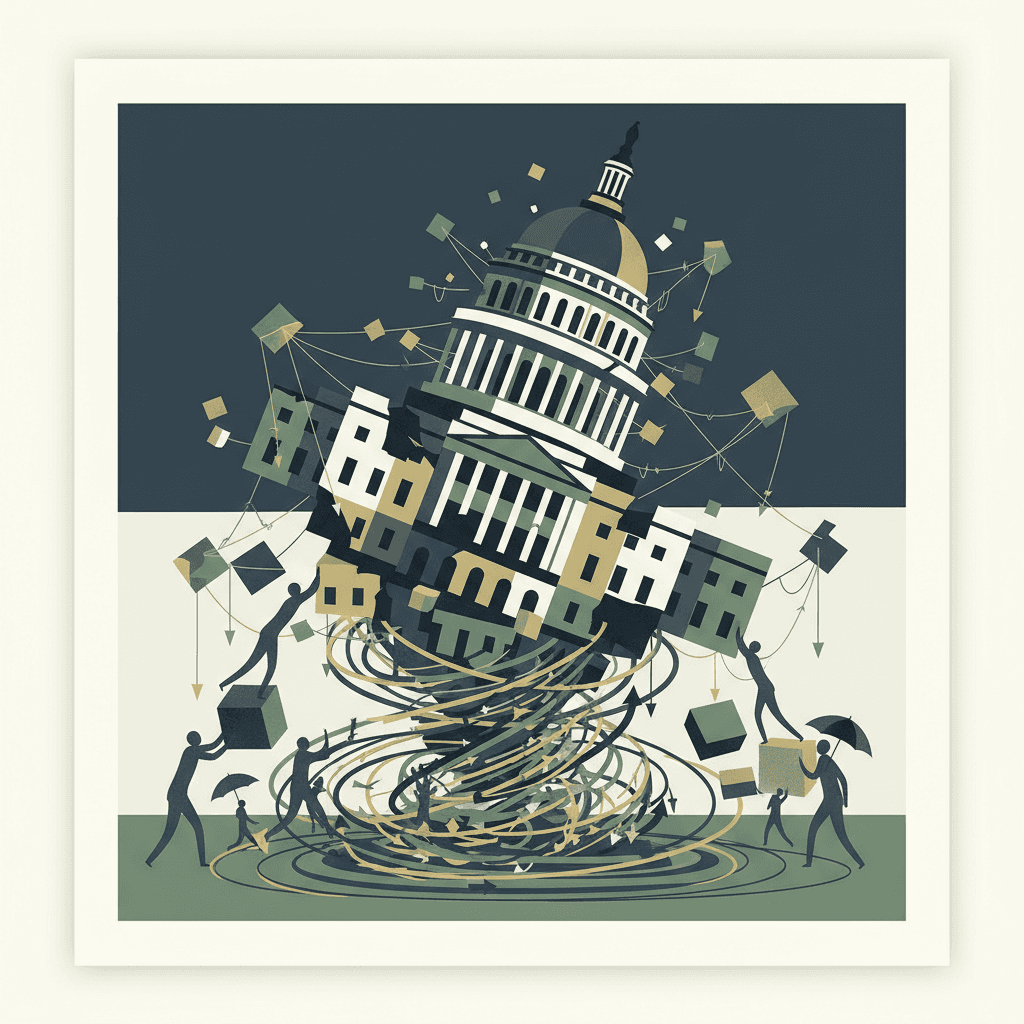
This creates what the investor Ray Dalio would call a "broken political machine" - a self-reinforcing cycle that looks something like this:
- Polarization prevents Congress from passing basic funding bills
- The shutdown drags on, damaging the economy (the Congressional Budget Office estimates roughly 0.1% of GDP lost per week)
- Economic damage makes both sides more desperate and less willing to compromise
- The lack of compromise extends the shutdown further
- Executive branch takes unilateral action to fill the governance gap
- Unilateral action enrages the opposing party, deepening polarization
- Return to step 1
And looking ahead, the cycle is only likely to accelerate. Prediction markets give Democrats an 83.5% chance of taking control of the House in the 2026 midterm elections, with Republicans holding just a 15.5% chance. That means the second half of the current presidential term would face full-blown legislative gridlock, making any pro-growth legislation, tax reform, or fiscal consolidation essentially impossible through at least January 2029.
What This Means for Markets
When a country's political system can't perform its most basic function, which is funding its own operations, the ripple effects spread across every asset class. The overall outlook is bearish for U.S. sovereign credibility, bearish for sectors that depend on government contracts, and bullish for assets that people buy when they're worried about institutional stability.
Remember, rating agencies have acted on far less. Fitch downgraded U.S. sovereign debt in 2023 during a debt ceiling standoff that was shorter than what markets now expect. Standard & Poor's did the same in 2011. A 60-plus day shutdown with no resolution in sight would give rating agencies an even stronger case for further downgrades.
Gold: The Headline Trade
GLD, the largest gold ETF, is rated a strong buy with 88% confidence in this analysis. Gold is the textbook asset people buy when they lose confidence in government institutions. It benefits from rising Treasury risk premiums (the extra return investors demand for lending to the U.S. government), from dollar weakness driven by fiscal dysfunction, and from a general flight away from assets whose value depends on a functioning government.
The self-reinforcing cycle described above is particularly gold-friendly. Every additional week the shutdown continues erodes institutional credibility a little more, which pushes gold a little higher, which signals to markets that something is genuinely wrong, which makes political resolution harder.
IAU, the iShares gold trust, earns a buy signal with 70% confidence as a slightly more cost-efficient version of GLD. Its expense ratio of 0.25% versus GLD's 0.40% makes it a better vehicle if you're holding for the duration of a multi-month shutdown.
The Shovels, Not Just the Gold
During the California Gold Rush, some of the most reliable profits went to the people selling pickaxes and shovels rather than the prospectors themselves. The same logic applies here.
B, the ticker for Barrick Mining (formerly Barrick Gold), is a buy at 82% confidence. Barrick is one of the world's largest gold miners, and mining companies have what analysts call "operating leverage" to gold prices. Because their costs are relatively fixed (you still need the same number of workers and machines regardless of the gold price), a 10% increase in the gold price can translate to a 25-30% increase in earnings. They're the pickaxe sellers in this scenario.
WPM, Wheaton Precious Metals, takes the shovel-seller concept even further. Wheaton doesn't actually mine anything. Instead, it provides financing to mining companies in exchange for the right to buy their gold and silver production at a fixed, low price. This is literally the Levi Strauss business model applied to precious metals: they profit from all mining activity without bearing the operational risk of actually running a mine. Buy signal, 80% confidence.
GDX, the VanEck Gold Miners ETF, offers a diversified basket of gold mining companies including Newmont, Barrick, and Agnico Eagle. It earns a buy signal at 68% confidence. The diversification eliminates single-company risk while still providing that 2-3x operating leverage to gold prices.
Treasuries: A More Complicated Story
TLT, which tracks long-duration U.S. Treasury bonds, receives a sell signal, but with an important caveat. When bond investors (sometimes called "bond vigilantes") lose confidence in a government's fiscal management, they demand higher interest rates to compensate for the risk. Higher rates mean lower bond prices, which is bad for TLT holders.
But there's a paradox. During moments of genuine crisis, investors often pile into Treasuries as the ultimate safe haven, even when the U.S. government itself is the source of the trouble. It's like how the dollar tends to strengthen during global panics even when America is at the center of the storm. The sell signal on TLT carries 78% confidence at the primary level and 60% confidence at the infrastructure level, reflecting this genuine uncertainty about which force wins.
GOVT, a broader Treasury ETF that holds bonds across multiple maturities, receives a weak sell signal at 55% confidence for similar reasons.
On the opposite end of the duration spectrum, SGOV, which holds ultra-short Treasury bills, gets a buy signal at 75% confidence. Short-term T-bills are insulated from the duration risk that threatens TLT. They currently yield around 5.2%, meaning you get paid to wait in the safest corner of the bond market while the dysfunction thesis plays out. Think of it as the defensive parking spot for cash.
The Dollar and Currency Plays
UDN, which rises when the dollar falls against a basket of major currencies, earns a buy signal at 72% confidence. A prolonged shutdown creates GDP drag, and aggressive unilateral executive actions signal institutional instability that erodes the premium investors pay for the world's reserve currency.
UUP, the bullish dollar fund, correspondingly gets a weak sell at 58% confidence. Dollar weakness is essentially the transmission mechanism through which all the other safe-haven trades work. If the dollar weakens, gold rises, emerging market assets benefit, and U.S. credibility metrics deteriorate in observable, tradeable ways.
FXF, which tracks the Swiss franc, is a weak buy at 65% confidence. When confidence in U.S. institutions erodes, capital tends to flow toward countries with a reputation for stability, and Switzerland sits near the top of that list. The limiting factor is that the Swiss National Bank actively intervenes against franc strength, which caps the upside.
Silver: Gold's Volatile Cousin
SIVR, the silver ETF, gets a weak buy at 64% confidence. Silver benefits from the same sovereign credibility erosion thesis as gold, and historically it outperforms gold on a percentage basis during fear-driven rallies. But roughly 80% of silver demand comes from industrial uses like solar panels and electronics, meaning a recession caused by the shutdown could actually hurt silver even while gold thrives. That tug-of-war between safe-haven demand and industrial weakness keeps the conviction moderate.
The Contrarian Angle: Government Contractors
BAH, Booz Allen Hamilton, is the largest government IT consulting firm in the country and sits directly in the crosshairs of a prolonged shutdown. Delayed contract awards, furloughed government counterparts, and billing interruptions all hit near-term revenue. The weak sell signal at 68% confidence reflects this short-term pain. But there's an interesting twist: after shutdowns end, there's always a massive backlog of deferred work, and consultants are the ones who help clear it. An 83.5% chance of a Democratic House in 2026 also means more oversight hearings, investigations, and compliance work, all of which flow through consulting firms. This is a short-term sell, not a structural one.
Two instruments were evaluated and deliberately set aside. CBON, a Chinese bond ETF, was considered as a diversification play away from U.S. sovereign risk but rated neutral at only 45% confidence because China has its own massive fiscal and property sector problems. And FIHD, a financial sector volatility instrument, was flagged at 40% confidence as not being a clean enough expression of the thesis to warrant capital.
The Risks You Need to Take Seriously
Every trade has a mirror image, and intellectual honesty demands laying out what could go wrong.
The biggest risk across all of these positions is a surprise bipartisan deal. If Congress suddenly reaches an agreement to fund the government, gold could pull back sharply, TLT could rally, and the dollar could strengthen, all in a matter of hours. Prediction markets assign high probabilities to an extended shutdown, but these markets have relatively thin liquidity and can drift.
Gold is already trading near all-time highs. A significant portion of the dysfunction premium may already be baked into the price. If you're buying gold here, you're betting that the situation gets even worse than what's already expected.
The dollar paradox is real and well-documented. In 2008 and 2020, the dollar strengthened during global crises even when America was at the epicenter. The greenback is sometimes described as "the least dirty shirt in the laundry," and that dynamic could reassert itself here, especially since Europe and China have their own significant problems.
The Fed could intervene in multiple ways. If the shutdown causes enough economic damage, the Fed might cut rates, which would support TLT and undermine the short-Treasury thesis. Conversely, if the shutdown is inflationary (through supply chain disruptions or delayed regulatory actions), the Fed might raise rates, which would create headwinds for gold.
For the mining stocks specifically, operational risks exist independently of the gold price. Strikes, permitting delays, cost inflation, and the historically poor capital allocation decisions of mining management teams can all cause miners to underperform the gold price itself. Currency exposure adds another layer, since many miners operate in Australia, Canada, and South Africa, where unfavorable exchange rates can eat into margins.
Finally, shorting Treasuries has been called a "widow-maker" trade for good reason. Timing is extremely difficult, and the flight-to-safety dynamic can cause Treasuries to rally precisely when the fundamental thesis says they should fall.
Why This Matters for Everyday Life
If you have a 401(k), a savings account, or just a weekly grocery bill, the implications of a broken political machine extend well beyond Wall Street.
A prolonged shutdown directly delays tax refunds, Social Security processing, and federal contract payments that flow into local economies. If the shutdown extends past 60 days and triggers a credit rating downgrade, the government's borrowing costs go up, which eventually means either higher taxes or reduced services for everyone. Federal workers who aren't being paid stop spending at local restaurants and shops, creating a multiplier effect that spreads through communities far from Washington.
The 83.5% probability of a divided government starting in 2027 means this isn't a temporary blip. The conditions that produce shutdowns and gridlock are likely to persist for years, which makes longer-term portfolio positioning, emphasizing real assets like gold and reducing dependence on government-credibility-dependent instruments, a legitimate consideration rather than just a short-term trade.
The gold rush analogy is worth returning to one final time. When the political landscape becomes unpredictable, the smartest money doesn't try to guess who wins each individual fight. It positions itself in the infrastructure that benefits regardless of which specific crisis materializes next, whether that's the shutdown extending to 90 days (currently a 26.5% probability), the Insurrection Act being invoked, or a credit rating downgrade. Gold miners, streaming companies, and short-duration cash instruments are the shovels in this particular gold rush. They don't need any single prediction to be right. They just need the overall environment of dysfunction to persist.
And at 99.5% on the 35-day threshold, the market is telling you that dysfunction isn't going anywhere soon.
Analysis based on prediction market data as of March 19, 2026. This is not investment advice.
How This Story Evolved
First detected Mar 19 · Updated daily
The new version cuts the opening household analogy and jumps straight into the prediction market statistics. The headline and intro also use more direct, urgent language to grab readers faster.
Read latest →