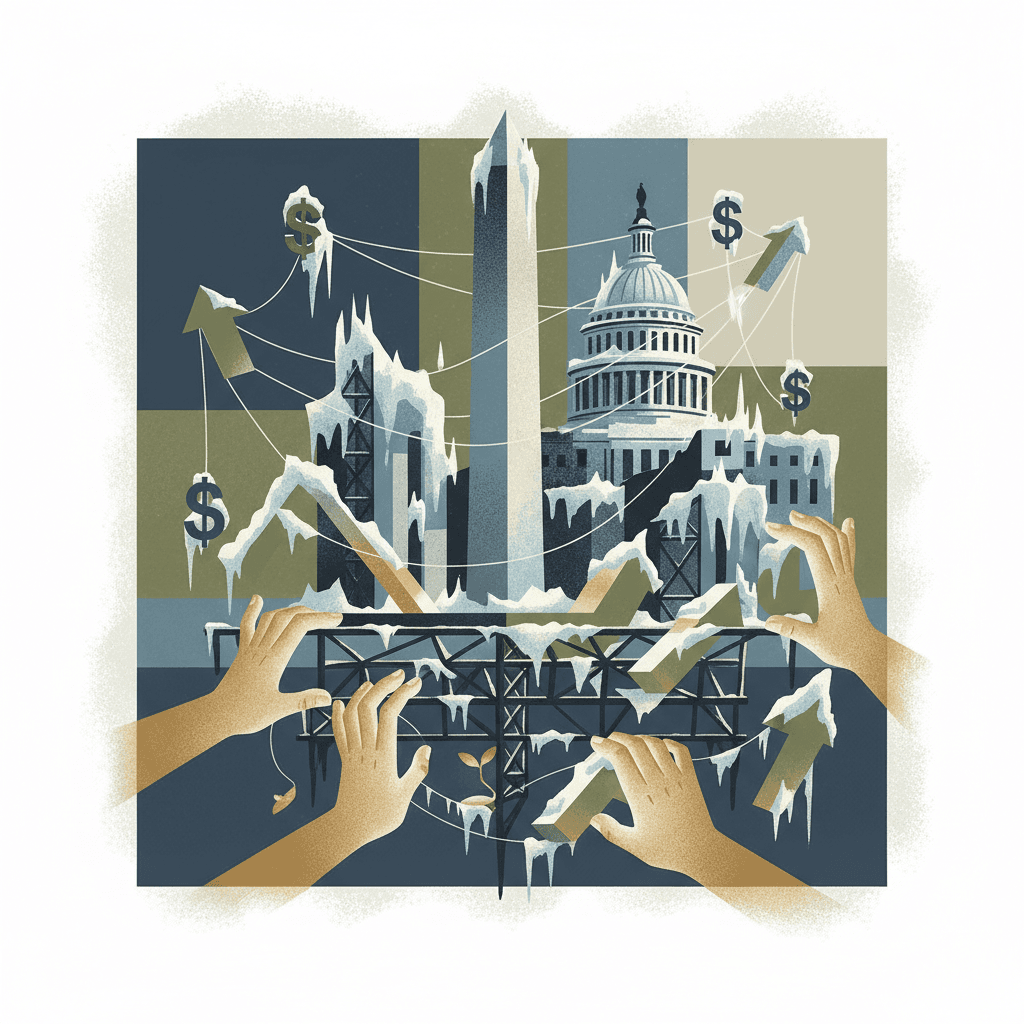
Washington Is About to Freeze Up. These Trades Profit From the Paralysis.
Prediction markets are telling us something important about the next two years of American politics: almost nothing is going to get done in Congress. And that gridlock itself creates a very specific, very tradeable pattern.
Let's walk through what the numbers are saying and why the companies that sell shovels during a political gold rush look like the smartest bets on the board.
The Gridlock Math
Betting markets currently give Democrats an 85% chance of controlling the House after the 2026 midterms, while Republicans hold a roughly 50/50 shot at keeping the Senate. The most likely outcomes for the balance of power heading into February 2027 are a Democratic House paired with a Republican Senate (the classic divided government setup) at 36.6%, or Democrats controlling both chambers at 46.4%. Either way, the Trump White House faces a hostile House.
But the paralysis isn't just a future problem. It's already visible in the current Congress. The DHS funding bill, a must-pass piece of legislation, has only a 65% chance of passing by May and a 76% chance by June. That's slow even by Washington standards for a bill most people agree needs to happen. More ambitious legislation? Forget it. The SAVE Act, which would require proof of citizenship to vote, sits at just 10.7%. A credit card interest rate cap has an 11% chance of becoming law. An election reform bill clocks in at 22%.
When you add it all up, prediction markets are pricing in near-total legislative paralysis for the remainder of the Trump presidency.
Why This Creates a Paradox Markets Hate
When Congress can't pass laws, the president's only remaining tools are executive orders, tariff policy, regulatory enforcement, and foreign policy. Think of it like a driver who loses their steering wheel but still has a gas pedal. They can go forward, but they can't turn. Every policy impulse gets channeled through the narrow set of things a president can do alone.
This creates a strange paradox: policy uncertainty goes UP even as the probability of actual policy change goes DOWN. Markets know something could happen at any moment via executive action, but they also know nothing permanent can get through Congress. That combination, lots of noise with little resolution, is the kind of environment that typically increases volatility.
And higher volatility is itself a tradeable thesis.
The Self-Reinforcing Gridlock Cycle
This pattern feeds on itself in a way worth understanding:
- Divided government makes legislation nearly impossible
- The White House compensates by leaning harder on executive actions, especially tariffs and geopolitical posturing
- Executive actions create sudden market-moving headlines but no stable policy framework
- Businesses and investors increase hedging activity to manage the unpredictability
- More hedging means more trading volume on exchanges and more demand for risk analytics
- Meanwhile, the lack of legislative resolution keeps everyone in a permanent state of uncertainty, which sends us back to step 2
This loop is the core insight. Every company positioned to profit from hedging activity and trading volume benefits regardless of whether the market goes up or down.
The Shovels, Not the Gold
During the California Gold Rush, the people who got reliably rich weren't the miners. They were the ones selling pickaxes, shovels, and denim jeans. The same logic applies to political uncertainty. You don't need to guess which executive order comes next. You just need to own the infrastructure that everyone uses to react to it.
CBOE is the strongest infrastructure play here, rated at 82% confidence as a strong buy. CBOE Global Markets operates the exchanges where VIX futures and options trade. The VIX, often called the "fear gauge," measures expected market volatility. CBOE essentially has a monopoly on VIX products. They don't care whether volatility goes up or down. They make money on the volume of hedging activity. When policy uncertainty rises and actual policy change stalls, the demand for volatility protection increases, and CBOE collects the toll.
CME Group gets a buy signal at 78% confidence. CME runs the world's largest futures exchange, covering everything from corn to crude oil to interest rates. When tariffs are the president's primary policy lever, every tariff announcement ripples through commodity markets. Farmers hedge their grain exposure. Energy companies hedge their fuel costs. Banks hedge their interest rate risk. All of that activity flows through CME's exchanges. They hold near-monopoly positions in many futures categories, and an estimated 35-45% of their volume is directly driven by the kind of commodity and rate volatility that executive-action-heavy governance creates.
ICE, or Intercontinental Exchange, earns a buy at 74% confidence. ICE benefits from the same volatility-driven trading thesis as CME, plus it owns the New York Stock Exchange and a mortgage technology platform called Ellie Mae. The credit card rate cap having only an 11% chance of passing means ICE's mortgage technology segment operates in a stable, predictable regulatory environment. That gives ICE a dual exposure: volatility profits on one side, regulatory stability on the other.
VRSK, Verisk Analytics, is a buy at 70% confidence. Verisk provides data analytics for insurance companies, energy firms, and financial institutions. When policy shifts come through executive action rather than clear legislation, companies need more sophisticated risk modeling to navigate the ambiguity. Verisk's dominant position in insurance analytics and its unique proprietary datasets make it a beneficiary, though the connection is more indirect than the exchange plays.
TROW, T. Rowe Price, gets a weak buy at 60% confidence. The thesis is that active fund management, where humans pick stocks rather than just tracking an index, becomes more valuable when policy uncertainty creates big performance gaps between winners and losers in the market. That said, the decades-long shift toward passive index funds is a powerful headwind, making this the weakest infrastructure play in the set.
Beyond Infrastructure: Direct Plays
ITA, the iShares U.S. Aerospace & Defense ETF, earns a buy at 75% confidence. The logic is straightforward: when a president can only act through executive power, foreign policy and defense become primary tools. Defense spending already has bipartisan support, meaning it's one of the few budget areas that can survive divided government. Geopolitical tensions, particularly around Iran, amplify this dynamic.
BKLN, the Invesco Senior Loan ETF which holds floating-rate bank loans, is a buy at 72% confidence. Legislative paralysis means no credit card rate caps (remember, 89% chance of failure), no major financial regulation overhauls, and limited political cover for the Federal Reserve to cut rates aggressively. Floating-rate loans perform well when interest rates stay elevated and the regulatory environment stays stable.
AMGN, Amgen, gets a weak buy at 63% confidence. Large-cap pharmaceutical companies benefit from legislative gridlock in a specific way: no new drug pricing legislation passes, which protects profit margins. Executive orders targeting drug prices have historically been narrow in scope and frequently challenged in court. Amgen's diversified pipeline and existing revenue base are essentially protected by Congress's inability to act.
XLV, the Health Care Select Sector SPDR, is the one weak sell in the group at 62% confidence. Healthcare broadly suffers in a gridlock environment because the sector gets trapped in limbo. No reforms pass, but the constant threat of executive action on drug pricing and CMS rulemaking (the rules governing Medicare and Medicaid payments) creates uncertainty that depresses valuations. It's not a disaster, just a slow drag. The sell signal is weak because gridlock also means no repeal of existing frameworks like the Affordable Care Act, which large insurers have already adapted to.
The Risks You Need to Know
Every thesis has holes, and intellectual honesty about them is what separates analysis from cheerleading.
The biggest risk to the volatility infrastructure trade is that markets simply go sideways. If political uncertainty becomes background noise that investors learn to ignore, trading volumes could actually decline, and CBOE, CME, and ICE would underperform. Sustained gridlock might eventually reduce uncertainty as markets simply price in stasis as the new normal.
For the defense play, the DHS funding bill already sits at 93% for eventual passage, which suggests Congress isn't completely dead. If some legislative function remains, the pure paralysis thesis weakens. Defense stocks also already carry elevated valuations reflecting geopolitical risk, and continuing resolutions (temporary funding measures that just keep spending at last year's levels) could actually freeze defense budgets rather than grow them.
The Fed could cut rates aggressively regardless of the political environment, which would undermine the BKLN thesis. A recession would overwhelm nearly every signal here, because when the economy contracts, trading volumes can decline, loan defaults rise, and defensive positioning matters more than political analysis. Executive action could also disrupt financial markets in ways that hurt the very exchanges profiting from volatility.
For the pharmaceutical and healthcare plays, the Inflation Reduction Act's drug pricing provisions are already law. Legislative paralysis means those existing price controls won't be repealed either, cutting both ways for companies like Amgen.
Finally, the entire thesis rests on prediction market probabilities that could shift. If Republicans hold the House or Democrats sweep the Senate by larger margins than expected, the gridlock assumption falls apart.
Why This Matters for Your Money
If you have a 401(k), you're exposed to these dynamics whether you realize it or not. Legislative gridlock means the tax code probably isn't changing. Your current brackets, deductions, and retirement contribution limits are likely staying put through at least 2028. That's actually useful for financial planning, even if it's frustrating for anyone hoping for reform.
More broadly, a government that can only act through executive orders creates an environment where headlines move markets more than fundamentals do. That's the kind of environment where owning the financial infrastructure, the exchanges, the analytics providers, the hedging products, provides a natural buffer. These companies make money on the chaos itself, which is about as close to a political hedge as your portfolio can get.
Analysis based on prediction market data as of April 2, 2026. This is not investment advice.
How This Story Evolved
First detected Mar 20 · Updated daily
The story's focus shifted from broad portfolio defense to specific trades that could gain from a gridlocked Washington, swapping out a wide range of holdings — including gold, utilities, and defense contractors — for a smaller, more targeted set of picks in areas like floating-rate loans and data analytics. The new trade ideas suggest analysts are getting more precise about where they see opportunity, while dropping earlier bets on volatility and infrastructure.
The headline was simplified to be more straightforward about investing advice. The opening paragraphs were rewritten to sound more direct and urgent, and a section header was renamed from "The Gridlock Math" to "The Case for Total Legislative Paralysis."
Read this version →