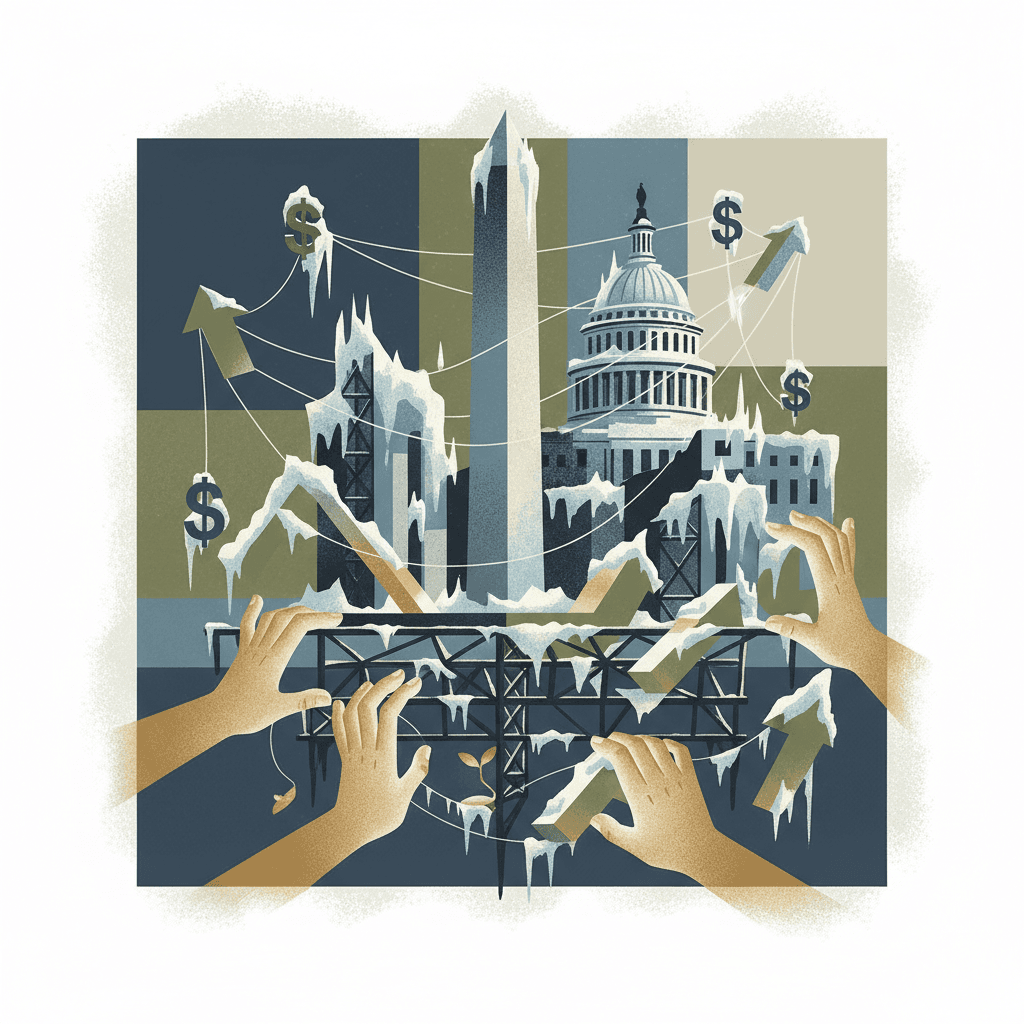
Washington Is About to Freeze Up. Here's How to Invest in the Gridlock.
Prediction markets are telling us something loud and clear: the federal government is heading into a deep freeze, and almost nothing will get done in Congress for the rest of this presidential term. That's not a political opinion. It's what thousands of real-money bets are pointing to right now, and the investing implications are surprisingly specific.
The Case for Total Legislative Paralysis
Let's start with the raw numbers from betting markets. Democrats have an 85% chance of controlling the House after the 2026 midterms. Republicans sit at roughly 50-51% to hold the Senate. Put those together and the most likely outcomes are a split government, with Democrats running the House and Republicans running the Senate (priced at 36.6%), or Democrats controlling both chambers against a Republican president (46.4%). Either way, the legislative machinery grinds to a halt.
But the gridlock signal doesn't stop at the balance of power. Look at what markets think will actually pass Congress. The SAVE Act, a voter ID measure? Only a 10.7% chance of becoming law. Credit card interest rate caps? 11%. A major election reform bill? Just 22%. Even basic government funding is moving at a crawl. DHS funding had only a 65% chance of passing by May and 76% by June, though more recent pricing has pushed that to 93% as the deadline approaches.
When you stack all these probabilities together, a picture emerges: markets are pricing in near-total legislative paralysis for the remainder of the Trump term.
Why This Creates a Strange Paradox
When Congress can't pass laws, the president doesn't just sit around. Executive action becomes the only game in town. Tariffs, regulatory enforcement, foreign policy moves, executive orders on everything from drug pricing to immigration. This creates a weird paradox that experienced investors should pay close attention to: higher policy uncertainty combined with lower policy change probability.
Think of it like a car stuck in traffic on the highway. The driver keeps honking, swerving between lanes, and hitting the brakes unpredictably, but the car barely moves forward. There's a lot of noise and jerky motion without much actual progress. That combination of erratic executive action and frozen legislation typically increases market volatility, because investors can't predict what the president will do next but can be fairly certain Congress won't clean up the mess or provide clarity.
This creates a self-reinforcing cycle:
- Divided government blocks legislation on every major issue
- The president leans harder into executive tools: tariffs, executive orders, foreign policy posturing
- Executive actions are legally challenged in courts, creating more uncertainty
- Markets demand more hedging as policy swings become less predictable
- Volatility rises, which drives even more hedging and trading activity
- The cycle continues until something breaks the gridlock, which betting markets say probably won't happen before 2029
The Shovels, Not the Gold
During the California Gold Rush, the people who most reliably made money weren't the miners. They were the ones selling shovels, pickaxes, and denim pants. The same principle applies here. Instead of trying to guess which sectors win or lose from each unpredictable executive order, you can invest in the companies that profit from the uncertainty itself.
The Top Shovel-Seller: CBOE (Strong Buy, 82% confidence)
CBOE Global Markets literally owns the VIX, the market's most famous fear gauge. They sell volatility products, VIX futures, and options. They don't care whether the market goes up or down. They make money when people hedge, and people hedge more when policy is unpredictable. In a legislative paralysis environment where every tariff announcement or executive order sends tremors through the market, CBOE is selling insurance to everyone who's nervous. With a near-monopoly on VIX products and a dominant position in options trading, this is the purest infrastructure play on political uncertainty. Infrastructure relevance score: 85 out of 100.
CME (Buy, 78% confidence)
CME Group runs the futures markets for agriculture, metals, energy, and interest rates. Every single one of those categories gets rattled by tariff announcements and executive policy swings. When a president can only govern through tariffs and executive orders, every tweet or press conference drives commodity futures volume. CME takes a cut of every trade. They hold near-monopoly positions in many futures categories, and roughly 35-45% of their volume is directly driven by the kind of commodity and rate volatility that executive-action-only governance creates. Infrastructure relevance score: 75 out of 100.
ICE (Buy, 74% confidence)
Intercontinental Exchange owns the New York Stock Exchange and has a strong position in energy derivatives. They also own Ellie Mae, a mortgage technology platform. The gridlock thesis benefits ICE in two ways. Their exchange business profits from elevated trading volumes driven by policy uncertainty, and their mortgage tech segment benefits from a stable regulatory environment. With credit card rate caps at only 11% probability of passing, the financial regulatory framework stays predictable for ICE's mortgage business. Infrastructure relevance score: 68 out of 100.
VRSK (Buy, 70% confidence)
Verisk Analytics provides risk modeling and data analytics for insurance companies, energy firms, and financial services. When policy changes come through unpredictable executive actions rather than clear legislation, companies need better analytics to understand their risk exposure. Verisk is dominant in insurance analytics with unique datasets that are hard to replicate. The benefit is more indirect than the exchange plays, but the demand for sophisticated risk modeling goes up when the regulatory environment gets murky. Infrastructure relevance score: 62 out of 100.
Beyond the Shovels: Sector Plays
ITA (Buy, 75% confidence)
The iShares U.S. Aerospace & Defense ETF benefits from a specific dynamic of gridlock. When a president's only real tools are executive action and foreign policy, expect more geopolitical posturing. Defense spending already sits at elevated levels and enjoys bipartisan support, meaning it's one of the few spending categories that actually gets through even a divided Congress. A commander-in-chief with no domestic legislative wins will lean into the world stage, and that's bullish for defense contractors.
BKLN (Buy, 72% confidence)
The Invesco Senior Loan ETF holds floating-rate bank loans, which are loans where the interest rate adjusts with the market rather than staying fixed. Legislative paralysis means no credit card rate caps (remember, 89% chance that legislation fails), no major financial regulation overhauls, and limited political cover for the Fed to cut rates aggressively. The existing lending framework stays intact, which benefits current loan structures.
AMGN (Weak Buy, 63% confidence)
Amgen and large-cap pharma generally benefit from a frozen Congress because no new drug pricing legislation can pass. Executive orders targeting drug prices have historically been limited in scope and frequently challenged in courts. Amgen's existing revenue base and pricing power are protected by the status quo. The caveat is that the Inflation Reduction Act's drug pricing provisions are already law, and gridlock means those won't be repealed either.
XLV (Weak Sell, 62% confidence)
The Health Care Select Sector SPDR gets a cautious negative signal. Healthcare needs legislative clarity to thrive, and instead it gets limbo. No ACA repeal (which protects insurers who've adapted), but also no reform, no expansion, no resolution. Meanwhile, the executive branch can still create uncertainty through CMS rulemaking and regulatory enforcement. Healthcare ends up in a no-man's-land that tends to depress the valuations investors are willing to pay.
TROW (Weak Buy, 60% confidence)
T. Rowe Price and active asset managers broadly could benefit if policy uncertainty creates bigger differences between winning and losing stocks. When executive actions randomly help one industry and hurt another, stock-picking matters more than just buying an index fund. That said, the secular shift toward passive investing is a powerful headwind, and this is the weakest conviction play in the pattern. Infrastructure relevance score: 50 out of 100.
Why This Matters for Your Money
If you have a 401(k), a savings account, or you just buy groceries, legislative gridlock affects you. It means interest rates are more likely to stay where they are because the Fed loses political cover for dramatic moves. It means tariffs, the ones making imported goods more expensive, aren't going away through negotiated legislation. They're the president's favorite tool and Congress can't take them away. It means your healthcare costs stay on their current trajectory, neither improving through reform nor worsening through repeal. And it means your portfolio should probably have some exposure to companies that profit from uncertainty itself, not just companies that bet on one political outcome.
The core insight is simple: when Washington freezes, volatility heats up. And the companies that sell hedging tools, run the exchanges where panicked trading happens, and provide the data that nervous corporations need to make decisions, those companies get paid regardless of which direction the political winds blow.
The Risks You Need to Know
No thesis is bulletproof, and this one has several genuine vulnerabilities.
For the exchange plays (CBOE, CME, ICE): if markets simply go sideways with low volatility despite the political noise, trading volumes drop and these stocks underperform. Sustained gridlock might eventually become boring. Markets could just price in permanent stasis and stop reacting. Competition from other exchanges and potential regulatory risk to derivatives markets through executive action also weigh on the thesis.
For BKLN: the Fed could cut rates aggressively regardless of the legislative environment, and credit deterioration in a slowing economy could hurt loan performance. A recession would overwhelm the gridlock thesis entirely.
For ITA: defense stocks are already richly valued with geopolitical premiums baked in. The DHS funding bill is already at 93% probability of passing, which suggests Congress isn't completely broken. Continuing resolutions, the legislative equivalent of kicking the can, could actually freeze defense spending instead of growing it. Sequestration risk also lurks if budget standoffs escalate.
For XLV: healthcare is a highly diversified sector where pharma, device makers, and insurers react differently to policy. The status quo might actually help large insurers. And as a classic defensive sector, healthcare could outperform if the broader market sells off on policy uncertainty, which would make a short position painful.
For AMGN: executive orders could still target drug pricing through CMS negotiations, and pipeline risk exists independent of politics.
The biggest macro risk across all positions: a genuine recession would overwhelm everything. If the economy contracts sharply, trading volumes might actually fall as participants pull back, loans deteriorate, and defensive positioning shifts in unpredictable ways. Legislative paralysis is a volatility thesis, and it works best in an environment where the economy is muddling through, not collapsing.
Tariff policy could also stabilize or moderate. If the administration strikes deals that reduce trade uncertainty, one of the primary drivers of commodity hedging demand goes away, and the exchange plays lose their tailwind.
Finally, prediction market probabilities can shift. If Republicans hold both chambers, or if a bipartisan coalition forms around specific issues, the entire gridlock thesis weakens. The 85% probability on a Democratic House is high but not certain, and the Senate race is essentially a coin flip.
Analysis based on prediction market data as of April 2, 2026. This is not investment advice.
How This Story Evolved
First detected Mar 20 · Updated daily
The story's focus shifted from broad portfolio defense to specific trades that could gain from a gridlocked Washington, swapping out a wide range of holdings — including gold, utilities, and defense contractors — for a smaller, more targeted set of picks in areas like floating-rate loans and data analytics. The new trade ideas suggest analysts are getting more precise about where they see opportunity, while dropping earlier bets on volatility and infrastructure.
Read latest →The headline was simplified to be more straightforward about investing advice. The opening paragraphs were rewritten to sound more direct and urgent, and a section header was renamed from "The Gridlock Math" to "The Case for Total Legislative Paralysis."