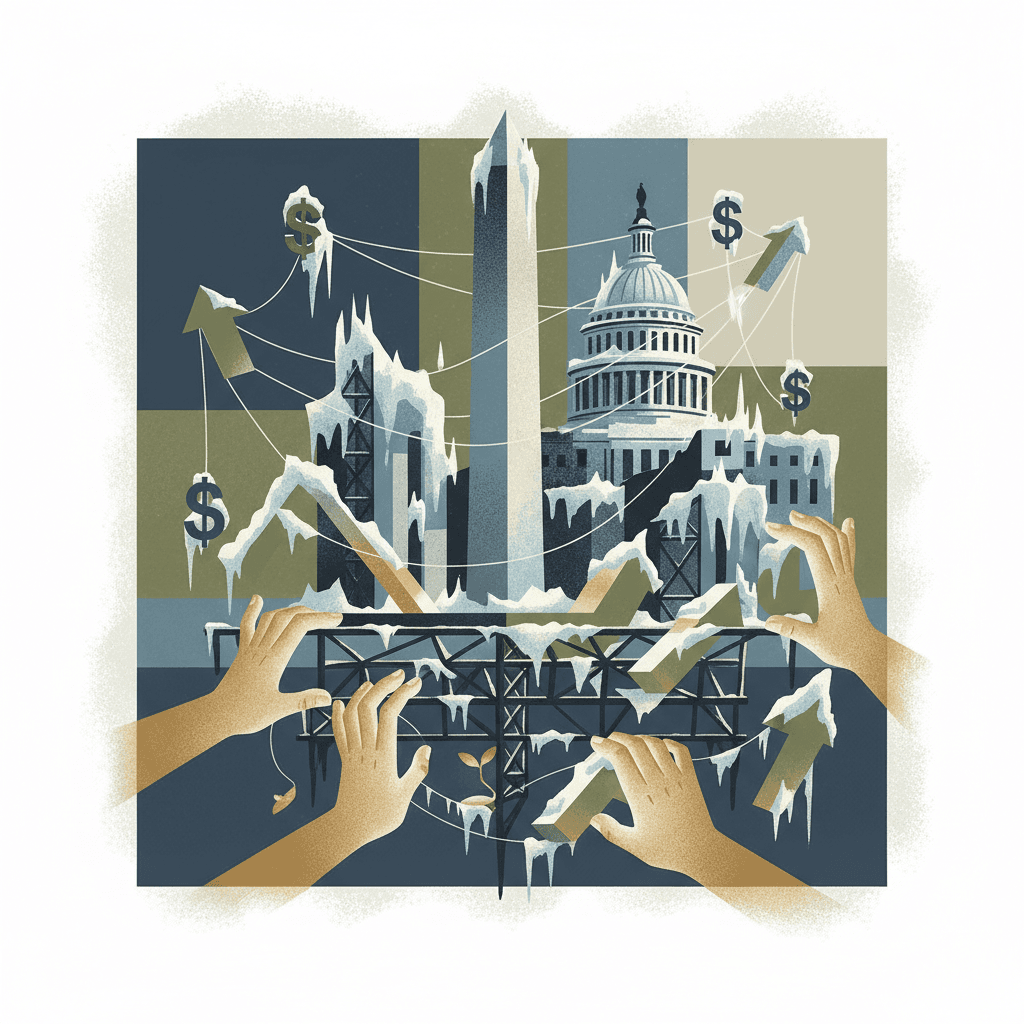
Prediction Markets Are Pricing In Total Legislative Paralysis. Here's What That Means for Your Portfolio.
Imagine a car with a broken steering wheel but a fully functional gas pedal. The driver can speed up, slow down, and honk the horn, but they can't actually turn. That's essentially what prediction markets are telling us about the U.S. government through the end of the Trump term: Congress is locked up, and the only person who can do anything is the president, armed with executive orders and tariffs.
The numbers paint a remarkably clear picture. Betting markets give Democrats an 84.3% chance of winning the House in 2026, while Republicans hold a 51.2% chance of keeping the Senate. The most likely outcomes for the balance of power after the midterms are a Democratic House with a Republican Senate (the "DR" combo) at 36.6%, or Democrats controlling both chambers at 46.4%. Either way, you get divided government or a configuration where the president faces a hostile legislature.
But the paralysis isn't waiting for 2027. It's already here. Prediction markets put the odds of passing DHS funding, which is one of the most basic functions of Congress, at just 65% by May and 76% by June. The SAVE Act, which would require proof of citizenship for voter registration, sits at a measly 10.7% chance of passage. A credit card interest rate cap? 11%. A major election reform bill? 22%. Across the board, the probability of any meaningful legislation becoming law is hovering near zero.
This creates a fascinating paradox for investors: the chance of major policy change is very low, but policy uncertainty is very high. That's because when Congress can't act, the president has to rely on executive orders, tariff announcements, regulatory enforcement, and foreign policy maneuvering. These tools are powerful but unpredictable, and they can be challenged in court, reversed by future administrations, or escalated on a whim. The result is an environment where nothing big changes legislatively, but the news cycle creates constant volatility.
Think of it like living in a house where the thermostat is broken but someone keeps opening and closing windows. The temperature never gets properly adjusted, but it swings around a lot.
The Self-Reinforcing Gridlock Cycle
This pattern feeds on itself in a way that's worth understanding step by step:
- Divided government makes legislative action nearly impossible.
- The executive branch compensates by leaning harder on tariffs, executive orders, and foreign policy.
- Executive overreach invites judicial challenges, creating even more uncertainty about which policies will actually stick.
- Markets can't price in stable outcomes because the policy mix keeps shifting without Congressional anchoring.
- Higher volatility drives more defensive positioning, which reduces risk appetite for the very investments (infrastructure, housing, healthcare) that would need legislative support to thrive.
- The cycle repeats, with each tariff announcement or executive order adding another layer of uncertainty.
What to Buy, What to Sell, and What to Watch
Broad Market: Hold Steady
SPLG, the S&P 500 ETF, gets a HOLD rating at 60% confidence. Large-cap stocks are already priced for the current policy framework. Gridlock means no big fiscal stimulus, but also no major legislative headwinds. The risk is that tariff escalation through executive action hammers corporate earnings, or that a recession develops from policy uncertainty without Congress being able to pass a fiscal rescue package.
Defensive Winners: Utilities and Defense
XLU, the utilities sector ETF, earns a BUY at 72% confidence. Utilities are the ultimate status-quo beneficiary. No new carbon regulations through Congress, no restructuring of utility rate frameworks, no energy policy overhaul. In a world where executive action creates volatility spikes in other sectors, defensive dividend-paying stocks attract capital like a harbor in a storm. The main risks are rising interest rates hurting valuations and executive orders on energy disrupting specific companies.
ITA, the defense and aerospace ETF, gets a BUY at 74% confidence. This is where the "executive action as the only policy lever" thesis really shines. When foreign policy and defense become the primary tools of presidential power, defense contractors benefit directly. Defense budgets largely run on autopilot through existing appropriations even when new funding stalls. The Iran situation and broader geopolitical tensions only amplify this. Risks include DHS funding delays signaling broader defense appropriation dysfunction, and valuations that are already elevated.
The Safe Haven: Gold
GLD gets a BUY at 72% confidence. Gold doesn't need any specific legislative outcome to work. It benefits from the paralysis itself. When the only active policy tools are tariffs and executive orders, macro uncertainty rises, currency debasement risk increases, and geopolitical risk premiums expand. All of those conditions favor gold. The counterargument is that a strong dollar driven by tariff-related capital inflows could suppress gold prices, or that a crisis event might break the gridlock and reduce gold's uncertainty premium.
International Diversification
IEFA, the international developed markets ETF, gets a WEAK BUY at 58% confidence. The logic is straightforward: if the U.S. government can't pass legislation, investors may rotate toward countries that can. Europe and Japan can actually pass budgets, infrastructure bills, and fiscal stimulus packages, creating what you might call "policy alpha" relative to American stagnation. The risk is that dollar strength from the tariff regime erodes returns when converted back to USD, and European political dysfunction could mirror what's happening in the U.S.
Selling the Shovels During the Uncertainty Rush
During the California Gold Rush, the people who got reliably rich weren't the miners. They were the people selling pickaxes, jeans, and supplies. The same logic applies here. If legislative paralysis plus executive-only policy creates a structurally higher-volatility environment, you want to own the companies that profit from volatility itself, regardless of which direction markets move.
CBOE, the company that literally owns the VIX (the market's main fear gauge) and operates major options exchanges, gets a STRONG BUY at 82% confidence, the highest conviction call in this entire pattern. Every time a tariff announcement whipsaws markets, every time an executive order gets challenged in court, every time geopolitical tensions spike, trading volume flows through Cboe's infrastructure. They don't care which way the market moves. They care that it moves.
CME Group, which owns the futures and derivatives exchanges for interest rates, commodities, and foreign exchange, earns a BUY at 78% confidence. Tariff announcements drive currency and commodity volatility. Geopolitical escalation drives energy futures volume. CME captures a fee on all of it.
ICE, the Intercontinental Exchange that operates energy exchanges, clearing houses, and the NYSE itself, gets a BUY at 75% confidence. Their energy exchange business benefits directly from an environment where Iran sanctions and tariff policy drive energy market swings. Their mortgage technology segment benefits from the regulatory status quo, since no housing policy changes can get through Congress.
BAH (Booz Allen Hamilton) earns a BUY at 76% confidence. When the executive branch becomes the sole policy engine, federal agencies need more consulting and technology support to implement executive orders and enforcement actions. These services flow through existing contract vehicles that don't require new legislation. SAIC operates on a similar thesis but with more competition and lower margins, earning a WEAK BUY at 68% confidence. Both face risk from government efficiency efforts that could cut contracts.
The Losers: Sectors That Need Congress to Act
PAVE, the infrastructure development ETF, gets a SELL at 70% confidence. This is the most direct victim of the gridlock thesis. Infrastructure bills, permitting reform, and federal funding reauthorization all require legislative action that markets are pricing at near-zero. The companies in PAVE, which include construction materials firms, engineering companies, and industrials, need bipartisan federal bills to generate revenue tailwinds. The important caveat: existing spending from the Infrastructure Investment and Jobs Act is already authorized and still being drawn down, and state-level infrastructure spending continues regardless of federal paralysis.
XHB, the homebuilders ETF, earns a WEAK SELL at 65% confidence. Homebuilders desperately need zoning reform, permitting reform, and labor policy changes to unlock housing supply. None of that is coming through Congress. Meanwhile, tariffs on lumber and building materials, which the president can impose unilaterally, raise input costs with no offsetting legislative relief. The risk to this bearish thesis is that Fed rate cuts could independently boost housing demand regardless of policy paralysis.
IHF, the healthcare providers ETF, gets a WEAK SELL at 62% confidence, though the thesis is genuinely mixed. Paralysis kills pro-industry legislative wins that healthcare companies had been hoping for, like drug pricing safe harbors and prior authorization reform. But it also means no negative healthcare legislation passes either, including no public option and no Medicaid cuts under divided government. The net effect is mildly bearish, but this one could reasonably be a hold.
The Volatility Play (With a Big Warning Label)
UVXY, the leveraged VIX ETF, gets a WEAK BUY at 55% confidence, but with a critical caveat that cannot be overstated: this instrument loses roughly 5-10% of its value per month due to futures roll decay when markets are calm. It is absolutely not a buy-and-hold investment under any circumstances. It only works as a short-term tactical position around specific catalysts, like a major tariff announcement or geopolitical escalation. Think of it as an expensive insurance policy that bleeds money every day you own it.
The U.S. dollar, tracked through UUP, gets a NEUTRAL rating at 50% confidence. Tariffs can push the dollar in either direction, and the forces genuinely cancel each other out. This one is worth watching but not trading on this thesis alone.
Finally, VICI Properties, a gaming real estate investment trust, gets a WEAK BUY at 62% confidence as a creative status-quo play. No new gambling legislation and no new tax structures means the current regulatory framework that supports their business stays intact. But the connection to the core gridlock thesis is indirect, and rising interest rates could hurt this REIT regardless of what Congress does or doesn't do.
Why This Matters for Your Everyday Finances
If you have a 401(k), this pattern affects you directly. Legislative paralysis means no new tax reform, so your current contribution limits and tax brackets stay put. It means no infrastructure spending boom that might create jobs and boost growth. It means tariff policy, which feeds into the prices you pay at the grocery store and on consumer goods, becomes even more important because it's the only economic lever being pulled.
The bigger picture is that we may be entering a period where the stock market gets choppier not because of any single dramatic event, but because of the constant drip of executive actions, court challenges, and geopolitical maneuvering that comes when a government can only govern through the president's pen. Your savings account benefits from any rate stability this brings, but your investment portfolio needs to be positioned for a world where the rules of the game keep shifting even though the game itself never fundamentally changes.
The Risks You Need to Know
Every thesis has holes, and intellectual honesty demands we lay them out:
- Gridlock may already be priced in. If markets have already absorbed the divided government expectation, the trades above may offer less edge than they appear to.
- A crisis event could break the paralysis. A recession, a major terrorist attack, or a financial crisis could create the bipartisan urgency needed to pass legislation, invalidating the entire thesis.
- Republicans could hold the House. There's roughly a 15% chance Republicans keep the House, which would unlock a legislative agenda and reverse several of these trade signals, particularly the bearish ones.
- The Fed operates independently of Congress. Rate cuts or hikes from the Federal Reserve can overwhelm any gridlock thesis for rate-sensitive sectors like utilities, housing, and REITs.
- Executive action on permitting reform doesn't need Congress. Some infrastructure and housing bottlenecks could be addressed without legislation, undermining the bearish calls on PAVE and XHB.
- Volatility can stay suppressed. Even in politically uncertain environments, markets sometimes just grind higher and ignore the noise, which would hurt the exchange and volatility infrastructure plays.
The overall pattern confidence sits at 85%, which is high but not certain. The core bet is that divided government produces policy paralysis, and that paralysis makes executive action the only game in town. If you believe the prediction markets are reading the political landscape correctly, the portfolio positioning follows logically: own the companies that profit from volatility and executive-driven policy, avoid the ones waiting for Congress to do something.
Analysis based on prediction market data as of April 1, 2026. This is not investment advice.
How This Story Evolved
First detected Mar 20 · Updated daily
The story's focus shifted from broad portfolio defense to specific trades that could gain from a gridlocked Washington, swapping out a wide range of holdings — including gold, utilities, and defense contractors — for a smaller, more targeted set of picks in areas like floating-rate loans and data analytics. The new trade ideas suggest analysts are getting more precise about where they see opportunity, while dropping earlier bets on volatility and infrastructure.
Read latest →The headline was simplified to be more straightforward about investing advice. The opening paragraphs were rewritten to sound more direct and urgent, and a section header was renamed from "The Gridlock Math" to "The Case for Total Legislative Paralysis."
Read this version →