The Fed Is Trapped: What a Stagflationary Freeze Means for Your Money
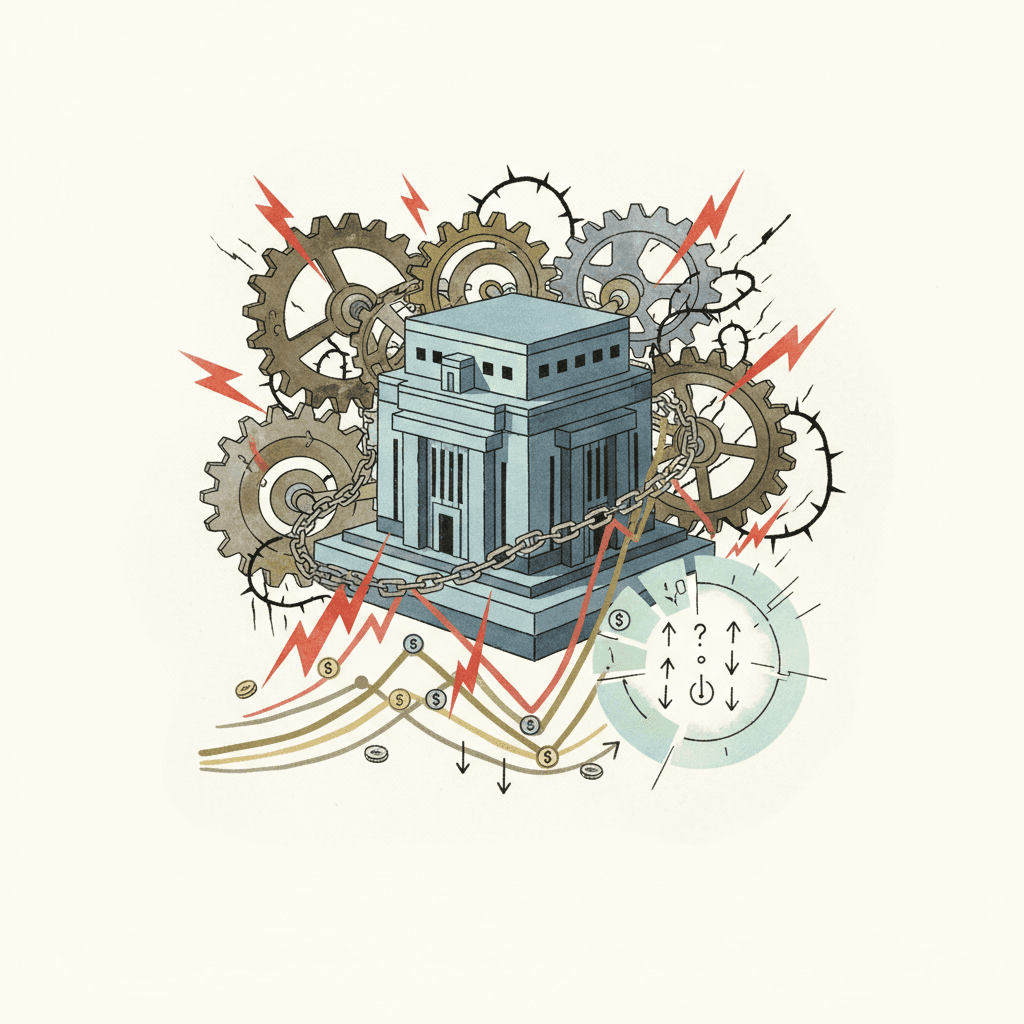
Imagine your car is stuck in mud. You can't go forward because there's a wall. You can't go backward because there's a ditch. You just sit there, spinning your wheels. That's essentially what the Federal Reserve is doing right now, and prediction markets are betting heavily that it stays stuck for months.
The numbers paint a remarkably clear picture. Betting markets place a 97.5% chance the Fed holds rates steady at its April 2026 meeting, and a 90.5% chance it does the same in June. Looking out to the end of the year, the single most likely outcome is that the Fed cuts rates exactly zero times, carrying a 38.3% probability. Not one cut. Not two. Zero. Meanwhile, the chance of two cuts sits at just 19.6%.
Why can't the Fed cut? Because inflation, measured by the Consumer Price Index (the government's main gauge of how fast prices are rising), is still running hot. Prediction markets price a 99.5% chance that year-over-year CPI for March 2026 comes in above 3.1%. That's well above the Fed's 2% target. Think of it like driving 55 in a zone where the speed limit is 40. You're not accelerating anymore, but you're still going way too fast.
And why can't the Fed hike? Because the economy is starting to wobble. Recession odds for 2026 sit at 22.5%, and there's a 37.7% chance unemployment climbs above 5% before 2027. The economy is fragile enough that raising rates further could tip it over the edge.
This is what economists call stagflation: prices rising while the economy stagnates. The normal tool for fixing economic problems, adjusting interest rates, is essentially disabled. Inflation is too high to cut, and the economy is too weak to hike. The thermostat is broken.
The Self-Reinforcing Trap
What makes this situation particularly dangerous is the way it feeds on itself:
- The Fed holds rates at restrictive levels because inflation remains sticky above 3%.
- High rates squeeze businesses that need to borrow, compress corporate profit margins, and make housing increasingly unaffordable.
- Economic growth slows, unemployment starts creeping up, and recession risks build.
- But the Fed still can't cut because inflation hasn't come down enough.
- The lack of rate relief keeps financial conditions tight, which loops back to step 2.
The confirmation of Kevin Warsh as the next Fed Chair, which prediction markets price at 95.3%, signals a hawkish transition that further cements the no-cut regime. There's only a 0.5% chance the fed funds rate drops below 3.75% after the April meeting, and just a 1.5% chance that May's CPI reading falls below 2.8%. The market sees inflation staying sticky and the Fed staying frozen.
What This Means for Markets
This setup is bearish for anything that depends on lower interest rates. Growth stocks that rely on cheap borrowing to fund expansion face a prolonged squeeze. Real estate, both commercial and residential, gets hammered because high mortgage rates keep buyers on the sidelines and high commercial borrowing costs freeze deal activity. Long-term bonds lose value because there's no rate relief coming to push their prices higher.
On the other hand, the frozen Fed is moderately supportive for the U.S. dollar, since American interest rates remain relatively high compared to what central banks in Europe and Japan are offering. Money tends to flow toward higher yields, and that flow supports the dollar.
But the truly asymmetric risk, the scenario that could really hurt, is if a recession materializes while the Fed is still battling inflation. In that world, the policy response would be delayed and messy. The Fed would have to choose between fighting inflation and saving the economy, and history suggests that kind of indecision leads to prolonged pain.
Selling Shovels During the Gold Rush
During the California Gold Rush, the people who most reliably made money weren't the miners. They were the ones selling shovels, picks, and denim jeans. The miners might strike gold or go bust, but the suppliers got paid either way.
The same logic applies in a stagflationary freeze. Instead of betting on which direction the economy breaks, you can own the infrastructure that profits regardless of the outcome.
BIL — SPDR Bloomberg 1-3 Month T-Bill ETF (Strong Buy, 88% confidence)
This is the ultimate shovel in a frozen-rate environment. With the Fed almost certainly holding rates steady through at least June, short-term Treasury bills lock in current yields of roughly 4.25% to 4.5% with virtually zero risk that rising or falling rates will erode your principal. You earn the risk-free rate while every other asset class faces uncertainty. It doesn't matter whether we get a recession, continued inflation, or more muddling through. BIL pays you to wait.
CME — CME Group (Strong Buy, 85% confidence)
CME Group owns the exchanges where interest rate futures, options, and currency derivatives trade. They're the tollbooth on the highway of financial uncertainty. The stagflationary trap creates maximum confusion about where rates, inflation, and currencies are headed, and that confusion drives maximum hedging demand and trading volume. Every bank repricing its rate expectations, every fund hedging its bond portfolio, every corporation managing currency risk does it through CME's platforms. They profit from the chaos itself, regardless of which direction markets move. Their interest rate products alone account for over 30% of revenue, and they hold a near-monopoly on U.S. Treasury and SOFR futures.
USFR — WisdomTree Floating Rate Treasury Fund (Buy, 82% confidence)
Floating rate Treasuries combine zero credit risk with rate-reset mechanics. That means the coupon adjusts as rates change, eliminating the duration risk that punishes traditional bonds when rates stay high or move higher. You get sovereign-backed safety with yields that stay elevated precisely because the Fed is frozen.
FLOT — iShares Floating Rate Bond ETF (Buy, 80% confidence)
Similar to USFR but holds investment-grade corporate floating rate bonds instead of Treasuries. The coupons reset with prevailing rates, so you earn a spread above the benchmark while avoiding duration risk. In a world where investors are fleeing long-term bonds, floating rate products absorb that flow.
ICE — Intercontinental Exchange (Buy, 78% confidence)
ICE owns the New York Stock Exchange and major fixed income and derivatives platforms, plus the mortgage technology stack through its Ellie Mae subsidiary. They benefit from elevated rate volatility driving trading volumes. Even when mortgage origination slows to a crawl, originators still need ICE's software to process loans. It's a diversified shovel-seller across multiple financial infrastructure verticals, though less of a pure play on rate uncertainty than CME.
Directional Trades
SH — ProShares Short S&P 500 (Buy, 72% confidence)
A straightforward hedge against broad equity declines. With no rate cuts to backstop stock prices and recession odds building, the downside risk for equities is meaningful. SH provides inverse S&P 500 exposure without the leverage decay problems that plague 2x and 3x products. If recession materializes while the Fed remains paralyzed by sticky inflation, the delayed policy response could send stocks significantly lower.
TBF — ProShares Short 20+ Year Treasury (Buy, 75% confidence)
A bet against long-term bonds. With zero cuts as the most likely year-end outcome and inflation glued above 3.1%, the long end of the bond market faces sustained pressure. No rate relief means long-term yields stay elevated or push higher, which drives bond prices lower. The Warsh confirmation further cements the hawkish stance.
UUP — Invesco DB US Dollar Index Bullish Fund (Weak Buy, 62% confidence)
High U.S. rates relative to other major economies support the dollar, but confidence is lower here because stagflation isn't always dollar-positive. If foreign investors start losing faith in U.S. economic management, capital could flow out rather than in.
CBRE — CBRE Group (Sell, 73% confidence)
CBRE is normally a classic shovel-seller in real estate. They earn fees on transactions, valuations, and property management regardless of which developers or REITs win. But they're the shovel-seller in a gold mine that's flooding. Frozen high rates crush commercial real estate deal volumes, refinancing activity dries up, and property valuations compress. Their diversification into facilities management and investment management provides some buffer, but the core transaction machine is seizing up.
The Risks You Need to Know
No thesis is bulletproof, and this one has several meaningful vulnerabilities.
The biggest risk is a tariff de-escalation. If trade tensions ease suddenly, inflation expectations could drop, giving the Fed room to cut and sparking a sharp relief rally in stocks and bonds. That scenario would hurt both the SH and TBF positions while reducing the premium on uncertainty that benefits CME and ICE.
The base case is still not a recession. At 78%, the probability of avoiding a recession remains far higher than the probability of entering one. The economy could simply muddle through, with slow growth and sticky inflation but no dramatic downturn. In that world, the equity short bleeds money through opportunity cost.
Oil prices offer another escape valve. Prediction markets see a 93% chance WTI stays below $106, and if energy prices fall further, inflation expectations could ease faster than currently priced, undermining the entire frozen-Fed thesis.
For the floating rate and T-bill positions, the uncomfortable truth is that real returns, meaning returns after accounting for inflation, are negative. With CPI above 3.1% and yields around 4.25-4.5%, you're preserving capital in nominal terms but slowly losing purchasing power. These are defensive positions, not wealth builders.
Finally, if a severe recession does hit, the Fed might be forced into emergency cuts regardless of inflation. That would crush the floating rate positions as coupons reset downward, and it would cause a massive rally in long-term bonds that would punish the TBF short. Flight to safety during a panic can overwhelm any inflation-based analysis.
Why This Matters for Your Wallet
If you have a 401(k), a mortgage, or just buy groceries, this affects you. A frozen Fed means mortgage rates stay high, which means home prices remain under pressure in many markets and affordability doesn't improve. It means the interest rate on your savings account stays attractive, but the prices at the store keep climbing faster than that interest. It means companies face higher borrowing costs, which eventually shows up as slower hiring, tighter budgets, and potentially layoffs.
The stagflationary trap is essentially the economy running in place. Your savings earn a decent nominal return but lose purchasing power. Your home doesn't appreciate because nobody can afford to buy. Your employer gets squeezed between rising costs and weakening demand.
The prediction market data carries an overall confidence rating of 91% on this pattern, and the nearly $14.6 million in combined dollar volume across these contracts suggests these aren't idle bets. Serious money is pricing in a Fed that's stuck, inflation that won't quit, and an economy that's slowly losing altitude.
The playbook is clear: earn the risk-free rate in short-duration instruments, own the financial infrastructure that profits from uncertainty, hedge equity downside without excessive leverage, and avoid anything that needs lower rates to survive. It's not exciting. But in a stagflationary trap, boring is the point.
Analysis based on prediction market data as of April 10, 2026. This is not investment advice.
How This Story Evolved
First detected Mar 20 · Updated daily
The story about the Fed's difficult position grew stronger today, with analysts now more focused on protecting against falling stocks and rising interest rates — adding new warning signals for real estate while highlighting exchanges like CME and ICE as potential winners. Safe-haven plays like gold dropped off the radar, suggesting the outlook shifted away from inflation fears and toward broader market turbulence.
The article added a section header ("The Worst of Both Worlds") and changed the car analogy from a stuck accelerator and jammed brakes to an overheating engine with a near-empty gas tank. The predicted probability of the Fed holding rates steady also nudged up slightly from 97% to 97.5%.
Read this version →