The Fed Is Stuck in a Trap, and Prediction Markets Are Pricing It In. Here's What It Means for Your Money.
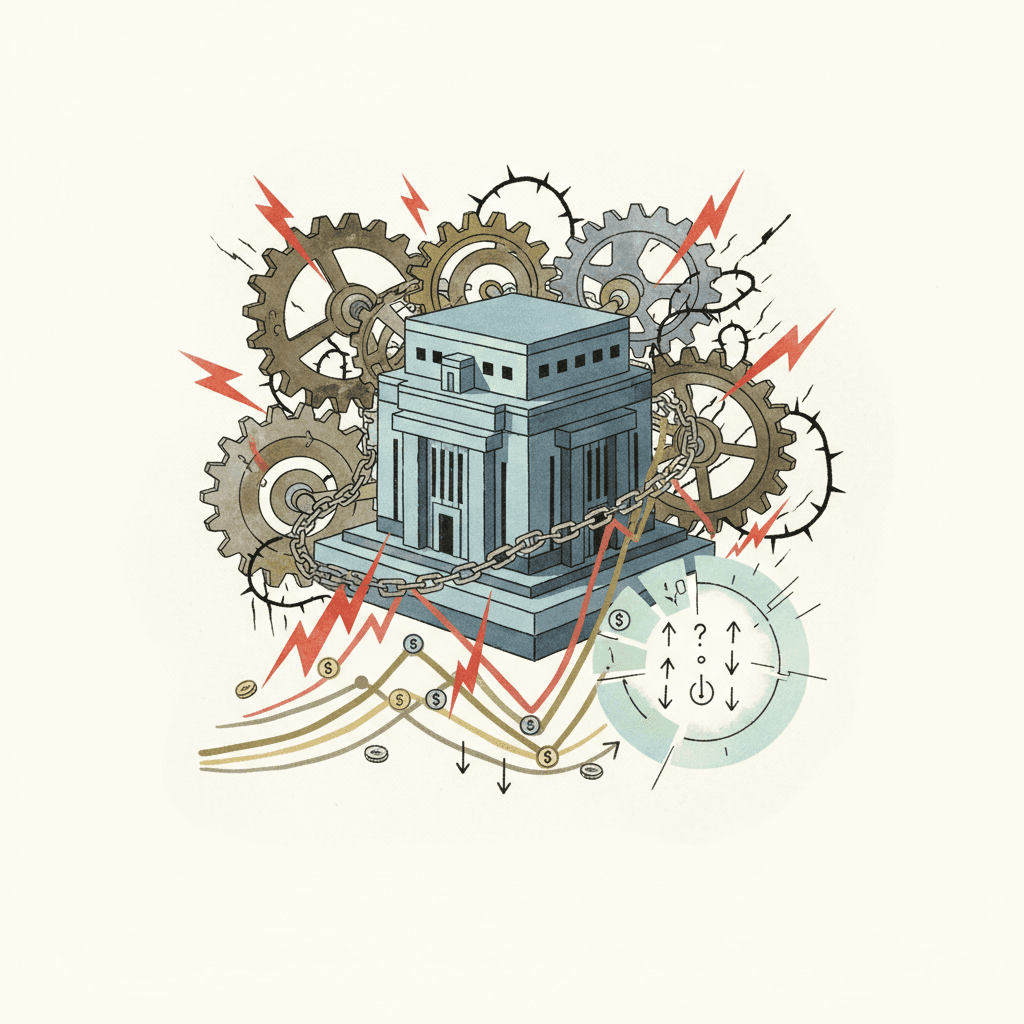
Imagine you're driving a car with the accelerator stuck and the brakes jammed at the same time. You can't speed up, you can't slow down, and the road ahead is getting bumpier. That's essentially where the Federal Reserve finds itself right now, and prediction markets are putting hard numbers on just how stuck they are.
Prediction markets currently show a 97% probability that the Fed does nothing with interest rates at its April 2026 meeting. Not a cut, not a hike. Just... nothing. The chance of a June cut sits at a mere 9%. And the probability that we get through the entire year of 2026 with zero rate cuts at all has climbed to 36.4%, jumping 4 percentage points in just the last 24 hours. Meanwhile, the chance that the fed funds rate (the benchmark interest rate the Fed controls, which influences everything from your mortgage to your car loan) stays above 3.00% is priced at 99%.
The Fed isn't choosing to stand still. It's boxed in.
The Stagflation Squeeze
On one side, inflation is refusing to cool off. The probability of core CPI (a measure of price increases that strips out volatile food and energy costs) running above 3.7% year-over-year by July 2026 has spiked 20% in recent trading. That's well above the Fed's 2% target, like driving 70 in a 50 zone. With prices still running hot, cutting rates would be like pouring gasoline on a fire.
On the other side, the economy is showing cracks. Prediction markets put the probability of a recession in 2026 at 25%, or one in four. Tech layoffs are expected to increase compared to last year, with an 83% probability that 2026 sees more tech job cuts than 2025. These are real signals of economic weakness that would normally prompt the Fed to lower rates to stimulate growth.
This combination of sticky inflation and slowing growth has a name that makes economists nervous: stagflation. It's the worst of both worlds. The Fed's usual tools are designed to fight one problem at a time. Cut rates to boost a weak economy, or raise rates to cool inflation. When both problems show up at the same time, the central bank is left staring at two fires with one bucket of water.
Making this posture even more durable, prediction markets give Kevin Warsh a 96% chance of being confirmed as the next Fed Chair. Warsh is widely viewed as more hawkish (more focused on fighting inflation than supporting growth) than the current leadership. His confirmation would essentially lock in this frozen, restrictive stance for the foreseeable future.
The self-reinforcing cycle works like this:
- Inflation stays sticky, so the Fed can't cut rates.
- High rates squeeze businesses and consumers, pushing the economy toward weakness.
- Economic weakness shows up in layoffs and reduced spending, but the Fed still can't cut because inflation hasn't budged.
- Without rate relief, the labor market adjusts the hard way, through job losses rather than monetary support.
- Those job losses compress consumer spending 6 to 12 months later, making the economy weaker, but inflation may persist due to supply-side factors like tariffs.
- Return to step 1.
What This Means for Markets
This setup is bearish for growth stocks, momentum plays, and any company relying on cheap borrowing. The S&P 500 finishing above 6,845 by year-end is essentially a coin flip at 51% probability. The market sees as much downside as upside from here.
Duration risk, the danger that long-term bonds lose value when rates stay high or rise, is elevated. If markets are wrong about the Fed standing pat and inflation actually forces a surprise rate hike, long-dated bonds and growth stocks would get crushed simultaneously.
The flip side: cash, short-duration bonds, and real assets like gold and commodities tend to do well in stagflationary environments. When both stocks and long-term bonds are unreliable, you want assets that either benefit from high rates or from monetary policy confusion.
The Trades: Shovels Over Gold
During the Gold Rush, most prospectors went broke. The people who got rich were the ones selling shovels, picks, and pans. The same logic applies here. Rather than trying to guess which direction the economy breaks, the smarter play may be owning the financial infrastructure that benefits regardless of the outcome.
The Highest-Conviction Plays: Park Your Cash at High Yields
BIL (SPDR Bloomberg 1-3 Month T-Bill ETF) is the ultimate shovel in this environment. It earns the short-term rate that the Fed controls, and that rate is locked in above 3.00% with 99% certainty. With the zero-cut scenario gaining steam, BIL's yield stays attractive with essentially zero risk of price decline. Every institutional investor needs a parking lot for capital when both stocks and long bonds are scary. BIL is that parking lot. Confidence: 92%.
SHV (iShares Short Treasury Bond ETF) follows the same logic, yielding roughly 4.3% to 4.5% with near-zero duration risk. In a world where the Fed might be forced into a surprise hike (a tail risk, but a real one), SHV actually benefits while everything else gets hammered. You earn a real yield while waiting for clarity. Confidence: 90%.
USFR (WisdomTree Floating Rate Treasury Fund) holds floating rate Treasury notes, meaning the interest payments adjust automatically when rates change. If rates stay frozen, you keep earning. If the tail risk of a hike materializes, your yield adjusts upward while fixed-rate bonds get destroyed. And because these are Treasuries, there's zero credit risk, unlike corporate floating-rate funds. Confidence: 86%.
FLOT (iShares Floating Rate Bond ETF) offers a similar floating-rate structure but with investment-grade corporate bonds instead of Treasuries. You pick up a bit more yield in exchange for some credit risk. Think of it as the shovel that works in both mines: if rates stay frozen at 97% probability or if they surprisingly rise, floating-rate instruments adjust. Confidence: 84%.
The Gold Play
GLD (SPDR Gold Shares) is the textbook stagflation asset. When the Fed loses credibility as both an inflation fighter and a growth supporter simultaneously, gold tends to thrive on that confusion. The 25% recession probability combined with rising CPI expectations creates exactly the kind of monetary policy oscillation that gold feeds on. Central bank buying around the world provides a structural price floor. Confidence: 82%.
RGLD (Royal Gold) is the shovel-seller's version of the gold trade. Instead of operating mines directly, with all the capital expenditure and execution risk that entails, Royal Gold owns royalty and streaming interests on other companies' mines. They finance miners and take a percentage of production regardless of operating challenges. Their margins run above 80%. In a stagflationary gold bull market, RGLD captures upside from any successful gold mine, no matter which operator wins. Confidence: 78%.
The Hedge
SH (ProShares Short S&P 500) is a modest hedging position, not a conviction short. With the S&P year-end target a literal coin flip, tech layoffs accelerating, and the frozen Fed offering no safety net under the market, the risk/reward for some equity protection is modestly attractive. Historically, when the Fed isn't actively supporting markets, drawdowns tend to be deeper when corrections do occur. But markets can grind higher on corporate buybacks and AI enthusiasm even when the macro picture is deteriorating, which is why this is a weak buy rather than a strong one. Confidence: 58%.
The Contrarian Infrastructure Pick
CTAS (Cintas Corporation) is a less obvious play on labor market restructuring. With an 83% probability of increased tech layoffs, workers are shifting from technology into services, healthcare, and logistics. Cintas provides uniforms, facility services, and safety equipment to the physical economy that absorbs these displaced workers. They benefit from labor market churn regardless of direction, holding over 60% market share in their core segments. The risk is that a full recession reduces total employment, and CTAS already trades at roughly 40x earnings, leaving little margin of safety. Confidence: 62%.
The Risks You Need to Know
No pattern is a sure thing, and honesty about what could go wrong is what separates useful analysis from cheerleading.
The biggest risk to this entire thesis is a sudden resolution of trade tensions. If tariffs get rolled back, inflation expectations could drop rapidly, giving the Fed room to cut, and risk assets would surge violently. Anyone positioned defensively would face significant opportunity cost.
An AI-driven productivity boom could also resolve the stagflation puzzle by boosting growth without fueling inflation, removing the premise entirely.
For the cash and floating-rate positions, the main danger is that inflation exceeds 4.5%, meaning your "safe" yield is actually losing purchasing power. If a crisis forces emergency rate cuts, those yields drop fast.
For gold, the asset has already had a massive run and may already be pricing in this scenario. A strong dollar from hawkish Fed policy could pressure gold in the short term, even if the longer-term thesis holds.
For the equity hedge, markets can stay irrational longer than hedges can remain solvent. The 25% recession probability means there's a 75% chance of muddling through, and that muddle-through scenario can be painful for short positions.
For RGLD, a broad equity sell-off could drag it down with general stocks even if gold holds steady. Counterparty risk exists if the mining operators it depends on face financial distress.
For CTAS, a full recession would hurt regardless of labor market churn, and its premium valuation leaves little room for disappointment.
Why This Matters for Your Everyday Finances
If you have a 401(k), this environment means the traditional "set it and forget it" approach to a stock-heavy portfolio carries more risk than usual. The market literally sees a coin flip on whether the S&P 500 finishes the year higher. That's unusual.
If you're carrying variable-rate debt, like certain credit cards or adjustable-rate mortgages, the frozen Fed means your rates aren't coming down anytime soon. That 36.4% probability of zero cuts all year, and rising, is a signal to prioritize paying down high-interest debt.
If you have cash sitting in a regular checking account earning 0.01%, this is one of those rare environments where simply moving it to a high-yield savings account or a money market fund is a genuinely good financial move. The risk-free rate is elevated and likely staying that way.
And your grocery bills? The sticky inflation readings suggest they're not getting meaningfully cheaper this year. Budgeting for continued elevated prices is the prudent move.
The Fed being frozen isn't just a Wall Street story. It ripples into every corner of the economy, from the rate on your savings to the price of your groceries to the stability of your job. Prediction markets are telling us this frozen state is the new normal for 2026. Planning accordingly beats hoping for a rescue that the numbers say isn't coming.
Analysis based on prediction market data as of April 9, 2026. This is not investment advice.
How This Story Evolved
First detected Mar 20 · Updated daily
The story about the Fed's difficult position grew stronger today, with analysts now more focused on protecting against falling stocks and rising interest rates — adding new warning signals for real estate while highlighting exchanges like CME and ICE as potential winners. Safe-haven plays like gold dropped off the radar, suggesting the outlook shifted away from inflation fears and toward broader market turbulence.
Read latest →The article added a section header ("The Worst of Both Worlds") and changed the car analogy from a stuck accelerator and jammed brakes to an overheating engine with a near-empty gas tank. The predicted probability of the Fed holding rates steady also nudged up slightly from 97% to 97.5%.
Read this version →