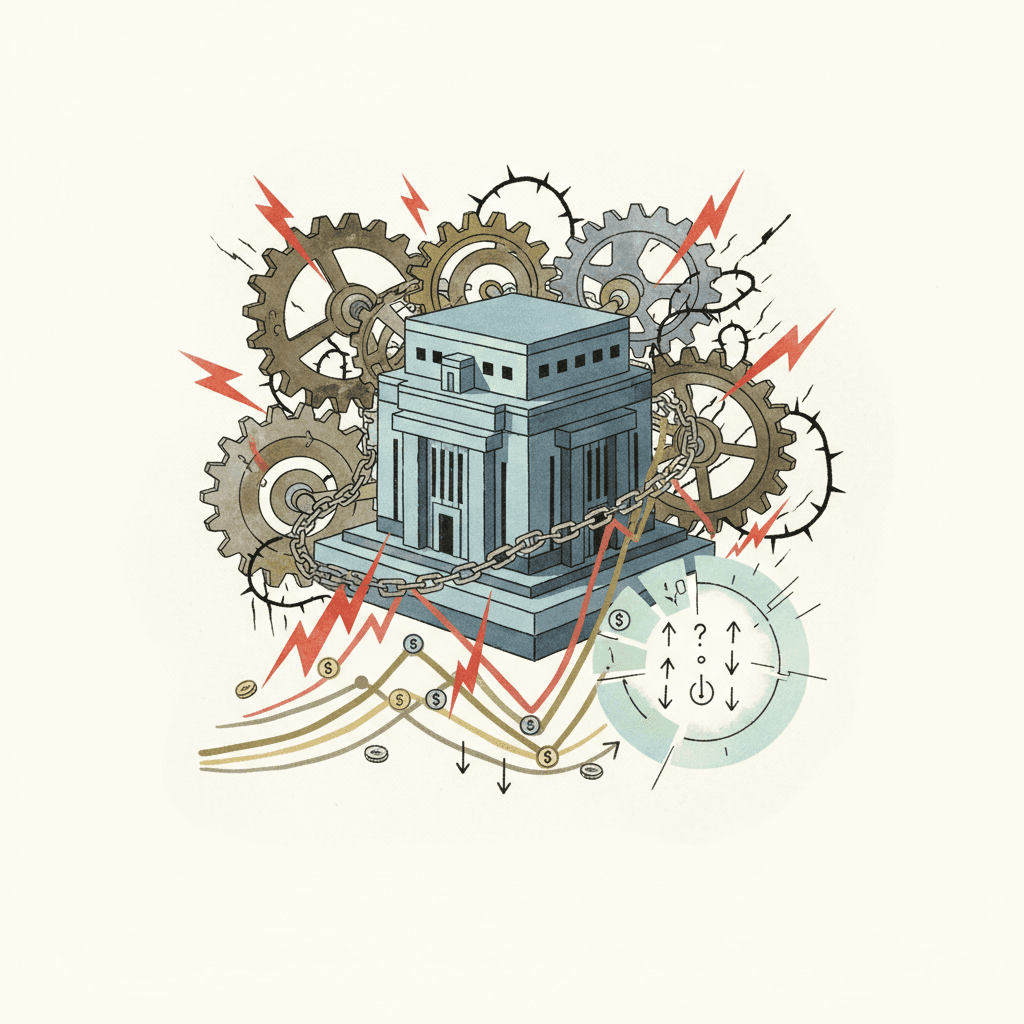
The Fed Is Stuck in a Trap, and Prediction Markets Are Pricing It In
The Worst of Both Worlds
Imagine you're driving a car and the engine is overheating while the fuel gauge is dropping toward empty. You can't speed up because the engine might blow. You can't slow down because you'll run out of gas on the highway. That's roughly where the Federal Reserve finds itself in April 2026, and prediction markets are putting hard numbers on just how stuck the central bank really is.
Betting markets now price a 97.5% chance the Fed holds rates steady at its April 2026 meeting. No cut. No hike. Nothing. The probability of zero rate cuts for the entire year has climbed to 36.4%, up 4 percentage points in just the last 24 hours. And the chance of even a single 25 basis point cut (that's a quarter of a percent) in June sits at a paltry 10.5%.
At the same time, the probability of the upper bound of the federal funds rate, the key interest rate the Fed controls, staying above 3.00% after the April 29 meeting is 99.5%. Monetary policy remains firmly restrictive, meaning borrowing costs for businesses and consumers stay elevated.
But the economy is showing cracks. Prediction markets put the chance of a recession in 2026 at 25.5%. The probability of tech layoffs exceeding 2025 levels is 83.25%. And the likelihood of core CPI, the inflation measure that strips out volatile food and energy prices, running above 3.7% in July 2026 just spiked 20%.
This combination has a name economists dread: stagflation. Inflation too sticky to justify cutting rates, an economy too fragile to justify raising them. The Fed can't treat the fever without making the patient weaker.
A Leadership Transition That Reinforces the Freeze
Adding another layer to this picture, prediction markets give a 96.55% chance that Kevin Warsh, widely regarded as a hawkish (inflation-fighting) voice, will be confirmed as the next Fed Chair before January 2029. Meanwhile, the probability of Jerome Powell leaving before the end of April 2026 is only 1.5%, meaning the transition hasn't happened yet but the market is already pricing in its implications.
A Warsh-led Fed would likely lean even harder against rate cuts, reinforcing the frozen posture. Markets may start questioning whether that hawkishness is sustainable if recession risks climb further, and that kind of policy uncertainty is exactly the environment where certain asset classes thrive.
What This Means for Your Money
The market implications are clear and uncomfortable. This setup is bearish for growth stocks, momentum plays, and any company carrying a lot of debt at variable rates. Duration risk, the danger that longer-term bonds lose value if rates stay high or rise, is elevated. If the market is wrong about zero cuts and inflation actually forces a surprise hike, long-duration assets get crushed.
The S&P 500 finishing the year above 6,845 is essentially a coin flip at 51%. That tells you the market sees roughly equal odds of going up or going down from here.
The tech layoff signal at 83.25% combined with a frozen Fed means the labor market is adjusting without any monetary cushion. Historically, when workers lose jobs and interest rates don't come down to stimulate new hiring and spending, consumer spending compresses about 6 to 12 months later. That's the pipeline connecting today's job cuts to next year's retail receipts.
Gold and commodities tend to benefit from stagflationary environments. Cash and short-duration instruments, the financial equivalent of keeping your powder dry, look attractive.
The Self-Reinforcing Loop
This is the part that should make the pattern click. Stagflation doesn't just happen and sit there. It feeds on itself:
- Tariffs and supply shocks keep inflation sticky, preventing the Fed from cutting rates.
- High interest rates squeeze businesses, leading to layoffs (83.25% probability of tech layoffs exceeding last year).
- Rising unemployment weakens consumer spending, dragging down economic growth.
- Weaker growth increases recession fears (25.5% and potentially climbing), but inflation prevents the Fed from responding.
- The Fed stays frozen, which means no relief valve, and the cycle repeats from step 2.
Each step makes the next one more likely. The Fed normally breaks this cycle by cutting rates aggressively, but with inflation above target, that option is off the table.
Shovels, Not Gold: The Infrastructure Trades
During the California Gold Rush, the people who got reliably rich weren't the miners. They were the ones selling shovels, pickaxes, and denim pants. The same logic applies to investing in a stagflationary trap. Rather than betting on which direction the economy breaks, you can own the assets that benefit no matter which way it goes.
The highest-conviction trade in this pattern is short-duration Treasury instruments. BIL, the SPDR Bloomberg 1-3 Month T-Bill ETF, is the ultimate parking lot for capital when both stocks and long bonds carry risk. Its entire purpose is capturing the short-term rate the Fed controls, and that rate is locked in at restrictive levels with 99.5% certainty. With fed funds frozen and the zero-cut probability rising, BIL yields remain attractive with essentially zero duration risk. Confidence: 92%.
SHV, the iShares Short Treasury Bond ETF, follows the same logic. Yielding roughly 4.3-4.5% with near-zero duration risk, it earns a real return while you wait for clarity. If the tail risk of a surprise hike materializes, SHV benefits while almost everything else gets hit. Confidence: 90%.
USFR holds floating rate Treasury notes, combining the safety of government-backed debt with a coupon that adjusts if rates move. Zero credit risk makes this the purest play on the frozen-Fed thesis. If recession hits, corporate credit instruments suffer but Treasury floaters don't. If inflation forces a hike, USFR adjusts upward immediately. Confidence: 86%.
FLOT, the iShares Floating Rate Bond ETF, applies the same floating-rate mechanism to investment-grade corporate bonds. It yields a bit more than USFR in exchange for taking on some credit risk. If rates stay frozen (97.5% in April), it keeps paying. If a hike comes, it adjusts upward while fixed-rate bonds decline. Think of it as the shovel that works whether you're digging for gold or silver. Confidence: 84%.
GLD is the canonical stagflation asset. Gold benefits from monetary policy confusion, the moment when the Fed loses credibility as both an inflation fighter and a growth supporter simultaneously. Central bank buying trends provide a structural floor under the price. Confidence: 82%.
RGLD, Royal Gold, is the quintessential shovel-seller in the gold trade. Instead of operating mines with all their capital expenditures and execution risk, Royal Gold owns royalty and streaming interests on other companies' mines. They finance the miners and take a cut of production regardless of operating challenges. Streaming margins run above 80%, meaning even moderate gold price stability keeps the business highly profitable. In a stagflationary gold bull market, RGLD captures upside from any successful mine regardless of which operator wins. Confidence: 78%.
SH, the ProShares Short S&P 500 ETF, serves as a hedge rather than a conviction bet. With the year-end S&P target literally a coin flip and the frozen Fed offering no "put" under the market (no promise of rate cuts to rescue falling stocks), drawdowns tend to be deeper when corrections happen. But the 25% recession probability means there's a 75% chance the economy muddles through, so this is modest protection, not an aggressive short. Confidence: 58%.
CTAS, Cintas Corporation, is a contrarian infrastructure play on labor market restructuring. With tech layoffs surging, workers shift from technology into services, healthcare, and logistics. Cintas provides uniforms, facility services, and safety equipment to the physical economy that absorbs those workers. They benefit from labor market churn regardless of direction, holding over 60% market share in core segments. The risk is that a full recession reduces total employment and hurts Cintas regardless of which sectors are churning. And the stock already trades at roughly 40x earnings, leaving limited margin for error. Confidence: 62%.
The Risks You Need to Understand
No pattern is a sure thing, and this one carries several meaningful risks.
Tariff rollback or trade deal. If the administration reverses course on tariffs, inflation expectations could drop rapidly, giving the Fed room to cut. Risk assets would surge, and the defensive positioning described above would underperform significantly. This is probably the single biggest threat to the thesis.
AI productivity surprise. A genuine productivity boom driven by artificial intelligence could resolve the stagflationary dilemma by boosting growth without adding inflationary pressure. This would remove gold's premium and make short-duration cash positions look like dead money.
Gold's prior run. Gold has already moved substantially higher. Much of the stagflationary scenario may already be priced in, limiting further upside and creating vulnerability to a pullback.
Inflation above 4.5%. Even the short-duration instruments yielding 4.3-4.5% would deliver negative real returns if inflation overshoots significantly. You'd be losing purchasing power slowly instead of losing it quickly in stocks, but you'd still be losing it.
Credit spread widening. If recession probability climbs above 40%, the corporate bond components in FLOT could suffer. Investment-grade credit is not immune to a downturn.
Emergency rate cuts. A sudden financial crisis could force the Fed to cut rates rapidly regardless of inflation. Floating rate instruments would see their yields drop immediately, and the entire frozen-Fed thesis would unravel.
Equity resilience. Markets can grind higher on corporate buybacks and earnings even when macro conditions deteriorate. The carry cost of being short or heavily defensive in a market with long-term positive drift is real.
Why This Matters for Everyday Investors
If you have a 401(k), this pattern affects how your retirement savings behave. A frozen Fed means your bond funds won't get the rate-cut rally many people were expecting. Your stock funds face roughly even odds of finishing the year higher or lower. And if you're carrying variable-rate debt, a mortgage adjustment or credit card balance, relief isn't coming soon.
At the grocery store, core inflation above 3.7% means prices keep climbing faster than the Fed's 2% target. Your paycheck buys a little less each month. If tech layoffs spread to adjacent industries, the job market gets tighter for everyone, not just software engineers.
The practical takeaway is that this is an environment that rewards patience and capital preservation over aggressive positioning. The shovels, short-duration Treasuries, floating rate instruments, and royalty companies, tend to do their best work when everyone else is confused about what comes next. And right now, confusion is exactly what prediction markets are pricing in.
Analysis based on prediction market data as of April 9, 2026. This is not investment advice.
How This Story Evolved
First detected Mar 20 · Updated daily
The story about the Fed's difficult position grew stronger today, with analysts now more focused on protecting against falling stocks and rising interest rates — adding new warning signals for real estate while highlighting exchanges like CME and ICE as potential winners. Safe-haven plays like gold dropped off the radar, suggesting the outlook shifted away from inflation fears and toward broader market turbulence.
Read latest →The article added a section header ("The Worst of Both Worlds") and changed the car analogy from a stuck accelerator and jammed brakes to an overheating engine with a near-empty gas tank. The predicted probability of the Fed holding rates steady also nudged up slightly from 97% to 97.5%.