The Fed Is Frozen and the Economy Is Cracking: What Prediction Markets Are Telling Us Right Now
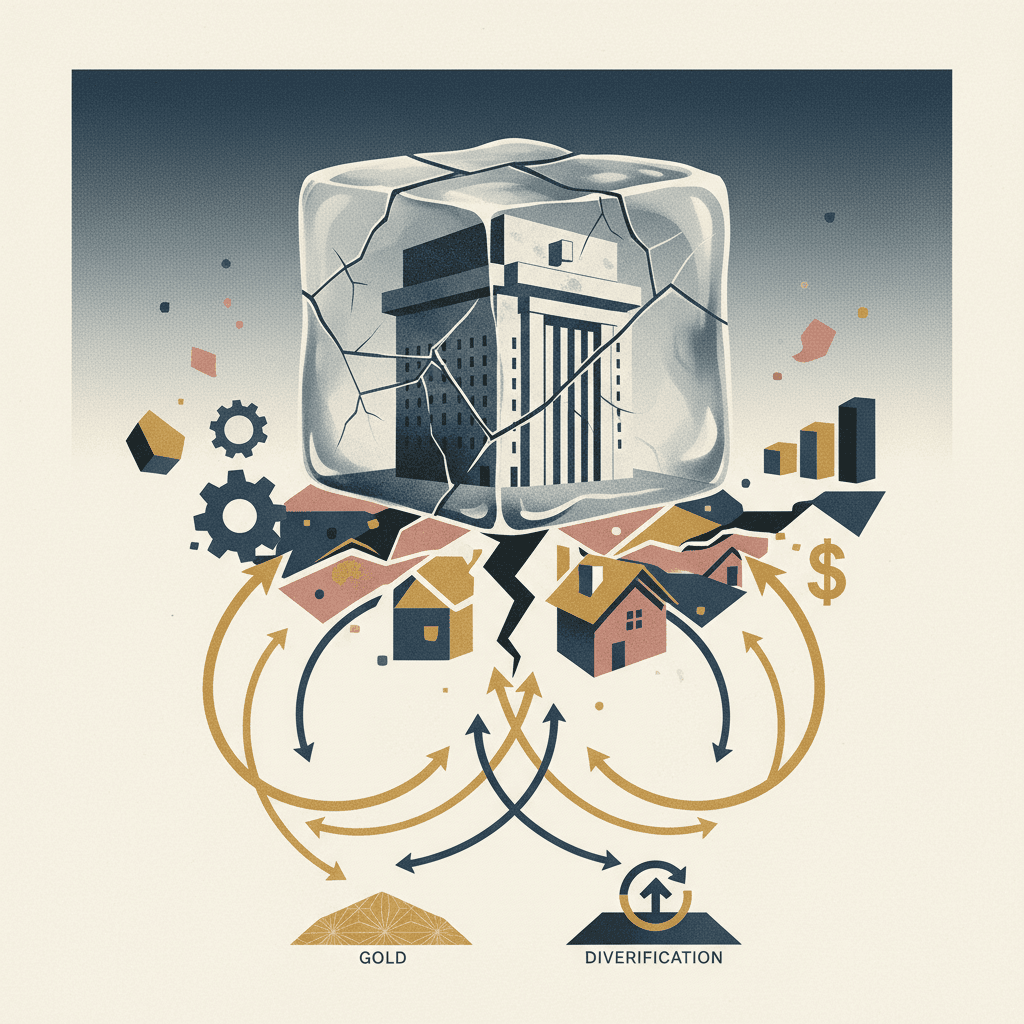
Imagine you're driving a car where the gas pedal is stuck and the brakes barely work, and you're heading toward a hill. That's roughly what the Federal Reserve looks like right now, according to prediction markets where real money is on the line.
Bettors are pricing in a 98.5% chance the Fed holds rates steady at its April 2026 meeting. Not a small cut. Not a big cut. Nothing. The probability of a 25-basis-point cut (that's a quarter of a percentage point, the smallest move the Fed typically makes) in April is a measly 1.5%. Even looking out to June, the odds of a cut sit at just 9.5%. The Fed, for all practical purposes, is frozen in place.
But that's not the alarming part. The alarming part is what's happening underneath.
The Ugly Combination Nobody Wants
Prediction markets put the chance of zero rate cuts for all of 2026 at 31.4%, and that number jumped almost 9 percentage points in the last 24 hours alone. Meanwhile, recession probability sits at 27.5%. There's a 39.5% chance unemployment exceeds 5% before 2027. And bettors see an 83% likelihood that tech layoffs increase from here.
When the central bank can't cut rates because inflation is still a concern, but the real economy is softening with rising unemployment and layoffs, economists have a word for that: stagflation. It's the economic equivalent of being stuck in traffic while your car overheats. You can't go forward, and sitting still makes things worse.
Ray Dalio, the legendary investor who built Bridgewater Associates, has described this exact scenario as the moment a central bank becomes "boxed in." Inflation fears prevent easing, but economic weakness demands it. The result is policy paralysis.
There's a 99.5% probability the federal funds rate stays above 3% after the April meeting. Only 19% of bettors think we'll get even two cuts this year. This isn't a healthy pause where the Fed catches its breath. This is a central bank that has no good options.
A New Sheriff Is Coming, and He's Not Dovish
Adding another layer: prediction markets show a 96.5% chance that Kevin Warsh gets confirmed as the next Fed chair. Warsh is widely regarded as more hawkish than Jerome Powell, meaning he's more inclined to keep rates high to fight inflation than to cut rates to support growth. Powell, for his part, shows essentially no chance of leaving early, with only a 0.85% probability of departing before May 2026.
A Warsh-led Fed further reduces the odds of any dovish pivot. If you were hoping for rate relief to bail out your mortgage rate or boost your stock portfolio, the betting money says don't hold your breath.
What This Means for Your Money
The S&P 500 is priced at roughly 53% to finish the year above current levels. That's basically a coin flip, which tells you something important: the smart money is genuinely uncertain about where stocks go from here. That's not bullish conviction. That's a shrug.
This environment is particularly painful for anything that depends on cheap borrowing. Real estate, high-growth tech stocks, and heavily leveraged companies all suffer when rates stay elevated. Credit spreads, the gap between what the government pays to borrow and what riskier borrowers pay, should widen as the economy slows without monetary relief.
The old Wall Street saying is "don't fight the Fed." But what do you do when the Fed isn't fighting for anyone?
The Shovels, Not the Gold
During the California Gold Rush, most prospectors went broke. The people who got rich were the ones selling shovels, pickaxes, and denim pants. The same principle applies in uncertain markets. Instead of betting on which direction stocks or bonds go, you can own the infrastructure that profits regardless of the outcome.
This pattern has several clear "shovel seller" plays.
USFR (WisdomTree Floating Rate Treasury Fund) is the purest expression of this idea. Floating rate Treasury notes pay you more when rates stay high, and they carry virtually zero duration risk, meaning their price barely moves when interest rates shift. With a 98.5% chance the Fed holds in April and a 31.4% chance of zero cuts all year, this fund just keeps paying you roughly 5% while you wait for clarity. It's the financial equivalent of getting paid to sit in a comfortable waiting room. Signal: Strong Buy (82% confidence).
The risks are straightforward: if the Fed suddenly slashes rates, your yield drops immediately (though your principal stays safe). You also face the opportunity cost of missing a stock market rally, and even 5% nominal returns get eaten by inflation over time. This is a preservation play, not a wealth builder.
BRK.B (Berkshire Hathaway) is the ultimate all-weather shovel seller. Warren Buffett has been piling up cash for exactly this kind of environment. With over $300 billion in cash and Treasury bills, Berkshire earns north of 5% on that hoard while rates stay elevated. Its insurance float, the money collected from premiums before claims are paid, generates even more investment income in a high-rate world. And if recession deepens and asset prices crater, Berkshire has the firepower to buy companies and stocks at bargain prices. The company wins whether the economy muddles through or falls apart. Signal: Buy (75% confidence).
The risks: Berkshire trades at a rich valuation relative to its book value. The transition from Buffett to Greg Abel as CEO remains untested in a crisis. If rates drop sharply, the cash yield advantage evaporates. And insurance catastrophe losses could offset investment gains in any given year.
CBOE (Cboe Global Markets) profits from uncertainty itself. This is the company that runs the VIX (Wall Street's "fear gauge") and dominates index options trading. When the Fed is frozen, recession odds are nontrivial, and the stock market is a coin flip, traders buy more options to hedge and speculate. CBOE collects transaction fees on every one of those trades regardless of direction. They sell the shovels to both the bulls and the bears. Signal: Buy (70% confidence).
Risks include the possibility that uncertainty resolves quickly (a trade deal, a disinflation surprise), which would collapse volatility and trading volumes. Competition from other exchanges exists, and the stock already trades at a premium reflecting its quality. Markets also don't always translate macro anxiety into actual options volume.
GLD (SPDR Gold Shares) benefits from the classic stagflation playbook. When the Fed can't cut because of inflation but the economy weakens, gold historically shines because of safe haven demand, central bank credibility concerns, and real rate uncertainty. Global central bank gold purchases remain elevated, and the Warsh appointment introduces regime-change uncertainty that tends to benefit gold. Signal: Buy (72% confidence).
But gold is already near all-time highs, meaning much of this uncertainty may be priced in. Higher nominal rates increase the opportunity cost of holding an asset that generates no income. Dollar strength from a hawkish Fed would pressure gold prices. And gold can be surprisingly volatile, not always performing as expected during recessions.
SCHO (Schwab Short-Term U.S. Treasury ETF) offers the barbell approach that Dalio would likely advocate. Short-duration Treasuries in the 1-to-3-year range yield around 4.5% with minimal price risk. If recession hits, these rally as markets price in future cuts. If rates stay elevated, you clip an attractive coupon. The risk-reward tilts in your favor. Signal: Buy (78% confidence).
XLU (Utilities Select Sector SPDR) is the classic defensive sector play. Unlike long-duration bonds, utilities pay dividends that partially compensate for high rates, and they're riding the secular tailwind of AI data center power demand regardless of the macro picture. In a world where growth stocks get punished by higher discount rates and cyclicals get punished by recession, regulated utilities with pricing power offer relative outperformance. Signal: Buy (65% confidence).
Risks: higher-for-longer rates increase borrowing costs for these capital-intensive businesses. Valuations are already elevated from investors crowding into defensives. If recession is avoided entirely and growth reaccelerates, utilities would underperform significantly.
The Other Side of the Shovel
CBRE (CBRE Group) is the infrastructure play you might want to avoid or even bet against. As the world's largest commercial real estate services firm, CBRE is the shovel seller for real estate transactions. It processes deals regardless of which properties win or lose. But when the entire sector freezes, which is exactly what higher-for-longer does to commercial real estate, transaction volumes collapse and the shovel seller has no one to sell shovels to. Signal: Weak Sell (60% confidence).
Important caveats: CBRE's facilities management and outsourcing divisions provide resilient recurring revenue that cushions the blow. The stock may already reflect higher-for-longer expectations. If a surprise rate cut materializes, commercial real estate snaps back violently. And CBRE has a strong balance sheet, so this would be a slow grind lower rather than a crash. Short positions always carry the theoretical risk of unlimited losses.
SH (ProShares Short S&P 500) provides a direct hedge against broad equity weakness. With the S&P 500 at only 53% to finish higher, the bearish case is almost as strong as the bullish one. But markets have already partially priced in higher-for-longer, and inverse ETFs suffer from daily rebalancing decay that eats into returns over time. Corporate earnings have also been more resilient than the macro data would suggest. Signal: Weak Buy (55% confidence) as a tactical hedge, not a core position.
TLT (iShares 20+ Year Treasury Bond ETF) is caught in a tug-of-war. Recession fears pull long-term bond yields down (which pushes TLT's price up), but sticky inflation and a hawkish incoming Fed chair keep yields elevated. The 99.5% probability that the fed funds rate stays above 3% and 31.4% chance of zero cuts means the long end gets no relief from policy easing. If recession deepens materially, TLT could rally hard, but the current stagflationary base case is toxic for long-duration bonds. Signal: Neutral (45% confidence). The risk-reward is genuinely unclear.
The Self-Reinforcing Trap
This is the dynamic that should make everyone pay attention, because it feeds on itself:
- Inflation stays sticky enough that the Fed can't justify cutting rates.
- High rates squeeze borrowers, slow housing, and pressure corporate margins.
- Economic weakness leads to rising unemployment and layoffs.
- Rising unemployment normally triggers rate cuts, but see step 1.
- The Fed stays frozen, and the economy deteriorates further without relief.
- A hawkish new Fed chair arrives, reinforcing the hold-steady bias.
- Return to step 2.
This loop can continue until something breaks, either inflation finally cools enough to justify cuts, or the economy weakens so dramatically that the Fed has no choice but to act despite inflation concerns.
Why This Matters for Everyday Life
If you have a 401(k), this pattern suggests your stock portfolio faces genuine uncertainty, not the kind of market where you can set it and forget it. If you're carrying a variable-rate mortgage or planning to buy a home, relief on borrowing costs isn't coming anytime soon. If you're in a industry vulnerable to layoffs, particularly tech, the 83% probability of increasing layoffs is worth taking seriously.
On the grocery bill front, stagflation means prices stay elevated even as the job market softens. Your paycheck buys less, and the raises that come during booming economies aren't materializing. The Fed's inability to act means no one is coming to the rescue with cheaper money.
The silver lining, if you can call it that, is that savings accounts and money market funds continue paying attractive yields. If you've been parking cash and earning 5%, this environment rewards that patience.
The Honest Risk Assessment
Every thesis has a way of being wrong. A sudden disinflation shock, maybe from a trade deal resolution or a collapse in commodity prices, could break the stagflation narrative and trigger a sharp rally in exactly the assets this analysis avoids. Corporate earnings have been surprisingly resilient, and markets can shrug off bad macro data for longer than most people expect. If the economy avoids recession entirely and growth reaccelerates, defensive positions would underperform substantially. And inverse ETFs, by their mathematical structure, decay over time, making them poor long-term holdings even when directionally correct.
The 53% probability of the S&P finishing higher is a reminder that this is close to maximum uncertainty. Anyone claiming to know exactly what happens next is selling something.
The prediction markets are telling us something clear, though: the Fed is stuck, the economy is softening, and the next Fed chair is more likely to keep rates high than to ride to the rescue. Positioning for that reality, owning the infrastructure that profits from uncertainty and elevated rates rather than betting on a specific outcome, is the most rational response to a world where the central bank has no good moves left.
Analysis based on prediction market data as of April 9, 2026. This is not investment advice.
How This Story Evolved
First detected Mar 20 · Updated daily
The article swapped its opening car metaphor and shifted its focus to lead with specific prediction market data, including a 98.5% chance the Fed holds rates steady. It also moved away from general advice about "positioning for policy paralysis" to directly explaining what betting markets are currently signaling.
The article swapped out the "car with a stuck gas pedal" opening analogy for a "house on fire and flooding" analogy to describe the Fed's situation. The headline also shifted focus from explaining what prediction markets are saying to giving readers advice on how to invest during this period of policy gridlock.
Read this version →