The Fed Is Frozen and the Economy Is Cracking: How to Position for Policy Paralysis
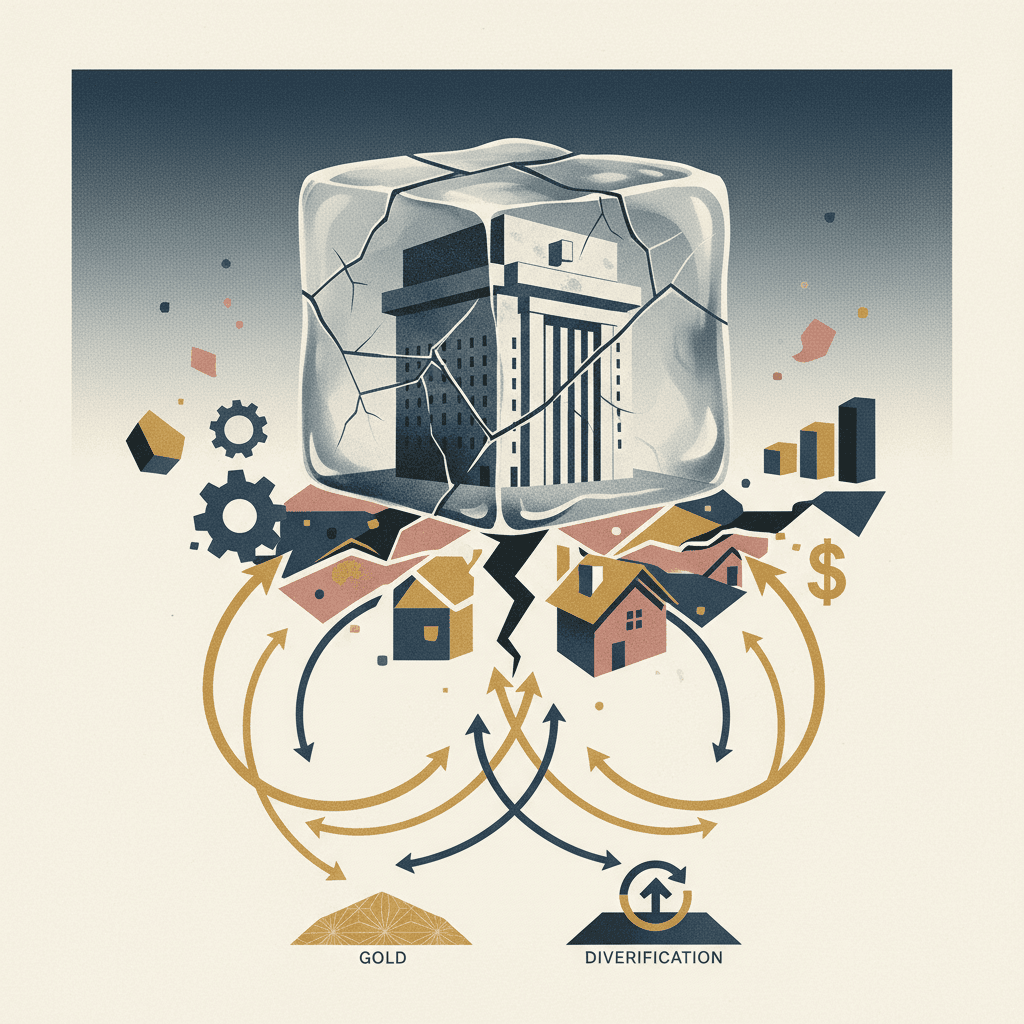
Imagine your house is on fire and flooding at the same time. You can't turn on the hose without making the flood worse, and you can't drain the water without letting the fire spread. That's roughly where the Federal Reserve finds itself right now, and prediction markets are putting hard numbers on just how stuck the central bank has become.
Betting markets currently price a 98.5% chance that the Fed does nothing at its April 2026 meeting. Not a cut, not a hike. Nothing. The probability of a 25-basis-point cut (meaning a quarter-percent reduction in the benchmark interest rate) in April sits at a mere 1.5%. Even looking ahead to June, there's only an 8% chance of a cut. And for the full year? The probability that the Fed cuts rates zero times in all of 2026 has surged to 31.4%, jumping 8.9 percentage points in just 24 hours. That's not a healthy "wait and see" pause. That's a central bank trapped in a box.
The problem is what's happening on the other side of the ledger. Recession probability for 2026 sits at 27%. Unemployment has a 39.5% chance of exceeding 5% before 2027. Tech layoffs are 83% likely to increase. The economic machine is slowing down, and the institution responsible for cushioning the blow can't act because inflation concerns won't let it.
Ray Dalio, the founder of the world's largest hedge fund, has written extensively about this exact dynamic. He calls it the late-cycle squeeze: the central bank wants to ease policy to support a weakening economy, but doing so risks reigniting inflation. The result is paralysis, and paralysis in monetary policy tends to be bearish for rate-sensitive sectors like real estate, high-growth technology, and anything that relies on cheap borrowing.
Adding another layer, prediction markets give Kevin Warsh a 96.5% chance of being confirmed as the next Fed chair, signaling a hawkish regime shift that makes dovish pivots even less likely. Meanwhile, the odds of Jerome Powell leaving before May 2026 are a tiny 0.85%, and the probability that the federal funds rate stays above 3% after the April meeting is 99.5%. The message from every corner of these markets is the same: rates are staying high, and help is not coming.
The S&P 500 reflects this confusion. Prediction markets put it at only 53% to finish the year above current levels. That's essentially a coin flip, not the kind of number you see when markets feel good about the future.
The Gold Rush Playbook: Sell Shovels, Don't Pan for Gold
When everyone rushed to California in 1849, the people who got rich weren't mostly the miners. They were the ones selling pickaxes, jeans, and supplies. The same logic applies to investing during periods of macro uncertainty. Instead of betting on which specific outcome materializes, you can own the companies and instruments that profit from the environment itself, regardless of which way individual bets break.
The strongest "shovel seller" signal in this pattern is USFR, the WisdomTree Floating Rate Treasury Fund. This ETF holds Treasury floating rate notes, which means their yields reset with short-term interest rates. When the Fed is frozen at elevated rates, with a 98.5% chance of no April action and a 31.4% chance of zero cuts all year, this fund earns roughly 5% with virtually zero interest rate risk. Think of it as a savings account backed by the U.S. government that adjusts automatically if rates move. It's the ideal parking spot when nobody knows what comes next. Confidence here is high at 82%. The main risk is opportunity cost: if stocks rip higher, you'll wish you'd been more aggressive. And if the Fed does surprise with aggressive cuts, the yield drops immediately, though your principal stays safe.
BRK.B, Berkshire Hathaway, is another classic shovel seller for this environment. Warren Buffett's conglomerate sits on more than $300 billion in cash and Treasury bills, earning over 5% while waiting for opportunities. Its massive insurance float (the premiums collected before claims are paid) generates even more income when rates are elevated. And if the economy tips into recession and asset prices fall? Berkshire becomes the ultimate buyer, deploying that cash hoard at bargain prices. The company wins whether rates stay high (more investment income) or the economy worsens (cheaper acquisition targets). Confidence sits at 75%. Risks include a rich valuation relative to book value and the untested leadership transition to Greg Abel.
CBOE, the Cboe Global Markets exchange operator, profits from something even more fundamental: uncertainty itself. When the Fed is frozen, recession odds are 27%, and the stock market is a coin flip, traders buy more options and volatility products to hedge or speculate. CBOE holds a monopoly on VIX products and dominates the SPX index options market. It earns transaction fees on every trade, regardless of direction. More fear, more trading, more revenue. Confidence is 70%, with the main risk being a sudden resolution of uncertainty that would collapse volatility and trading volumes.
GLD, the SPDR Gold Shares ETF, fits the classic Dalio "all-weather" allocation for stagflationary environments. When the Fed can't cut because of inflation but the economy is deteriorating, gold benefits from three forces working simultaneously: real interest rate uncertainty, erosion of central bank credibility, and safe-haven demand. The potential Warsh appointment adds regime change uncertainty, which historically benefits gold. Central bank purchases globally remain elevated. Confidence is 72%, though gold near all-time highs means much of this uncertainty may already be reflected in the price.
Defensive Positions and Tactical Hedges
XLU, the Utilities Select Sector SPDR, gets a buy signal at 65% confidence. Utilities are the classic defensive play in late-cycle deterioration. Unlike long-duration Treasury bonds, utilities pay dividends that partially compensate for higher-for-longer rates. They also benefit from a secular trend that has nothing to do with Fed policy: the massive buildout of AI data centers is driving unprecedented electricity demand. In a stagflationary environment where growth stocks get hammered by higher discount rates and cyclical stocks get hammered by recession, regulated utilities with pricing power offer relative outperformance.
SCHO, the Schwab Short-Term U.S. Treasury ETF, offers attractive yields around 4.5% with minimal price risk from 1-3 year Treasury bonds. This is the barbell approach: if recession hits, short-term Treasuries rally as markets price in future cuts. If rates stay elevated, you clip an attractive coupon. Confidence is 78%.
SH, the ProShares Short S&P 500 ETF, gets a weak buy signal at 55% confidence as a tactical hedge against broad equity weakness. With the S&P at only 53% to finish above current levels, the case for a hedge exists, but markets have already partially priced in higher-for-longer. This is not a high-conviction position. Inverse ETFs also suffer from daily rebalancing decay over time, which erodes returns if held for extended periods.
On the short side, CBRE, the world's largest commercial real estate services firm, gets a weak sell signal at 60% confidence. CBRE is a shovel seller for real estate, processing transactions regardless of which properties win or lose. But when the entire sector freezes because of higher-for-longer rates, transaction volumes collapse, and CBRE's revenue suffers. The firm's facilities management division provides some cushion with recurring revenue, and the stock may already reflect these expectations. Short positions also carry unlimited theoretical loss.
TLT, the iShares 20+ Year Treasury Bond ETF, gets a neutral rating at just 45% confidence. Long-duration Treasuries are caught in a tug-of-war. Recession fears pull yields down (which would send TLT's price up), but sticky inflation and the coming hawkish Warsh regime keep yields elevated. Stagflation is historically the worst environment for long-duration bonds, making the risk-reward genuinely unclear.
The Self-Reinforcing Loop
This is where understanding the cycle makes you a smarter investor. The pattern feeds on itself:
- Tariff uncertainty and sticky inflation prevent the Fed from cutting rates.
- Higher-for-longer rates squeeze borrowers, slow housing, and freeze commercial real estate transactions.
- Economic weakness shows up in rising unemployment and tech layoffs.
- Deteriorating economic data increases recession fears, but the Fed still can't cut because inflation hasn't cooperated.
- Policy paralysis deepens, uncertainty rises, and the cycle reinforces itself.
The only things that break this loop are either a disinflation shock (perhaps from a trade deal or collapsing commodity prices) that frees the Fed to cut, or a recession deep enough that the Fed cuts despite inflation concerns. Neither outcome is predictable, which is exactly why the shovel-seller approach makes sense.
Why This Matters for Your Money
If you have a 401(k), this environment means the broad stock market is not the reliable escalator up that it's been in recent years. A 53% chance of finishing higher is not reassuring. If you're saving for a house, higher-for-longer means mortgage rates aren't coming down soon, and the 99.5% probability of fed funds above 3% confirms it. If you're watching grocery bills, the stagflationary character of this pattern means prices stay stubborn even as the job market weakens.
The core takeaway is straightforward: when the Fed is paralyzed, don't bet on the Fed doing something. Own the instruments and companies that profit from the paralysis itself. Floating rate Treasuries earning 5%. Cash-rich conglomerates waiting to pounce. Exchanges that mint money from uncertainty. Short-duration bonds clipping coupons with minimal risk. These are the shovels. The gold rush might not pan out for anyone.
Honest Risks to This Entire Thesis
No pattern is a sure thing, and this one comes with several ways it could break down:
- A sudden disinflation shock or trade deal could trigger a sharp equity rally and make defensive positioning look foolish.
- Corporate earnings have remained more resilient than macro data suggests, and they could continue to surprise.
- Markets can stay irrational longer than you can stay solvent. The economy can deteriorate for months before asset prices reflect it, or vice versa.
- If the Fed surprises with aggressive cuts, every rate-sensitive position flips. USFR's yield drops, gold's opportunity cost argument weakens, and CBRE snaps back violently.
- Inverse ETFs like SH suffer from daily rebalancing decay, making them poor long-term holds.
- A prolonged low-volatility grind is possible even in this macro environment. Markets don't always reflect macro fear on schedule.
- Insurance catastrophe losses could offset Berkshire's investment gains, and gold near all-time highs may have already absorbed much of the safe-haven demand.
- Dollar strength from a hawkish Fed would pressure gold prices.
The prediction market data paints a clear picture of a frozen central bank and a deteriorating economy. The question isn't whether the Fed is stuck. It is. The question is what breaks the stalemate, and when. Positioning for the uncertainty itself, rather than guessing the resolution, is the most defensible approach.
Analysis based on prediction market data as of April 9, 2026. This is not investment advice.
How This Story Evolved
First detected Mar 20 · Updated daily
The article swapped its opening car metaphor and shifted its focus to lead with specific prediction market data, including a 98.5% chance the Fed holds rates steady. It also moved away from general advice about "positioning for policy paralysis" to directly explaining what betting markets are currently signaling.
Read latest →The article swapped out the "car with a stuck gas pedal" opening analogy for a "house on fire and flooding" analogy to describe the Fed's situation. The headline also shifted focus from explaining what prediction markets are saying to giving readers advice on how to invest during this period of policy gridlock.