The Fed Is Frozen and the Economy Is Cracking: How to Position for Policy Paralysis
Imagine your car is overheating, but you can't pull over because you're stuck in the middle lane of a highway with traffic on both sides. That's essentially where the Federal Reserve finds itself right now. Inflation concerns make it dangerous to cut interest rates, but the real economy is showing unmistakable signs of deterioration. The result isn't a thoughtful strategic pause. It's paralysis.
Prediction markets are painting this picture in vivid detail, and the numbers tell a story that anyone with a 401(k) or a mortgage should understand.
The Numbers Behind the Freeze
Bettors are placing a 98.5% probability on the Fed holding rates steady at its April 2026 meeting. The chance of even a modest 25 basis point cut (a quarter of a percentage point reduction) in April sits at a microscopic 1.5%. Looking further ahead to June, the odds of a cut only climb to about 9.5%. This isn't a central bank carefully weighing its options. This is a central bank that has no options.
The probability of zero rate cuts for the entire year of 2026 now stands at 33.1%, and that number has surged by 8.9 percentage points in just the last 24 hours. Meanwhile, there's only a 19% chance the Fed manages to cut twice this year. And the betting markets give a 99.5% probability that the federal funds rate stays above 3.00% after the April meeting, cementing the "higher for longer" reality.
On the other side of the ledger, the economy is wobbling. Prediction markets price a 27.5% chance of a recession in 2026. There's a 39.5% probability that unemployment climbs above 5% before 2027. And an 83% chance that tech layoffs increase. These aren't numbers that describe a healthy economy taking a breather. They describe a late-cycle economy grinding toward trouble while the central bank watches from the sidelines.
Ray Dalio, the founder of the world's largest hedge fund, has written extensively about moments like this. He calls them the periods when central banks become "boxed in," unable to stimulate growth because inflation won't allow it, but watching the economy weaken without the tools to help. The technical term for this ugly combination of stagnant growth and persistent inflation is stagflation, and it's one of the hardest environments for investors to navigate.
A Hawkish Changing of the Guard
Making matters more complicated, the leadership at the Fed is about to shift. Prediction markets assign a 96.5% probability that Kevin Warsh will be confirmed as the next Fed chair. Warsh is widely regarded as more hawkish than the current regime, meaning he's more inclined to keep rates elevated to fight inflation than to cut rates to support growth. The probability that Jerome Powell leaves before May 2026 is only 0.85%, so the transition isn't imminent, but the market is already pricing in what comes next. A Warsh-led Fed further reduces the odds of any dovish pivot, reinforcing the higher-for-longer thesis.
The S&P 500 being priced at just a 53% probability of finishing the year above current levels tells you everything about investor confidence. That's barely better than a coin flip. Genuine uncertainty, not bullish conviction, defines the current mood.
Selling Shovels in a Stagflationary Gold Rush
During the California Gold Rush, the people who reliably made money weren't the miners panning for gold. They were the merchants selling shovels, picks, and denim jeans. The miners might strike it rich or go broke, but the shovel sellers got paid either way.
The same principle applies here. In a stagflationary environment full of uncertainty, the smartest plays aren't bets on which direction the market moves. They're positions in assets and companies that profit from the conditions themselves, regardless of whether the economy tips into recession or muddles through.
USFR — Floating Rate Treasuries (Strong Buy, 82% confidence)
This is the purest shovel-seller play available. The WisdomTree Floating Rate Treasury Fund holds U.S. Treasury floating rate notes, which means the yield adjusts automatically as interest rates change. With a 98.5% probability the Fed holds in April and a 33.1% chance of zero cuts all year, these instruments pay roughly 5% with virtually no interest rate risk. You're earning the risk-free rate while everyone else argues about what happens next. If the Fed eventually cuts, your yield goes down but your capital is preserved. The worst case is that you earned a decent return while waiting. That's about as close to a free lunch as markets offer.
BRK.B — Berkshire Hathaway (Buy, 75% confidence)
Warren Buffett has been building Berkshire's cash pile to over $300 billion, and this environment explains why. Berkshire is the ultimate shovel-seller for policy paralysis because it wins no matter which specific outcome materializes. If rates stay high, Berkshire's enormous cash and Treasury bill hoard earns 5% or more, and its insurance float (the money collected from premiums before claims are paid) generates outsized investment income. If recession deepens and asset prices fall, Berkshire has the firepower to buy distressed businesses and stocks at bargain prices. The company is a diversified conglomerate built for exactly this macro regime. The risk is that it's already richly valued relative to book value, and the succession from Buffett to Greg Abel remains untested in a crisis.
CBOE — Cboe Global Markets (Buy, 70% confidence)
When nobody knows what's going to happen, people buy options. And when people buy options, Cboe collects transaction fees. As the operator of the VIX (the market's "fear gauge") and the dominant exchange for S&P 500 index options, Cboe essentially sells insurance to a nervous market. It doesn't matter whether stocks go up or down. What matters is that uncertainty stays elevated, and with the Fed frozen, recession odds at 27.5%, and the S&P basically a coin flip, uncertainty is abundant. The risk is that if conditions resolve cleanly in either direction, volatility collapses and trading volumes dry up.
XLU — Utilities Select Sector SPDR (Buy, 65% confidence)
Utilities are the classic defensive play when the economic cycle turns late. Unlike long-duration bonds, utilities pay dividends that partially compensate for the pain of higher rates, and regulated utilities have built-in pricing power that protects their revenue. They also benefit from a secular tailwind that has nothing to do with the Fed: the explosive growth in AI data centers is driving massive demand for electricity. In an environment where growth stocks get hammered by high discount rates and cyclical companies get hammered by recession, utilities offer a rare combination of defense and structural growth.
GLD — SPDR Gold Shares (Buy, 72% confidence)
Gold thrives in exactly the kind of environment where central bank credibility erodes. When the Fed can't cut and the economy weakens anyway, gold benefits from safe haven demand and uncertainty about real interest rates (the interest rate after subtracting inflation). The incoming Warsh regime adds another layer of uncertainty that historically supports gold prices. Central bank purchases globally remain elevated. The catch is that gold is already near all-time highs, and higher nominal rates increase the opportunity cost of holding an asset that pays no yield.
SCHO — Schwab Short-Term U.S. Treasury ETF (Buy, 78% confidence)
Short-duration Treasuries (bonds maturing in one to three years) offer around 4.5% yields with minimal price risk. If recession hits and the market starts pricing in future cuts, these bonds rally modestly. If rates stay elevated, you clip an attractive coupon. The risk-reward profile is asymmetric in favor of holders, making this an ideal complement to the floating rate position in USFR.
The Other Side of the Trade
CBRE — CBRE Group (Weak Sell, 60% confidence)
If there's a shovel-seller that benefits from activity in real estate markets, CBRE is it. As the world's largest commercial real estate services firm, it processes transactions regardless of which specific properties win or lose. But when the entire real estate sector freezes, which is what higher-for-longer does, transaction volumes collapse and CBRE's core business suffers. The company's facilities management division provides some resilient recurring revenue, which is why this is a weak sell rather than a strong one. And short positions always carry the risk of unlimited theoretical losses.
SH — ProShares Short S&P 500 (Weak Buy, 55% confidence)
This inverse ETF goes up when the S&P 500 goes down, making it a direct hedge against broad equity weakness. With the S&P at just 53% to finish higher, the market is essentially admitting it doesn't know what happens next. But inverse ETFs suffer from a mathematical quirk called daily rebalancing decay, which erodes their value over time even if the market goes nowhere. This is a tactical hedge for a portion of a portfolio, not a conviction bet. Corporate earnings have also been more resilient than the macro data would suggest.
TLT — iShares 20+ Year Treasury Bond ETF (Neutral, 45% confidence)
Long-duration Treasury bonds are caught in a genuine tug-of-war. Recession fears want to pull yields down and bond prices up. But sticky inflation, a hawkish incoming Fed chair, and the 99.5% probability of rates staying above 3% keep yields elevated. Stagflation is historically the worst possible environment for long-duration bonds. If a deep recession materializes, TLT rallies hard and becomes an excellent trade. But the timing is impossible to pin down, and in the meantime, you're holding an asset that bleeds in a stagflationary grind.
The Risks You Need to Know
Every thesis has failure modes, and intellectual honesty about them is what separates analysis from cheerleading.
First, markets can stay irrational longer than you can stay solvent. Even if the macro picture is deteriorating, equities can grind higher on momentum, buybacks, and the sheer weight of passive investment flows.
Second, a sudden disinflation shock or a major trade deal could trigger a sharp rally in risk assets and crush the defensive positioning described here. The probability of zero cuts surged 8.9% in a single day, which means it can swing the other direction just as fast.
Third, corporate earnings have remained stubbornly resilient. Companies have adapted to higher rates better than most economists expected, and earnings growth could continue to support equity prices even as macro conditions deteriorate.
Fourth, insurance catastrophe losses could offset Berkshire's investment gains. Regulatory changes could hit utility margins or Cboe's options volumes. Gold could decline if the dollar strengthens on the back of a hawkish Fed.
Finally, the biggest risk is that this pattern resolves cleanly. If inflation drops, the Fed cuts, and recession is avoided, nearly every defensive position underperforms the simple strategy of buying and holding a broad market index fund.
Why This Matters for Your Money
If you have a 401(k), a savings account, or a mortgage, this pattern is already affecting you. Higher-for-longer rates mean your savings account pays more, which is good. But it also means mortgage rates stay elevated, home prices face pressure, and companies that rely on borrowing (which includes many employers) face higher costs that eventually show up as hiring freezes and layoffs.
The 39.5% probability of unemployment exceeding 5% before 2027 isn't just an abstract number. It represents real jobs at real companies. The 83% likelihood of increased tech layoffs means the sector that drove much of the past decade's wealth creation is pulling back.
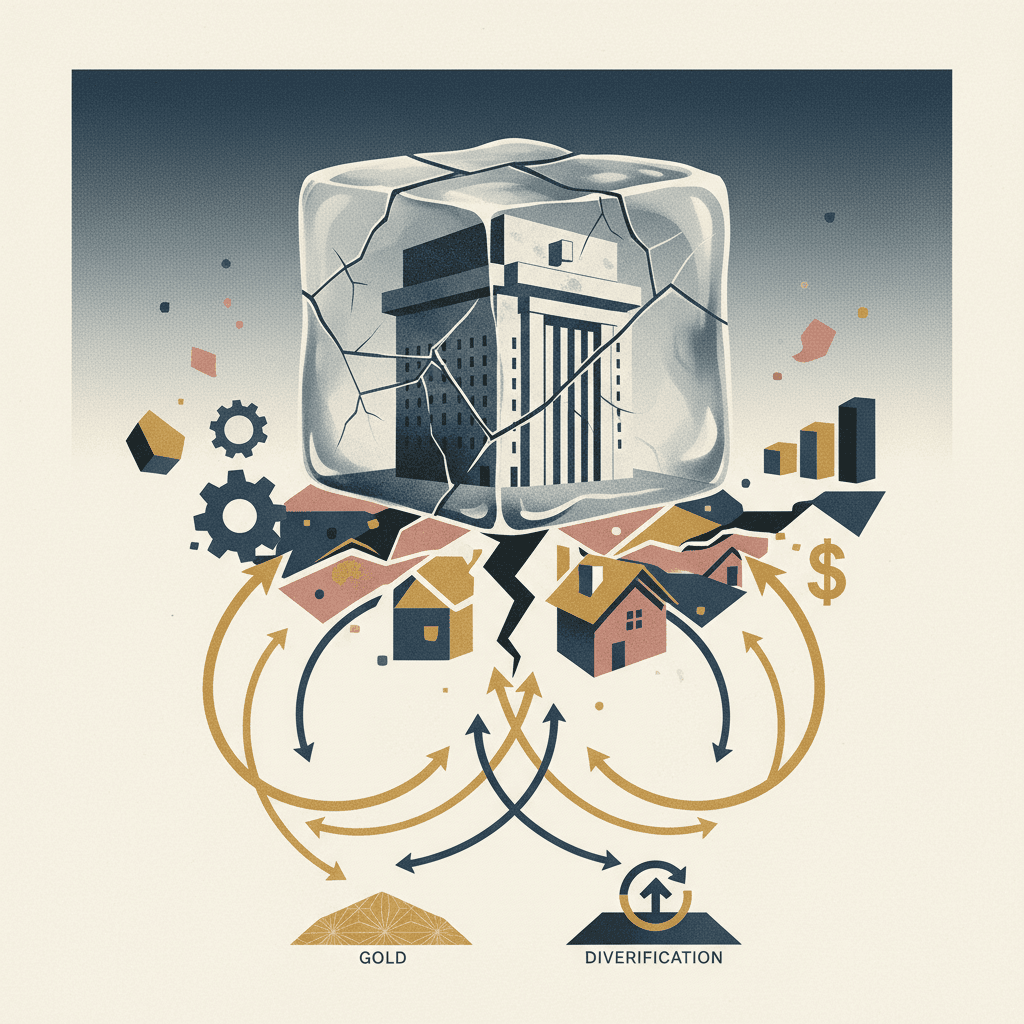
The self-reinforcing cycle works like this:
- Inflation stays sticky, preventing the Fed from cutting rates.
- High rates slow economic activity, especially in rate-sensitive sectors like housing and commercial real estate.
- Slower activity leads to layoffs and rising unemployment.
- Rising unemployment should cool inflation, but the Fed can't be sure, so it stays frozen.
- The freeze extends the period of economic pain, which feeds back into step 2.
This loop can run for quarters or even years before something breaks it. The key insight is that you don't need to predict which specific thing breaks it. You need to own the assets that benefit from the uncertainty itself. Floating rate Treasuries that pay you to wait. Companies like Berkshire with the cash to profit from either outcome. Exchanges like Cboe that collect fees on every nervous trade. Utilities that keep the lights on regardless.
The shovels, not the gold.
Analysis based on prediction market data as of April 8, 2026. This is not investment advice.
How This Story Evolved
First detected Mar 20 · Updated daily
The article swapped its opening car metaphor and shifted its focus to lead with specific prediction market data, including a 98.5% chance the Fed holds rates steady. It also moved away from general advice about "positioning for policy paralysis" to directly explaining what betting markets are currently signaling.
Read latest →The article swapped out the "car with a stuck gas pedal" opening analogy for a "house on fire and flooding" analogy to describe the Fed's situation. The headline also shifted focus from explaining what prediction markets are saying to giving readers advice on how to invest during this period of policy gridlock.
Read this version →