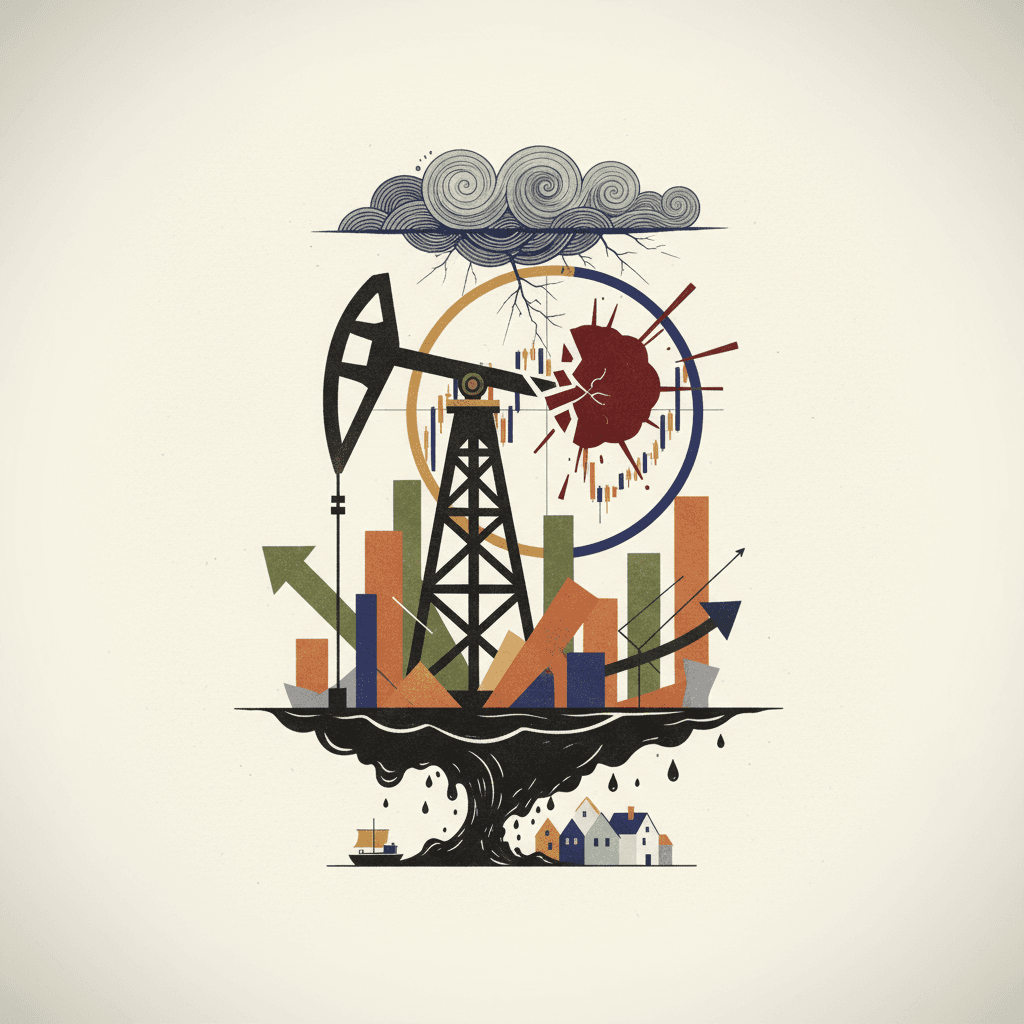
Prediction Markets Are Pricing a Middle East Oil Shock. Here's What That Means for Your Portfolio.
Something unusual is happening across prediction markets right now. Contracts tracking oil prices, Strait of Hormuz shipping traffic, Iran nuclear negotiations, and even Iranian regime change scenarios are all flashing the same signal: the Middle East is entering a period of maximum danger, and the oil market is about to feel it.
Let's walk through the numbers, because they tell a story that traditional financial news hasn't fully picked up on yet.
The Oil Price Signal
Prediction markets currently give a 76% chance that WTI crude oil (the benchmark price for US oil) will hit at least $115 per barrel at some point before the end of 2026. That alone is remarkable, given that oil has spent much of the past year well below that level. But the tail-risk numbers are what really stand out. There's a 38% chance oil touches $140, a 33% chance it reaches $150, a 27% chance it hits $160, and even a 17% chance it spikes all the way to $180.
To put that in perspective, $180 oil has only happened once in history, briefly in 2008. The fact that bettors are assigning a roughly one-in-six probability to that outcome tells you something serious is being priced in.
The Strait of Hormuz Is Already Disrupted
The Strait of Hormuz is a narrow waterway between Iran and Oman. About 20% of the world's oil passes through it every day. Think of it as a single-lane bridge on a highway that carries a fifth of all global traffic. If that bridge gets blocked or even just feels dangerous to cross, everything backs up.
Right now, prediction markets show only a 4% chance that shipping transit through the Strait normalizes above 60 calls per day by April 15, and that number dropped 1.2 percentage points in just the last 24 hours. Even by May 1, the probability of normalization is only 23%, which itself fell nearly 17 points recently. Ships are already rerouting. Insurance premiums are already climbing. The disruption isn't hypothetical. It's happening now.
This is the mechanism that connects geopolitics to your gas station receipt. When ships avoid Hormuz, they sail around the southern tip of Africa instead, adding thousands of miles and weeks of transit time. Even without a single missile being fired, the effective supply of oil tightens because every barrel takes longer to reach its destination.
The Iran Deal Timeline Creates a Danger Window
Prediction markets put the probability of a new US-Iran nuclear deal at 51% by the end of 2026. That sounds like a coin flip, which is actually pretty optimistic for such a complex negotiation. But the timing matters enormously. The chance of a deal by May is only 9%. By June, it's 26%. By August, 38%.
What this means is that markets see several months of maximum geopolitical risk before any diplomatic resolution arrives. The pattern looks like crisis first, resolution later. For investors, that gap between "now" and "eventually" is where the opportunity lives.
Adding to the instability, there are live prediction market contracts on Iranian regime change. Reza Pahlavi, the exiled son of Iran's last Shah, has a 14% chance of becoming the next head of state and a 18% chance of visiting Iran before 2027. The US recognizing him as Iran's leader sits at 14%. These aren't high probabilities, but the fact that they're being actively traded at all tells you that scenarios well outside the normal range of outcomes are on the table. Meanwhile, Benjamin Netanyahu leaving office as Israeli Prime Minister before 2027 sits at 33%, adding another layer of regional fluidity.
The Self-Reinforcing Cycle
This is the part that should make you feel smarter at your next dinner party. The situation in the Middle East isn't just a collection of separate risks. It's a loop where each element feeds the others:
- Geopolitical tension rises between the US and Iran, whether over nuclear programs, regional proxies, or regime change rhetoric.
- Ships begin avoiding the Strait of Hormuz, either from direct threats or spiking insurance costs.
- Effective oil supply tightens as transit times lengthen, even without a physical blockade.
- Oil prices spike, which worsens inflation in oil-importing countries.
- Higher energy costs create stagflationary pressure (rising prices plus slowing growth), which limits central banks' ability to cut interest rates in response.
- The economic pain from high oil prices increases diplomatic urgency, eventually pushing both sides toward a deal, but that resolution takes months.
- Until the deal arrives, the cycle continues to tighten.
What to Buy: Shovels, Not Gold
During the California Gold Rush, the people who reliably made money weren't the miners panning for gold. They were the people selling shovels, pickaxes, and denim pants. The same logic applies here. Yes, you can try to trade oil futures directly, but the smarter play is often owning the companies that profit regardless of which specific geopolitical outcome materializes, as long as energy markets stay tight.
Direct Energy Exposure
XLE is the broadest play, an ETF holding ExxonMobil, Chevron, ConocoPhillips, and dozens of other energy companies. With oil at 76% probability of hitting $115+, these companies generate enormous free cash flow that gets returned through buybacks and dividends, creating a floor under the stock even if prices eventually retreat. Confidence: 82%.
FANG, Diamondback Energy, is a pure Permian Basin producer with breakeven costs around $40 per barrel. This is asymmetric in the best sense: if oil stays flat, Diamondback still prints cash. If oil spikes to $140+, the incremental profit on every barrel is staggering. The Permian Basin is the only place on Earth that can meaningfully ramp production in response to a supply crunch, and Diamondback is one of its best operators. Confidence: 77%.
The Shovel Sellers
OIH, the oil services ETF holding Schlumberger, Halliburton, and Baker Hughes, benefits from a simple truth: when oil spikes, every producer wants to drill more, and they all need services companies to do it. Higher oil prices mean higher rig counts mean pricing power for the companies that own the drills. Confidence: 78%.
STNG, Scorpio Tankers, is the ultimate infrastructure play for Hormuz disruption. When ships reroute around Africa instead of through the Strait, every voyage gets thousands of miles longer. More miles per voyage means the global fleet effectively shrinks, even though no ships have been lost. Day rates spike. Scorpio operates one of the largest modern product tanker fleets in the world, and the transit data confirms rerouting is already underway. Confidence: 85%.
INSW, International Seaways, offers similar tanker exposure but with more crude carrier (VLCC and Suezmax) ships. If Persian Gulf crude needs to find longer routes or buyers need to source replacement crude from farther away, ton-miles increase either way. INSW has been aggressively returning capital to shareholders and trades at a low multiple relative to current earnings. Confidence: 80%.
FTI, TechnipFMC, makes the subsea production systems that sit on the ocean floor enabling deepwater drilling. They're one of only three companies globally that can do this, which is about as close to an oligopoly as you'll find in energy. When oil at $115+ makes marginal deepwater projects economically viable, TechnipFMC's addressable market expands. The catch is that this takes 12 to 24 months to show up in revenue. Confidence: 76%.
TDW, Tidewater, operates the world's largest fleet of offshore support vessels, the ships that supply and service offshore drilling platforms. Every offshore operator from Petrobras to Saudi Aramco needs these boats. If the oil spike holds, Tidewater's earnings revision cycle is just beginning, though the 6 to 12 month lag between oil prices and offshore activity means patience is required. Confidence: 75%.
TRGP, Targa Resources, operates the pipelines and processing plants that handle natural gas and natural gas liquids in the Permian Basin. Think of these as toll booths. When US producers drill more oil in response to global supply disruption, they also produce associated gas that has to be gathered and processed. Targa collects fees on volume regardless of which E&P company is doing the drilling. The dividend yield provides a cushion on the downside. Confidence: 74%.
AMSC, American Superconductor, is a lower-confidence idea at 58%. The connection is real but indirect: energy supply crises tend to accelerate government spending on grid hardening and resilience. AMSC makes systems that protect against grid instability. But this is a small-cap company with thin margins, and government procurement moves slowly. Treat this as a speculative position at best.
Why This Matters for Everyday Life
If you have a 401(k), you probably have energy exposure whether you know it or not. More directly, oil at $115 means gasoline somewhere north of $4.50 nationally, possibly much higher in states with high gas taxes. Oil at $140+ means grocery bills climb too, because everything in a supermarket arrived on a truck that burns diesel.
The stagflation angle is particularly painful. When oil prices spike, inflation runs hot, which means the Federal Reserve can't cut interest rates to help the economy. Your mortgage rate stays high. Your car loan stays expensive. And the prices at the pump keep climbing. It's the worst combination for household budgets: things cost more and borrowing doesn't get cheaper.
The Risks, Honestly
This thesis can break in several ways, and you should know them before putting money to work.
A quick Iran nuclear deal could collapse the entire geopolitical premium rapidly. Markets currently say 51% by year-end, and energy stocks often sell off at the first hint of diplomatic progress, not when a deal is actually signed.
The US Strategic Petroleum Reserve could be tapped to temporarily cap prices, buying time but creating a political rather than market-driven ceiling.
A global recession could destroy oil demand enough to offset the supply disruption. Stagflation, where prices rise while growth stalls, is a real possibility, and in that scenario even energy stocks can sell off initially as everything gets repriced lower.
Tanker stocks like STNG and INSW are notoriously volatile. They can give back weeks of gains in a single session on a diplomatic headline. Tanker earnings can swing 50%+ from one quarter to the next.
The prediction market probabilities themselves may be unreliable. WTI hitting $115+ at 76% seems extremely elevated compared to what futures markets are pricing. These contracts can be thinly traded, and the betting crowd may be overweighting tail risks.
For the longer-duration plays like FTI and TDW, if the oil spike is short-lived and purely geopolitical, the expected pickup in offshore spending and subsea orders simply won't materialize.
Finally, windfall profits tax narratives tend to gain traction whenever oil spikes. If political momentum builds around taxing excess energy profits, it directly compresses the upside for producers like FANG.
None of these risks make the thesis wrong. They make it incomplete without proper position sizing and awareness of what could go sideways.
Analysis based on prediction market data as of April 9, 2026. This is not investment advice.
How This Story Evolved
First detected Mar 20 · Updated daily
The article's focus shifted from giving portfolio advice to readers to highlighting what experienced investors are paying attention to. The opening was also rewritten to lead with specific data points, like a 76% probability of oil hitting $115, instead of building up to the crisis picture more gradually.
Read latest →The headline was tweaked to sound less technical and more personal to everyday investors. The opening of the article was rewritten to ease readers in more gradually, adding context about the Strait of Hormuz before diving into the specific price predictions.
Read this version →The updated article adds specific probability numbers and price targets from prediction markets, such as a 73% chance oil hits $115 per barrel and a 16% chance it reaches a record $180. It also shifts from a general overview of market signals to leading with concrete data and trading volume to back up its claims.
Read this version →The article was updated to add more context about what's driving the predicted oil price spike, mentioning specific factors like shipping lanes, Iranian diplomacy, and regional leadership changes. The opening was also rewritten to be more detailed and conversational, and the article added clearer section headers.
Read this version →The new version adds more specific details about what the prediction markets are tracking, naming the Strait of Hormuz, Iran nuclear talks, and Iranian regime change as examples. It also adds a claim that traditional financial news hasn't fully caught on to the story yet.