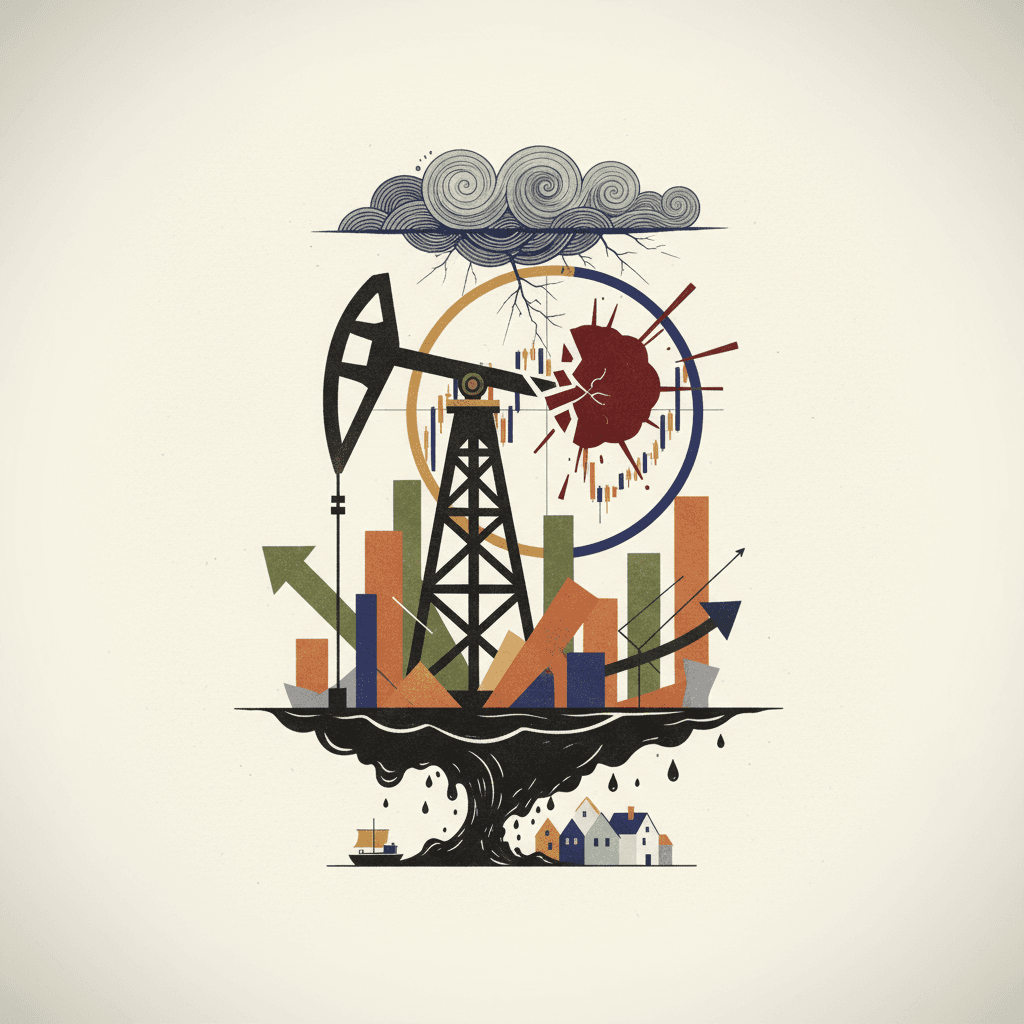
Prediction Markets Are Pricing a Middle East Oil Shock. Here's What That Means for Your Portfolio.
Something unusual is happening in prediction markets right now. Bettors are placing real money on oil prices reaching levels we haven't seen since 2022, and the probabilities they're assigning are startling. At the same time, a separate set of markets tracking shipping through the Strait of Hormuz, the narrow waterway between Iran and the Arabian Peninsula where roughly 20% of the world's oil passes daily, is flashing red. Put these signals together and you get a picture of a Middle East crisis that could send energy prices surging before any diplomatic resolution arrives.
Let's walk through the numbers, what they mean, and how investors might position for this scenario.
The Prediction Market Signals
Prediction markets currently assign a 76% chance that WTI crude oil (the U.S. benchmark price) will touch $115 per barrel at some point before the end of 2026. That alone is remarkable, considering oil has been trading well below that level. But the tail-risk numbers are even more eye-opening: there's a 38% chance oil hits $140, a 33% chance it reaches $150, a 27% chance for $160, and even a 17% chance it spikes to $180 or higher. These aren't normal probabilities. They reflect a market that sees a meaningful chance of a genuine supply crisis.
The Strait of Hormuz data tells us why. Prediction markets give only a 4% chance that shipping transit through the Strait normalizes by April 15, a number that dropped 1.2 percentage points in just 24 hours. The odds of normalization by May 1 sit at just 22%, down a dramatic 16.7% recently. Ships are already avoiding or reducing transit through the Strait, and when tankers reroute around the southern tip of Africa instead, the effective supply of oil tightens even if no one fires a shot. Insurance premiums for vessels entering the region spike, shipping companies charge more, and the whole supply chain gets squeezed.
Then there's the Iran nuclear deal question. Prediction markets price a 51% chance of a new U.S.-Iran agreement by the end of 2026, but only a 9% chance by May and 25% by June. The probability rises to 38% by August. Read that progression carefully: the market believes we're in a window of maximum danger right now, with diplomatic resolution most likely to come later. Crisis first, deal second.
Adding to the volatility, Reza Pahlavi, the exiled Iranian crown prince, has a 13% chance of becoming head of state and a 17% chance of visiting Iran before January 2027. The U.S. recognizing him as Iran's leader sits at 14%. These aren't high probabilities, but they're not zero either, and they suggest that regime change scenarios are genuinely live in the minds of people putting money on the line. Meanwhile, Israeli Prime Minister Benjamin Netanyahu's chance of leaving office before 2027 stands at 32%, adding another layer of regional unpredictability.
The Self-Reinforcing Oil Shock Cycle
This is the part worth understanding deeply, because it explains why the situation can get worse even without a dramatic military escalation.
- Geopolitical tension rises in the Persian Gulf region, creating uncertainty about safe passage through the Strait of Hormuz.
- Shipping companies and their insurers respond by raising premiums or avoiding the Strait entirely, forcing tankers onto longer routes around Africa.
- Longer routes mean each ship spends more days at sea per delivery, effectively reducing the global tanker fleet's carrying capacity without losing a single vessel.
- Reduced carrying capacity tightens oil supply at the destination, pushing prices higher.
- Higher oil prices increase the economic stakes of the conflict, drawing more political attention and potentially more aggressive posturing from all sides.
- More aggressive posturing feeds back into step one.
Notice that this cycle doesn't require anyone to actually blockade the Strait. The mere threat, reflected in collapsing normalization probabilities, is enough to set the gears turning. That's what makes this pattern so powerful and so tradeable.
The Trades: Gold Miners and Shovel Sellers
During the California Gold Rush, the people who most reliably made money weren't the miners. They were the people selling shovels, pickaxes, and blue jeans. The same logic applies to energy markets during a supply disruption. Yes, you can buy oil directly, but the infrastructure companies that enable oil production and transportation often offer better risk-adjusted returns because they profit from activity and volume, not just price.
That said, this pattern supports both direct energy plays and infrastructure picks.
Direct Energy Exposure
XLE — Strong Buy (82% confidence). This is the broadest, most diversified way to play a rising oil price. XLE is an ETF holding the largest U.S. energy companies, including ExxonMobil, Chevron, and ConocoPhillips. With a 76% probability of $115 oil, the entire upstream and integrated energy complex reprices higher. These companies generate enormous free cash flow at elevated prices, which they return to shareholders through buybacks and dividends, creating a floor under the stock even if prices eventually retreat.
FANG — Buy (77% confidence). Diamondback Energy is a pure-play Permian Basin exploration and production company with breakeven costs around $40 per barrel. That's the asymmetry that makes it attractive: if oil stays flat, Diamondback still generates solid cash flow. If oil spikes to $115 or $180, the profit on each incremental barrel is extraordinary. The Permian Basin is the only major oil-producing region globally that can meaningfully ramp up production in response to a supply disruption, and Diamondback is one of the best operators there.
OIH — Buy (78% confidence). This ETF holds oil services companies like Schlumberger, Halliburton, and Baker Hughes. These are already "shovel sellers" at the primary level. When oil spikes, every producer wants to drill more, and they all need the rigs, equipment, and expertise that services companies provide. Higher oil prices mean higher rig counts, which means pricing power for services. These companies have been disciplined about spending in recent years, so their profit margins expand rapidly when volume picks up.
The Infrastructure Plays (Shovel Sellers)
STNG — Strong Buy (85% confidence). Scorpio Tankers is the ultimate shovel seller for a Hormuz disruption. When ships can't or won't transit the Strait, tanker routes get longer. Longer routes mean each ship covers more ton-miles per delivery, which directly increases the daily rates tanker companies can charge. Scorpio operates a modern product tanker fleet that benefits from any rerouting, regardless of who wins the geopolitical chess match. The key insight: even the threat of Hormuz closure, which is happening right now according to prediction market data, raises insurance premiums and forces rerouting. The catalyst isn't hypothetical. It's already in motion.
INSW — Buy (80% confidence). International Seaways operates crude and product tankers and benefits from the same rerouting dynamics as Scorpio, but with more exposure to larger crude carriers (VLCCs and Suezmaxes). If Hormuz is disrupted, Persian Gulf crude must find alternative routes, or alternative crude sources must travel further to replace it. Either way, ton-miles increase and day rates rise. INSW trades at a low multiple relative to current spot earnings and has been aggressively returning cash to shareholders.
FTI — Buy (76% confidence). TechnipFMC makes the subsea production systems, the actual physical equipment sitting on the ocean floor, that enable deepwater oil production. This is the quintessential picks-and-shovels company. Only three major companies globally make this equipment, giving TechnipFMC oligopoly pricing power. At $115+ oil, marginal deepwater projects become economically viable, expanding TechnipFMC's addressable market. The caveat is timing: revenue from new orders takes 12 to 24 months to show up.
TDW — Buy (75% confidence). Tidewater operates the world's largest fleet of offshore support vessels. Think supply boats, anchor handlers, and platform support ships. Every offshore drilling operator on the planet, from Petrobras to Saudi Aramco, needs these vessels. When oil prices spike and offshore drilling activity increases, Tidewater benefits. The catch is a 6 to 12 month lag between an oil price spike and the actual pickup in offshore spending, which is both a risk and an opportunity if prices stay elevated.
TRGP — Buy (74% confidence). Targa Resources is a midstream company, meaning it operates the pipelines and processing plants that gather, process, and transport natural gas and natural gas liquids (NGLs) from the Permian Basin. Think of pipelines as toll roads: Targa gets paid based on volume flowing through its system, not the price of the commodity itself. When U.S. producers drill more in response to global supply disruption, Targa handles the increased flow. Its dividend yield provides some downside protection, though the fee-based revenue model also limits the upside compared to direct commodity exposure.
AMSC — Weak Buy (58% confidence). This is a speculative, second-order play. American Superconductor provides grid hardening solutions and power electronics. The theory is that energy supply disruptions accelerate government spending on grid resilience. It's a plausible thesis, but the connection to the Hormuz situation is indirect, the company is small, and government procurement moves slowly. Treat this one with appropriate skepticism.
Why This Matters for Your Everyday Life
If this pattern plays out, you'll feel it at the gas pump first. Oil at $115 translates to roughly $4.50 to $5.00 per gallon gasoline in many parts of the U.S., and the extreme tail scenarios of $140 to $180 oil could push prices well above $5.00. That hits commuters, trucking companies, airlines, and ultimately the price of everything that gets shipped anywhere.
For your 401(k), a sustained oil shock creates a particularly nasty economic environment called stagflation, where prices rise (inflation) while economic growth stalls (stagnation). The Federal Reserve can't easily fix this because cutting interest rates to help growth would worsen inflation, while raising rates to fight inflation would crush an already struggling economy. If the Fed is effectively frozen, as other prediction market patterns suggest, energy stocks become one of the few sectors that actually benefit.
That's the uncomfortable truth about energy investing during a crisis: the things that are good for oil stocks are often bad for the broader economy and bad for consumers. But if these prediction markets are right about the probability of an oil spike, having some energy exposure in your portfolio acts as a natural hedge against the pain you'll feel everywhere else.
The Risks (And They're Real)
Before committing a dollar to any of these ideas, consider what could go wrong.
A rapid Iran nuclear deal could collapse the geopolitical premium almost overnight. The prediction markets give this a 51% chance by end of 2026, so it's literally a coin flip. Energy stocks, especially tankers, often sell off at the first sign of diplomatic progress, not when the actual deal is signed.
The U.S. Strategic Petroleum Reserve (SPR) provides a buffer. A large SPR release could temporarily cap oil prices and deflate the crisis premium.
A global recession, potentially triggered by the stagflation this very scenario creates, could destroy enough oil demand to offset the supply disruption. This is the paradox of oil shocks: they can be self-limiting if they kill enough economic activity.
Tanker stocks are notoriously volatile. STNG and INSW can give back weeks of gains in a single session on a positive diplomatic headline.
Perhaps most importantly, these prediction market probabilities may not be fully reliable. WTI $115+ at 76% appears extremely elevated compared to what the futures market is pricing. Prediction markets can be thinner and more volatile than traditional financial markets, meaning a handful of large bettors can skew the odds. Treat these probabilities as directional signals, not gospel.
Finally, if oil does spike dramatically, the political pressure for windfall profits taxes on energy companies could intensify, capping the upside for shareholders even as companies generate record cash flows.
The Bottom Line
Prediction markets are painting a picture of a Middle East crisis that gets worse before it gets better. The Strait of Hormuz data shows disruption happening in real time, the Iran deal timeline suggests months of danger before any diplomatic resolution, and the oil price probabilities reflect a market bracing for a serious supply shock. The "crisis then resolution" arc creates a tradeable pattern: energy and tanker stocks benefit now, and a potential deal later in 2026 provides a natural exit signal.
The highest-conviction plays are the shovel sellers, the tanker companies and infrastructure providers that profit from disruption regardless of who wins the geopolitical game. STNG and XLE stand out as the strongest signals, with INSW, OIH, and FANG close behind. The infrastructure names like FTI, TDW, and TRGP offer exposure with longer time horizons and somewhat lower volatility.
Just remember: the same prediction markets that see a 76% chance of $115 oil also see a 51% chance of an Iran deal by end of 2026. The opportunity and the risk come from the same source.
Analysis based on prediction market data as of April 14, 2026. This is not investment advice.
How This Story Evolved
First detected Mar 20 · Updated daily
The article's focus shifted from giving portfolio advice to readers to highlighting what experienced investors are paying attention to. The opening was also rewritten to lead with specific data points, like a 76% probability of oil hitting $115, instead of building up to the crisis picture more gradually.
Read latest →The headline was tweaked to sound less technical and more personal to everyday investors. The opening of the article was rewritten to ease readers in more gradually, adding context about the Strait of Hormuz before diving into the specific price predictions.
The updated article adds specific probability numbers and price targets from prediction markets, such as a 73% chance oil hits $115 per barrel and a 16% chance it reaches a record $180. It also shifts from a general overview of market signals to leading with concrete data and trading volume to back up its claims.
Read this version →The article was updated to add more context about what's driving the predicted oil price spike, mentioning specific factors like shipping lanes, Iranian diplomacy, and regional leadership changes. The opening was also rewritten to be more detailed and conversational, and the article added clearer section headers.
Read this version →The new version adds more specific details about what the prediction markets are tracking, naming the Strait of Hormuz, Iran nuclear talks, and Iranian regime change as examples. It also adds a claim that traditional financial news hasn't fully caught on to the story yet.
Read this version →