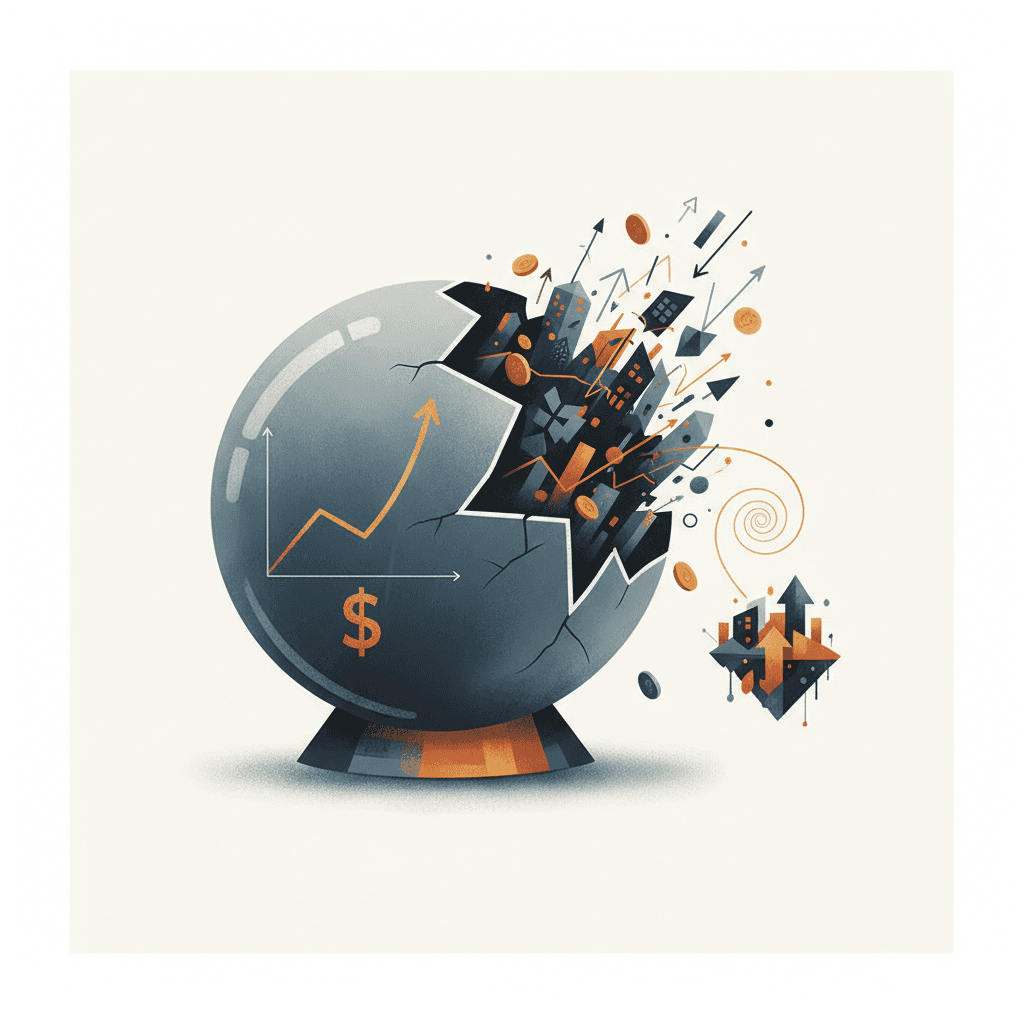
Prediction Markets See a 1-in-3 Chance of Economic Catastrophe. Here's How to Position for It.
There's a composite crisis index tracked on prediction markets that requires something truly ugly to pay out: three or more of five extreme economic indicators have to trigger before mid-2028. We're talking unemployment above 10%, the S&P 500 dropping more than 30%, a housing crash of over 10% year-over-year, labor's share of income falling below 50%, or outright deflation. As of this week, that contract is trading at 30.3% and rising, up 2.7 percentage points in just 24 hours, with $22.8 million in volume behind it.
That means the collective wisdom of people putting real money on the line says there's roughly a 1-in-3 chance of a genuine economic catastrophe.
And it doesn't exist in isolation. A constellation of other prediction market contracts tells the same story from different angles. The probability of a 2026 recession sits at 29%. There's a 38.5% chance unemployment hits 5% or higher. The Nasdaq 100 has a 16.5% chance of falling below 19,000 by year-end. The S&P 500 finishing above 6,845.5, which is essentially flat from here, is basically a coin flip at 49%. And the Federal Reserve? Markets see a 98.5% chance the Fed does nothing at its April meeting and only an 8.5% chance of a 25-basis-point cut in June. There's a 40.4% chance the Fed doesn't cut rates at all this year.
The Fed, in other words, is frozen. And that paralysis is the engine that connects all of these risks together.
The Doom Loop Nobody Wants to Talk About
These aren't separate, unrelated problems. They feed into each other through a single causal chain, and understanding it is worth the minute it takes to read:
- Tariff-driven inflation keeps prices elevated, which keeps the Fed from cutting rates.
- Fed paralysis means borrowing costs stay high for businesses and consumers.
- High borrowing costs squeeze corporate earnings, especially for companies that need to refinance debt.
- Earnings declines lead to layoffs and hiring freezes.
- Rising unemployment crushes consumer spending, which is roughly 70% of the U.S. economy.
- Falling consumer spending tips the economy into recession.
- Recession drags asset prices down, which reduces household wealth, which further reduces spending.
This is what legendary investor Ray Dalio calls a "beautiful deleveraging" failure, where multiple bubbles deflate at the same time and policymakers can't get ahead of the damage because they're fighting inflation and recession simultaneously.
The prediction market data paints a bimodal picture of the future. There's roughly a 50% chance things muddle through and the economy avoids disaster. There's roughly a 30% chance things break badly. And there's very little probability assigned to a strong bull case. That asymmetry, where the downside scenario is almost as likely as the base case while the upside scenario is nearly absent, is what makes this pattern worth paying attention to.
Direct Hedges: Insurance, Not a Bet
If you're looking at these numbers and thinking about protecting your portfolio, two traditional safe-haven assets show up in the analysis alongside one direct hedge.
SH is the most straightforward play. It's an inverse S&P 500 ETF, meaning it goes up when the market goes down. With the S&P priced as a coin flip at current levels and crisis probability at 30%, the risk-reward tilts negative for stocks. But this comes with a BUY signal at 68% confidence, not a strong buy, because the most likely single outcome is still "muddle through." Think of SH as portfolio insurance rather than a core position. It also suffers from daily reset decay, which means if you hold it for months without a downturn, the value erodes slowly like an insurance premium you never collect on.
TLT, the long-duration Treasury bond ETF, carries a BUY signal at 72% confidence. The logic follows Dalio's "All Weather" framework: in a genuine deleveraging crisis, investors stampede into government bonds and the Fed is eventually forced to slash rates, sending bond prices sharply higher. TLT could rally 15-25% in a recession scenario. And if things muddle through instead, you're still collecting roughly 4% in yield. The one scenario where Treasuries fail to protect you is stagflation, where inflation stays hot and the economy shrinks at the same time. In that world, the Fed might actually be forced to raise rates, which would be devastating for long bonds.
GLD gets the highest confidence among the direct hedges at 75%. Gold is the rare asset that works in both of the bad scenarios this pattern identifies. In a deflationary deleveraging, gold acts as a safe haven. In stagflation, where bonds get destroyed, gold acts as an inflation hedge. Central banks globally are buying gold at multi-decade highs. If the Fed stays frozen and can't cut, gold becomes the default hiding place for nervous capital. The catch is that gold is already near all-time highs, so some of this is priced in. And in the initial phase of an acute crash, gold often sells off too as investors liquidate everything to meet margin calls.
The Shovels Trade: Sell Pickaxes During the Gold Rush
During the California Gold Rush, the people who most reliably made money weren't the miners. They were the ones selling shovels, pickaxes, and blue jeans. The same logic applies to financial crises. When uncertainty spikes and everyone rushes to hedge their portfolios, someone has to operate the exchanges where all that frantic trading happens.
CBOE, the company that owns the VIX (the market's "fear gauge"), options exchanges, and volatility products, gets the strongest signal in the entire analysis: STRONG BUY at 80% confidence and an infrastructure relevance score of 88 out of 100. When crisis probability climbs from 30% toward 50%, volatility explodes and trading volumes surge across every product Cboe operates. They collect transaction fees regardless of whether markets go up or down. During the 2020 crash and the 2022 selloff, Cboe's revenues surged. About 45% of their revenue is directly tied to volatility-sensitive products. They hold a monopoly on the VIX, which is the single most-traded volatility instrument in the world.
CME, operator of the world's largest derivatives exchange, earns a BUY at 76% confidence with an infrastructure score of 82. CME covers the other side of the crisis-trading coin. While Cboe dominates equity volatility, CME dominates interest rate futures, commodity futures, and foreign exchange. When the Fed is frozen and nobody knows where rates are heading, trading in Treasury futures and SOFR contracts (the benchmark for short-term interest rates) goes through the roof. When tariffs create commodity price chaos, CME's commodity complex benefits. These two companies together cover nearly the entire landscape of crisis-driven trading activity.
BRK.B, Berkshire Hathaway, gets a BUY at 74% confidence for a different reason. Warren Buffett is sitting on over $330 billion in cash. In a genuine economic crisis, Berkshire becomes the buyer of last resort, the company that swoops in to provide emergency capital on extraordinary terms. They did it in 2008 with Goldman Sachs and GE, extracting deals that generated billions in profit. Berkshire's diverse operating businesses provide earnings even in downturns, and the massive cash pile earns more in a high-rate environment. It's the ultimate "heads I win, tails I don't lose much" position. The main risk is succession. Buffett's age means the crisis-deployment playbook might not be executed as effectively by his successors.
VRSK, Verisk Analytics, earns a BUY at 71% confidence as the "risk modeling shovel." Verisk provides data analytics and risk assessment primarily to insurance and financial services companies. When economic uncertainty spikes, demand for better risk modeling surges. Insurance companies, Verisk's core customers, need more analytics when the world gets unpredictable, not less. Their subscription-based revenue model provides resilience, and they hold a near-monopoly in certain insurance data sets.
Finally, MINT, a PIMCO ultra-short bond ETF, gets a WEAK BUY at 65% confidence. It's not exciting, but in a bimodal world where you don't know which way things break, parking some capital in a vehicle yielding around 5% while maintaining the flexibility to redeploy into distressed assets has strategic value. It's the financial equivalent of keeping cash in your pocket at an auction. You earn yield from the Fed's paralysis (high short-term rates) while staying liquid enough to act if opportunities appear.
The Risks Are Real
Intellectual honesty demands acknowledging what could make this entire thesis wrong.
The biggest risk across every position is the muddle-through scenario. If tariff tensions de-escalate, if a trade deal materializes, or if AI-driven productivity gains sustain corporate earnings despite macro headwinds, markets could rip higher and every hedge in this portfolio loses money or underperforms. The inverse S&P position (SH) decays over time. Gold stalls or drops from all-time highs. The exchange stocks (CBOE, CME) see trading volumes normalize. Cash earns 5% while the S&P gains 20%.
Stagflation is the scenario that breaks the traditional hedging playbook. If inflation stays persistently high and the economy still tips into recession, bonds and stocks could fall together. The Fed might even be forced to hike rates, which would be catastrophic for TLT.
There are also specific risks worth naming. Foreign central banks like China and Japan could dump Treasury holdings, pushing yields higher before any flight-to-quality bid kicks in. The SEC could impose new regulations on options and derivatives markets, hitting CBOE and CME. Berkshire's roughly $300 billion equity portfolio would decline in a crash, partially offsetting the advantage of their cash hoard. And gold, despite its reputation as the ultimate safe haven, tends to sell off in the initial panic phase of a crash as margin calls force liquidation across all asset classes.
Why This Matters for Your Money
You don't need to be a trader for this to be relevant. If you have a 401(k), a savings account, or a mortgage, the scenario these prediction markets are pricing affects you directly.
A 30% chance of economic catastrophe means the grocery bill you've been complaining about could get worse before it gets better, or it could crater along with your home value. It means the job market, which still looks okay on the surface, has a 38.5% chance of deteriorating significantly. It means the Federal Reserve, the institution most people trust to steer the economy, has essentially told us through market pricing that it has no idea what to do next.
The core takeaway isn't that the sky is falling. The most likely outcome is still that things are fine, or at least fine enough. But a nearly 1-in-3 chance of something much worse is not a probability you ignore. It's the kind of probability that justifies checking your portfolio balance, making sure you're not overexposed to a single outcome, and maybe keeping a little more cash on hand than feels comfortable.
The people selling shovels during a gold rush don't need to know whether you'll strike gold. They just need you to keep digging. In a market environment where crisis probability is elevated and the Fed is stuck, the exchanges, the risk modelers, and the companies with fortress balance sheets are the modern equivalent of those shovel sellers.
Analysis based on prediction market data as of April 15, 2026. This is not investment advice.
How This Story Evolved
First detected Mar 20 · Updated daily
The headline was updated to focus on how to position your portfolio instead of just what the odds mean. The article's opening was rewritten to explain the crisis index more clearly and in a more straightforward tone, though the key statistics stayed the same.
The new version adds specific details about what the five economic indicators actually are (unemployment above 10%, S&P 500 down 30%+, a 10%+ housing crash, labor's share of income below 50%, or deflation) right in the opening paragraph. The core facts and numbers stayed the same, but the rewrite makes the warning feel more urgent and personal with phrases like "most people aren't paying attention to."
Read this version →The article was reframed from an investment advice piece to a broader explainer, dropping the "how to position" angle in the headline. The new version also leads with specific numbers right away — a 30.3% probability, a 2.7 percentage point jump in 24 hours, and $22.8 million in trading volume — instead of first explaining what the crisis index is.
Read this version →The article added a name for the prediction market contract ("Citrini composite crisis index") and gave more specific details about some of the triggers, like clarifying the housing crash condition. The headline also shifted its focus from what investors are already doing to how readers themselves can prepare.
Read this version →The headline shifted from explaining what the recession odds mean to focusing on how readers should position their money for it. The article's opening now leads with a clearer breakdown of the specific economic triggers required for the crisis contract to pay out, rather than starting with a general warning about the rising probability.
Read this version →The article was reframed to focus more on explaining what the prediction market signal means for everyday readers, rather than what "smart money" is doing in response. The new version also added a named source for the crisis index (the "Citrini composite crisis index") and included more specific details about some of the trigger conditions, like clarifying the housing price drop threshold.
Read this version →