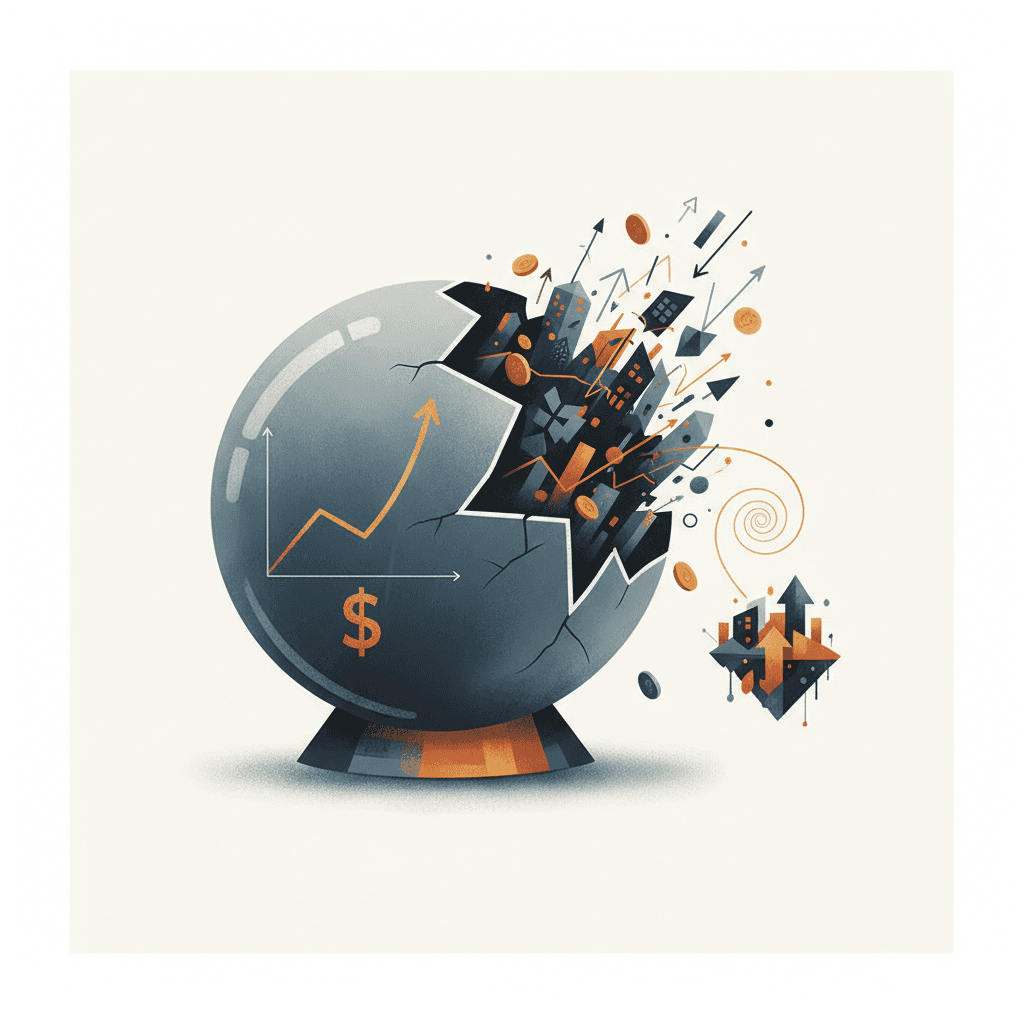
Prediction Markets See a 1-in-3 Chance of Economic Catastrophe. Here's How to Position for It.
Right now, prediction markets are pricing in a 30.3% chance that three or more extreme economic indicators will trigger before mid-2028. That means unemployment above 10%, the S&P 500 down more than 30%, a housing crash of 10% or worse in major cities, labor's share of national income falling below 50%, or outright deflation. Three of those five need to hit for this contract to pay out, and bettors with $22.8 million in volume think there's roughly a 1-in-3 chance it happens.
That's not a fringe bet. That's serious money saying the economy might genuinely break.
And it doesn't exist in isolation. Prediction markets also price the chance of a 2026 recession at 29%. There's a 38.5% chance unemployment reaches 5% or higher before 2027. The Nasdaq has a 16.5% chance of falling below 19,000 by year's end. The S&P 500 finishing above 6,845 (roughly where it is now) is essentially a coin flip at 49%. And the Federal Reserve? There's a 98.5% chance they do nothing in April, only an 8.5% chance they cut in June, and a 40.4% chance they don't cut rates at all this year.
When you stack all of these numbers on top of each other, the picture that emerges is unsettling. These aren't independent risks. They're connected through the same chain of cause and effect.
The Doom Loop, Step by Step
This is the part that should make you sit up a little straighter, because once you see the logic, you can't unsee it.
- Tariffs push prices up. Import costs rise, and that feeds directly into consumer prices.
- The Fed freezes. Inflation stays sticky, so the central bank can't cut rates to help the economy. That's why markets see a 40% chance of zero rate cuts this year.
- Corporate earnings decline. Higher input costs and higher borrowing costs squeeze profit margins.
- Companies lay people off. When profits fall, headcount follows. Hence the 38.5% chance unemployment hits 5%+.
- Consumers pull back. Fewer jobs and more expensive goods mean less spending.
- Recession arrives. Falling demand drags the whole economy down.
- Asset prices collapse. Stocks, housing, and other risk assets deflate as the cycle reinforces itself.
Ray Dalio, the founder of Bridgewater Associates, has a name for when this cycle runs out of control: a failed "beautiful deleveraging." In a successful deleveraging, the central bank can ease policy, the currency weakens gently, and debt gets restructured over time. In a failed one, multiple bubbles pop at once and the tools to fix it are broken. The Fed being paralyzed, stuck between fighting inflation and fighting recession, is exactly the broken-tool scenario.
The key insight from these prediction market numbers is that the S&P 500 being priced as a coin flip while crisis probability sits at 30% means the risk-reward is tilted to the downside. Markets seem to be pricing two worlds: a roughly 50% chance that things muddle through without much excitement, and a roughly 30% chance that things break badly. There's very little probability assigned to a strong bull case. That kind of bimodal distribution, where the bad outcome is almost as likely as the boring outcome and the good outcome barely registers, is when careful positioning matters most.
Direct Hedges: Insurance You Hope You Don't Need
If you want straightforward protection against a market decline, SH is the most liquid way to bet against the S&P 500 on a 1-to-1 basis. It's an inverse ETF, meaning it goes up roughly 1% for every 1% the S&P falls. The confidence level on this signal is 68%, and that moderate number is intentional. The base case is still "muddle through" at about 50% probability, so this is portfolio insurance, not a core position. Think of it like buying fire insurance on your house. You're not hoping for a fire. But if one starts, you'll be glad you have it.
The main risk with SH is daily reset decay, a quirk of inverse ETFs where the math of daily rebalancing slowly eats away at your returns if the market chops sideways for months. A sudden tariff de-escalation or trade deal could also trigger a sharp relief rally. And the possibility of an AI-driven productivity boom sustaining corporate earnings, even in a rough macro environment, can't be dismissed.
TLT, which holds long-duration U.S. Treasury bonds (the 20+ year kind), carries a 72% confidence signal. The logic is classic: in a genuine crisis, investors flee to the safety of government bonds, driving their prices up. If a recession materializes, TLT could rally 15-25%. If things muddle through, you still collect roughly 4% in yield. That asymmetry, where your upside in the bad scenario far exceeds your downside in the boring scenario, is attractive. The one environment where Treasuries fail to protect you is stagflation, where inflation stays high AND the economy shrinks simultaneously. In that world, bonds and stocks both get hurt.
GLD gets the highest confidence of the direct hedges at 75%, because gold works across the widest range of bad outcomes. If the crisis is deflationary, gold acts as a safe haven. If it's stagflationary, gold acts as an inflation hedge when bonds are failing. Central bank gold purchases globally are at multi-decade highs. With the Fed paralyzed and unable to cut, gold becomes the default store of value. The catch is that gold is already near all-time highs, so some of this is priced in. And during the initial panic phase of an acute crash, gold often sells off too as investors liquidate everything to meet margin calls.
The Shovels, Not the Gold: Infrastructure Plays
During the California Gold Rush, the people who most reliably made money weren't the miners. They were the ones selling pickaxes, shovels, and denim jeans. The same logic applies to financial markets during periods of crisis and volatility. You don't have to guess the direction of the market. You can own the companies that profit from the chaos itself.
CBOE, the Cboe Global Markets, earns a STRONG BUY at 80% confidence, the highest conviction call in this entire pattern. Cboe owns the VIX (the market's "fear gauge"), operates options exchanges, and runs the derivatives products that everyone uses to hedge. When crisis probability climbs from 30% toward 50%, volatility explodes and trading volumes surge across every Cboe product: options, futures, VIX derivatives. They collect transaction fees regardless of whether markets go up or down. During both the 2020 pandemic crash and the 2022 bear market, Cboe revenues surged. About 45% of their revenue is directly tied to volatility-sensitive products, and they hold a near-monopoly on VIX-related trading. They are the pickaxe seller when everyone is rushing to buy protection.
CME Group, which runs the world's largest derivatives exchange, gets a BUY at 76% confidence. CME covers interest rate futures, equity index futures, commodities, and foreign exchange. In the current environment, Fed paralysis drives massive interest rate uncertainty, tariffs drive commodity price swings, and recession fears drive equity hedging demand. CME profits from all three simultaneously. Their interest rate complex alone, including Treasury futures and SOFR contracts, sees enormous volume whenever the Fed is stuck. CME complements CBOE: CME covers rates and commodities, CBOE covers equity volatility.
BRK.B, Berkshire Hathaway, gets a BUY at 74% confidence for a different reason. Warren Buffett's company is sitting on more than $330 billion in cash. In Dalio's failed deleveraging scenario, that cash hoard becomes a strategic weapon. Berkshire becomes the buyer of last resort, the provider of emergency capital at punishing terms. They did this in 2008, extracting extraordinary deals from Goldman Sachs and GE when those companies were desperate. Their insurance float provides permanent capital, and their diversified operating businesses keep earning money even in downturns. If crisis doesn't come, the cash earns solid returns in a high-rate environment. If crisis does come, they deploy it at bargain prices. Heads they win, tails they don't lose much.
VRSK, Verisk Analytics, is the "risk modeling shovel" at BUY and 71% confidence. They provide data analytics and risk assessment primarily to insurance and financial services companies. When economic uncertainty spikes, demand for risk modeling, catastrophe analytics, and underwriting intelligence goes up, not down. Their subscription-based revenue model provides resilience. When the probability distribution grows fatter tails, meaning extreme outcomes become more likely, everyone needs better risk assessment tools.
MINT, the PIMCO Enhanced Short Maturity Active ETF, rounds out the positioning at a WEAK BUY and 65% confidence. This is essentially a cash-equivalent vehicle yielding around 5% that preserves your ability to act. In a bimodal world where the two most likely outcomes are "nothing happens" and "everything breaks," holding near-cash that earns yield while keeping your powder dry is itself a strategic choice. If crisis materializes, you have liquid capital ready to deploy into distressed assets.
The Risks You Need to Take Seriously
No honest analysis skips the risks, and this pattern has meaningful ones.
The biggest single risk is that the "muddle through" scenario wins. At roughly 50% probability, it's the most likely individual outcome. In that world, inverse ETFs decay, gold drifts sideways, and you underperform a simple index fund.
Stagflation is the nightmare scenario where even the hedges don't work. If inflation stays stubbornly high while the economy contracts, bonds lose value at the same time stocks do. Gold might hold up, but Treasuries would not.
Tariff de-escalation could change everything overnight. A trade deal or policy reversal would trigger a sharp relief rally that punishes bearish positioning.
The infrastructure plays, CBOE and CME, already trade at premium valuations that reflect some of the volatility optionality. If markets stay calm, their trading volumes normalize and revenue growth stalls.
Berkshire faces succession risk. Buffett's crisis-deployment playbook is legendary, but whether it executes as effectively under future leadership is an open question. And their $300 billion equity portfolio would decline in a crash, partially offsetting the advantage of their cash.
Regulatory risk hovers over the exchange operators. The SEC could impose new rules on options and derivatives markets. Foreign central banks might reduce Treasury holdings as geopolitical tensions rise, pushing yields higher before any flight-to-quality bid materializes.
Why This Matters for Your Money
You don't need to be a professional trader for this to affect you. If you have a 401(k), it's likely weighted toward U.S. stocks, which means you're implicitly betting on the "muddle through" scenario with nearly your entire retirement savings. If you're saving for a house, a 10%+ decline in home values would change your math dramatically, either as an opportunity or as a hit to your current equity. If you buy groceries, tariff-driven inflation is already showing up in your cart.
The prediction market data isn't saying a catastrophe is coming. It's saying there's a meaningful, roughly 1-in-3 chance that it does. The difference between a 5% chance and a 30% chance of a house fire is the difference between declining insurance and demanding it. That's the gap these markets are highlighting.
Positioning for a bimodal world means owning some assets that do well if things break, some that earn a return if things don't, and some, like the exchanges and analytics companies, that profit from the uncertainty itself. The shovels-not-gold approach doesn't require you to predict which way the market goes. It just requires you to notice that everyone is digging.
Analysis based on prediction market data as of April 7, 2026. This is not investment advice.
How This Story Evolved
First detected Mar 20 · Updated daily
The headline was updated to focus on how to position your portfolio instead of just what the odds mean. The article's opening was rewritten to explain the crisis index more clearly and in a more straightforward tone, though the key statistics stayed the same.
Read latest →The new version adds specific details about what the five economic indicators actually are (unemployment above 10%, S&P 500 down 30%+, a 10%+ housing crash, labor's share of income below 50%, or deflation) right in the opening paragraph. The core facts and numbers stayed the same, but the rewrite makes the warning feel more urgent and personal with phrases like "most people aren't paying attention to."
Read this version →The article was reframed from an investment advice piece to a broader explainer, dropping the "how to position" angle in the headline. The new version also leads with specific numbers right away — a 30.3% probability, a 2.7 percentage point jump in 24 hours, and $22.8 million in trading volume — instead of first explaining what the crisis index is.
Read this version →The article added a name for the prediction market contract ("Citrini composite crisis index") and gave more specific details about some of the triggers, like clarifying the housing crash condition. The headline also shifted its focus from what investors are already doing to how readers themselves can prepare.
Read this version →The headline shifted from explaining what the recession odds mean to focusing on how readers should position their money for it. The article's opening now leads with a clearer breakdown of the specific economic triggers required for the crisis contract to pay out, rather than starting with a general warning about the rising probability.
The article was reframed to focus more on explaining what the prediction market signal means for everyday readers, rather than what "smart money" is doing in response. The new version also added a named source for the crisis index (the "Citrini composite crisis index") and included more specific details about some of the trigger conditions, like clarifying the housing price drop threshold.
Read this version →