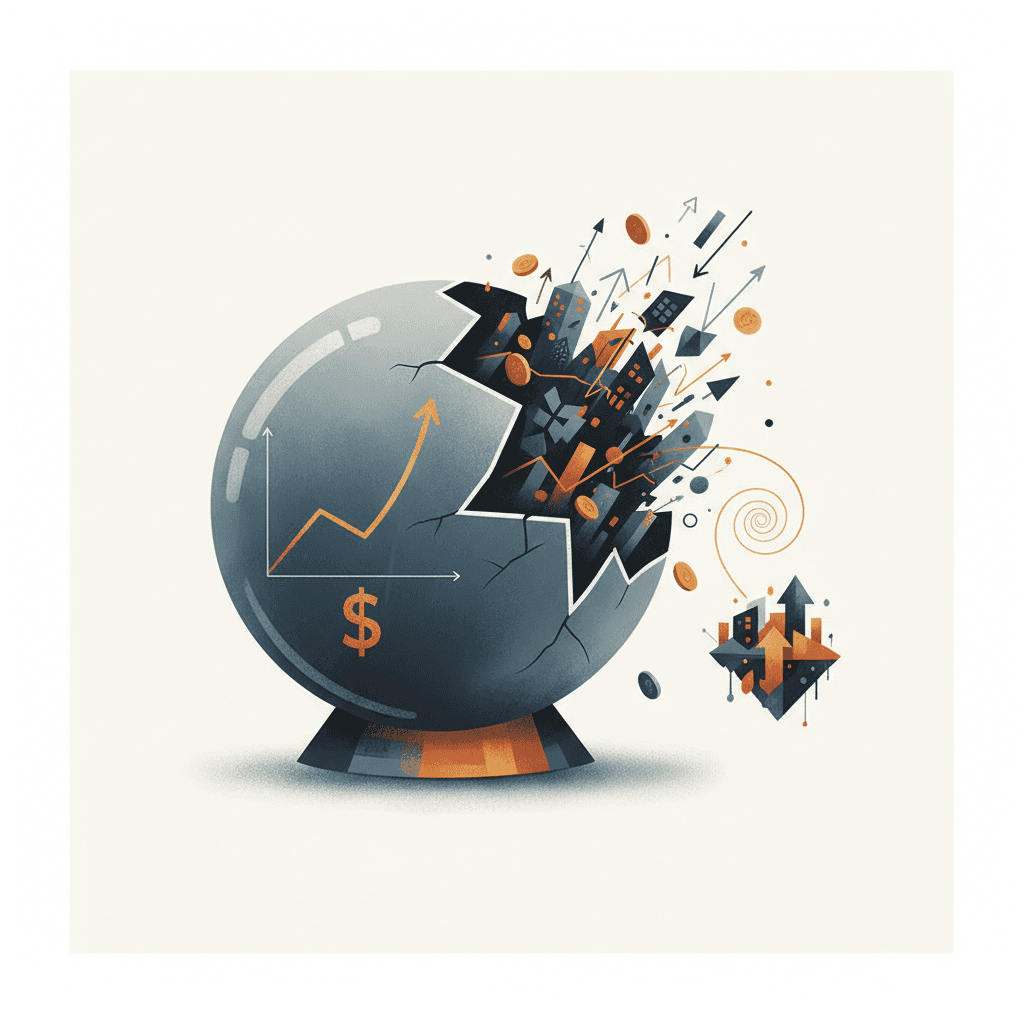
Prediction Markets See a 1-in-3 Chance of Economic Catastrophe. Here's What That Means for Your Portfolio.
Prediction markets are flashing a signal that deserves attention. A composite crisis index, one that requires at least three out of five extreme economic indicators to trigger simultaneously, has climbed to 30.3% and is rising, up 2.7 percentage points in just 24 hours on $22.8 million in trading volume. That means bettors with real money on the line believe there is nearly a one-in-three chance of a genuine economic catastrophe before mid-2028.
The five indicators this contract tracks are severe: unemployment above 10%, the S&P 500 falling more than 30% from its highs, a housing crash with home values dropping more than 10% year-over-year in major cities, labor's share of national income falling below 50%, and outright deflation. For this contract to pay out, three of those five things need to happen. That's not a garden-variety recession. That's a multi-system failure.
And the number doesn't exist in isolation. Cross-reference it with other prediction market contracts and the picture gets more coherent, not less. The probability of a recession in 2026 sits at 29.5%. There's a 38.5% chance unemployment reaches 5% or higher before 2027. The Nasdaq has a 16.5% chance of falling below 19,000 by year-end. And the Federal Reserve appears frozen in place, with a 98.5% chance of no action at its April meeting, only an 8.5% chance of a 25-basis-point cut in June, and a 40.4% chance of zero rate cuts for the entire year.
That last part matters enormously, because the Fed's paralysis is the hinge on which everything else swings.
The Self-Reinforcing Doom Loop
These risks aren't independent dice rolls. They're connected through a causal chain that feeds on itself, and understanding that chain is the key insight here.
- Tariffs drive up prices. Import costs rise, and businesses pass them along to consumers.
- The Fed can't cut rates because inflation is still running above target. Cutting would pour gasoline on the fire. But they can't hike either, because the economy is already softening. They're stuck.
- Higher costs and higher borrowing rates squeeze corporate earnings. Companies that can't raise prices enough start cutting costs the old-fashioned way.
- Layoffs begin. Unemployment ticks up.
- Consumers pull back spending. When people lose jobs or fear losing them, wallets close.
- Less spending means less revenue for businesses, which means more layoffs, which means less spending. The cycle accelerates.
- Asset prices fall as earnings decline and investors reprice risk.
Each step makes the next one more likely. That's what makes this pattern dangerous and why a 30% crisis probability isn't something to shrug off.
Meanwhile, the S&P 500 is priced almost exactly as a coin flip. Prediction markets give it a 49% chance of finishing 2026 above 6,845.5, which is roughly where it sits today. The market is essentially saying: flat is the median outcome. But when you combine "flat as the most likely outcome" with "30% chance of a severe crisis," the math tilts negative. You're looking at a bimodal distribution, about a 50% chance things muddle through, about a 30% chance they break badly, and very little probability assigned to a strong bull case. The risk-reward is lopsided to the downside.
Selling Shovels During a Gold Rush (or a Panic)
During the California Gold Rush, the people who reliably made money weren't the miners. They were the ones selling pickaxes, shovels, and denim jeans. The same principle applies in financial markets during periods of crisis and uncertainty. Instead of betting purely on direction, the smarter play is often owning the infrastructure that profits regardless of which way prices move.
CBOE is the strongest example of this. Cboe Global Markets owns the VIX, the most widely watched volatility index in the world, along with major options exchanges and volatility products. When crisis probability rises and fear takes hold, trading volumes in options, futures, and VIX derivatives explode. Cboe earns transaction fees on all of it, regardless of whether markets go up or down. In 2020 and 2022, their revenue surged during volatility spikes. Roughly 45% of their revenue is directly tied to volatility-sensitive products, and they hold a near-monopoly on VIX-linked trading. They are, quite literally, the pickaxe seller when everyone rushes to buy portfolio insurance. Confidence on this signal is the highest of the group at 80%.
CME plays a complementary role. CME Group operates the world's largest derivatives exchange, covering interest rate futures, equity index futures, commodities, and foreign exchange. In the current environment, Fed paralysis creates massive uncertainty in interest rates, tariffs create commodity price volatility, and recession fears drive equity hedging demand. CME profits from all three simultaneously. Their interest rate complex, which includes SOFR and Treasury futures, sees enormous volume whenever the Fed's path is unclear. Together, CBOE covers equity volatility and CME covers rates and commodities, giving you broad infrastructure exposure across the crisis spectrum. Confidence: 76%.
VRSK, Verisk Analytics, is a subtler infrastructure play. They provide data analytics and risk modeling primarily to insurance companies and financial services firms. When economic uncertainty spikes and the tails of the probability distribution get fatter, demand for better risk assessment goes up, not down. Insurance companies need more analytics when they can't tell how bad things might get. Verisk's subscription-based revenue model provides a stable floor, and their near-monopoly position in certain insurance data sets protects their competitive position. Confidence: 71%.
The Traditional Hedges
Beyond infrastructure, the pattern supports three more conventional positions.
GLD carries the highest confidence among the traditional hedges at 75%. Gold is unique because it benefits from both major crisis scenarios. If the economy tips into deflation and deleveraging, gold acts as a safe haven. If instead we get stagflation, where inflation stays high while the economy shrinks, gold acts as an inflation hedge at the exact moment when bonds fail to protect you. Central bank gold purchases globally are running at multi-decade highs. Gold has already been strong, so some of this is priced in, but in a genuine multi-bubble deflation it historically outperforms by a wide margin.
TLT, the iShares 20+ Year Treasury Bond ETF, represents long-duration U.S. government bonds. In a classic deleveraging crisis, these rally hard as investors flee to safety and the Fed is eventually forced to cut rates aggressively. With the Fed currently frozen, long bonds look cheap relative to the crisis scenario. If recession materializes, TLT could rally 15-25%. If things muddle through, you still collect roughly a 4% yield while you wait. Confidence: 72%.
BRK.B, Berkshire Hathaway, is in a category of its own. With over $330 billion in cash, Berkshire is essentially the buyer of last resort for corporate America. In 2008, Warren Buffett extracted extraordinary terms from Goldman Sachs and GE when those companies were desperate for capital. That playbook could repeat. Their insurance float provides permanent capital, their diverse operating businesses generate earnings even in downturns, and that mountain of cash earns more in a high-rate environment. If crisis hits, they deploy at distressed prices. If it doesn't, they sit on their cash and wait. Confidence: 74%.
SH, the ProShares Short S&P 500 ETF, provides direct inverse exposure to the S&P 500. With crisis probability at 30% and the index essentially priced as a coin flip, the risk-reward skews negative. This is best thought of as insurance, not a directional bet. It gets a BUY rather than a STRONG BUY because the most likely single outcome is still the muddle-through scenario at roughly 50% probability. Confidence: 68%.
MINT, the PIMCO Enhanced Short Maturity Active ETF, is a cash-equivalent vehicle yielding around 5%. In a bimodal environment where you're not sure if things will be fine or terrible, holding near-cash that pays you to wait is itself a strategic position. You earn yield from the Fed's high short-term rates while maintaining the liquidity to rotate into distressed assets if the crisis scenario unfolds. Confidence: 65%.
The Risks You Need to Understand
No honest analysis ignores what could go wrong, and there's plenty that could undermine this thesis.
The most important risk is the simplest one: things could just be fine. The muddle-through scenario at roughly 50% probability is the single most likely outcome. A tariff de-escalation or trade deal could trigger a sharp relief rally. An AI-driven productivity boom could sustain corporate earnings despite macro headwinds. If the crisis doesn't materialize, the infrastructure plays like CBOE and CME see trading volumes normalize and revenue growth stall, gold likely goes sideways or down, and the inverse S&P position (SH) bleeds value from daily reset decay.
The stagflation scenario is the one that breaks the traditional playbook. If inflation stays stubbornly high while the economy simultaneously enters recession, bonds and equities both get hammered. TLT would not protect you. The Fed might actually be forced to hike rates rather than cut, which would destroy bond prices. Rising fiscal deficits could push long-term yields higher even without Fed action. Foreign central banks like China and Japan could sell Treasury holdings as geopolitical tensions escalate.
For gold specifically, there's a paradox: in the acute phase of a market crash, gold often sells off initially as margin calls force investors to liquidate everything, including their safe-haven positions, to meet cash demands. Gold's safety arrives after the panic, not during it.
Berkshire faces succession risk. Buffett's crisis-deployment playbook may not be executed with the same judgment by his successors. And Berkshire's roughly $300 billion equity portfolio would decline in a crash, partially offsetting the advantage of their cash position.
For the exchange operators, regulation is an ever-present risk. The SEC could impose new rules on options and derivatives markets. Competition from each other and from new electronic platforms could erode margins.
And all of these positions carry valuation risk. CBOE, CME, VRSK, and BRK.B already trade at premiums that reflect some of this crisis optionality. A broad market selloff could compress their multiples regardless of their fundamental resilience.
Why This Matters for Your Money
If you have a 401(k), a brokerage account, or savings you're planning to use in the next few years, the signal from prediction markets is worth paying attention to. A 30% chance of catastrophe is not a forecast that the sky is falling. It's more like a weather report saying there's a 30% chance of a severe thunderstorm. You probably still go outside, but you bring an umbrella.
The practical takeaway is about portfolio balance. If your retirement account is 100% stocks, you're betting entirely on the muddle-through scenario. The prediction markets are telling you that bet has roughly a coin-flip chance of working and a meaningful chance of going very wrong. Some allocation to bonds, gold, cash-equivalents, and companies that profit from volatility itself could make the difference between a portfolio that survives a storm and one that gets caught without an umbrella.
The infrastructure thesis, owning the exchanges and data providers rather than just betting on direction, is the more sophisticated version of this. You don't need to predict whether the economy crashes or mudddles through. You just need to recognize that uncertainty itself is a product people will pay for, and the companies that sell risk management tools tend to do well when the world needs more of them.
Analysis based on prediction market data as of April 9, 2026. This is not investment advice.
How This Story Evolved
First detected Mar 20 · Updated daily
The headline was updated to focus on how to position your portfolio instead of just what the odds mean. The article's opening was rewritten to explain the crisis index more clearly and in a more straightforward tone, though the key statistics stayed the same.
Read latest →The new version adds specific details about what the five economic indicators actually are (unemployment above 10%, S&P 500 down 30%+, a 10%+ housing crash, labor's share of income below 50%, or deflation) right in the opening paragraph. The core facts and numbers stayed the same, but the rewrite makes the warning feel more urgent and personal with phrases like "most people aren't paying attention to."
Read this version →The article was reframed from an investment advice piece to a broader explainer, dropping the "how to position" angle in the headline. The new version also leads with specific numbers right away — a 30.3% probability, a 2.7 percentage point jump in 24 hours, and $22.8 million in trading volume — instead of first explaining what the crisis index is.
The article added a name for the prediction market contract ("Citrini composite crisis index") and gave more specific details about some of the triggers, like clarifying the housing crash condition. The headline also shifted its focus from what investors are already doing to how readers themselves can prepare.
Read this version →The headline shifted from explaining what the recession odds mean to focusing on how readers should position their money for it. The article's opening now leads with a clearer breakdown of the specific economic triggers required for the crisis contract to pay out, rather than starting with a general warning about the rising probability.
Read this version →The article was reframed to focus more on explaining what the prediction market signal means for everyday readers, rather than what "smart money" is doing in response. The new version also added a named source for the crisis index (the "Citrini composite crisis index") and included more specific details about some of the trigger conditions, like clarifying the housing price drop threshold.
Read this version →