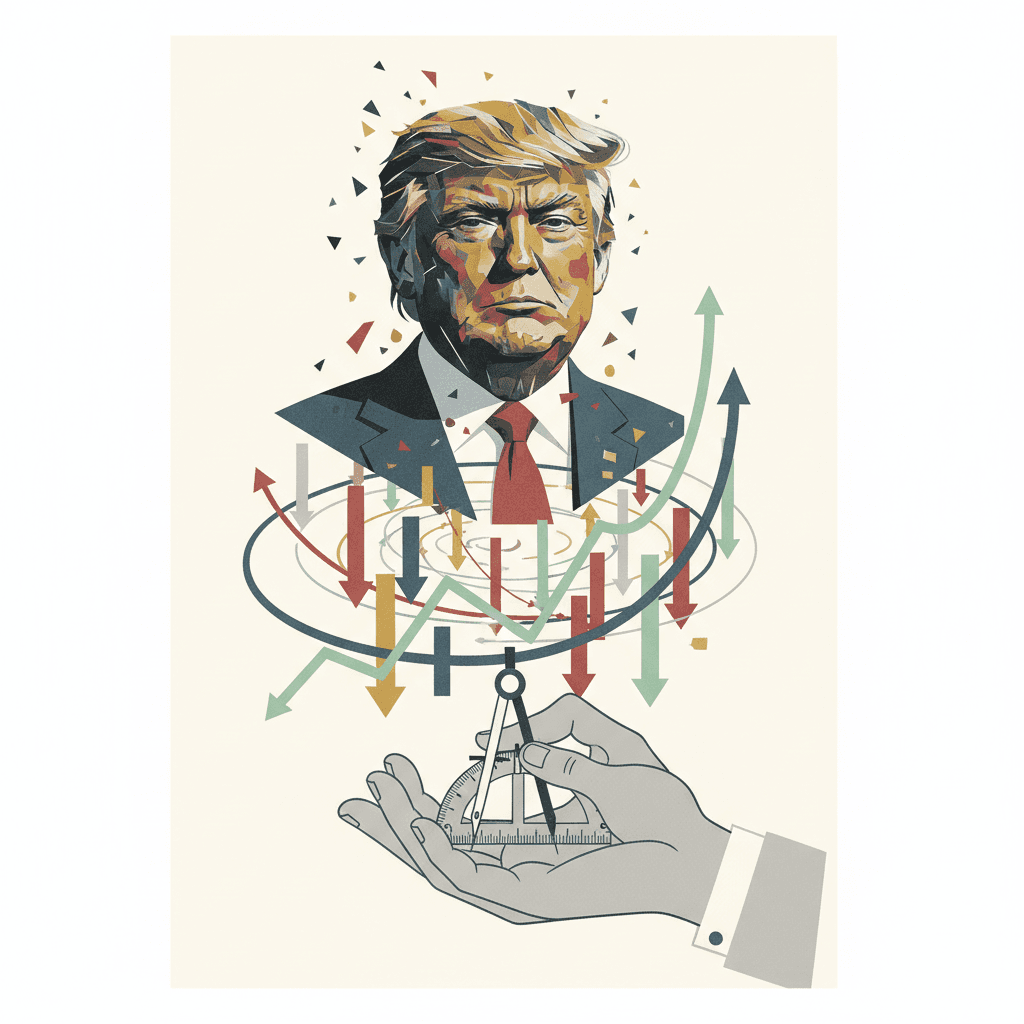
Prediction Markets Are Pricing In a Trump Administration in Decline. Here's What That Means for Your Portfolio.
Prediction markets are telling a story right now, and it's not a subtle one. Across more than a dozen political betting contracts with over $17 million in combined trading volume, the collective wisdom of thousands of traders is pointing in the same direction: the Trump administration is losing political capital, and the erosion is accelerating.
Let's walk through the numbers, because they paint a remarkably coherent picture.
The Power Cycle Is Running Down
Political capital works a lot like a battery. Presidents arrive in office with a full charge, and every fight, every controversy, every legislative battle drains it. Some presidents recharge through wins. Others watch the gauge tick steadily toward zero. Prediction markets are betting that Trump's battery is draining fast.
The probability that Trump leaves office before January 2029 sits at 41.7%. The chance he's out before 2028 is 30.4%, and even the near-term contract for leaving before August 2026 is trading at 7%, which is not trivial for a sitting president. Impeachment before January 2029 is priced at a striking 68.5%. Actual removal from office through impeachment and conviction is at 26.5%, a number that sounds low until you remember it has literally never happened in American history.
Meanwhile, the cabinet is hollowing out. Attorney General Pam Bondi's departure by the end of 2026 is priced at 99.5%, with a 92.5% chance she's gone by May. FBI Director Kash Patel leaving before 2027 is at 72%. Defense Secretary Pete Hegseth's departure sits at 48.5%, essentially a coin flip. When senior cabinet members start heading for the exits at these rates, it signals either internal dysfunction or a coming reshuffling of power, and sometimes both.
The political opposition is gaining ground too. Democrats winning the House in the 2026 midterms is priced at 85.5%. And the 2028 Republican presidential nomination is already fragmenting, with J.D. Vance at 37.2%, Marco Rubio at 24.4%, and Tucker Carlson at 6%. When a party starts fighting over the next nominee before the current president has even reached his midterm, that tells you something about how the party views the current trajectory.
Perhaps the most telling number of all: the "Trump bull case" contract, which bundles together optimistic scenarios for the administration through 2026, is trading at just 6.3%. The market sees a 93.7% chance that things don't go well.
Why This Matters for Your Money
This isn't just political drama. It has real financial consequences that could show up in your 401(k), your grocery bills, and your savings account.
A lot of the stock market gains over the past year were built on assumptions about what Trump's second term would deliver: deregulation, tax policy continuity, and a pro-business stance on trade (even if tariffs created short-term chaos). If the administration is consumed by impeachment proceedings, cabinet turnover, and a hostile Democratic House starting in 2027, most of that agenda stalls.
Tariff policy becomes unpredictable. Deregulation efforts lose momentum. Fiscal stimulus dies in a divided Congress. The "Trump trade" that lifted certain sectors starts to unwind. And uncertainty, more than any single bad outcome, is what markets hate most.
This creates a self-reinforcing cycle that's worth understanding:
- Cabinet departures signal instability, which emboldens Congressional opposition
- Congressional opposition (especially a Democratic House at 85.5%) blocks the legislative agenda
- A stalled agenda weakens the president's political capital further
- Weakened political capital makes impeachment proceedings more likely
- Impeachment proceedings consume oxygen that would otherwise go toward policy
- The lack of policy wins accelerates more cabinet departures
- Return to step 1
This is the kind of loop that, once it starts spinning, is very hard to stop.
The Trades: Selling Shovels in a Political Gold Rush
The most important investing lesson from the California Gold Rush wasn't about gold. It was about shovels. Most prospectors went broke. The people who sold them picks, shovels, and denim jeans got rich regardless of whether any individual miner struck gold. The same logic applies here: you don't need to predict exactly how political instability plays out. You just need to own the infrastructure that profits from the chaos itself.
The Shovel Sellers
CBOE is the highest-conviction trade in this pattern, with a confidence rating of 80%. Cboe Global Markets literally owns the VIX, the volatility index that Wall Street uses to measure fear. Every single volatility trade, whether someone is buying protection or selling it, generates transaction fees for Cboe. They don't care which direction the market moves. They profit from the movement itself. A prolonged period of political instability means elevated hedging activity for years, not just one spike. They benefit whether Trump stays or goes, whether markets rise or fall. That's as close to a pure infrastructure play as you can find.
CME operates the world's largest derivatives exchange, with a confidence rating of 78%. Political uncertainty drives hedging across every asset class: interest rate futures when fiscal policy gets unpredictable, currency futures when tariff policy whipsaws, equity index futures when headline risk spikes, and Treasury futures when deficit concerns bubble up. The combination of tariff whiplash, potential government shutdowns, and impeachment drama creates a multi-year volume tailwind for CME's business.
ICE rounds out the exchange operators as a weaker buy at 68% confidence. Intercontinental Exchange runs exchanges and clearinghouses across energy, credit, and fixed income derivatives, plus it owns the New York Stock Exchange. It's more diversified than Cboe, which means less concentrated upside from this specific thesis, but it still benefits from the same structural demand for hedging.
The Direct Plays
VIXY gets a buy signal at 72% confidence as a direct bet on rising volatility. A 68% impeachment probability, accelerating cabinet departures, and the Democratic House takeover create what looks like a structural volatility regime rather than a one-off spike. The 24-month timeline of escalating political conflict suggests repeated volatility surges. But this comes with a massive caveat: VIX products suffer from something called contango decay, which means they lose roughly 5-10% of their value per month during calm periods. Think of it like holding ice cream on a hot day. You need the volatility to show up relatively soon, or the position melts in your hands. This is a tactical trade, not something to set and forget.
GLD earns a buy at 76% confidence. Gold is the classic hedge against institutional instability, and this pattern describes a multi-year regime of U.S. political dysfunction. Central banks around the world are already stockpiling gold as part of a broader move away from dollar-denominated reserves. American political chaos accelerates that trend. Gold also serves as portfolio insurance if the "Trump trade" unwind is sharper than expected. The concern is that gold is already near all-time highs, so a lot of this worry may already be reflected in the price.
SH, which is an inverse S&P 500 ETF that goes up when the market goes down, gets only a weak buy at 55% confidence. If deregulation stalls, tariff policy turns erratic, and fiscal stimulus dies in a divided Congress, the S&P 500 could give back gains built on those assumptions. But corporate earnings might stay strong on their own, and the Federal Reserve still has tools to support markets. This is a hedge position, not a core holding.
TLT, the long-term Treasury bond ETF, gets a weak buy at 58% confidence. Long-duration Treasuries tend to benefit from flight-to-safety buying during political crises and from the growth-dampening effects of policy uncertainty. If the pro-growth agenda stalls, that's disinflationary, which supports bond prices. A Democratic House blocking fiscal expansion would also ease deficit concerns somewhat. But this one cuts both ways: if political chaos triggers a credit rating downgrade or a debt ceiling crisis, long-term Treasuries could actually sell off sharply.
The Risks You Need to Take Seriously
This is a high-conviction pattern at 85% confidence, but there are real reasons it could be wrong.
The structural decay problem. Both VIXY and SH lose value over time even when the thesis is correct, due to the mechanics of how these products are built. Being early on volatility is functionally the same as being wrong.
Markets have shrugged off impeachment before. During the Clinton impeachment, the S&P 500 actually rose. Political drama and market drama don't always move in lockstep.
The pessimism might already be priced in. With the Trump bull case at only 6.3%, a contrarian could argue that expectations are already so negative that any positive surprise would spark a rally. When everyone is already bearish, there's nobody left to sell.
Trump could stabilize. A foreign policy crisis, a deal with Congress, or a rally-around-the-flag moment could reverse the erosion of political capital. The prediction markets are giving him roughly a one-in-three chance of making it to 2029 without impeachment, which is not zero.
Corporate fundamentals might override politics. Companies have reported strong earnings through past political upheavals. If profit growth stays solid, stocks could rise regardless of what's happening in Washington.
The exchange operators carry their own risks. CBOE and CME are already trading at premium valuations, and they face competition from each other and from emerging crypto derivatives platforms. If political chaos resolves quickly, trading volumes normalize and the thesis weakens.
Gold at all-time highs means GLD has significant downside if uncertainty fades, and it pays no income while you hold it. In a world of 4-5% interest rates, that opportunity cost is real.
Rising real interest rates would hurt both gold and long-duration Treasuries regardless of the political backdrop, and sticky inflation could keep rates elevated for longer than anyone expects.
The Bottom Line
The prediction market data tells a consistent story: the Trump administration is in a classic second-term power decline, and it's happening faster than most historical precedents. The cabinet is thinning out, the opposition is gaining seats, the party is already looking past this presidency, and the market for optimistic outcomes has nearly dried up.
For investors, the most durable way to play this isn't by betting on any single political outcome. It's by owning the companies that profit from the uncertainty itself. Cboe, CME, and ICE are the shovel sellers of political volatility. They collect fees on every hedge, every trade, every panicked portfolio adjustment, regardless of which way the political winds blow. In a world where the only thing we can predict with confidence is unpredictability, that's a valuable business model to own.
Analysis based on prediction market data as of April 7, 2026. This is not investment advice.
How This Story Evolved
First detected Mar 20 · Updated daily
The article's headline was simplified to be more direct and reader-friendly, dropping the "Power Cycle" concept. The opening paragraph was also tweaked slightly, with the total trading volume figure reduced from $20 million to $17 million and some sentences rearranged.
The new version uses more colorful, informal language (like comparing the administration to "a car losing parts on the highway") and adds a reference to the "Trump trade" affecting markets. The overall message stays the same, but the tone becomes more casual and punchy.
Read this version →