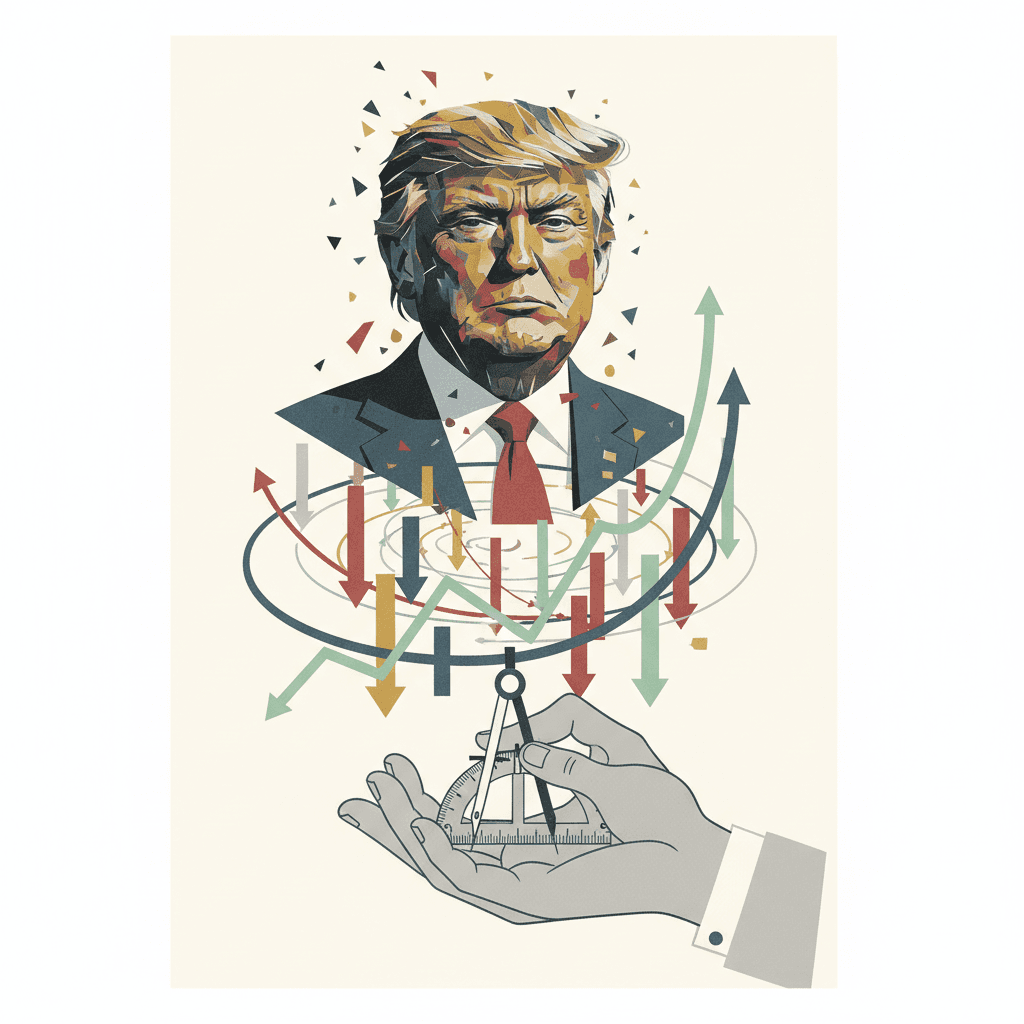
Betting Markets See Trump's Power Eroding Fast. Here's How to Position for It.
Prediction markets are painting a striking picture of the Trump administration right now, and it looks less like a well-oiled machine and more like a car losing parts on the highway. Multiple betting markets, representing over $17 million in combined trading volume, are converging on a single theme: political instability is accelerating, executive power is eroding, and the so-called "Trump trade" that juiced markets is running out of fuel.
Let's walk through what the numbers actually say, because they tell a story that's hard to ignore.
The Numbers Tell a Story
Betting markets currently price a 30.4% chance that Trump leaves office before 2028 and a 41.7% chance he's out before January 2029. The probability of impeachment before Inauguration Day 2029 sits at 68.5%, while actual removal from office is priced at 26.5%. For context, those are not fringe odds. A 68.5% impeachment probability means bettors think it's roughly twice as likely to happen as not.
The near-term outlook is less dramatic. There's only a 7% chance Trump leaves before August 2026 and a 15.4% chance he departs this year. But the probabilities climb quickly as you extend the timeline, suggesting bettors see a slow boil rather than a sudden crisis.
Meanwhile, the cabinet is hemorrhaging. Attorney General Pam Bondi's departure before year-end is priced at a near-certain 99.5%, with a 91.5% chance she's out by April 9th. FBI Director Kash Patel leaving before 2027 sits at 72%. Defense Secretary Pete Hegseth's departure is at 48.5%, essentially a coin flip.
And the broader political landscape is shifting against the administration. Democrats winning the House in 2026 is priced at 85.5%. The 2028 Republican nomination is already fragmenting, with J.D. Vance at 37.2%, Marco Rubio at 24.4%, and Tucker Carlson at 6%. Perhaps most telling of all, the "Trump bull case combo" for 2026, a bet that Trump's policy agenda succeeds on multiple fronts, is trading at just 6.3%.
That last number deserves a second look. Only 6.3% of bettors think the optimistic scenario plays out. That's the market saying this term will be defined by conflict, not execution.
The Power Cycle in Decline
This pattern follows a self-reinforcing loop that political scientists would recognize immediately:
- Cabinet departures signal internal dysfunction, which makes it harder to execute policy.
- Failed policy execution erodes public support and emboldens congressional opposition.
- An emboldened opposition (especially a Democratic House at 85.5% probability) launches investigations and potentially impeachment proceedings.
- Impeachment proceedings consume political oxygen, causing more cabinet departures and further stalling the agenda.
- A stalled agenda fragments the party's 2028 bench, as potential successors start positioning themselves rather than supporting the president.
- The fragmentation signals weakness, which restarts the cycle at step one.
This is the political capital machine running down. And it has real consequences for your portfolio.
What This Means for Markets
The market implications are bearish for policy continuity and bullish for anything that benefits from uncertainty. Much of the stock market rally over the past year was built on assumptions about deregulation, tariff strategy, and fiscal stimulus. If those assumptions unwind, so do the gains built on top of them.
A Democratic House means legislative gridlock from late 2026 onward. Tariff policy becomes erratic without a unified governing coalition. Fiscal stimulus dies in divided government. The "Trump trade" doesn't just pause. It reverses.
Trade Signals: Selling Shovels During the Gold Rush
During the California Gold Rush, most prospectors went broke. The people who got rich were the ones selling shovels, pickaxes, and blue jeans. The same logic applies to political volatility. You don't need to correctly predict whether Trump gets impeached or whether the S&P crashes. You just need to own the infrastructure that profits from the chaos itself.
The Shovel Sellers
CBOE (Buy, 80% confidence) is the ultimate shovel seller for political volatility. Cboe Global Markets literally owns the VIX, the fear index you see on cable news. They profit from every single volatility trade, whether someone is buying or selling, regardless of direction. When political uncertainty drives hedging demand, options volume surges, and Cboe collects transaction fees on all of it. A prolonged period of political instability means elevated hedging activity for years, not just one spike. They benefit whether Trump stays or goes, whether markets go up or down.
Risk factors: Revenue depends on trading volume, so extended calm periods hurt. They face competition from CME Group and ICE in derivatives. The stock already trades at a premium valuation, and regulatory changes to options markets could impact fees.
CME (Buy, 78% confidence) operates the world's largest derivatives exchange. Political uncertainty drives hedging across every asset class, including interest rate futures when fiscal policy becomes unpredictable, equity index futures, currency futures when tariff uncertainty spikes, and Treasury futures if deficit concerns rise under divided government. The combination of tariff policy whiplash, potential government shutdowns, and impeachment drama creates a multi-year volume tailwind.
Risk factors: Fee compression from competition and regulatory pressure, already fairly valued as a quality defensive name, volume normalizes if political chaos resolves quickly, and emerging crypto derivatives competition.
ICE (Weak Buy, 68% confidence) operates exchanges and clearinghouses across energy, credit, and fixed income derivatives. ICE also owns the NYSE, so it benefits from equity market volatility too. Policy uncertainty around tariffs, energy policy, and fiscal direction drives hedging demand across ICE's product suite. It's less directly exposed than Cboe to pure volatility but benefits from the same structural tailwinds.
Risk factors: High diversification means less concentrated upside from this specific thesis. Their mortgage technology segment (from the Ellie Mae acquisition) is rate-sensitive in the wrong direction. Premium valuation limits upside, and revenue growth may not accelerate meaningfully from only a moderate volatility increase.
Direct Volatility and Hedging Plays
VIXY (Buy, 72% confidence) gives you direct exposure to VIX futures, which steepen as political uncertainty translates into market uncertainty. A 68% impeachment probability, accelerating cabinet departures, and a Democratic House takeover at 85.5% create a structural volatility regime. The 24-month timeline of escalating political conflict suggests repeated volatility spikes rather than a single event. But this is a tactical position, not a hold-forever trade, because VIX products have structural decay built in.
Risk factors: Severe contango decay costs roughly 5-10% monthly in calm markets. Political dysfunction may already be priced into equity markets. Trump could stabilize through deal-making or rally-around-the-flag events. Markets historically shrugged off impeachment proceedings during the Clinton era. And being early on volatility is functionally the same as being wrong.
GLD (Buy, 76% confidence) is the classic political uncertainty hedge. This pattern describes a multi-year regime of U.S. institutional instability. Cabinet exodus, impeachment proceedings, policy discontinuity on tariffs and deregulation, and 2028 primary fragmentation all erode confidence in U.S. policy predictability. Central banks globally are already accumulating gold as de-dollarization accelerates, and U.S. political dysfunction amplifies that trend. Gold also serves as portfolio insurance if the Trump trade unwind is sharper than expected.
Risk factors: Gold is already at or near all-time highs, with significant downside if uncertainty resolves. Rising real interest rates would hurt gold regardless of the political backdrop. Gold pays no yield, creating significant opportunity cost in a high-rate environment. Dollar strength could offset safe-haven flows. And the political instability trade may already be consensus, reducing any edge.
SH (Weak Buy, 55% confidence) is the ProShares Short S&P 500 ETF, essentially a bet against the broad market. If the Trump trade unwinds, with deregulation stalling, tariff policy becoming erratic, and fiscal stimulus dying in a divided Congress, the S&P 500 gives back gains built on those assumptions. But this is a hedge, not a core position. Corporate earnings fundamentals may override political noise, and the Fed still has tools.
Risk factors: Inverse ETFs suffer from daily rebalancing decay over longer periods. Corporate earnings could remain strong independent of political chaos. Fed accommodation could offset policy uncertainty. Markets often do well under divided government because of reduced legislative risk. And the already-low 6.3% Trump bull case may mean pessimism is fully priced in, creating contrarian risk.
TLT (Weak Buy, 58% confidence) holds long-duration Treasury bonds, which benefit from flight-to-safety bids during political crises and from the growth-dampening effects of policy uncertainty. If Trump's term is defined by conflict rather than execution, the pro-growth agenda stalls, which is disinflationary (meaning it pushes prices down rather than up) and supports long bonds. A Democratic House blocks fiscal expansion, reducing deficit concerns somewhat.
Risk factors: A government shutdown or debt ceiling crisis could actually hurt Treasuries. Sticky inflation would keep rates elevated regardless of politics. If divided government leads to fiscal irresponsibility, the term premium (the extra yield investors demand for holding long-term bonds) rises. Duration risk is extreme, meaning 20-plus year bonds are highly sensitive to rate changes. And the correlation between political uncertainty and Treasury demand is historically inconsistent.
Why This Matters for Your Wallet
You don't need to trade a single one of these tickers for this pattern to affect you. If you have a 401(k) or any retirement savings, the assumptions baked into U.S. equity valuations include some degree of policy stability and follow-through on the pro-business agenda. A 6.3% bull case probability means the market is already bracing for disappointment on that front.
Divided government after the 2026 midterms, at 85.5% probability, historically means less gets done in Washington. That can actually be good for markets in normal times because it reduces the risk of bad legislation. But this isn't normal times. The combination of active impeachment risk, tariff uncertainty, and a fragmenting Republican party creates a level of policy unpredictability that goes beyond typical gridlock.
For everyday life, this means planning around uncertainty. Interest rates may stay volatile. Energy policy could whipsaw. Tax policy after 2025 is a question mark. The grocery bill and savings account rate you're earning both connect back to a government that prediction markets increasingly expect to be consumed by political warfare rather than economic management.
The shovel-seller thesis, owning the exchanges and infrastructure that profit from volatility regardless of direction, is the most robust way to position for this environment. You don't need to predict the outcome. You just need to recognize that the game itself is getting louder, and someone is collecting a fee on every move.
Analysis based on prediction market data as of April 7, 2026. This is not investment advice.
How This Story Evolved
First detected Mar 20 · Updated daily
The article's headline was simplified to be more direct and reader-friendly, dropping the "Power Cycle" concept. The opening paragraph was also tweaked slightly, with the total trading volume figure reduced from $20 million to $17 million and some sentences rearranged.
Read latest →The new version uses more colorful, informal language (like comparing the administration to "a car losing parts on the highway") and adds a reference to the "Trump trade" affecting markets. The overall message stays the same, but the tone becomes more casual and punchy.