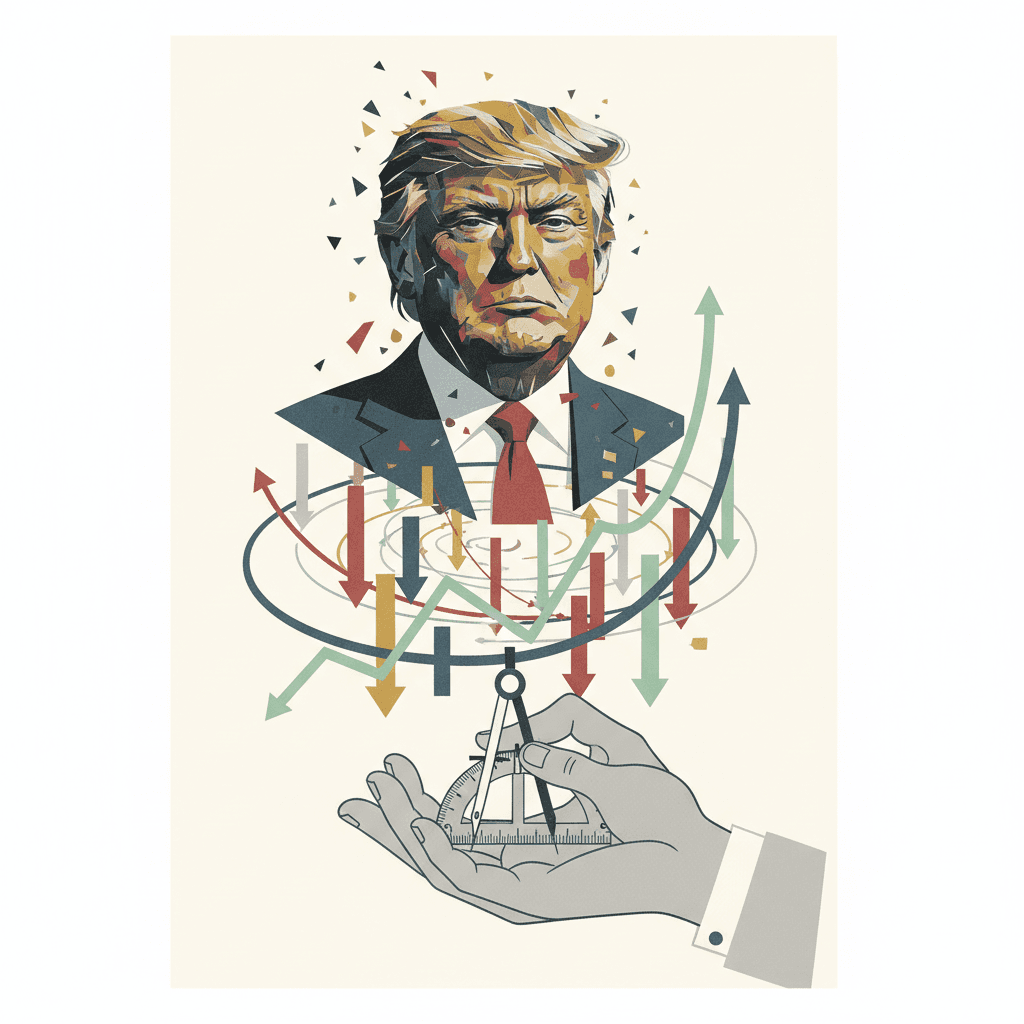
The Power Cycle Is Running Down: What Prediction Markets Are Saying About Trump's Second Term and How to Position for It
Prediction markets are painting a remarkably coherent picture right now, and it's not a pretty one for the Trump administration. Across more than a dozen actively traded contracts with over $20 million in combined volume, bettors are converging on a single theme: the political capital that powered Trump's second term is eroding, and the consequences are going to ripple through financial markets for years.
Let's walk through the numbers, because they tell a story.
The Probability Landscape
The chance that Trump leaves office before his term ends in January 2029 sits at 41.7%. Before 2028, it's 30.4%. Before 2027, it's 15.4%. Even the question of whether he'll be gone by August 2026 has a non-trivial 7% probability. These aren't fringe bets. These contracts have attracted millions in volume.
Meanwhile, the impeachment market is pricing in a 68.5% chance that Trump is impeached before January 20, 2029. Actual removal from office via impeachment and conviction sits at 26.5%, which is lower but still extraordinary by historical standards. No president has ever been removed through this process, and betting markets are giving it roughly one-in-four odds.
The cabinet is coming apart too. Attorney General Pam Bondi's departure before 2027 is priced at a near-certain 99.5%, with her leaving before May 2026 at 92.5%. FBI Director Kash Patel departing before 2027 is at 72%. Defense Secretary Pete Hegseth leaving before 2027 sits at 48.5%, essentially a coin flip.
And the broader political environment? Democrats winning the House in 2026 is at 85.5%. The 2028 Republican presidential nomination is already fragmenting, with JD Vance at 37.2%, Marco Rubio at 24.4%, and Tucker Carlson at 6%. Perhaps most telling of all, the "Trump bull case" for 2026, a composite market measuring whether his pro-growth agenda actually delivers, is trading at just 6.9%.
Read that again. Bettors are putting a 93% probability on the optimistic economic scenario NOT happening.
The Self-Reinforcing Cycle
These numbers aren't random. They describe a political feedback loop that tends to accelerate:
- Cabinet departures signal internal dysfunction and reduce the administration's ability to execute policy.
- Policy stalls (on deregulation, tariffs, fiscal stimulus) disappoint markets and erode public support.
- Falling approval makes the 2026 midterms worse, and an 85.5% probability of a Democratic House means legislative gridlock from late 2026 onward.
- A hostile House launches investigations and likely impeachment proceedings (that 68.5% probability).
- Impeachment drama consumes political oxygen, further stalling policy and accelerating more cabinet departures.
- The 2028 primary begins early as ambitious Republicans position themselves, fragmenting party unity.
- Return to step 1.
This is what political scientists call a "power cycle decline." Think of it like a car running out of gas. You can still steer, you can still brake, but the engine that moves everything forward is losing power. Each problem makes the next one worse.
What This Means for Your Money
The market implications are significant and underappreciated. Much of the stock market's pricing since Trump took office has baked in assumptions about deregulation, tax policy continuation, and a business-friendly environment. If the administration's ability to deliver on those promises drops to near zero, which is what a 6.9% bull case probability implies, then a chunk of the market's gains are built on a foundation that's crumbling.
This creates massive uncertainty around tariff policy (which could become erratic rather than strategic), deregulation (which stalls without executive focus), and fiscal policy (which dies in a divided Congress). All three of these have been partially priced into equities as positives. The unwinding of those "Trump trade" assumptions is the core risk.
Trade Signals: Shovels During a Gold Rush
During the California Gold Rush, most prospectors went broke. The people who got rich were the ones selling shovels, pickaxes, and denim pants. The same principle applies to political volatility. You don't have to predict exactly when or how the instability plays out. You just have to own the infrastructure that profits from the chaos itself.
The Direct Volatility Play
VIXY — BUY, 72% confidence. This ETF tracks VIX futures, which measure expected stock market volatility. A 68% impeachment probability, accelerating cabinet departures, and a near-certain Democratic House takeover create a structural regime of elevated volatility. The important distinction is that this pattern suggests repeated volatility spikes over 24 months (impeachment proceedings, midterms, primary fragmentation) rather than one big event. That said, VIXY is a tactical weapon, not something to hold forever. VIX products suffer from something called contango decay, which means they lose roughly 5-10% per month during calm periods as the futures contracts they hold roll forward at higher prices. Being early on volatility is functionally the same as being wrong.
The Equity Hedge
SH — WEAK BUY, 55% confidence. This inverse S&P 500 ETF goes up when the market goes down. If deregulation stalls, tariff policy becomes erratic, and fiscal stimulus dies in a divided Congress, the S&P 500 gives back gains built on those assumptions. But this is a hedge, not a core position. Corporate earnings could remain strong independent of political noise, the Fed still has tools to support markets, and historically, markets have often done well under divided government precisely because it reduces the risk of disruptive legislation. There's also a contrarian concern: with only 6.9% of bettors expecting the bull case, a lot of pessimism may already be baked in.
The Shovel Sellers
CBOE — BUY, 80% confidence. This is the strongest conviction pick in the pattern, and the logic is elegant. Cboe Global Markets literally owns the VIX. It runs the exchange where volatility products trade. Every time someone buys or sells an options contract to hedge against political uncertainty, Cboe collects a transaction fee. It doesn't matter whether markets go up or down, whether Trump stays or goes, whether impeachment succeeds or fails. As long as people are hedging, and political instability guarantees they will be, Cboe makes money. A prolonged period of institutional instability means elevated hedging activity for years.
CME — BUY, 78% confidence. CME Group operates the world's largest derivatives exchange, covering interest rate futures, equity index futures, currency futures, and Treasury futures. Political uncertainty drives hedging demand across every single one of these categories. Tariff whiplash drives currency hedging. Fiscal policy uncertainty drives interest rate hedging. Potential government shutdowns drive Treasury hedging. Like Cboe, CME profits from volume regardless of direction. The combination of erratic trade policy, potential government shutdowns under divided government, and impeachment drama creates a multi-year tailwind for trading volumes.
ICE — WEAK BUY, 68% confidence. Intercontinental Exchange operates exchanges and clearinghouses across energy, credit, and fixed income derivatives, plus it owns the NYSE. Policy uncertainty around tariffs, energy, and fiscal direction drives hedging demand across ICE's product suite. It's less directly exposed to pure volatility than Cboe but benefits from the same structural forces. One caution: ICE's mortgage technology segment (from its Ellie Mae acquisition) is rate-sensitive in a way that could work against the thesis.
The Safe Haven Plays
GLD — BUY, 76% confidence. Gold is the classic political uncertainty hedge, and this pattern describes a multi-year regime of U.S. institutional instability. Cabinet exodus, impeachment proceedings, policy discontinuity, and primary fragmentation all erode confidence in American policy predictability. Central banks around the world are already accumulating gold as part of a broader trend away from dollar dependence, and U.S. political dysfunction pours fuel on that fire. Gold also serves as portfolio insurance if the "Trump trade" unwind is sharper than expected. The risk is that gold is already near all-time highs, pays no dividends, and gets hurt by rising real interest rates.
TLT — WEAK BUY, 58% confidence. Long-term Treasury bonds, which TLT tracks, tend to benefit from flight-to-safety buying during political crises and from slower growth expectations. If Trump's second term is defined by conflict rather than execution, the pro-growth agenda stalls, which is disinflationary (meaning it reduces price pressures) and supports bond prices. A Democratic House blocking fiscal expansion also reduces deficit concerns somewhat. But caution is warranted. If political chaos leads to a credit rating downgrade, a government shutdown, or a debt ceiling crisis, long-term Treasuries could actually sell off sharply. Duration risk in 20-plus-year bonds is extreme, meaning small changes in interest rates cause large price swings.
The Risk Section (Read This Before You Do Anything)
Every thesis has ways it can break. Here are the most important ones:
Political risks cut both ways. Trump could stabilize through deal-making, a rally-around-the-flag moment from an international crisis, or simply by outlasting his opponents. Markets historically shrugged off Bill Clinton's impeachment proceedings in the late 1990s, and they could do the same here.
Markets might already know. With the bull case at only 6.9%, a lot of pessimism is already priced in. If you're positioning for bad outcomes that everyone already expects, your edge is thin. Contrarian risk is real.
Structural decay in volatility products. VIXY and SH both suffer from mathematical decay over time. VIXY loses value in calm markets due to futures contango. SH loses value due to daily rebalancing in trending-up markets. These are tactical tools with expiration dates, not buy-and-hold investments.
Corporate fundamentals could dominate. Companies might keep growing earnings regardless of what happens in Washington. The Fed retains tools to support the economy. Political noise, even very loud political noise, doesn't always translate into economic damage.
The shovel sellers aren't cheap. CBOE, CME, and ICE all trade at premium valuations already. If political uncertainty resolves faster than expected, their volume tailwinds fade and the premiums compress.
Gold's double-edged sword. At or near all-time highs, gold has significant downside if uncertainty resolves or if real interest rates rise. It also pays no yield, which is a meaningful opportunity cost when cash and bonds offer 4-5%.
Why This Matters for Your 401(k)
You don't have to be a trader to care about this. If you have a 401(k) heavily weighted toward U.S. stocks, you're implicitly betting that the policy environment stays stable enough for corporate earnings to keep growing. Prediction markets are saying there's a 93% chance the optimistic version of that story doesn't play out.
That doesn't mean markets crash. It means the assumptions underpinning some of the market's gains might be wrong, and the next two years are likely to be bumpier than the market's recent calm would suggest. For ordinary investors, this is a good time to check your diversification, make sure you're not overexposed to any single policy outcome, and consider whether your portfolio has any built-in shock absorbers.
The shovel-seller thesis, owning the exchanges and infrastructure that profit from uncertainty itself, is one way to add resilience. These companies make money in chaos and in calm, they just make more of it when people are nervous. And prediction markets are telling us, pretty loudly, that people are going to be nervous for a while.
Analysis based on prediction market data as of April 7, 2026. This is not investment advice.
How This Story Evolved
First detected Mar 20 · Updated daily
The article's headline was simplified to be more direct and reader-friendly, dropping the "Power Cycle" concept. The opening paragraph was also tweaked slightly, with the total trading volume figure reduced from $20 million to $17 million and some sentences rearranged.
Read latest →The new version uses more colorful, informal language (like comparing the administration to "a car losing parts on the highway") and adds a reference to the "Trump trade" affecting markets. The overall message stays the same, but the tone becomes more casual and punchy.
Read this version →