Prediction Markets Are Flashing a Distributed Warning Signal on Trump's Political Future — and It's Showing Up in 10+ Markets at Once
Something unusual is happening across prediction markets right now. It's not one contract spiking on a single headline. It's a pattern showing up simultaneously in more than ten different markets, all pointing in the same direction: traders are pricing in serious political instability around the Trump presidency, and the implications for your portfolio are worth understanding.
The Signal Isn't One Market. It's All of Them.
When a single prediction market moves, it might be noise. When ten-plus markets move in coordination, it's a signal. Here's what bettors are currently pricing:
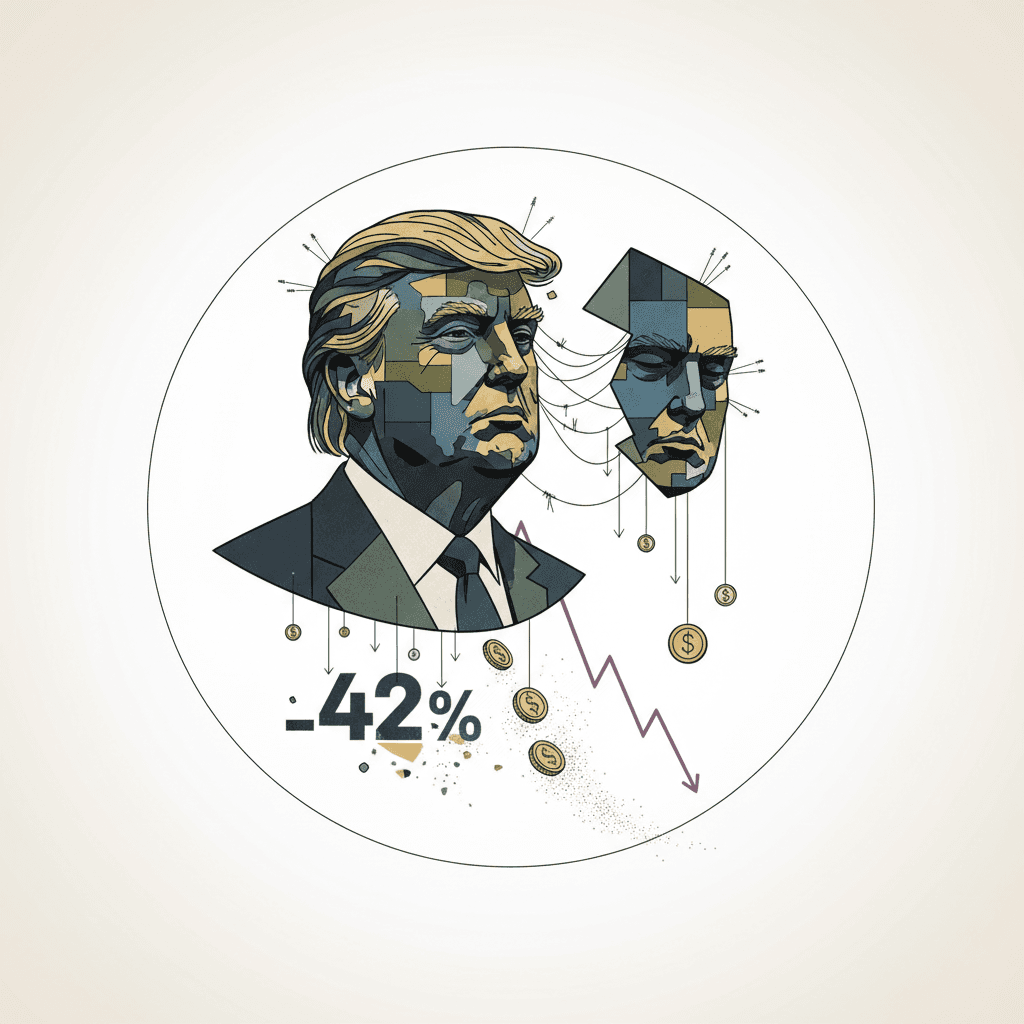
- There's a 7% chance Trump leaves office before August 2026, a 30% chance he's out before 2028, and a 42% chance he doesn't make it to the end of his term in January 2029.
- The probability of impeachment proceedings stands at 65-71%.
- The probability of actual removal from office sits at 22-23%.
- The so-called "Trump bull case" for 2026, a combo bet on favorable economic and political outcomes, is priced at just 7.5%.
- Cabinet turnover is being actively traded. Attorney General Pam Bondi leaving by end of 2026 is priced at 68%. Tulsi Gabbard being the next cabinet member out sits at 9-14%.
- And perhaps most telling: the 2028 Republican presidential nomination market has JD Vance at 37%, Marco Rubio at 25%, and Trump himself at a mere 2.7% for renomination.
That last number is remarkable. Trump's own party, at least as reflected in betting markets, doesn't expect him to be the nominee again. The 2028 GOP field is wide open, which tells you that even people betting real money on Republican politics see meaningful uncertainty about succession and continuity.
Think of it this way: if you were buying a house and someone told you there was a 42% chance the neighborhood's zoning laws would completely change before you finished paying off the mortgage, you'd want to know that before signing. That's essentially what these markets are telling investors about the current policy environment.
Why This Matters for Policy-Dependent Investments
A lot of money has flowed into trades that depend on the current administration's policy direction holding steady. Deregulation plays, tariff beneficiaries, defense and border spending stocks. All of these assume a clean second-term policy arc.
But if prediction markets are right that there's a nearly one-in-three chance Trump isn't in office by 2028, that arc gets interrupted. And even if he stays, a 65%+ impeachment probability combined with Democrats potentially taking the House creates a clear mechanism for political gridlock that gums up the legislative agenda.
This creates what traders call a "political risk premium," essentially an extra dose of uncertainty that makes long-term bets on current policy direction less attractive. If you're sitting on investments that only work if today's tariff regime or regulatory approach stays intact for three more years, these numbers should give you pause.
The Trades: Direct Plays and the Shovel Sellers
There are two ways to think about positioning for political uncertainty. You can bet on the chaos directly, or you can own the infrastructure that profits regardless of which direction the chaos goes. During the Gold Rush, most miners went broke. The people who sold them shovels got rich. The same principle applies here.
Direct Plays
GLD — BUY (Confidence: 75%)
Gold is the oldest political uncertainty hedge in the book. If Trump faces removal or even serious impeachment proceedings, you get policy discontinuity, dollar uncertainty, and a rush toward safe-haven assets. A 30% probability of early departure is a meaningful tail risk, and gold prices against exactly that kind of scenario. The downside is somewhat cushioned by the already-elevated geopolitical risk environment we're in.
VIXY — BUY (Confidence: 72%)
This is the most direct "long political uncertainty" trade available on stock exchanges. VIXY tracks short-term VIX futures, which measure expected market volatility. A 65-71% impeachment probability combined with active cabinet turnover creates the conditions for event-driven volatility spikes. But this comes with a huge caveat: VIX futures products lose roughly 5% per month in calm markets due to something called contango, where future prices are higher than current prices and the fund bleeds money as contracts roll forward. This is strictly a tactical, shorter-term position, not something you hold for months hoping for a crisis.
TLT — WEAK BUY (Confidence: 55%)
Long-duration Treasury bonds, essentially loans to the U.S. government that mature 20+ years from now, tend to benefit when investors flee to safety during political crises. If the Trump policy arc gets truncated, aggressive fiscal expansion and tariff policies might moderate, which would be good for bond prices. But this is a lower-conviction trade because political chaos could also mean fiscal dysfunction like debt ceiling fights and government shutdowns, which actually hurts Treasury prices. It cuts both ways.
GOVT — WEAK BUY (Confidence: 62%)
If TLT feels too aggressive, GOVT offers intermediate-duration Treasury exposure, a more balanced approach to the safe-haven trade. Shorter maturities mean less sensitivity to the fiscal premium blowout that could hurt longer bonds. It's the steadier, less dramatic version of the same basic idea.
The Shovel Sellers (Infrastructure Plays)
This is where the thesis gets more interesting for longer-term investors.
CBOE — BUY (Confidence: 78%)
Cboe Global Markets owns the VIX franchise. They don't bet on volatility. They collect a fee every single time someone else does. More political uncertainty means more hedging demand, which means more options and VIX futures traded, which means more revenue for Cboe. VIX and SPX options account for roughly 40% of their revenue, and all of it benefits from uncertainty. Unlike holding VIXY directly, Cboe doesn't suffer from contango drag. They're the casino, not the gambler. Their infrastructure relevance score for this pattern is 82 out of 100, the highest of any ticker here.
CME — BUY (Confidence: 76%)
CME Group is the toll road for hedging across rates, foreign exchange, equities, and commodities. When companies face policy discontinuity risk, they hedge their tariff exposure, their interest rate exposure, their currency exposure. All of that hedging flows through CME's exchanges. They hold near-monopoly positions in many futures categories. Political uncertainty is one driver among many for their volumes, but it's a meaningful one. Think of CME as a slightly more diversified version of the Cboe thesis.
BRK.B — WEAK BUY (Confidence: 68%)
Berkshire Hathaway is sitting on over $330 billion in cash. That cash pile is a structural hedge against political chaos. If policy discontinuity creates market dislocations and bargain prices, Berkshire is positioned to deploy capital when others are panicking. They profit from chaos rather than suffering from it. Their diversification across insurance, utilities, railroads, and manufacturing means no single policy shift can hurt them badly. The post-Buffett succession question is its own source of uncertainty, but the balance sheet speaks for itself.
WM — WEAK BUY (Confidence: 65%)
Waste Management is the "policy-agnostic essential infrastructure" play. Regardless of who occupies the White House, what tariff regime exists, or whether impeachment proceedings are underway, garbage still needs collecting. When you can't predict which policies will survive, rotating into businesses with zero policy dependency provides ballast for a portfolio. WM sits in a dominant duopoly with Republic Services and has near-zero revenue exposure to political trends, which is exactly the point.
SPLV — WEAK BUY (Confidence: 60%)
The Invesco S&P 500 Low Volatility ETF is a systematic way to stay invested in stocks while tilting away from policy-sensitive names. Its holdings naturally favor utilities, consumer staples, and healthcare, sectors that tend to hold up better when political headlines dominate. It's the simplest expression of "I want to own stocks but I'm nervous about Washington."
The Self-Reinforcing Loop
What makes this pattern particularly worth watching is how the pieces feed into each other:
- Democrats gain House control, creating the votes for impeachment proceedings.
- Impeachment proceedings (priced at 65-71%) create policy uncertainty and legislative gridlock.
- Policy gridlock undermines the economic agenda, making the "bull case" less likely (currently just 7.5%).
- Cabinet members start departing as the political environment deteriorates (Bondi departure at 68%).
- Departures and chaos further weaken the administration's ability to execute policy.
- Republican insiders begin positioning for 2028 (Vance at 37%, Rubio at 25%, Trump at just 2.7%).
- The open 2028 field signals to markets that even the president's own party sees the writing on the wall.
- That signal feeds back into higher departure probabilities and lower policy continuity expectations.
Each step makes the next one more likely. It's not a prediction of what will happen. It's a description of what markets are currently pricing.
The Risks (And They're Real)
Any honest analysis needs to confront the reasons this thesis could be wrong:
Prediction markets might overstate drama. Betting markets attract people who find political scenarios interesting, which can skew probabilities toward dramatic outcomes. Impeachment proceedings don't necessarily equal a market-moving crisis. Both Clinton's impeachment in 1998 and Trump's first two impeachments in 2019-2020 saw markets largely shrug.
Gold is already near all-time highs. A lot of political risk may already be baked into the price. If real interest rates rise, gold faces headwinds regardless of what happens in Washington.
VIX products are terrible long-term holds. VIXY losing roughly 5% monthly in calm markets is not a typo. This is a ticking clock, not a set-it-and-forget-it position.
Political risk could resolve quickly. If impeachment fizzles, if the cabinet stabilizes, if the administration finds its footing, all the defensive positioning described here would underperform a simple S&P 500 index fund, potentially by a wide margin.
Treasury dysfunction. Political chaos doesn't always mean "buy bonds." If the chaos manifests as debt ceiling standoffs or government shutdowns, Treasuries could actually sell off.
Infrastructure stocks are already richly valued. CBOE and CME trade at premium multiples because the market already recognizes their toll-road business models. You're not getting these at a discount.
Factor crowding. If too many investors pile into the same low-volatility, defensive names, those positions become crowded and vulnerable to sharp reversals when the all-clear signal sounds.
Why This Matters for Your Money
You don't need to be a political junkie to care about this. If you have a 401(k), your retirement savings are exposed to the policy assumptions baked into stock prices. If current deregulation or trade policy gets disrupted, companies that benefited from those policies will see their stock prices adjust. If you're making decisions about major purchases, career moves, or business investments that assume the current economic policy framework stays intact for several more years, a 42% probability that the presidency doesn't reach its scheduled end should factor into your thinking.
The prediction market data doesn't tell us what will happen. It tells us what thousands of people putting real money on the line believe is likely. And right now, across more than ten different markets, they're collectively saying: don't assume smooth sailing.
Analysis based on prediction market data as of April 2, 2026. This is not investment advice.
How This Story Evolved
First detected Mar 20 · Updated daily
The story shifted from flagging a single stark odds number to highlighting how political uncertainty is spreading across many markets at once, suggesting the concern is becoming broader and harder to ignore. Investors appear to be moving away from aggressive hedges like inverse funds and volatility plays, and instead leaning toward steadier, defensive holdings like gold and government bonds.
The article was updated to include specific numbers from prediction markets, such as a 42% chance Trump doesn't finish his term and a 65-71% chance of impeachment proceedings. The headline and opening also shifted from describing a vague "warning signal" to leading with those concrete statistics.
Read this version →