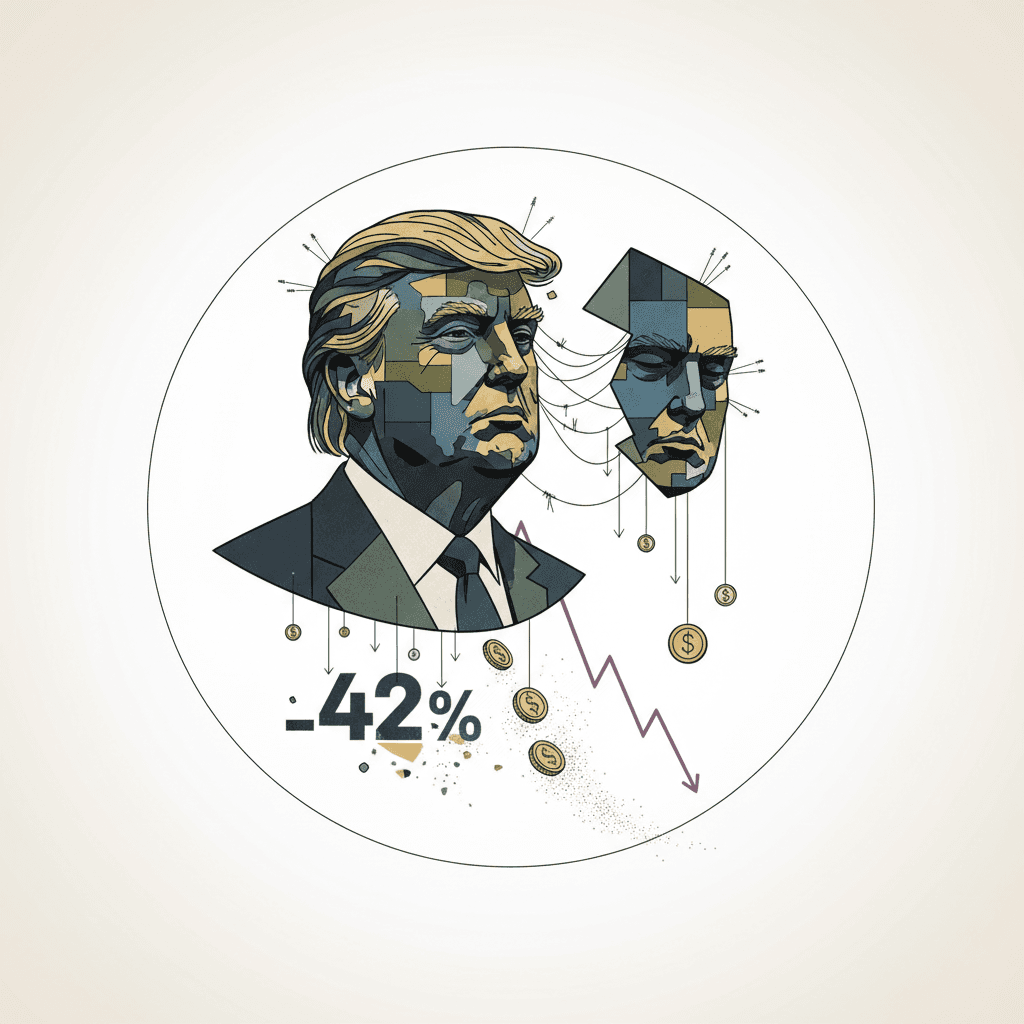
Prediction Markets Are Pricing a 42% Chance Trump Doesn't Finish His Term. Here's What That Means for Your Portfolio.
Something unusual is happening across prediction markets right now, and it's not showing up in any single contract. It's showing up in more than ten of them simultaneously.
Betting markets currently price a 7% chance Trump leaves office before August 2026, a 30% chance he's gone before 2028, and a 42% chance he doesn't make it to the end of his term in January 2029. The probability of impeachment proceedings sits at 65-71%. The probability of actual removal from office is 22-23%. And the so-called "Trump bull case" for 2026, a composite bet on favorable economic and political outcomes, is trading at just 7.5%.
These numbers alone would be notable. But the picture gets more interesting when you look at how the rest of the political landscape is being priced. The 2028 Republican presidential nomination market has JD Vance at 37%, Marco Rubio at 25%, and Trump himself at just 2.7% for renomination. His own party's bettors essentially don't expect him to run again. Meanwhile, cabinet turnover is being actively traded: Attorney General Pam Bondi has a 68% chance of leaving by year-end, and Tulsi Gabbard is priced at 9-14% to be the next cabinet departure.
This isn't one prediction market flashing a warning signal. It's a distributed pattern across elections, impeachment, cabinet stability, and succession markets all pointing in the same direction: meaningful political instability ahead.
What This Means for Markets
If you're invested in anything that depends on the current policy direction continuing, whether that's deregulation beneficiaries, tariff-protected industries, or companies banking on increased defense and border spending, these numbers represent a real headwind. A wide-open 2028 Republican field with the sitting president at under 3% for renomination means the market doesn't expect a clean second-term policy arc. That creates what traders call a "political risk premium," basically an extra layer of uncertainty tax on any investment thesis that relies on current policies staying in place.
The 65% impeachment probability combined with Democrats having taken the House creates a clear causal mechanism for how this plays out. Impeachment doesn't require conviction to disrupt markets. The proceedings themselves generate headlines, uncertainty, and policy paralysis. Think of it as the difference between a hurricane making landfall and a hurricane warning: even the warning changes behavior.
That said, this environment is genuinely bullish for one category of investments: anything that benefits from volatility and uncertainty itself.
Direct Plays on Political Uncertainty
VIXY (ProShares VIX Short-Term Futures ETF) is the most direct way to go long political uncertainty through a regular brokerage account. With impeachment probability between 65-71% and active cabinet turnover creating potential event-driven volatility spikes, there's a case for elevated implied volatility persisting. The confidence here is moderate at 72%, though, because VIX futures products have a brutal structural problem: they lose roughly 5% per month in calm markets due to something called contango, where the futures contracts you're rolling into cost more than the ones expiring. This is a tactical position you'd hold for weeks around specific catalysts, not something to park money in.
GLD (SPDR Gold Shares) is the classic political uncertainty hedge, and it carries higher conviction at 75%. If Trump leaves office early or faces prolonged impeachment proceedings, the resulting policy discontinuity creates dollar uncertainty and safe-haven demand. A 30% probability of the president leaving before 2028 is a meaningful tail risk, and gold is one of the few assets that reliably responds to that kind of uncertainty. Gold also benefits from the fiscal confusion that accompanies any political transition. The downside case is limited given that geopolitical risk is already elevated from multiple directions.
TLT (iShares 20+ Year Treasury Bond ETF) gets a weaker signal at 55% confidence. Long-duration Treasuries, meaning bonds that don't mature for 20 or more years, typically benefit from crisis-driven flight to safety. If the Trump policy arc gets truncated, aggressive fiscal expansion and tariff policies might moderate, which would be good for long bonds. But this trade has an awkward contradiction built into it: political chaos could also mean fiscal dysfunction like debt ceiling fights and government shutdowns, which is actually bad for Treasuries. The signal is real but conflicted.
GOVT (iShares U.S. Treasury Bond ETF) offers a more balanced version of the same idea at 62% confidence. By holding intermediate-duration Treasuries instead of the longest-dated ones, you get the flight-to-quality benefit without as much exposure to the risk that fiscal premium blows out on the long end of the curve.
Selling Shovels During a Gold Rush
During the California Gold Rush, the people who most reliably made money weren't the miners. They were the ones selling pickaxes, shovels, and denim jeans. The same principle applies to political volatility. Instead of betting on volatility directly and suffering from structural decay, you can own the companies that collect a fee every time someone else makes a volatility trade.
CBOE (Cboe Global Markets) is the ultimate shovel-seller here, carrying the highest confidence of any signal in this pattern at 78%. Cboe literally owns the VIX, the market's fear gauge, and profits from every VIX futures contract, every SPX options trade, and every volatility product that changes hands. Higher political uncertainty means more hedging demand, which means more options and VIX futures traded, which means more revenue for Cboe. VIX and SPX options account for roughly 40% of their revenue, and all of it benefits from uncertainty. Crucially, unlike holding VIX products directly, Cboe doesn't suffer from contango drag. They collect their toll regardless of which direction volatility moves.
CME (CME Group) is a similar toll-road business at 76% confidence. CME profits from hedging activity across interest rates, foreign exchange, equities, and commodities, all of which see elevated trading volume during political uncertainty. Policy discontinuity risk means more corporations hedging their tariff exposure, more banks hedging rate volatility, more multinationals hedging currency swings. CME is the infrastructure layer underneath all of that activity. It's more diversified than Cboe, which means political risk alone doesn't move the needle as dramatically, but it also means the business is resilient across many scenarios.
Defensive Positioning
For investors who want to stay in equities but reduce their exposure to policy-sensitive names, there are several lower-conviction but still useful positions.
WM (Waste Management) at 65% confidence represents the "policy-agnostic essential infrastructure" play. Regardless of who is president, what party controls Congress, or what tariff regime exists, garbage still needs collecting. Waste Management operates a dominant duopoly with Republic Services, and its revenue has essentially zero dependency on political trends. That independence IS the point when policy continuity is this uncertain.
BRK.B (Berkshire Hathaway Class B) at 68% confidence brings a different kind of resilience. Berkshire's massive cash pile, north of $330 billion, is a structural hedge against political chaos. If policy discontinuity creates market dislocations, crashes, or panic selling, Berkshire is positioned to deploy that capital opportunistically. They profit from chaos rather than suffering from it. Their diversification across insurance, utilities, railroads, and manufacturing means no single policy vector can seriously hurt them.
SPLV (Invesco S&P 500 Low Volatility ETF) at 60% confidence is a systematic approach. This fund holds the least volatile stocks in the S&P 500, which naturally tilts toward utilities, consumer staples, and healthcare, sectors with lower political risk sensitivity. It's a way to stay invested in stocks while reducing exposure to the names most likely to get whipsawed by impeachment headlines.
The Risks You Need to Understand
Prediction markets are powerful aggregators of information, but they are not omniscient. There are several important risks to this entire thesis.
First, markets have historically shrugged off impeachment proceedings. During Clinton's impeachment in 1998 and Trump's first two impeachments in 2019-2020, the S&P 500 actually rose. Impeachment proceedings create political drama that doesn't necessarily translate into market-moving economic disruption.
Second, prediction markets may overstate political drama. These markets attract participants who are politically engaged and may systematically overweight dramatic outcomes. A 65% impeachment probability could reflect the enthusiasm of political bettors more than cold probability assessment.
Third, gold is already near all-time highs. Much of the political risk premium may already be baked into the price. If political uncertainty resolves smoothly, gold could sell off meaningfully.
Fourth, the exchange plays (CBOE and CME) already trade at premium valuations that reflect their toll-road business models. You're paying up for quality, and a sustained period of calm would hurt their trading volumes.
Fifth, if political risk resolves positively, through a negotiated resignation, a failed impeachment vote, or simply the drama fading from headlines, cyclical and policy-dependent stocks would massively outperform every position suggested here. Defensive positioning has a real opportunity cost in a bull market.
Finally, for VIX-related products specifically, the structural decay from contango is not a minor nuisance. It's a portfolio killer over time. VIXY has lost over 99% of its value since inception through roll costs alone. This is a scalpel, not a savings account.
Why This Matters for Your Money
Even if you never trade a single one of these tickers, the pattern matters for anyone with a 401(k), a savings account, or a grocery bill. A 42% chance the president doesn't finish his term means a 42% chance of significant policy disruption, whether that involves tariffs, tax policy, regulation, or government spending. That kind of uncertainty affects corporate planning, hiring decisions, and the broader economy in ways that eventually touch everyday prices and wages.
The core takeaway is straightforward: when more than ten different prediction markets independently price significant political instability, that's a signal worth paying attention to, even if you ultimately decide not to act on it. The shovel-sellers like CBOE and CME offer a way to position for uncertainty without having to predict exactly how the uncertainty resolves. And the defensive names like WM and BRK.B offer a way to stay invested while acknowledging that the political ground beneath your feet might shift.
Analysis based on prediction market data as of April 2, 2026. This is not investment advice.
How This Story Evolved
First detected Mar 20 · Updated daily
The story shifted from flagging a single stark odds number to highlighting how political uncertainty is spreading across many markets at once, suggesting the concern is becoming broader and harder to ignore. Investors appear to be moving away from aggressive hedges like inverse funds and volatility plays, and instead leaning toward steadier, defensive holdings like gold and government bonds.
Read latest →The article was updated to include specific numbers from prediction markets, such as a 42% chance Trump doesn't finish his term and a 65-71% chance of impeachment proceedings. The headline and opening also shifted from describing a vague "warning signal" to leading with those concrete statistics.