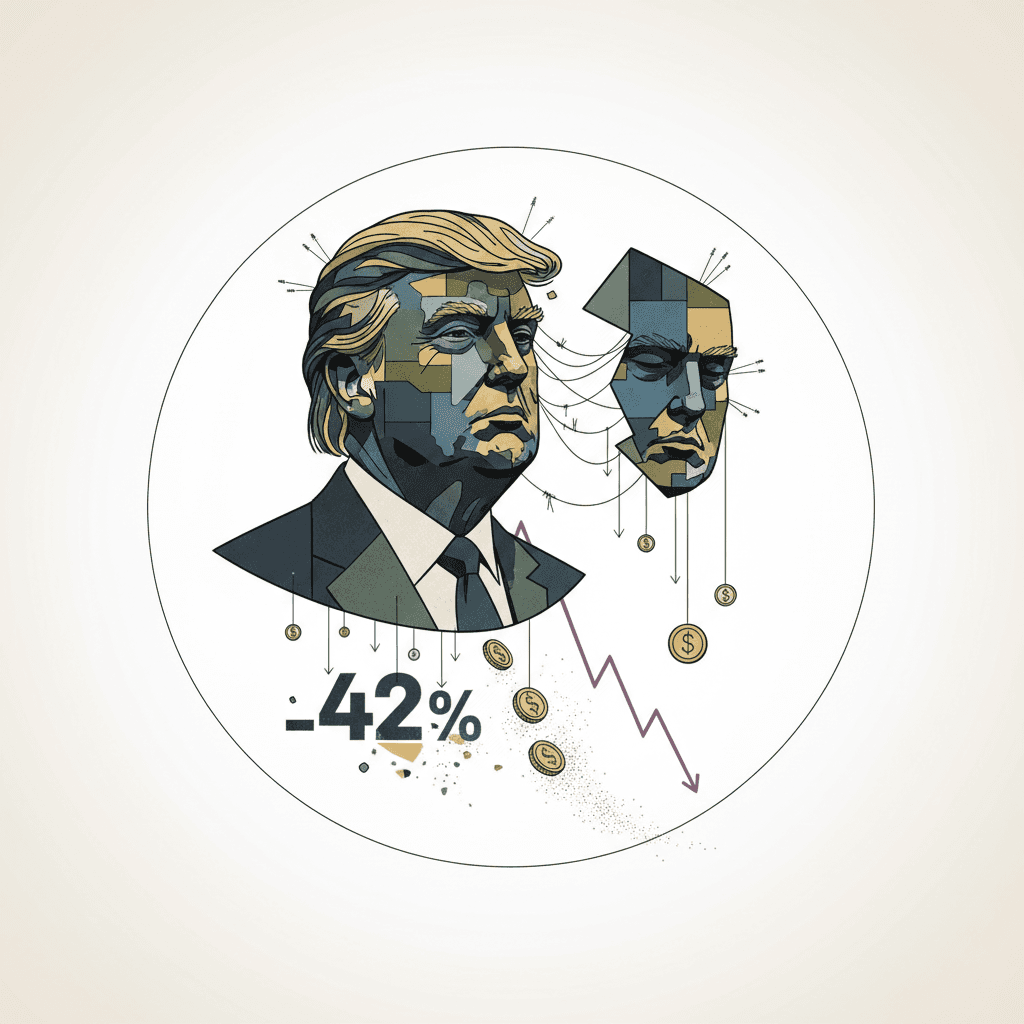
Prediction Markets Are Pricing a 42% Chance Trump Doesn't Finish His Term. Here's What That Means for Your Portfolio.
Something unusual is happening across prediction markets right now, and it's not just one quirky bet. More than ten separate betting markets are telling the same story: traders are pricing meaningful political instability into the remainder of Trump's second term.
The numbers paint a striking picture. Prediction markets currently show a 7.85% chance Trump leaves office before August 2026, a 30.4% chance he's out before 2028, and a 42.25% chance he doesn't make it to the end of his term in January 2029. The probability of impeachment proceedings sits at 65.5%, though actual removal from office is priced lower at 22.5%. Meanwhile, cabinet turnover is being actively traded, with a 45% chance Attorney General Pam Bondi leaves by the end of 2026 and a 14.5% chance Tulsi Gabbard is the next cabinet member out the door.
Perhaps most telling is what the 2028 Republican primary market looks like. JD Vance leads at 37.25%, Marco Rubio follows at 25%, and Trump himself sits at just 2.75% for renomination. The "Trump bull case" for 2026, a composite bet on favorable outcomes, trades at a mere 7.55%. Even his own party's betting community doesn't expect a clean second-term arc.
This isn't one nervous bettor putting money on an extreme scenario. It's a distributed signal across more than ten different markets, all pointing in the same direction.
The Self-Reinforcing Loop
To understand why this pattern matters for investors, think about how political instability feeds on itself:
- Cabinet turnover and internal chaos weaken the administration's ability to execute its policy agenda (deregulation, tariffs, defense spending).
- Weakened policy execution makes midterm losses more likely, which prediction markets already price in through elevated Democratic House odds.
- A Democratic House creates the mechanism for impeachment proceedings, which the market prices at 65.5%.
- Impeachment proceedings, even without conviction, consume political oxygen and further stall the policy agenda.
- A stalled agenda opens up the 2028 Republican primary to alternatives, which is exactly what the wide-open nomination market reflects.
Each step reinforces the others. The wide-open 2028 field isn't just a curiosity. It tells us that even Republican insiders and political bettors expect significant disruption to the normal second-term playbook.
The Shovel Sellers: Who Profits from Chaos Itself
During the California Gold Rush, the people who reliably made money weren't the miners. They were the folks selling pickaxes, shovels, and denim jeans. The same principle applies to political volatility. Instead of betting on which direction chaos pushes the market, you can invest in the companies that profit from the chaos itself.
CBOE is the purest version of this trade. Cboe Global Markets owns the VIX, the market's fear gauge, and earns transaction revenue every time someone trades VIX options, S&P 500 options, or any volatility product. They profit from both sides of every trade. Political chaos means more hedging demand, more volume, more revenue. BUY signal at 78% confidence. VIX and volatility-linked products account for roughly 30-40% of their revenue, and the broader options flow benefits too. Cboe essentially holds a monopoly on volatility trading infrastructure.
CME benefits from the same dynamic but across a wider set of markets: interest rate futures, currencies, commodities, and equity indexes. If tariff policy becomes unpredictable, currency and commodity hedging surges. If fiscal policy gets clouded by impeachment drama, Treasury futures volume spikes. CME collects a toll on every transaction, like a highway system that gets more valuable as traffic increases. BUY signal at 76% confidence. The company holds near-monopoly positions in interest rate and agricultural futures.
GLD and IAU represent the oldest shovel-selling business in the world: gold. When institutional confidence erodes, when people aren't sure which policies will survive and which won't, gold benefits as a store of value. It doesn't matter whether Trump stays or goes, whether Democrats impeach or fail, whether Vance or Rubio inherits the party. Gold just sits there, profiting from doubt. Central bank buying has been structurally elevated for years, and domestic political crisis adds another layer of demand. GLD gets a BUY signal at 72-74% confidence. IAU, which is functionally identical but charges a lower expense ratio (0.25% vs 0.40%), gets a BUY at 70% confidence. IAU is slightly preferred for cost-conscious longer holds.
ICE, Intercontinental Exchange, operates exchanges and clearing houses across energy, fixed income, and equities (they own the NYSE). Political instability drives hedging volume across their platforms. However, ICE has diversified heavily into mortgage technology through its Black Knight acquisition, which dilutes the pure volatility play and adds debt to the balance sheet. WEAK BUY at 68% confidence.
Direct Volatility Plays
VIXY provides direct exposure to VIX futures and gets a BUY signal at 72% confidence as a tactical hedge. If Democrats take the House in 2026 and initiate impeachment proceedings, VIX spikes are almost certain. But VIXY comes with an important caveat: it suffers from severe contango drag, a structural feature where the fund loses value over time as it rolls expiring futures contracts into more expensive ones. Think of it like holding an ice cube. Even if you're right about the temperature eventually dropping, the ice keeps melting while you wait. This is not a buy-and-hold position. A separate, more cautious assessment of VIXY as a longer-term hold rates it NEUTRAL at 40% confidence for exactly this reason.
UVXY, the leveraged version, gets a WEAK BUY at 52% confidence. It provides amplified exposure to VIX spikes but suffers even more severe structural decay, losing 50-90% of its value annually from contango roll costs. Only viable as a short-duration tactical hedge around specific catalyst windows like midterm results or House leadership votes.
Defensive Positioning
SH, the inverse S&P 500 ETF, gets a WEAK BUY at 55% confidence. If the pattern is correct that policy continuity is breaking down, broad equity exposure faces headwinds. But conviction is low because the economy has its own momentum. Corporate earnings can remain strong even amid political drama. History shows that markets often shrug off Washington dysfunction.
TLT, the long-duration Treasury bond ETF, gets a WEAK BUY at 60% confidence as a flight-to-safety play during acute crisis moments. The relationship is complicated though. Political dysfunction could also raise concerns about fiscal credibility and debt ceiling risks, which would actually hurt Treasuries. GOVT, a broader Treasury ETF spanning multiple durations, gets a WEAK BUY at 50% confidence as a more moderate version of the same thesis without the extreme duration risk.
XLU, the utilities sector ETF, gets a WEAK BUY at 55% confidence as a "political agnosticism" play. Utilities are regulated monopolies whose revenues barely change regardless of who controls Washington. As the 2028 GOP field opens up and policy continuity becomes uncertain, capital could rotate from policy-sensitive sectors toward these stable cash-flow businesses.
One explicit warning: SQQQ, the 3x leveraged inverse Nasdaq ETF, rates NEUTRAL at 40% confidence and is flagged as a poor play on this theme despite seeming intuitive. Its daily rebalancing mechanics destroy value over any holding period beyond a few days, and tech companies derive significant revenue globally, insulating them from U.S. domestic political turmoil. The AI capital expenditure cycle is a far stronger force for Nasdaq than political headlines.
The Risks You Need to Understand
This analysis carries real risks, and being honest about them matters.
Trump has repeatedly defied prediction market probabilities. A 65% impeachment probability does not mean impeachment happens. Even successful impeachment in the House faces a 22.5% removal probability in the Senate, meaning the most likely impeachment outcome is proceedings that don't result in removal. Markets may price this in advance, limiting any VIX spike.
The economy may simply be strong enough to power through political noise. Corporate earnings, labor markets, and consumer spending operate semi-independently from the drama in Washington. Fed policy and global liquidity matter more than political headlines for broad equity direction. Even impeachment proceedings didn't crash markets during Clinton's presidency or Trump's first term.
Gold is already near all-time highs, meaning much of this uncertainty may already be reflected in the price. Rising real interest rates remain a structural headwind for an asset that pays no income. Dollar strength during risk-off events can actually suppress gold prices.
Volatility instruments like VIXY and UVXY have severe structural decay. Being right about the direction of political risk but wrong about the timing can result in significant losses. These are wasting assets that require precision.
Finally, rally-around-the-flag effects could actually suppress volatility if impeachment proceedings are seen by the public as partisan overreach.
Why This Matters for Your Money
If you have a 401(k) or any exposure to U.S. equities, this pattern is worth understanding even if you never trade a single ticker mentioned here. The core insight is that policy continuity, the assumption that current regulations, tariffs, and spending priorities will stay roughly stable for the next few years, is being questioned by people willing to put real money behind their doubts.
That doesn't mean you should panic or sell everything. It means that the trades most dependent on a smooth second-term policy arc, things like deregulation beneficiaries, tariff-protected industries, and defense spending plays, carry more risk than they might appear to on the surface. And it means that the companies selling the tools of uncertainty management, the exchanges, the gold funds, the volatility infrastructure, are positioned to benefit regardless of how the political story actually ends.
The smartest position might not be betting on any particular political outcome. It might be owning the tollbooths that everyone has to pass through on the way to finding out.
Analysis based on prediction market data as of April 1, 2026. This is not investment advice.
How This Story Evolved
First detected Mar 20 · Updated daily
The story shifted from flagging a single stark odds number to highlighting how political uncertainty is spreading across many markets at once, suggesting the concern is becoming broader and harder to ignore. Investors appear to be moving away from aggressive hedges like inverse funds and volatility plays, and instead leaning toward steadier, defensive holdings like gold and government bonds.
Read latest →The article was updated to include specific numbers from prediction markets, such as a 42% chance Trump doesn't finish his term and a 65-71% chance of impeachment proceedings. The headline and opening also shifted from describing a vague "warning signal" to leading with those concrete statistics.
Read this version →