Greenland, Panama, and Iran: How a Multi-Front Geopolitical Gamble Could Send Oil Past $150
Something unusual is happening across prediction markets right now. Bettors aren't just pricing in one geopolitical flashpoint. They're pricing in several at once, and the combined picture points to a world where oil prices could spike dramatically, defense spending surges, and the Federal Reserve finds itself stuck in a corner.
Let's walk through what the numbers are telling us.
Three Theaters, One Pattern
Prediction markets currently show a 35.5% chance the United States acquires some part of Greenland before 2029, with a 25.3% chance that Trump actually purchases the island outright. Meanwhile, there's a 31.5% probability the U.S. takes back the Panama Canal. And on Iran, the signals are even more provocative: markets give only an 8.5% chance of a nuclear deal by May and just 23% by June, while the probability that the U.S. formally recognizes Reza Pahlavi (the exiled son of Iran's last shah) as Iran's leader sits at 16.5% and is surging, up 6.5 percentage points recently. The odds of Pahlavi actually visiting Iran before 2027 are at 22.5%.
Taken individually, each of these is an interesting curiosity. Taken together, they describe an aggressive U.S. foreign policy posture playing out across the Arctic, Latin America, and the Middle East simultaneously. Ray Dalio, the legendary hedge fund manager, has written extensively about how great power conflicts drive commodity supercycles. This is that template, unfolding in real time across betting markets.
And the oil markets are paying attention.
The Oil Spike Everyone Is Quietly Betting On
Prediction markets currently assign a 55% probability that WTI crude oil (the main U.S. benchmark) touches $140 per barrel at some point before the end of 2026. The chance it hits $150 is 49%. Even $180 per barrel carries a 28% probability.
To put that in perspective, WTI is trading around $60-65 right now. A move to $140 would mean oil more than doubles. A move to $180 would be roughly triple current prices, approaching levels never seen before.
Now, an important caveat: these are "maximum price" contracts, meaning they capture any intraday spike, not a sustained price level. Oil could touch $150 for a single afternoon during a crisis and then fall back. But even a brief spike that violent would send shockwaves through the economy.
Iran is the key connector. With no nuclear deal likely in the near term and the U.S. actively signaling regime-change sympathies through Pahlavi recognition, the risk of a confrontation that disrupts Middle Eastern oil supply is elevated. Iran controls the Strait of Hormuz, through which roughly 20% of the world's oil passes every day. Any disruption there, even a partial one, would send prices screaming higher.
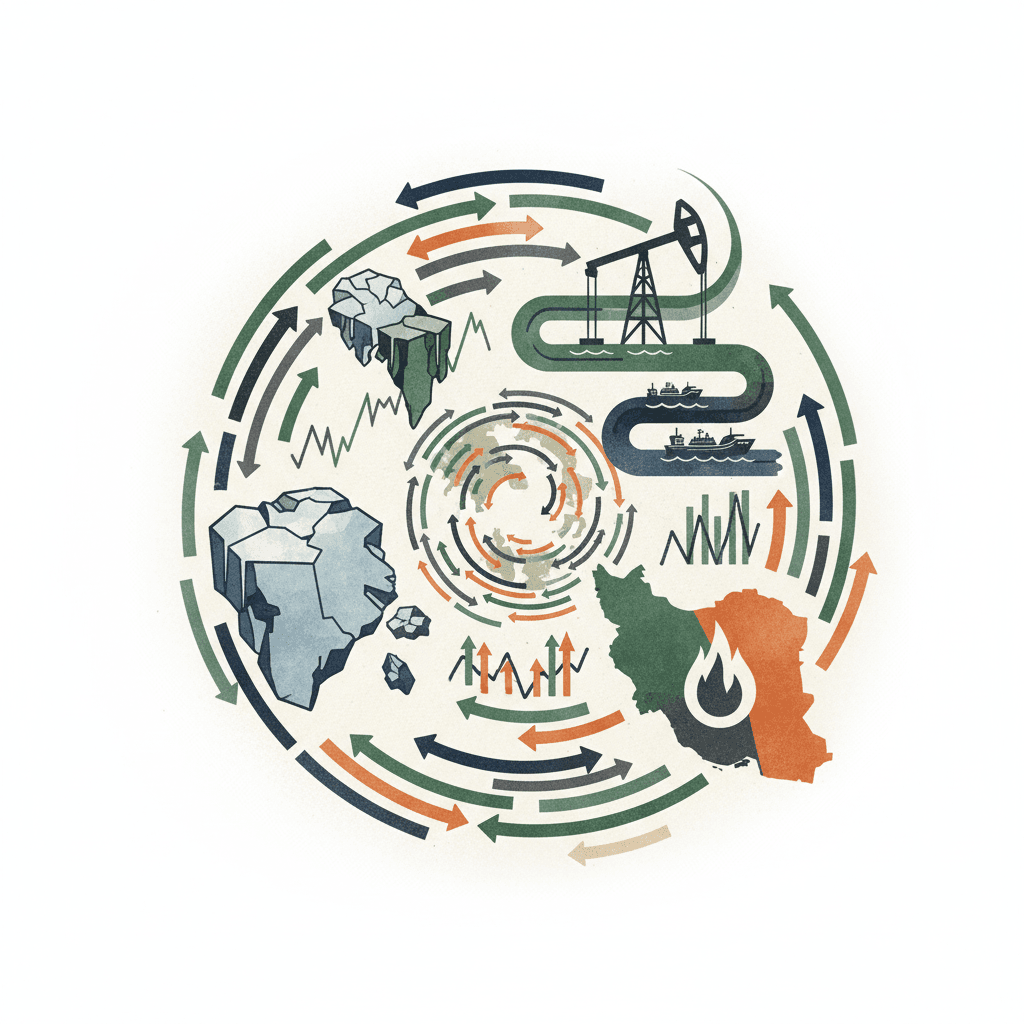
This creates a self-reinforcing loop that investors should understand:
- Geopolitical tensions with Iran escalate, threatening oil supply through the Strait of Hormuz
- Oil prices spike, pushing gasoline and energy costs higher across the economy
- Higher energy costs feed into inflation, which the Consumer Price Index (the government's main inflation measure) picks up within weeks
- The Federal Reserve, seeing inflation reaccelerate, cannot cut interest rates even if the economy is weakening
- The economy weakens further under the weight of high energy costs AND high interest rates
- The Fed is paralyzed, unable to help, which is exactly the "Fed paralysis" pattern we've written about before
Where the Money Flows: The Shovel Sellers
During the California Gold Rush, the people who got reliably rich weren't the miners. They were the people selling shovels, pickaxes, and blue jeans. The same principle applies to geopolitical commodity cycles. You don't have to predict exactly which crisis erupts or how high oil goes. You can own the companies that profit from the activity itself.
Direct Oil Exposure
USO is the most direct way to bet on oil prices, but it comes with significant structural problems. USO holds oil futures contracts and has to "roll" them every month, which means selling the expiring contract and buying the next one. When future months are more expensive than the current month (a situation called contango), this rolling process bleeds money. You could be absolutely right about oil spiking and still lose money holding USO over several months. Confidence: 62%.
XLE, the broad energy sector ETF, avoids the contango problem entirely because you're owning actual companies, not futures contracts. These companies generate cash flow, pay dividends (XLE yields roughly 3.5%), and benefit from higher oil prices without the structural decay. Think of it this way: if oil goes nowhere, USO slowly loses value while XLE pays you to wait. If oil spikes, both go up, but XLE doesn't give back gains through rolling costs. Confidence: 70%.
FANG (Diamondback Energy) is a pure-play Permian Basin producer with breakeven costs around $40 per barrel. That means at current prices it's already printing money, and at $100 or $140 oil, the free cash flow becomes enormous. When Middle Eastern supply gets threatened, the world turns to American shale producers as the swing supply. Diamondback IS the shovel for global energy security. Confidence: 67%.
HES (Hess Corporation) offers exposure to Guyana's Stabroek block, one of the most important new oil provinces on earth. If Middle Eastern barrels go offline, Atlantic basin oil becomes strategically critical. However, the ongoing Chevron-Hess merger creates arbitrage dynamics that might decouple the stock from pure oil price movements. Confidence: 55%.
The Real Shovel Sellers: Oilfield Services
HAL (Halliburton) is the quintessential shovel seller for the oil industry. When oil spikes, every producer on earth wants to drill more wells and complete them faster. They all need Halliburton's services. The company dominates North American completions work and is one of the top three oilfield services firms globally alongside SLB and Baker Hughes. The Dalio insight here is critical: when oil prices spike, the bottleneck shifts from finding oil to having the capacity to get it out of the ground. Halliburton profits from drilling activity volume regardless of which exploration company wins. Confidence: 73%.
SLB (formerly Schlumberger) is the largest oilfield services company in the world, with deeper international exposure than Halliburton. If Iran tensions disrupt Middle Eastern supply, every non-OPEC producer globally needs to ramp up, and SLB is the primary service provider outside North America. When one region goes offline, others must produce more, and SLB services them all. Confidence: 71%.
Defense: The Other Shovel
LMT (Lockheed Martin) benefits from the geopolitical posture itself, regardless of whether any specific action materializes. Defense budgets are set by threat perception, not actual conflicts. If the U.S. is simultaneously posturing toward Greenland, the Panama Canal, and Iran, Congress funds the military accordingly. Confidence: 72%.
NOC (Northrop Grumman) maps uniquely to the specific type of activity in this pattern. Arctic surveillance for Greenland, naval reconnaissance for the Panama Canal, and long-range stealth strike capability for Iran all point directly to Northrop's core programs: the B-21 bomber, Global Hawk drones, and space-based surveillance systems. Intelligence, surveillance, and reconnaissance capabilities are needed before, during, and after any geopolitical action. Confidence: 68%.
Inflation Protection
TIP (Treasury Inflation-Protected Securities ETF) is the direct infrastructure play for the inflation itself. TIPS are government bonds whose value adjusts upward with the Consumer Price Index, so they benefit from inflation regardless of which specific event causes it. However, this is more of a portfolio hedge than a high-conviction trade, because if the Fed responds by pushing real interest rates (interest rates after subtracting inflation) even higher, TIPS can still lose value on a price basis despite the inflation adjustment. Confidence: 60%.
The Risks You Need to Take Seriously
This pattern is compelling, but it's far from a sure thing. There are meaningful reasons it could fall apart.
First, the oil price probabilities might be inflated. Prediction markets on extreme outcomes tend to attract speculative money. The actual oil futures curve is nowhere near pricing $140 WTI, and the gap between prediction market probabilities and futures market pricing is uncomfortably wide. These "max price" contracts only need a single-day spike to pay off, which makes them more like lottery tickets than forecasts of sustained price levels.
Second, a global recession would crush oil demand and override supply concerns. If the economy falls into a sharp downturn, oil could go to $40 before it goes to $140, taking all of these trades with it.
Third, diplomacy could move faster than expected. An Iran nuclear deal has a 43% chance of materializing by year-end. If it does, the geopolitical risk premium in oil evaporates quickly, and the whole thesis weakens.
Fourth, OPEC+ has spare production capacity that could cap sustained rallies. Saudi Arabia alone can bring significant barrels online relatively quickly.
Fifth, the Greenland and Panama moves may be pure negotiating bluster, the kind of maximalist opening position that never actually materializes into military action.
And sixth, defense stocks already reflect an elevated geopolitical baseline. Domestic budget efficiency pushes (sometimes called DOGE-style cuts) could eat into Pentagon spending even as threats multiply abroad.
Why This Matters for Your Money
You don't need to trade any of these stocks for this analysis to be relevant to your financial life. If this pattern plays out even partially, here is what it means in practical terms.
Gasoline prices would spike, hitting your wallet directly. Grocery prices would follow, since food transportation costs track diesel prices closely. Your 401(k), if it's heavy in bonds or growth stocks, would face headwinds from both inflation and the Fed's inability to cut rates. And if you're sitting in a savings account earning 4-5%, the Fed staying frozen means those rates stick around longer, which is actually one of the few silver linings of this scenario.
The bigger picture is that we may be entering a period where geopolitical risk isn't a once-in-a-decade shock but a persistent background condition that keeps energy prices elevated and inflation sticky. Adjusting your portfolio to reflect that reality, even modestly, could make a meaningful difference over the next 12 to 18 months.
Analysis based on prediction market data as of April 7, 2026. This is not investment advice.
How This Story Evolved
First detected Apr 7 · Updated daily
The article's opening was rewritten to lead with skepticism about each individual event before building to the bigger pattern, rather than jumping straight to the "three storms converging" idea. The new version tries to draw readers in by first acknowledging why someone might dismiss each situation, then revealing why the combination still matters.
Read latest →The new version makes the opening more concise and direct, cutting straight to the three key hotspots instead of building up to them slowly. It also adds a new weather map analogy to help explain how the three risks combine to create bigger danger.
Read this version →The article was rewritten to feel more like a guide for everyday investors, using simpler, more direct language to explain the same idea. The new version also places more emphasis on how all these events connect to a bigger financial picture, rather than just listing the geopolitical situations.
Read this version →The article got a more specific headline that names the three key locations (Greenland, Panama Canal, and Iran) instead of using vaguer language about a "geopolitical storm." The opening of the article was also rewritten to be more direct, framing the story around U.S. foreign policy actions across three regions rather than focusing on the prediction markets themselves.
Read this version →The article's title was tweaked to replace "Multi-Front Geopolitical Gamble" with the more straightforward "Three Geopolitical Flashpoints." The opening was also rewritten to feel more personal and direct, spelling out why these events matter to everyday readers through their wallets instead of starting with a focus on prediction markets.
Read this version →