Prediction Markets Are Pricing In a Multi-Front Geopolitical Storm. Here's What It Means for Energy and Your Portfolio.
Something unusual is happening across prediction markets right now. Bettors aren't just pricing in one geopolitical flashpoint. They're pricing in several at once, and the combined picture looks like a world where the U.S. is flexing aggressively on multiple fronts simultaneously. Greenland acquisition attempts, Panama Canal control, and regime-change signals toward Iran are all showing meaningful probabilities. When you connect these dots to oil price spike bets, a coherent macro story emerges, one that has real implications for energy prices, inflation, and your 401k.
Let's walk through the numbers.
The Geopolitical Cluster
Prediction markets currently give a 35% chance the United States acquires some part of Greenland before 2029, with a 27% chance of an outright purchase. The probability of the U.S. taking control of the Panama Canal sits at 32%. These are not certainties, but they're far from negligible. Think of it this way: if someone told you there was a one-in-three chance your commute was about to get rerouted permanently, you'd probably start looking at alternate routes.
Then there's Iran, and this is where the energy story really takes shape. Prediction markets give only an 11% chance of a new nuclear deal by May 2026, 27% by June, and 40% by August. Even looking out to the full year, the probability of a deal only reaches 54%. That means bettors see a near-coin-flip chance that no deal happens at all.
Meanwhile, signals pointing toward regime change are ticking upward. The probability of the U.S. officially recognizing Reza Pahlavi, the exiled Iranian crown prince, sits at 13% and has been rising (reportedly up 6.5 percentage points recently). The chance of Pahlavi actually visiting Iran before 2027 is at 17%, and the probability that he becomes Iran's next head of state or government is 11%. These are small numbers individually, but together they paint a picture of a U.S. posture that's leaning toward confrontation rather than diplomacy with Tehran.
The Oil Price Transmission Mechanism
Iran is a major oil producer, and any escalation there ripples through global crude markets almost instantly. Prediction markets currently price a 31% chance that WTI crude (the benchmark U.S. oil price) hits $140 per barrel by the end of 2026, a 25% chance it reaches $150, an 18% chance it touches $160, and a 17% chance it spikes all the way to $180.
An important note of honesty: some initial reports on this pattern overstated these probabilities, citing numbers roughly double what the actual market data shows. The real probabilities are meaningful but more moderate than the headline-grabbing figures that circulated. Still, a one-in-four chance of $150 oil is the kind of tail risk that deserves attention.
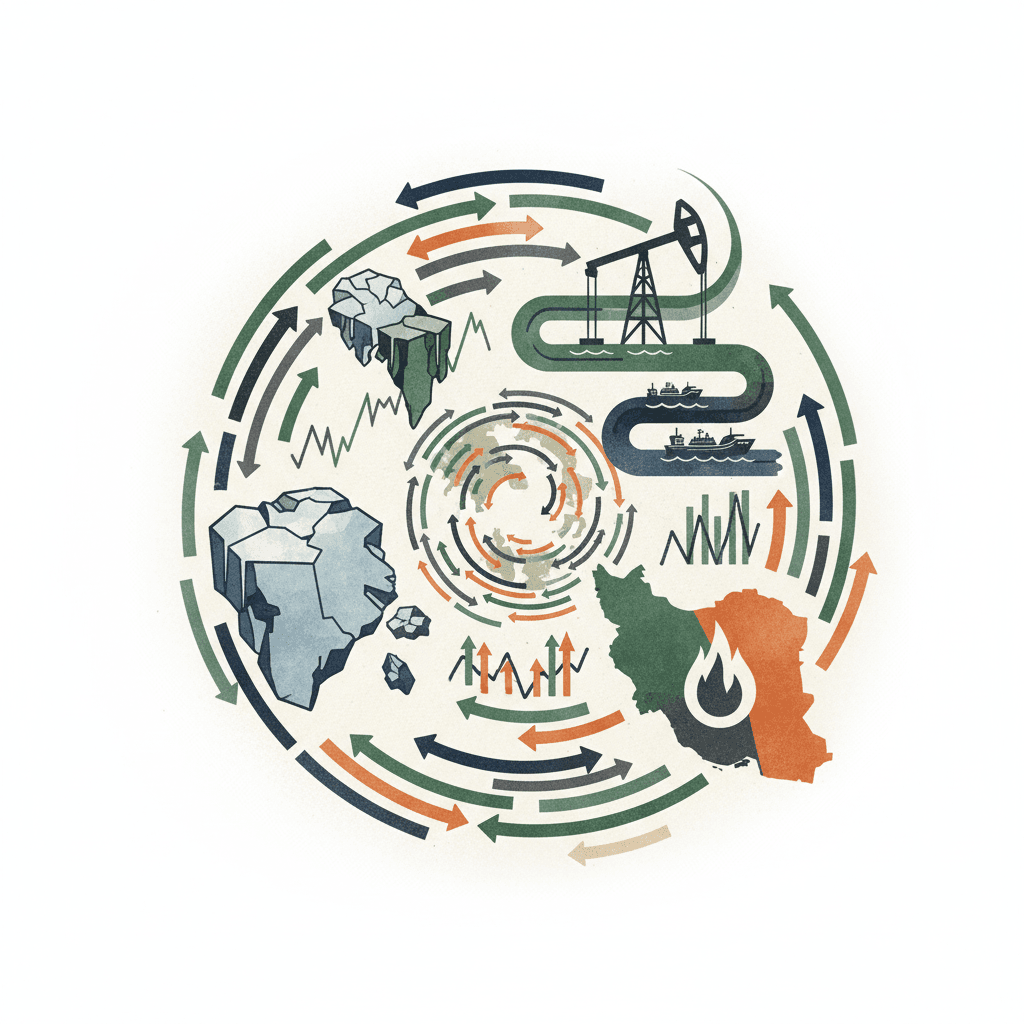
The self-reinforcing cycle works like this:
- Aggressive U.S. posture toward Iran reduces the probability of a near-term nuclear deal
- Without a deal, Iranian oil supply remains constrained or at risk of further disruption
- Supply risk pushes crude prices higher, building a geopolitical risk premium into every barrel
- Higher oil prices feed directly into inflation through gasoline, diesel, jet fuel, and petrochemicals
- Persistent energy-driven inflation paralyzes the Federal Reserve, which can't cut interest rates to help a weakening economy without risking even higher prices
- The combination of expensive energy and tight monetary policy squeezes consumers and businesses alike
This is what investor Ray Dalio has described as the template for great power conflicts driving commodity cycles. Multiple theaters of tension create compounding uncertainty, and that uncertainty finds its way into the price of everything.
Trade Signals: Who Benefits
The most direct play is crude oil itself. USO, which tracks WTI futures, gets a BUY signal at 62% confidence. The logic is straightforward: if Iran tensions escalate and no deal materializes, oil goes up and USO goes up with it. But there's a structural problem with USO that matters. Oil futures contracts expire monthly, and USO has to "roll" from one contract to the next. When later-dated contracts cost more than near-term ones (a situation called contango), this rolling process slowly erodes your returns like a slow leak in a tire. You can be right about the direction of oil and still lose money over time.
That's why XLE, the broad energy stock ETF, gets a slightly higher BUY signal at 65% confidence. Energy companies like ExxonMobil and Chevron don't suffer from contango drag. They pump oil out of the ground and sell it at whatever the market price is, and they pay you dividends while you wait. Even if oil doesn't spike to $150, a sustained environment of $80-100 crude with a geopolitical risk premium supports strong cash flow for these businesses.
DBA, an agricultural commodity fund, gets a WEAK BUY at 50% confidence. The connection is more indirect: energy costs flow into fertilizer and transportation, and Panama Canal disruption (at 32% probability) could reroute agricultural trade. But weather still drives crop prices more than geopolitics, making this a second-order bet.
The Shovels, Not the Gold
During the California Gold Rush, the people who got reliably rich weren't the prospectors panning for gold. They were the merchants selling pickaxes, shovels, and blue jeans. The same principle applies to energy markets during a geopolitical escalation.
HAL (Halliburton) gets a BUY at 68% confidence, the highest of any signal in this pattern. Halliburton provides drilling, completion, and production services. If governments decide energy security is a national priority and every oil company races to increase production, they all need Halliburton's equipment and expertise. It doesn't matter which oil company wins. Halliburton gets paid either way.
SLB (Schlumberger, the largest oilfield services company in the world) gets a BUY at 67% confidence. SLB has particularly deep exposure to the Middle East, where roughly 20% of its revenue comes from. If Iran tensions push Saudi Arabia, the UAE, and Kuwait to accelerate their own production capacity investments, SLB is the primary beneficiary of that spending.
OIH, the oilfield services ETF that holds both HAL and SLB along with dozens of smaller companies, gets a BUY at 66% confidence. It's the diversified shovel basket.
FLNG, a liquefied natural gas shipping company, gets a BUY at 60% confidence. When geopolitical fragmentation disrupts traditional energy trade routes, ships carrying LNG have to travel longer distances, increasing what the industry calls "ton-miles." Europe's ongoing shift away from Russian gas toward American LNG creates structural demand for these vessels. FLNG operates the ships regardless of which gas producer fills them.
TIP, the Treasury Inflation-Protected Securities ETF, gets a BUY at 70% confidence. If the whole thesis boils down to "geopolitics drives energy prices drives inflation drives Fed paralysis," then TIPS are the ultimate infrastructure play on that cycle. You don't need to pick the right commodity or the right energy company. TIPS are government bonds that automatically adjust their value based on the Consumer Price Index. They're the shovel for the inflation trade itself.
MATX (Matson), a U.S.-flagged shipping company protected by the Jones Act, gets a WEAK BUY at 52% confidence. If Panama Canal transit gets disrupted, U.S. domestic shipping routes and Pacific trade lanes get repriced. But with Canal control probability at only 32%, this is more of a speculative add-on than a core position.
The Risks (And They're Real)
This pattern has significant vulnerabilities that deserve equal weight.
The biggest one: the nuclear deal probability of 54% by year-end means betting markets actually think de-escalation with Iran is slightly more likely than escalation. If a deal gets struck, the geopolitical risk premium in oil evaporates quickly, and every trade signal above reverses.
The oil spike probabilities, while noteworthy, are lower than some initial reports suggested. A 25% chance of $150 oil is real risk, but a 75% chance it doesn't reach that level is the more likely outcome.
Global recession risk could destroy oil demand and overwhelm any supply disruption. OPEC+ nations hold spare production capacity that could offset Iranian supply losses. The Greenland and Panama Canal rhetoric may be negotiating tactics rather than genuine military intentions.
For the individual stocks, oilfield services companies lag oil price moves because higher crude doesn't immediately translate to more drilling activity. Energy companies practicing capital discipline may not ramp up spending even if prices rise. SLB's heavy Middle East exposure cuts both ways: actual military conflict could disrupt its operations, not just boost its revenue.
TIPS carry duration risk, meaning their prices can fall if real interest rates (the rate after subtracting inflation) spike, even if inflation itself is rising. And energy stocks may already have a meaningful geopolitical premium baked into current prices.
Why This Matters
You don't need to be a commodities trader for this to affect your life. If the geopolitical escalation scenario plays out, gasoline prices rise, grocery bills increase (because food travels on trucks that burn diesel), and the Federal Reserve finds itself stuck, unable to lower interest rates because inflation won't cooperate. That means mortgage rates stay elevated, car loans stay expensive, and the kind of economic relief that rate cuts normally provide just doesn't arrive.
For anyone with a retirement account, this pattern suggests that the traditional 60/40 stock-and-bond portfolio may not provide the protection people expect. Energy stocks and inflation-protected bonds become more important as diversifiers when geopolitical risk premiums are building across multiple regions at once.
The prediction market data doesn't say any of this will definitely happen. It says the probabilities are high enough to take seriously, and the potential consequences are large enough to prepare for.
Analysis based on prediction market data as of April 9, 2026. This is not investment advice.
How This Story Evolved
First detected Apr 7 · Updated daily
The article's opening was rewritten to lead with skepticism about each individual event before building to the bigger pattern, rather than jumping straight to the "three storms converging" idea. The new version tries to draw readers in by first acknowledging why someone might dismiss each situation, then revealing why the combination still matters.
Read latest →The new version makes the opening more concise and direct, cutting straight to the three key hotspots instead of building up to them slowly. It also adds a new weather map analogy to help explain how the three risks combine to create bigger danger.
Read this version →The article was rewritten to feel more like a guide for everyday investors, using simpler, more direct language to explain the same idea. The new version also places more emphasis on how all these events connect to a bigger financial picture, rather than just listing the geopolitical situations.
The article got a more specific headline that names the three key locations (Greenland, Panama Canal, and Iran) instead of using vaguer language about a "geopolitical storm." The opening of the article was also rewritten to be more direct, framing the story around U.S. foreign policy actions across three regions rather than focusing on the prediction markets themselves.
Read this version →The article's title was tweaked to replace "Multi-Front Geopolitical Gamble" with the more straightforward "Three Geopolitical Flashpoints." The opening was also rewritten to feel more personal and direct, spelling out why these events matter to everyday readers through their wallets instead of starting with a focus on prediction markets.
Read this version →