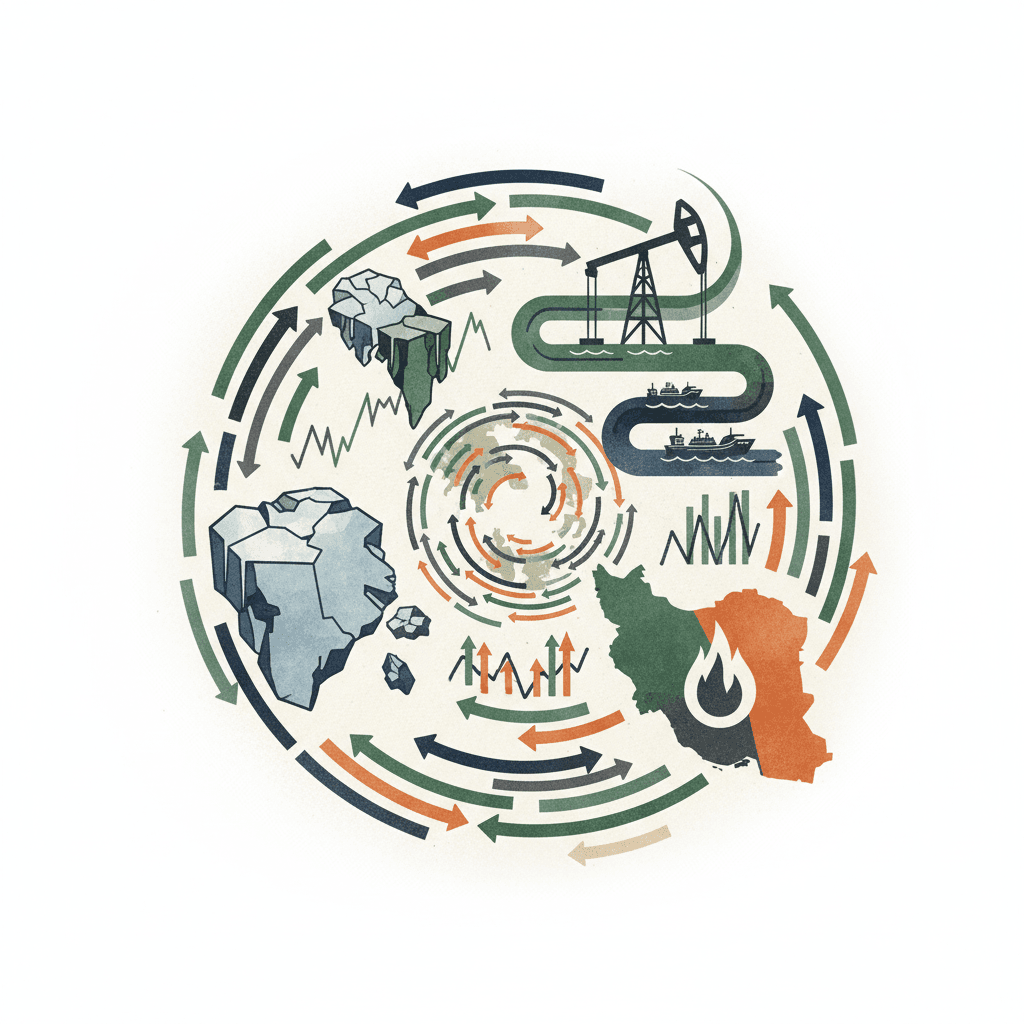
Greenland, Panama, and Iran: How Three Geopolitical Flashpoints Could Send Oil Past $150
Prediction markets are lighting up across three separate geopolitical theaters right now, and when you step back and look at them together, they tell a story that matters for your portfolio, your gas bill, and your grocery receipt.
The pattern looks like this: the United States is simultaneously pursuing territorial expansion in the Arctic, asserting control over a critical shipping chokepoint in Central America, and signaling regime change in the Middle East. None of these moves exist in isolation. Together, they represent the kind of great-power posturing that historically drives commodity prices through the roof.
Let's walk through what the betting markets are actually pricing in.
The Three Theaters
Greenland: Bettors give a 35.5% chance that the U.S. acquires some part of Greenland before 2029, and a 25.3% chance that Trump outright purchases it. That might sound low, but consider that six months ago these numbers were in the single digits. Meanwhile, there's an 80.5% probability that no acquisition happens during Trump's term, which tells you the market sees this as aggressive posturing that probably doesn't result in a deal but keeps tensions elevated.
Panama Canal: There's a 31.5% chance that Trump takes back operational control of the Panama Canal before 2029. The Canal handles roughly 5% of global trade. Even the threat of disruption to that corridor ripples through shipping costs and supply chains worldwide.
Iran: This is the most consequential piece. Prediction markets show only an 8.5% chance of a new nuclear deal by May, 23% by June, and 33% by August. The full-year probability sits at just 43%, meaning the market believes it's more likely than not that there will be no deal in the near term. At the same time, the probability that the U.S. formally recognizes Reza Pahlavi (the exiled son of the former Shah) as Iran's leader has jumped to 16.5%, with a 22.5% chance he visits Iran before 2027 and 13.5% odds he becomes the next head of state. That Pahlavi recognition number surged 6.5 percentage points recently, which is a huge move for a market like this. When you combine "no nuclear deal" with "active regime-change signaling," you get a picture of escalating confrontation with the world's fourth-largest oil producer.
The Oil Transmission Mechanism
This is where these political stories connect to your wallet. Prediction markets are pricing a 55% chance that WTI crude oil (the U.S. benchmark) hits at least $140 per barrel at some point before the end of 2026. The probability of $150 or higher sits at 49%. Even $160 carries 39.5% odds, and the truly extreme scenario of $180 oil has a 28% probability.
To put that in perspective, WTI is currently trading around $60-65 per barrel. A move to $140 would mean oil more than doubles. A move to $180 would roughly triple it. These are the kinds of numbers we saw briefly during the worst moments of the 2008 spike and the early days of Russia's invasion of Ukraine.
A key caveat: these are "max price" contracts, meaning they capture any spike at any point during the year, even if it lasts a single day. Oil could touch $150 on an Iran crisis, then fall back to $90 within weeks. The prediction market probabilities reflect the chance of the spike happening, not the chance of oil staying there.
Still, even a temporary spike to those levels would send shockwaves through inflation data, gasoline prices, and Federal Reserve policy. And that creates a self-reinforcing cycle worth understanding:
- Geopolitical tensions escalate with Iran, threatening Middle East oil supply
- Oil prices spike on supply-disruption fears
- Higher energy costs flow into consumer prices, pushing inflation higher
- The Fed, already dealing with sticky inflation, cannot cut interest rates to help a slowing economy
- The economy weakens under the weight of high energy costs AND high borrowing costs simultaneously
- This is the "Fed paralysis" scenario: inflation too high to cut, economy too weak to hike
This is essentially the Ray Dalio template for how great-power conflicts create commodity cycles that reshape monetary policy for years.
The Trade Signals: Gold Rush Shovels Over Gold
During the California Gold Rush, the people who got reliably rich weren't the miners. They were the people selling shovels, pickaxes, and denim jeans. The same logic applies here. If geopolitical tension is the gold rush, you want to own the infrastructure that benefits from the activity itself, not just bet on the most extreme outcome.
Direct Oil Exposure
USO (United States Oil Fund) is the most direct way to bet on oil prices, and it earns a BUY signal at 62% confidence. The reasoning is straightforward: if Iran tensions escalate and that 49% probability of $150+ oil materializes, USO captures the move directly. But confidence is tempered significantly because USO suffers from a structural problem called contango drag, where the fund loses value over time as it rolls expiring futures contracts into more expensive ones. You could be completely right about an oil spike and still lose money holding USO for months waiting for it to happen. It's a trade, not an investment.
XLE (Energy Select Sector SPDR) gets a BUY at 70% confidence. Energy stocks avoid USO's contango problem while still capturing the geopolitical risk premium. They generate actual cash flow at current prices, pay dividends (XLE yields roughly 3.5%), and carry embedded call-option-like upside if oil spikes. The Dalio framework says: own the producers when commodity cycles turn.
The Shovel Sellers
HAL (Halliburton) earns the highest confidence BUY at 73% with an infrastructure relevance score of 82 out of 100. Halliburton is a pure oilfield services company, meaning it provides the equipment, technology, and crews that oil producers need to drill wells and complete them. Think of it like owning the only equipment rental company in a boomtown. If geopolitical risk drives oil higher, every producer globally ramps up drilling activity, and they all need Halliburton's services. The company doesn't care which oil company wins. It profits from the volume of activity itself.
SLB (Schlumberger) gets a BUY at 71% confidence with an infrastructure score of 80. SLB is the largest oilfield services company in the world, with deeper international exposure than Halliburton. If Iran tensions disrupt Middle East supply, non-OPEC producers everywhere must ramp up, and SLB is the primary service provider outside North America. When one region goes offline, others must produce more, and SLB services them all.
FANG (Diamondback Energy) gets a BUY at 67% confidence with an infrastructure score of 70. Diamondback is a pure-play Permian Basin producer with breakeven costs around $40 per barrel, meaning it generates massive free cash flow at any price above that. When Middle East supply is threatened, U.S. shale is what keeps the lights on globally. FANG is the shovel for global energy security.
Defense Plays
LMT (Lockheed Martin) earns a BUY at 72% confidence. Multi-theater geopolitical aggression, whether it's Greenland, the Panama Canal, or Iran, signals sustained elevated defense spending. The critical insight is that defense budgets are set by threat perception, not actual conflicts. LMT benefits from the posture regardless of whether any specific action materializes. It's a shovel seller for geopolitical tension itself.
NOC (Northrop Grumman) gets a BUY at 68% confidence with an infrastructure score of 72. Northrop is uniquely aligned with the specific type of posturing in this pattern: Arctic surveillance capabilities for Greenland, naval reconnaissance for the Panama Canal, and long-range strike and stealth capabilities for Iran. The B-21 bomber, Global Hawk drones, and space-based surveillance all map directly to these theaters. Intelligence, surveillance, and reconnaissance (ISR) is needed before, during, and after any geopolitical action.
Inflation Hedging and Other Plays
TIP (iShares TIPS Bond ETF) gets a WEAK BUY at 60% confidence. Treasury Inflation-Protected Securities, or TIPS, are bonds whose value adjusts with the Consumer Price Index, making them a direct hedge against inflation. If energy-driven inflation accelerates, TIPS benefit from the inflation itself regardless of which geopolitical event causes it. But confidence is low because rising real yields (the interest rate after subtracting inflation) could hurt TIPS even if inflation is elevated, and breakeven inflation rates already embed some premium.
HES (Hess Corporation) gets a WEAK BUY at 55% confidence. Hess has significant assets in Guyana's Stabroek block, one of the world's most important new oil provinces. If Middle East supply is disrupted, Atlantic basin barrels become strategically critical. However, the pending Chevron merger creates arbitrage dynamics that may decouple the stock from oil fundamentals, and litigation risk from Exxon's pre-emptive rights claim adds further uncertainty.
The Risks Are Real
This pattern carries substantial risks that deserve honest acknowledgment.
The max-price contracts in prediction markets capture any intraday spike, not sustained price levels. Oil could touch $150 for a single afternoon and fall back to $80. You'd win the prediction market bet but potentially lose money on an energy stock you bought too late.
Global recession would crush oil demand and override supply concerns entirely. If the economy weakens enough, falling demand could swamp any supply-side disruption.
An Iran deal could materialize quickly under diplomatic pressure. The 43% full-year probability of a deal means there's nearly a coin flip chance that the entire Iran risk premium evaporates.
OPEC+ has spare capacity that could cap sustained oil rallies. Saudi Arabia alone could bring roughly 3 million barrels per day back online.
The Greenland and Panama Canal moves may be negotiating tactics that fizzle into nothing. Prediction markets assign 80.5% odds that no Greenland acquisition happens.
Defense spending could face domestic efficiency cuts. Congressional pushback on military adventurism could cap budgets regardless of the geopolitical posture.
And critically, current WTI sitting in the $60s means these $140+ probabilities imply a 115%+ spike, which is historically extreme. The prediction market odds on extreme oil prices may reflect speculative excess rather than calibrated risk assessment.
Why This Matters for Your Money
Even if you never buy a single energy stock, this pattern affects you. If oil spikes toward $150, you'll feel it at the gas pump within days. Grocery prices follow within weeks, since everything from farming to trucking runs on diesel. Your 401(k) takes a hit if the Fed can't cut rates to support a weakening economy. And if you're holding bonds expecting rate cuts, energy-driven inflation could delay those cuts by months or longer.
The broader takeaway is that geopolitical risk doesn't stay in the news section of your phone. It flows through energy prices into everything you buy, everything you save, and every assumption your retirement portfolio is built on. The prediction markets are telling us that the probability of a major disruption is higher than most people realize, and the companies that serve as infrastructure for that disruption, the shovel sellers, may be the smartest way to position for it.
Analysis based on prediction market data as of April 7, 2026. This is not investment advice.
How This Story Evolved
First detected Apr 7 · Updated daily
The article's opening was rewritten to lead with skepticism about each individual event before building to the bigger pattern, rather than jumping straight to the "three storms converging" idea. The new version tries to draw readers in by first acknowledging why someone might dismiss each situation, then revealing why the combination still matters.
Read latest →The new version makes the opening more concise and direct, cutting straight to the three key hotspots instead of building up to them slowly. It also adds a new weather map analogy to help explain how the three risks combine to create bigger danger.
Read this version →The article was rewritten to feel more like a guide for everyday investors, using simpler, more direct language to explain the same idea. The new version also places more emphasis on how all these events connect to a bigger financial picture, rather than just listing the geopolitical situations.
Read this version →The article got a more specific headline that names the three key locations (Greenland, Panama Canal, and Iran) instead of using vaguer language about a "geopolitical storm." The opening of the article was also rewritten to be more direct, framing the story around U.S. foreign policy actions across three regions rather than focusing on the prediction markets themselves.
Read this version →The article's title was tweaked to replace "Multi-Front Geopolitical Gamble" with the more straightforward "Three Geopolitical Flashpoints." The opening was also rewritten to feel more personal and direct, spelling out why these events matter to everyday readers through their wallets instead of starting with a focus on prediction markets.