Greenland, the Panama Canal, and Iran: How Prediction Markets Are Pricing a Global Energy Shock
Prediction markets are flashing a pattern that connects some seemingly unrelated headlines into a single, coherent story. The U.S. government is pursuing an aggressive geopolitical posture across three theaters simultaneously, Greenland, the Panama Canal, and Iran, and the energy markets are starting to price in the consequences.
This isn't about any single crisis. It's about the cumulative effect of all of them happening at once, and what that means for oil prices, inflation, and your portfolio.
The Geopolitical Picture
Let's start with what prediction markets are actually telling us.
Greenland: Bettors give a 35% chance the United States acquires some part of Greenland before 2029, and a 27% chance Trump outright purchases it. The near-term odds are lower, only 9% by 2027, but the longer-term numbers show this isn't just talk. There's an 81% probability of no acquisition during Trump's term, which means about one-in-five bettors think some kind of deal actually gets done.
Panama Canal: There's a 32% chance Trump takes back the Panama Canal. One in three. That's a major global trade chokepoint with serious implications for shipping routes worldwide.
Iran: This is where the energy connection gets concrete. Prediction markets show only an 11% chance of a nuclear deal by May, 27% by June, and 40% by August. The full-year probability of a deal lands at 54%, which means roughly half the market thinks we end 2026 without any agreement. Meanwhile, the U.S. appears to be signaling support for regime change. The probability of recognizing Reza Pahlavi, the exiled son of Iran's last Shah, as Iran's leader sits at 13%. The chance of Pahlavi actually visiting Iran before 2027 is 17%. And the chance of him becoming head of state is 11%. These numbers are small individually, but the pattern, no deal plus regime-change signaling, points toward escalation rather than diplomacy.
The Oil Price Transmission Mechanism
All of this geopolitical activity feeds directly into oil. The prediction markets on WTI crude, the benchmark price for U.S. oil, show meaningful probabilities of price spikes by the end of 2026:
- 31% chance WTI hits $140 or higher
- 25% chance it hits $150 or higher
- 18% chance it hits $160 or higher
- 17% chance it hits $180 or higher
An important note of honesty here: some initial summaries of this pattern overstated these probabilities, claiming $140+ at 55% and $150+ at 49%. The actual market data shows roughly half those numbers. That matters. The bull case for oil is real, but it's not as strong as the headline version suggests.
Still, a roughly one-in-four chance of $150 oil is not a number to ignore. For context, we haven't seen prices that high since 2008. And the mechanism is straightforward: Iran is one of the world's largest oil producers. If tensions escalate to the point of military action, sanctions enforcement, or regime instability, supply gets disrupted. The Strait of Hormuz, through which about 20% of the world's oil passes, becomes a flashpoint. Add Panama Canal disruption on top of that, and global energy logistics start looking genuinely fragile.
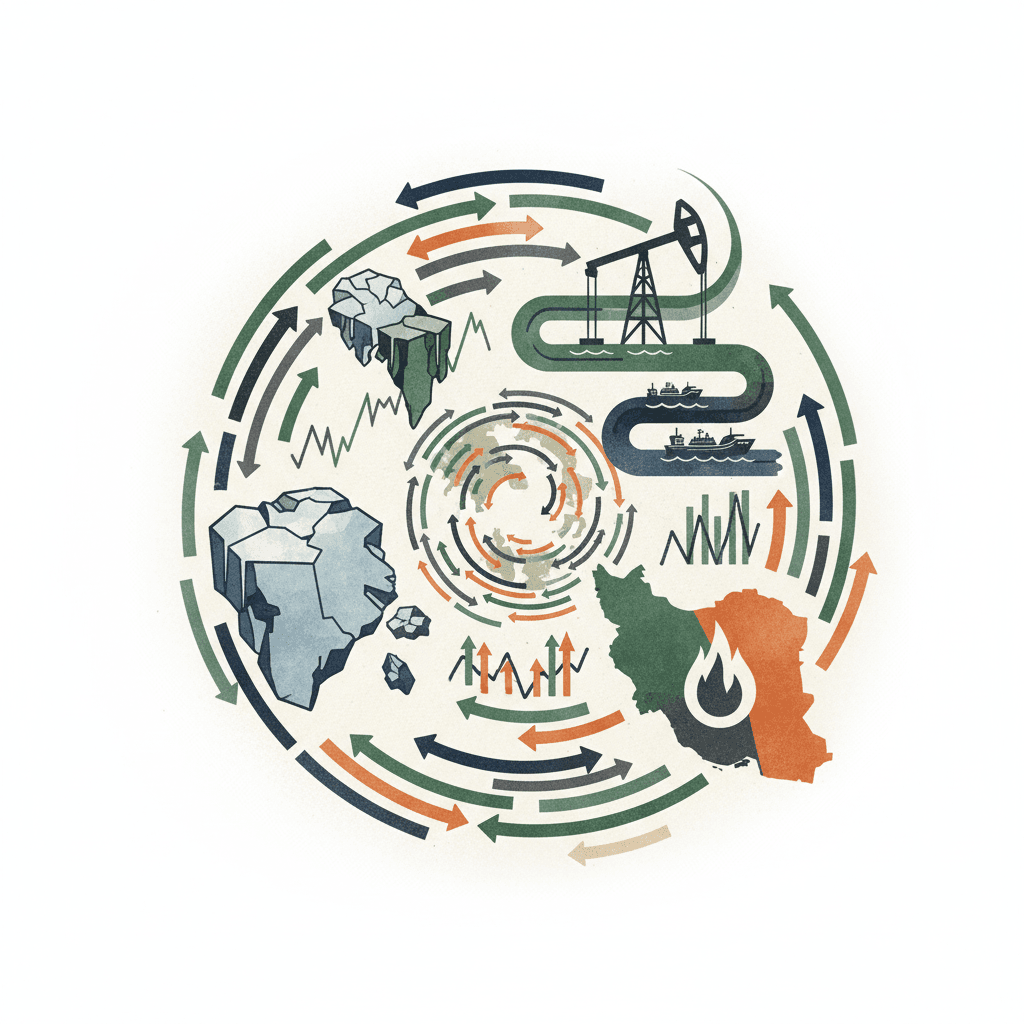
This creates a self-reinforcing cycle that's worth understanding step by step:
- Aggressive U.S. posture across multiple theaters raises geopolitical risk premiums
- Oil prices rise to reflect the increased probability of supply disruption
- Higher energy costs feed into inflation across the economy, from gasoline to fertilizer to shipping
- The Federal Reserve, which needs inflation to come down before cutting interest rates, finds itself paralyzed, unable to ease monetary policy even if economic growth slows
- The combination of high energy costs and tight monetary policy squeezes consumers and businesses
- Government rhetoric intensifies as economic pressure builds, which feeds back into step one
This is what investor Ray Dalio calls the great power conflict cycle driving commodity markets. It doesn't require any single crisis to go nuclear, literally or figuratively. It just requires the overall temperature to stay elevated.
Why This Matters for Your Money
If you have a 401(k), a savings account, or just buy groceries, this pattern matters. Higher oil prices don't stay contained in the energy sector. They ripple through everything. The diesel that trucks run on, the natural gas that makes fertilizer, the jet fuel that moves goods and people around the world. When oil goes up, your cost of living follows with a lag of a few months.
And if the Fed can't cut rates because inflation stays sticky, that means mortgage rates stay high, car loans stay expensive, and credit card debt keeps compounding. The people hoping for rate relief in 2026 might be waiting longer than they think.
Trade Signals: Shovels, Not Gold
During the California Gold Rush, most miners went broke. The people who got rich were selling shovels, pickaxes, and blue jeans. The same logic applies to geopolitical energy trades. You don't have to predict exactly which crisis erupts or how high oil goes. You can own the companies that benefit regardless of which specific producer wins or loses.
Direct Energy Exposure:
USO gives you direct crude oil exposure through WTI futures. It's the most obvious play, but it comes with a structural problem called contango, where the futures curve slopes upward and the fund loses money every time it rolls from one contract to the next. Think of it as a slow leak in your tire. Confidence: 62%.
XLE, the Energy Select Sector SPDR ETF, gives you broad exposure to U.S. energy companies, the ExxonMobils and Chevrons of the world. Unlike USO, these companies don't suffer from contango drag, they pay dividends, and they generate strong free cash flow even if oil stays in the $80-100 range rather than spiking to $150. Better risk/reward than pure futures. Confidence: 65%.
The Shovel Sellers (Oilfield Services):
HAL (Halliburton) is the quintessential picks-and-shovels play. Every oil company in the world needs Halliburton's drilling and completion services. They benefit whether ExxonMobil, a Saudi national oil company, or a small independent wins the production race. If governments start prioritizing energy security, drilling budgets go up, and HAL collects. Confidence: 68%.
SLB (formerly Schlumberger) is the largest oilfield services company on the planet, with particularly deep exposure to the Middle East. If Iran tensions push neighboring Gulf states to accelerate their own production capacity, SLB is the primary beneficiary of Saudi, UAE, and Kuwaiti upstream spending. Confidence: 67%.
OIH, the VanEck Oil Services ETF, bundles HAL, SLB, Baker Hughes, and dozens of smaller oilfield services companies into one basket. It's the ultimate shovel-seller ETF for this thesis. Confidence: 66%.
Infrastructure and Hedges:
FLNG (FLEX LNG) operates liquefied natural gas shipping vessels. When geopolitical disruption reroutes global energy trade, ships travel longer distances, which means more revenue per voyage. Europe's ongoing pivot from Russian gas to American LNG creates structural demand. Confidence: 60%.
TIP (iShares TIPS Bond ETF) holds Treasury Inflation-Protected Securities, which are U.S. government bonds whose value adjusts upward with inflation. If the thesis is right that energy-driven inflation prevents the Fed from cutting rates, TIP is the shovel for the inflation trade itself. You don't need to pick the right commodity. Confidence: 70%.
DBA (Invesco DB Agriculture Fund) is a weaker, second-order play. Geopolitical disruption spills into agricultural commodities through higher fertilizer and transportation costs, but the connection is less direct. Confidence: 50%.
MATX (Matson Inc.) is a U.S.-flagged shipping company protected by the Jones Act, which restricts domestic shipping to American vessels. If Panama Canal transit gets disrupted or repriced, domestic shipping routes gain value. But the Panama Canal probability is only 32%, making this a speculative add. Confidence: 52%.
The Risks, and They're Real
This pattern has meaningful holes that deserve honest attention.
The nuclear deal could happen. At 54% probability for the full year, the market actually thinks a deal is slightly more likely than not. If diplomacy succeeds, the entire Iran risk premium evaporates, and energy stocks could sell off sharply.
The oil spike probabilities are lower than they first appear. The actual market data shows $140+ at 31% and $150+ at 25%, roughly half the numbers that circulated in early pattern summaries. That's the difference between a probable event and a possible one.
Greenland and Panama rhetoric may be negotiating posture. Politicians use aggressive language to create leverage. A 32% chance on the Panama Canal means it's twice as likely to not happen. The Greenland numbers tell a similar story.
Demand destruction is a counterweight. If tariffs and trade wars slow global growth, oil demand could fall enough to overwhelm any supply disruption. A recession doesn't care about geopolitical risk premiums.
OPEC+ has spare capacity. Saudi Arabia and the UAE could ramp up production to offset an Iran disruption, which is exactly what SLB's Middle East presence is designed to service, but which would also cap oil price spikes.
Oilfield services stocks lag oil prices. Higher crude doesn't immediately translate into more drilling rigs. E&P companies have learned capital discipline the hard way and may not open the spending floodgates even at elevated prices.
Contango erodes USO returns over time regardless of spot price movements. If you hold USO for months while waiting for a spike that doesn't come, you're bleeding value.
Real rates could spike. If the Fed turns hawkish in response to inflation, even TIP holders get hurt because rising real yields push down TIPS prices.
The combined dollar volume across these prediction market contracts exceeds $14.7 million, which tells you real money is behind these probabilities, not just casual speculation. But the probabilities themselves are a reminder that the most likely outcome in any single theater is that nothing dramatic happens. The pattern's power comes from the possibility that multiple theaters heat up simultaneously, an outcome the market hasn't fully priced.
Analysis based on prediction market data as of April 9, 2026. This is not investment advice.
How This Story Evolved
First detected Apr 7 · Updated daily
The article's opening was rewritten to lead with skepticism about each individual event before building to the bigger pattern, rather than jumping straight to the "three storms converging" idea. The new version tries to draw readers in by first acknowledging why someone might dismiss each situation, then revealing why the combination still matters.
Read latest →The new version makes the opening more concise and direct, cutting straight to the three key hotspots instead of building up to them slowly. It also adds a new weather map analogy to help explain how the three risks combine to create bigger danger.
Read this version →The article was rewritten to feel more like a guide for everyday investors, using simpler, more direct language to explain the same idea. The new version also places more emphasis on how all these events connect to a bigger financial picture, rather than just listing the geopolitical situations.
Read this version →The article got a more specific headline that names the three key locations (Greenland, Panama Canal, and Iran) instead of using vaguer language about a "geopolitical storm." The opening of the article was also rewritten to be more direct, framing the story around U.S. foreign policy actions across three regions rather than focusing on the prediction markets themselves.
The article's title was tweaked to replace "Multi-Front Geopolitical Gamble" with the more straightforward "Three Geopolitical Flashpoints." The opening was also rewritten to feel more personal and direct, spelling out why these events matter to everyday readers through their wallets instead of starting with a focus on prediction markets.
Read this version →