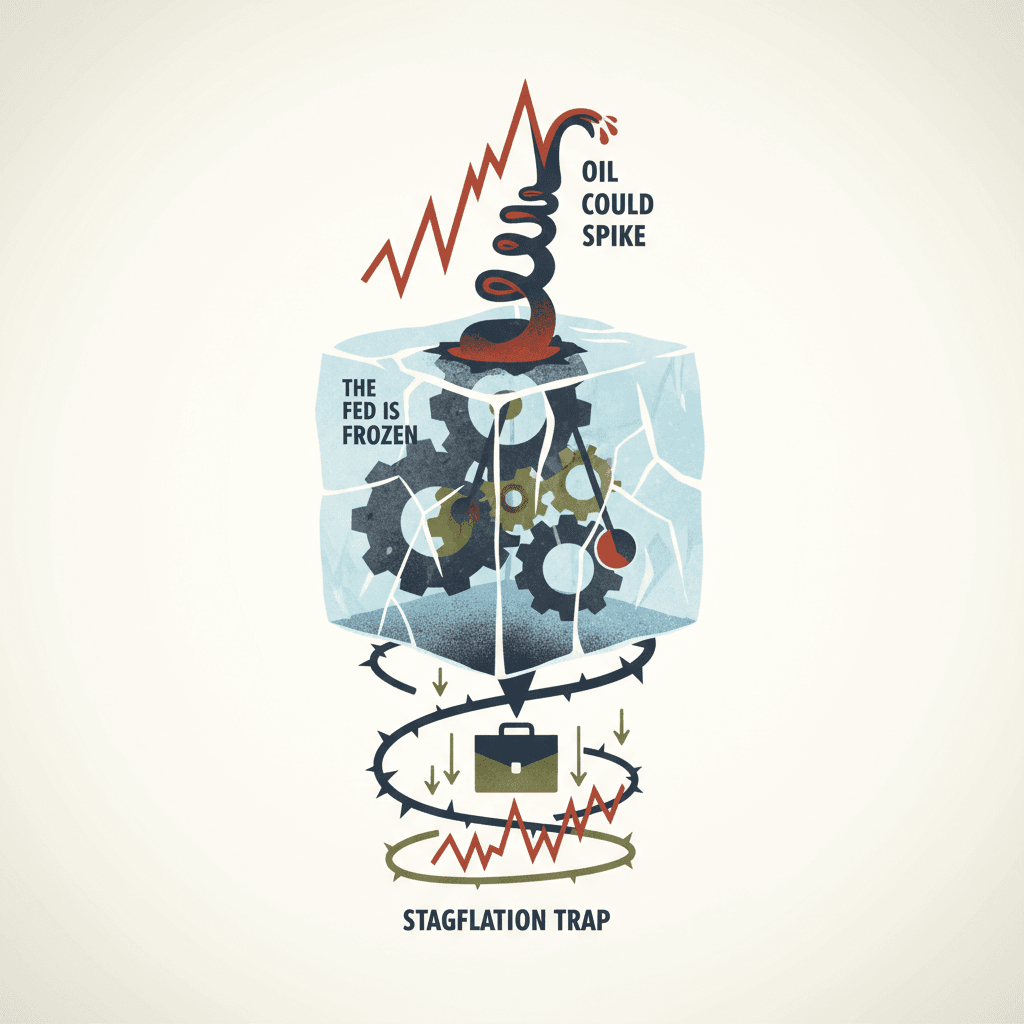
The Fed Is Frozen and Oil Is Threatening to Spike. That's the Worst Combo for Your Portfolio.
Imagine you're driving a car where the gas pedal makes the engine overheat and the brake pedal makes the wheels fall off. That's roughly the position the Federal Reserve finds itself in right now. Prediction markets are pricing in a 98.5% chance the Fed does absolutely nothing at its April 2026 meeting. Not a hike, not a cut. Just... nothing. The probability of a 25 basis point rate hike (a 0.25% increase) sits at a trivial 0.5%. The chance of a 25 basis point cut is barely better at 1.5%. The Fed is paralyzed.
And it's not just April. Looking at the full year, there's a 40.5% chance the Fed makes zero rate cuts in all of 2026. Zero. After years of Wall Street begging for lower borrowing costs, the betting money says there's nearly a coin-flip chance rates stay right where they are for the entire year.
That alone would be noteworthy. But pair it with what's happening on the other side of the economy, and the picture gets genuinely ugly.
The Stagflation Trap
Prediction markets currently put the probability of a recession in 2026 at 29%. There's a 36.5% chance unemployment climbs above 5% before 2027. The economy is clearly showing signs of slowing down.
At the same time, oil prices are flashing danger signals in the opposite direction. Betting markets give a 56% probability that WTI crude oil reaches $140 per barrel by year-end, a 40% chance of hitting $150, 40% for $160, and even 24.5% for $180. With crude currently sitting around $60-65, these numbers imply the market sees a realistic chance of oil more than doubling.
When the economy slows down and prices go up at the same time, economists have a word for it: stagflation. Think of it like being stuck in traffic on a hot day with a broken air conditioner. You're not going anywhere, and you're getting more uncomfortable by the minute.
Ray Dalio, the billionaire investor who founded Bridgewater Associates, has warned about exactly this kind of trap for years. The Federal Reserve has two jobs, often called its "dual mandate": keep prices stable and keep employment high. In a stagflationary environment, those two goals pull in opposite directions. Cutting rates to help the job market would pour fuel on already-hot inflation. Raising rates to fight inflation would push even more people out of work. The result is what we're seeing in the prediction markets: a frozen central bank that can do neither.
The self-reinforcing cycle works like this:
- Oil prices spike, raising costs for businesses and consumers across the economy
- Companies absorb those costs by cutting staff or raising prices, pushing unemployment up and inflation higher simultaneously
- The Fed can't cut rates because inflation is too hot
- The Fed can't hike rates because the economy is too weak
- Policy paralysis means no relief, which lets the cycle continue
For context, even looking ahead to June, the probability of a 25 basis point cut is only 6.5%. The market sees virtually no chance the Fed funds rate drops below its current upper bound of around 4.25-4.50%, with only a 0.5% probability it falls below 3.75% after the April meeting.
What This Means for Stocks and Bonds
This environment is toxic for the assets most Americans hold in their retirement accounts. The S&P 500 has only about a 48% chance of finishing above 6845 by year-end, according to related prediction market data. That's essentially a coin flip on whether stocks go up or down from here. The Nasdaq faces a 17% probability of falling below 19,000, which represents meaningful downside risk for anyone heavily weighted in tech.
Long-term bonds, which are normally a safe haven when the economy weakens, get hit from both sides in stagflation. Rising oil prices and inflation expectations push bond yields up (which means bond prices fall). But the economic weakness that would normally trigger a flight to safety and push bond prices up gets neutralized because the Fed refuses to cut rates. Bonds become a no-man's-land.
The Shovel Sellers
During the California Gold Rush, the people who most reliably made money weren't the miners. They were the ones selling pickaxes, shovels, and denim jeans. The same principle applies to investing during periods of market stress: look for the companies and assets that profit from the trend itself, regardless of exactly how the specific outcomes play out.
Gold is the ultimate shovel in a stagflation environment. GLD, the SPDR Gold Trust ETF, gets a BUY signal with 75% confidence, the highest of any asset in this analysis. Gold benefits from every branch of this scenario. Inflation stays elevated because of oil? Gold goes up. Economic uncertainty rises from recession risk? Gold goes up. The Fed is paralyzed and real interest rates (rates adjusted for inflation) get compressed? Gold goes up. Geopolitical tensions around Iran drive the oil spike? Gold goes up. It's the one asset that profits from the entire theme of monetary policy confusion, not just one specific outcome.
Energy stocks are the other major shovel play. XLE, the Energy Select Sector SPDR Fund, earns a BUY signal at 68% confidence. Unlike buying oil directly through a fund like USO (more on that in a moment), energy stocks don't suffer from a problem called contango decay, where the cost of rolling futures contracts forward eats into your returns over time. XLE holds integrated majors like Exxon and Chevron that generate actual cash flows. They also serve as real-asset inflation hedges, meaning their revenues naturally adjust upward when prices rise.
HAL, Halliburton, is the classic shovel seller in oil markets with a BUY signal at 65% confidence. Halliburton provides the completion and production services that every oil producer needs. In a high oil price environment with supply constraints (there's a 58% chance there's no Iran nuclear deal, which would keep Iranian oil off the market), producers face intense pressure to maximize output from existing wells. That's exactly what Halliburton does. They benefit from activity levels, not just the commodity price itself.
On the defensive side, SH, the ProShares Short S&P 500 ETF, gets a BUY signal at 62% confidence as a direct hedge against broad equity declines. With the Fed unable to ride to the rescue and oil threatening to compress profit margins across the economy, downside protection has real value.
DBMF, the iMGP DBi Managed Futures Strategy ETF, receives a WEAK BUY at 55% confidence. This fund replicates hedge fund trend-following strategies, which historically perform well during stagflationary periods because they can go long commodities and short bonds at the same time. It's a shovel for navigating regime uncertainty rather than betting on one specific outcome.
Two positions round out the picture. USO, the United States Oil Fund, gets only a WEAK BUY at 50% confidence. While the oil spike probabilities look compelling on paper, current WTI is around $60-65, meaning $140 would require a 115%+ move. Oil probability markets actually fell 5-13% in the most recent 24-hour period, suggesting momentum is already fading. And USO's fund structure, with its constant rolling of futures contracts, destroys returns over time. TLT, the iShares 20+ Year Treasury Bond ETF, sits at NEUTRAL with 40% confidence. Long-duration bonds are the textbook stagflation victim, getting hammered by inflation on one side and unable to rally on safety flows because the Fed won't cut. But shorting bonds here is also risky, given that a hard recession would trigger exactly the kind of panic buying that sends Treasury prices soaring.
Finally, VICI, VICI Properties, a gaming-focused real estate investment trust, gets a SELL signal at 65% confidence. REITs with long-duration cash flows (income streams stretching far into the future) are the "anti-shovel" of this environment. Their future income gets discounted more heavily when rates stay higher for longer. With a 40.5% chance of zero cuts all year, the REIT sector, which had been priced for rate relief, faces a painful repricing.
The Risks You Need to Know
This is a minority-probability thesis, and that matters. A 29% recession probability means there's a 71% chance of no recession. Markets have a persistent upward bias, and equities could rally simply on hope that rate cuts eventually arrive.
The oil spike leg of the argument has specific vulnerabilities. There's a 42% chance an Iran nuclear deal gets done, which would flood the market with additional supply and crush crude prices. Demand destruction from a recession would work against oil too. There's a fundamental tension in the prediction market data itself: it's hard to have $140+ oil and a recession at the same time, because expensive oil destroys the demand that keeps prices high.
Gold is already near all-time highs, which limits the asymmetric upside you'd want from a hedge. A strong dollar, supported by high U.S. interest rates, historically acts as a headwind for gold prices. And if a true deflationary crash materializes instead of stagflation, gold could actually sell off in a liquidity crunch as investors dump everything to raise cash.
Inverse ETFs like SH suffer from daily rebalancing decay. In a choppy, sideways market where stocks bounce around without a clear trend, SH slowly bleeds value even if stocks end up flat over time. DBMF faces a similar problem: managed futures strategies struggle in range-bound conditions.
For the VICI short, the company's triple-net lease structure (where tenants pay all operating costs) provides remarkably stable cash flows. Its gaming exposure includes CPI-linked rent escalators that offer some inflation protection. And shorting REITs is already a crowded trade, meaning much of the bad news may already be reflected in prices.
Why This Matters for Your Money
If you have a 401(k), a brokerage account, or even just a savings account, the Fed's paralysis touches your financial life directly. High interest rates mean your savings account earns decent interest, but they also mean your mortgage is expensive and the companies in your retirement fund are paying more to borrow money. If oil spikes to $140 or beyond, you'll feel it at the gas pump and the grocery store, as transportation costs flow through to the price of almost everything. And if the economy tips into recession while prices stay high, that's the worst of both worlds: harder to find a job, and everything costs more.
The core message from prediction markets is that we're entering a period of unusually wide uncertainty. This isn't a time for concentrated bets. The assets that tend to do well are the ones that benefit from confusion itself: gold, energy infrastructure companies, and strategies designed to profit from trends in either direction.
Analysis based on prediction market data as of April 6, 2026. This is not investment advice.
How This Story Evolved
First detected Mar 20 · Updated daily
The headline was updated to highlight prediction markets as the source for stagflation concerns, replacing the mention of a slowing economy. The article's body made mostly small wording tweaks, like changing "serious" to "significant" and updating a subheading, but the overall meaning stayed the same.
Read latest →The headline was slightly reworded to make it flow more naturally, but the meaning stayed the same. The opening analogy changed from a car with stuck pedals to one with an overheating engine and failing brakes, and the article now more directly mentions the impact on personal portfolios.
Read this version →The article's opening was rewritten to start with a car analogy to make the Fed's situation easier to picture, before getting into the prediction market data. The new version also jumps more quickly into specific numbers, like the 98% probability of no Fed action, while the old version eased into the topic more gradually.
Read this version →The new version removed the car overheating analogy that opened the article and jumped straight into explaining the situation. It also added a clearer, simpler definition of stagflation early on for readers who may not know the term.
Read this version →The stagflation story stayed largely the same, but the focus sharpened — concerns about a slowing economy were dropped from the headline, leaving oil prices and the Fed's inability to act as the main worries. Investors appear to be moving toward energy and short-term safe assets while pulling back from longer-term bonds and some previous energy plays.
Read this version →The article updated its car analogy to better illustrate a "stagflation trap," where both action and inaction cause harm. The headline and framing now explicitly highlight a slowing economy alongside the frozen Fed and oil threat, painting a more complete picture of stagflation risks.
Read this version →The article updated its car analogy from a stuck gas pedal and brake to one where both pedals cause damage, making the Fed's situation sound even more dangerous. The headline also changed to more directly warn readers about the impact on their portfolio.
The article swapped out the overheating car analogy for a locked steering wheel analogy to describe the Fed's situation. The section header also changed from "The Fed Can't Move" to "A Central Bank With Its Hands Tied," but the core message and statistics stayed the same.
Read this version →