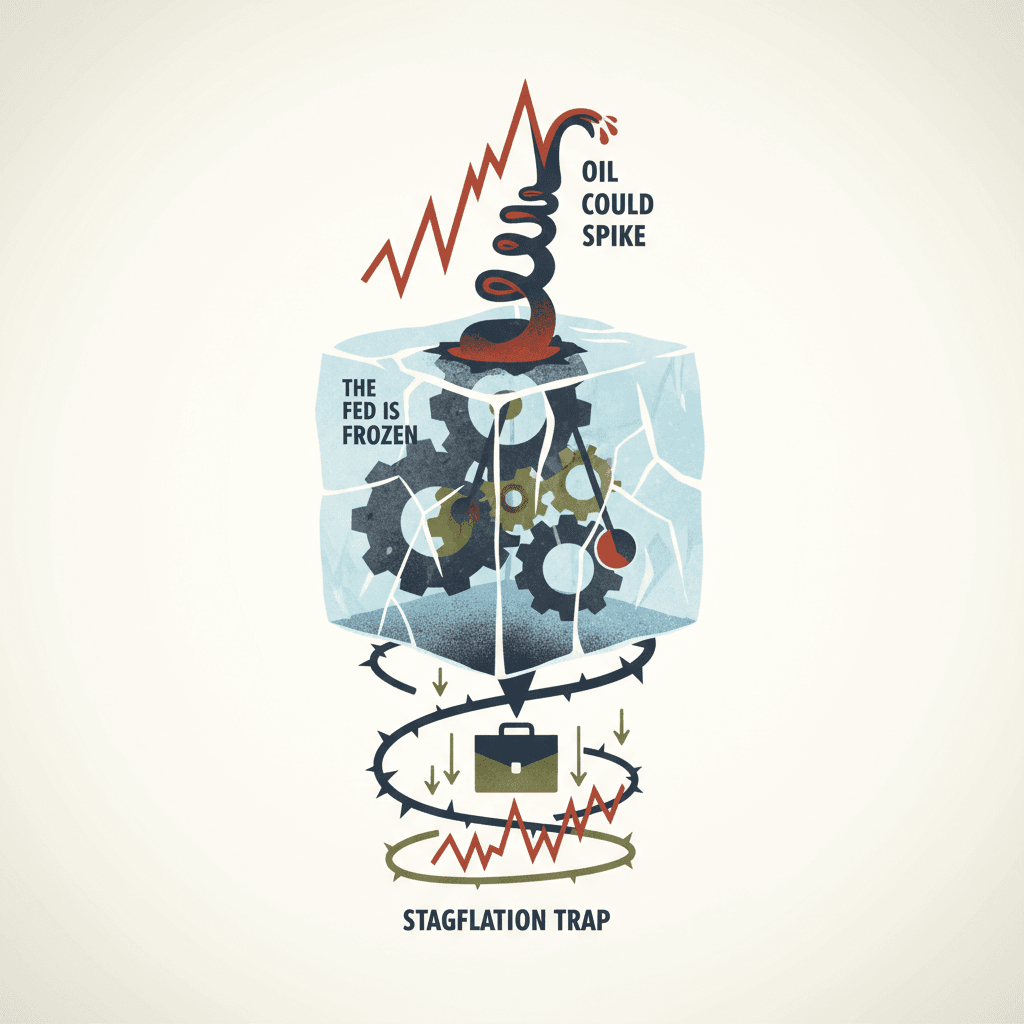
The Fed Is Frozen, Oil Could Spike, and the Economy Is Slowing. That's Called Stagflation.
Imagine you're driving a car where the gas pedal and the brake pedal are both stuck. You can't speed up and you can't slow down. You're just rolling toward whatever's ahead of you, hoping the road stays flat. That's essentially where the Federal Reserve finds itself right now, and prediction markets are putting hard numbers on just how stuck the central bank really is.
A Central Bank That Can't Move
Prediction markets are pricing a 98% probability that the Fed takes no action at its April 2026 meeting. Not a hike, not a cut, nothing. The chance of a 25 basis point rate hike (that's a quarter-percentage-point increase) sits at 0%. The chance of a 25 basis point cut is just 1%. Even looking out to June, there's only a 9% chance of a cut.
Zoom out further and the picture gets even more striking. There's a 33% chance the Fed makes zero rate cuts in all of 2026. Not one. The federal funds rate, which is the interest rate the Fed charges banks and which ripples through every mortgage, car loan, and credit card in America, has a 0% chance of dropping below 3.75% after the April meeting. The thermostat is set and nobody can touch the dial.
Why can't they move? Because they're caught between two problems that demand opposite solutions.
The Stagflation Trap, Step by Step
Ray Dalio, the founder of the world's largest hedge fund, has written extensively about what he calls the "economic machine." One of the scariest modes that machine can enter is stagflation, where the economy stagnates and prices keep rising at the same time. It's rare, it's painful, and it paralyzes policymakers. Prediction markets are now pricing in a meaningful chance that we're headed there.
The self-reinforcing cycle works like this:
- The economy is weakening. Recession probability sits at 27-29%, and there's a 39% chance that unemployment exceeds 5% before 2027. Those aren't panic numbers, but they're not comfortable ones either.
- Energy costs threaten to spike. Oil has a 31% chance of hitting $140 per barrel by year-end, a 25% chance of reaching $150, an 18% chance of $160, and a 17% chance of $180. Current prices hover around $60-70. We're talking about a potential doubling.
- The Fed can't cut rates to help the economy because cutting would pour gasoline on inflation that's already being fed by rising oil prices.
- The Fed can't hike rates to fight inflation because hiking would push a weakening economy into outright recession.
- The paralysis persists, which means neither problem gets addressed, and both problems can get worse.
This is the box. The Fed is stuck inside it.
What This Means for Markets
This environment is bearish for what analysts call "rate-sensitive" assets, meaning anything that benefits from lower interest rates or cheap borrowing. Think real estate, high-growth tech companies, and heavily leveraged businesses. When borrowing costs stay elevated and the economy softens, these get squeezed from both sides.
The S&P 500 has only about a 48% chance of finishing the year above 6845, which implies the market sees a coin-flip between gains and losses from current levels. The Nasdaq has a 17% chance of falling below 19,000. That's not a base case, but it's the kind of tail risk that destroys portfolios that aren't prepared for it.
Long-duration bonds, like 20-year Treasuries, face their own special version of misery. Normally when recession looms, investors pile into bonds and prices rise. But with inflation lurking from potential oil spikes, bond yields can't fall much. And if inflation actually picks up, bond yields could rise, which means bond prices would fall. Long bonds get neither the safety-haven bid nor the rate-cut tailwind.
The Trades: Shovels, Gold, and a Parking Spot
During the California Gold Rush, the people who most reliably made money weren't the miners. They were the people selling shovels, picks, and denim pants. The same logic applies in a stagflation environment. You want to own the infrastructure, the real assets, and the things that benefit no matter which version of the ugly scenario plays out.
The equity hedge: SH (BUY, 62% confidence). This inverse S&P 500 ETF provides straightforward short exposure to US stocks. With the Fed frozen, recession odds near 30%, and oil threatening to spike, equities face a toxic combination. The confidence here is moderate, not high, because a 30% recession probability still means a 70% chance of no recession, and markets can rally on the perception of stability even when the Fed is doing nothing.
The inflation beneficiary: XLE (BUY, 68% confidence). Energy stocks are the clearest winners in a stagflation pattern because they ARE the inflation. When oil prices are the thing driving costs higher, energy companies aren't victims of inflation, they're the source of it. At current oil prices of $60-70, these companies already generate strong free cash flow. At $140, they'd be printing money. Energy stocks have historically outperformed during stagflationary periods, and this is Dalio's playbook in action: own real assets when the monetary machine is broken.
The shovel-sellers of the oil patch: OIH (BUY, 66% confidence). Oil services companies like Schlumberger, Halliburton, and Baker Hughes provide the drilling rigs, pressure pumping equipment, and completion services that every producer needs. They don't care which oil company wins. They sell the shovels. If oil prices spike, producers will rush to drill more, and services demand will surge. Even without a spike, current prices support steady drilling activity.
The stagflation Swiss Army knife: GLD (BUY, 72% confidence). Gold thrives in every version of this scenario. Recession? Gold is a safe haven. Inflation spike? Gold is an inflation hedge. Fed stays frozen? The absence of rising real interest rates (which are gold's biggest enemy) removes the main headwind. Central bank buying around the world provides a structural demand floor. Gold works when the monetary system is confused, and right now, the monetary system is very confused.
The broad commodity basket: PDBC (BUY, 65% confidence). This diversified commodity ETF covers energy, metals, and agriculture. It's the infrastructure play for the entire macro theme because it doesn't depend on any single commodity spiking. When the Fed is paralyzed, real assets tend to outperform financial assets. This is the diversified version of that bet.
The diversified producer: CTRA (BUY, 64% confidence). Coterra Energy operates in both the Permian Basin (oil) and the Marcellus Shale (natural gas), giving it exposure to both sides of the energy equation. If oil spikes but gas stays cheap, or vice versa, Coterra has a foot in each camp. Its low breakeven costs mean it can survive even if prices stay flat, and its strong balance sheet provides a cushion in a downturn.
The parking spot: BIL (BUY, 82% confidence). This is the highest-confidence call, and it's the simplest one. When the Fed is frozen at current rates, short-term Treasury bills lock in roughly 4.25-4.50% yields with essentially zero risk of price decline. This is the Dalio cash-equivalent position: earn a real return while you wait for the fog to clear. It benefits from the exact scenario prediction markets are describing, where the Fed stays put and rates don't move.
The vulnerable infrastructure: BILL (SELL, 58% confidence). Inverting the shovel-seller logic, Bill.com provides financial automation software to small and medium businesses. These businesses are the most exposed to rising input costs from oil and the most in need of rate relief that isn't coming. BILL's revenue depends on SMB transaction volumes and customer growth, both of which contract in a stagflationary environment. This is the short-side shovel play: selling the picks when the miners are going home.
The conflicted bond: TLT (NEUTRAL, 45% confidence). Long-duration Treasuries are genuinely trapped. They should benefit from recession fears but can't because inflation keeps the Fed from cutting. With duration risk above 17 years, meaning small changes in yield create large price swings, and no clear catalyst in either direction, this is honestly a coin flip. The neutral rating isn't a hedge, it's an acknowledgment that the risk-reward is genuinely unclear.
The Risks You Need to Know
Every probability above has a mirror image, and intellectual honesty demands laying them out.
The recession probability is 27-29%, which means there's a 70%+ chance we avoid recession entirely. The soft landing remains the base case. If the economy holds up and oil never spikes, the stagflation thesis collapses and equities could rally hard, making the SH position and BILL short painful.
Oil has a 69% chance of staying below $140. The spike scenario is a real tail risk, but tail risks are by definition the less likely outcome. A sudden geopolitical resolution, think a peace deal or a shift in OPEC+ production quotas, could collapse the oil risk premium overnight.
Inverse ETFs like SH suffer from daily rebalancing decay, which means they slowly lose value if held for extended periods even when the market goes sideways. They're tools for tactical hedging, not buy-and-hold positions.
Gold has already rallied enormously and may be overbought. In a world where T-bills pay 4.5%, gold's zero yield represents a real opportunity cost. If the Fed eventually does find room to hike, rising real rates would be devastating for gold.
Commodity ETFs like PDBC face a technical headwind called contango, where futures contracts for future delivery cost more than the current spot price. Every time the fund rolls from an expiring contract to a new one, it loses a small amount. Over time, this drag erodes returns versus holding the physical commodity.
And perhaps most importantly, the pattern may be overstating the confluence. Many of these are tail-risk probabilities, not base cases. A 31% chance of $140 oil, a 27% chance of recession, and a 33% chance of zero cuts are each minority outcomes. The odds that all three happen together are significantly lower than any individual probability suggests.
Why This Matters for Your Money
You don't need to be a trader for this to matter. If you have a 401(k), the split between stocks and bonds in your target-date fund was designed for a world where the Fed can respond to problems. A frozen Fed changes the math. Growth stocks, which make up a large chunk of most retirement funds, face the worst of both worlds: slowing revenue growth and elevated borrowing costs.
If you're a homeowner hoping to refinance, the 33% chance of zero cuts all year means your window might not open in 2026. If you drive to work, a potential doubling of oil prices would hit your gas bill and your grocery bill, since everything from farm equipment to delivery trucks runs on diesel.
The core message from prediction markets is not that disaster is certain. It's that the range of possible outcomes is unusually wide and the entity responsible for smoothing out economic turbulence, the Federal Reserve, is stuck. When the pilot announces they can't change altitude or speed, you want your seatbelt fastened, even if the skies are currently calm.
Analysis based on prediction market data as of April 9, 2026. This is not investment advice.
How This Story Evolved
First detected Mar 20 · Updated daily
The headline was updated to highlight prediction markets as the source for stagflation concerns, replacing the mention of a slowing economy. The article's body made mostly small wording tweaks, like changing "serious" to "significant" and updating a subheading, but the overall meaning stayed the same.
Read latest →The headline was slightly reworded to make it flow more naturally, but the meaning stayed the same. The opening analogy changed from a car with stuck pedals to one with an overheating engine and failing brakes, and the article now more directly mentions the impact on personal portfolios.
Read this version →The article's opening was rewritten to start with a car analogy to make the Fed's situation easier to picture, before getting into the prediction market data. The new version also jumps more quickly into specific numbers, like the 98% probability of no Fed action, while the old version eased into the topic more gradually.
The new version removed the car overheating analogy that opened the article and jumped straight into explaining the situation. It also added a clearer, simpler definition of stagflation early on for readers who may not know the term.
Read this version →The stagflation story stayed largely the same, but the focus sharpened — concerns about a slowing economy were dropped from the headline, leaving oil prices and the Fed's inability to act as the main worries. Investors appear to be moving toward energy and short-term safe assets while pulling back from longer-term bonds and some previous energy plays.
Read this version →The article updated its car analogy to better illustrate a "stagflation trap," where both action and inaction cause harm. The headline and framing now explicitly highlight a slowing economy alongside the frozen Fed and oil threat, painting a more complete picture of stagflation risks.
Read this version →The article updated its car analogy from a stuck gas pedal and brake to one where both pedals cause damage, making the Fed's situation sound even more dangerous. The headline also changed to more directly warn readers about the impact on their portfolio.
Read this version →The article swapped out the overheating car analogy for a locked steering wheel analogy to describe the Fed's situation. The section header also changed from "The Fed Can't Move" to "A Central Bank With Its Hands Tied," but the core message and statistics stayed the same.
Read this version →