Tech Is Splitting in Two: What Prediction Markets Say About the Coming K-Shaped Shakeout
Imagine the tech industry as a giant tree. For years, every branch grew. Startups hired, Big Tech hired more, and the whole canopy expanded. But prediction markets are now telling us something important: that tree is splitting. A few branches are growing faster than ever while the rest are being pruned hard. Understanding which side of the split you're on, whether as an investor, a worker, or just someone with a 401(k), matters a lot right now.
The Numbers Painting the Picture
Let's start with what the betting markets are actually saying. Across several high-volume contracts totaling over $35 million in trading activity, a striking pattern has emerged.
First, there's an 84.5% probability that tech layoffs in 2026 will exceed 2025 levels, and 2025 was already a painful year for tech workers. This isn't a blip. This is the market saying the wave of job cuts is accelerating.
At the same time, the race for AI supremacy has become wildly concentrated. Prediction markets give Anthropic a 57% chance of having the best AI model by December 2026. Google comes in second at 24%. OpenAI, which many people still think of as the AI leader thanks to ChatGPT, has fallen to just 10%. Elon Musk's xAI sits at 7%. That's a dramatic reshuffling of the AI leaderboard.
Meanwhile, SpaceX has a 73% chance of going public by July 2026 (and a 21% chance it happens by June). And sitting in the background like a warning light on your dashboard: there's a 17.5% probability the Nasdaq-100 finishes 2026 below 19,000. That's meaningful downside tail risk for a market where tech dominates the index.
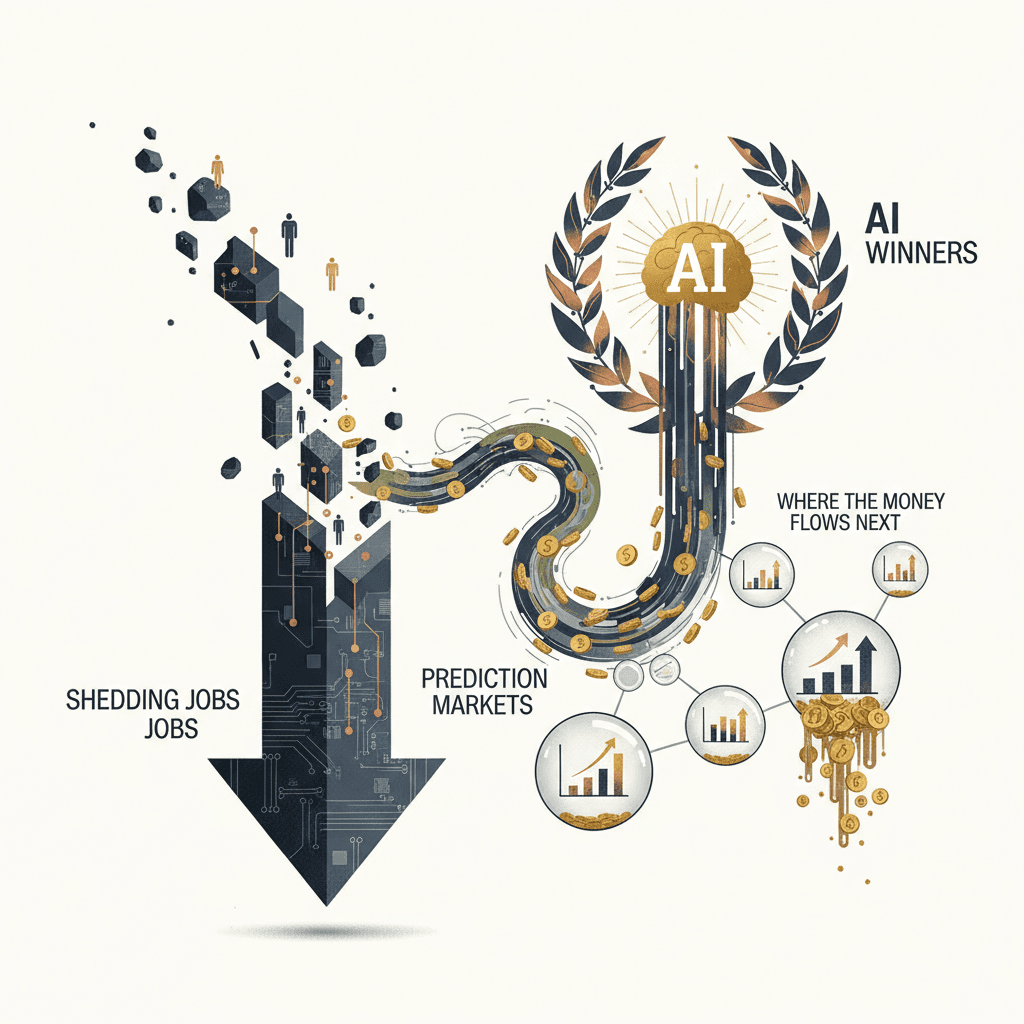
Put all of this together and you get a picture of a tech sector that is simultaneously firing people, concentrating enormous value into a tiny number of AI winners, and rushing toward liquidity events. This isn't a collapse. It's a rotation. Think of it less like a building falling down and more like a river forking into two channels, one rushing and deep, the other slowing to a trickle.
The K-Shaped Tech Economy
Economists use the term "K-shaped recovery" when one part of the economy shoots upward while another slides down, and the two lines diverge like the arms of the letter K. That's exactly what's happening in tech.
On the upper arm: companies at the AI frontier are absorbing investment at a staggering pace. Anthropic, Google DeepMind, and their infrastructure suppliers are in a capital-attraction vortex. Every major cloud provider, every chip company, every power utility serving a data center is feeling this pull.
On the lower arm: the rest of tech is cutting headcount. Companies are using AI to do more with fewer people, and the efficiency gains translate directly into layoffs. Those layoffs ripple outward. Tech workers in the Bay Area and Seattle spend less, which hits local real estate, restaurants, and retail. Digital advertising budgets shrink when companies tighten belts. The SpaceX IPO timing is also telling. When private companies rush to go public, it often signals that private capital is looking for exit liquidity, and that IPO could absorb investor dollars that might otherwise flow into existing public tech stocks.
This self-reinforcing cycle works like this:
- AI models get more capable, allowing companies to automate tasks previously done by people.
- Companies lay off workers, improving their margins and freeing up capital.
- That freed capital gets reinvested into more AI infrastructure and frontier model development.
- AI models get even more capable, and the cycle repeats.
- Meanwhile, laid-off tech workers reduce consumer spending, which pressures companies outside the AI core to cut costs further, often by adopting more AI.
The cycle feeds itself. And the prediction market data, with layoffs accelerating and AI leadership concentrating, suggests we're firmly inside it.
Where the Money Flows: AI Winners and Shovel Sellers
During the California Gold Rush, most prospectors went broke. The people who got rich were the ones selling shovels, pickaxes, and denim jeans. The AI boom has its own version of this dynamic, and it's worth paying close attention to.
The AI Frontier Players (Public Markets)
GOOGL stands out as the strongest public equity play on AI leadership. Google and its DeepMind division hold a 24% probability of having the best AI by December 2026, second only to Anthropic, which is private. Google owns the full stack: TPU chips for training, Google Cloud for deployment, DeepMind for research, and massive distribution through Search and Android. In a K-shaped tech economy where AI winners absorb investment, Google is uniquely positioned as both an AI leader and an infrastructure provider. Confidence: 74%.
AMZN benefits from a slightly different angle. AWS remains the leading cloud provider and a critical infrastructure layer for AI deployment. Amazon is also a major investor in Anthropic with a $4 billion-plus stake, meaning that even if Anthropic wins the model race, AWS benefits from hosting those workloads. Amazon is simultaneously a deployer of AI (warehouse automation, logistics optimization) and a provider of AI infrastructure. The broader layoff trend actually helps Amazon by reducing labor cost pressure. Confidence: 70%.
META occupies a middle ground. Meta is aggressively deploying AI across its products through Llama models, AI assistants, and recommendation engines, and the company has shown a willingness to cut headcount aggressively, aligning with the layoff acceleration trend. AI-driven ad targeting makes their core business more efficient. But Meta is conspicuously absent from the prediction market's "best AI" leaderboard, suggesting the market views their AI efforts as application-layer rather than frontier research. Not a pure winner, but not a loser either. Confidence: 60%.
The Shovel Sellers (Infrastructure)
This is where the Gold Rush analogy really shines. Regardless of whether Anthropic, Google, OpenAI, or xAI wins the AI race, all of them need the same physical infrastructure.
NVDA is the quintessential shovel seller. Every frontier AI lab needs NVIDIA GPUs for training. Data center and AI revenue is now NVIDIA's dominant revenue driver, and their CUDA software ecosystem creates a moat that's extremely difficult for competitors to cross. The layoff-driven efficiency narrative actually reinforces AI adoption, which means more GPU demand. Infrastructure relevance score: 92 out of 100. Confidence: 78%.
VRT (Vertiv) provides the power management, thermal management, and IT infrastructure that keeps data centers running. AI workloads generate enormous heat and consume enormous power. Every data center needs cooling and power distribution regardless of which AI company wins. As energy constraints become a bottleneck for AI scaling, efficient power management becomes more valuable, not less. Infrastructure relevance: 85. Confidence: 75%.
ANET (Arista Networks) makes the high-performance networking equipment that connects the thousands of GPUs inside AI training clusters. Ultra-low-latency, high-bandwidth networking is non-negotiable for AI training at scale, and Arista dominates cloud-scale networking. The concentration dynamic actually helps them because fewer, larger AI players means bigger networking orders. Infrastructure relevance: 80. Confidence: 73%.
ASML is the shovel seller's shovel seller. One level deeper than NVIDIA, ASML makes the extreme ultraviolet (EUV) lithography machines that are required to manufacture the advanced chips powering AI. There is literally no alternative supplier for cutting-edge EUV equipment. It's a perfect monopoly. The limitation is that AI chip production is a growing but still partial share of ASML's total business, which also serves mobile, automotive, and other semiconductor segments. Infrastructure relevance: 78. Confidence: 70%.
EQIX (Equinix) is the world's largest data center REIT (a real estate investment trust, meaning it owns and operates the physical buildings where servers live). Every tech company needs physical space for computing, and Equinix benefits from network effects since the more companies that colocate in its facilities, the more valuable those facilities become for interconnection. The REIT structure provides some downside protection through dividends. Infrastructure relevance: 72. Confidence: 68%.
ETN (Eaton) is a diversified power management company with significant exposure to data center electrical infrastructure like transformers, uninterruptible power supplies, and switchgear. AI data centers are extremely power-hungry, and Eaton sells the electrical distribution equipment they need. The diversification into aerospace, vehicles, and utilities means diluted AI exposure but also provides a cushion if AI spending disappoints. Infrastructure relevance: 58. Confidence: 67%.
The Risks You Need to Take Seriously
This pattern carries real risks, and being honest about them is more useful than cheerleading.
AI bubble deflation. If companies collectively decide that AI spending isn't generating returns fast enough, capital expenditure could plateau or pull back. That would hit every infrastructure name on this list, and it would compress multiples even for the winners. NVIDIA's extreme valuation leaves no margin for error on this front.
Antitrust action. Google faces ongoing regulatory scrutiny that could force structural changes or even a breakup. Meta faces data privacy regulations in the EU and US that could limit AI training capabilities.
Custom silicon erosion. Google's TPUs, Amazon's Trainium chips, and Microsoft's Maia processors are all designed to reduce dependence on NVIDIA. If these alternatives gain traction, NVIDIA's near-monopoly weakens.
Export restrictions. Both NVIDIA and ASML face reduced addressable markets due to export controls on advanced technology to China. ASML is particularly exposed here.
Consumer spending weakness. The layoff acceleration isn't just a labor market story. If hundreds of thousands of well-paid tech workers lose their jobs, consumer spending drops. That hurts Amazon's retail business, Meta's advertising revenue, and Google's ad business. It also hits Bay Area and Seattle real estate.
Crowded trades. NVIDIA in particular is already widely owned by institutional and retail investors. Crowded trades have a fragility to them. When everyone is on one side of the boat, it doesn't take much to tip it.
SpaceX IPO capital absorption. A massive SpaceX IPO could pull billions of dollars out of existing public tech investments. When a shiny new stock hits the market, the money has to come from somewhere.
Cyclicality. Semiconductor demand can turn quickly. ASML's order book is lumpy, NVIDIA's revenue could stall, and even data center buildouts can decelerate if the economic cycle turns.
Why This Matters for You
If you have a 401(k) or any index fund exposure to the Nasdaq, you are already a participant in this K-shaped split. The broad tech indices contain both the AI winners and the companies shedding workers to survive. The 17.5% probability of the Nasdaq falling below 19,000 by year-end is a reminder that the index-level story can mask what's happening underneath.
The infrastructure thesis, the idea that selling shovels is safer than panning for gold, applies directly to how you think about your portfolio. You don't need to correctly predict whether Anthropic or Google will build the best AI model. You need to recognize that both of them, along with everyone else in the race, need GPUs, networking equipment, power management, data center space, and lithography machines. The picks-and-shovels layer captures value from the entire AI boom without requiring you to pick the model winner.
At the same time, the layoff acceleration means the economic pain from this transition is real and spreading. If you work in tech or live in a tech-heavy metro area, the prediction market's 84.5% probability of worsening layoffs is worth paying attention to. The rotation from human labor to AI capability is not slowing down. The money is moving, and understanding which direction it's flowing gives you a meaningful edge.
Analysis based on prediction market data as of April 15, 2026. This is not investment advice.
How This Story Evolved
First detected Mar 20 · Updated daily
The article swapped out a river metaphor for a tree metaphor to explain the tech industry's split. The new version also adds more emphasis on why everyday people — not just investors — should care about which side of the divide they're on.
The article swapped out a technical finance term ("K-shaped") in the intro for a simpler explanation of the tech industry split, and added a river analogy to help readers visualize how money is flowing toward AI winners while leaving others behind. The core story about layoffs and AI investment concentration stayed the same.
Read this version →The article was updated to add SpaceX's upcoming IPO as a major theme alongside the layoffs and AI investment storylines. The opening was also rewritten to be more direct and punchy, and the body now uses headers and specific statistics to organize the information.
Read this version →The article's opening was rewritten to lead with the K-shaped economy idea in plain, direct language instead of starting with the letter K visual metaphor. The new version jumps straight into explaining the split between layoffs and AI winners before introducing the term.
Read this version →The article's opening was rewritten to frame the story as a "fracturing" economy that affects everyday investors and workers, rather than focusing on contradictory industry trends. The headline also softened the phrase "Layoff Losers" to "Mass Layoffs" and changed "Shovel Sellers" to "Where the Money Goes Next."
Read this version →The article was rewritten to open more simply and directly, leading with the core contradiction of layoffs and AI spending right away instead of building up to it. It also added a specific statistic — an 84.5% predicted chance that 2026 tech layoffs will exceed 2025 — to make the opening more concrete.
Read this version →The article was rewritten to open with a simpler, more direct description of what's happening in tech before introducing prediction markets, rather than leading with the prediction markets themselves. It also added a specific statistic early on — an 84.5% chance that 2026 tech layoffs will exceed 2025 levels — which wasn't in the previous version.
Read this version →