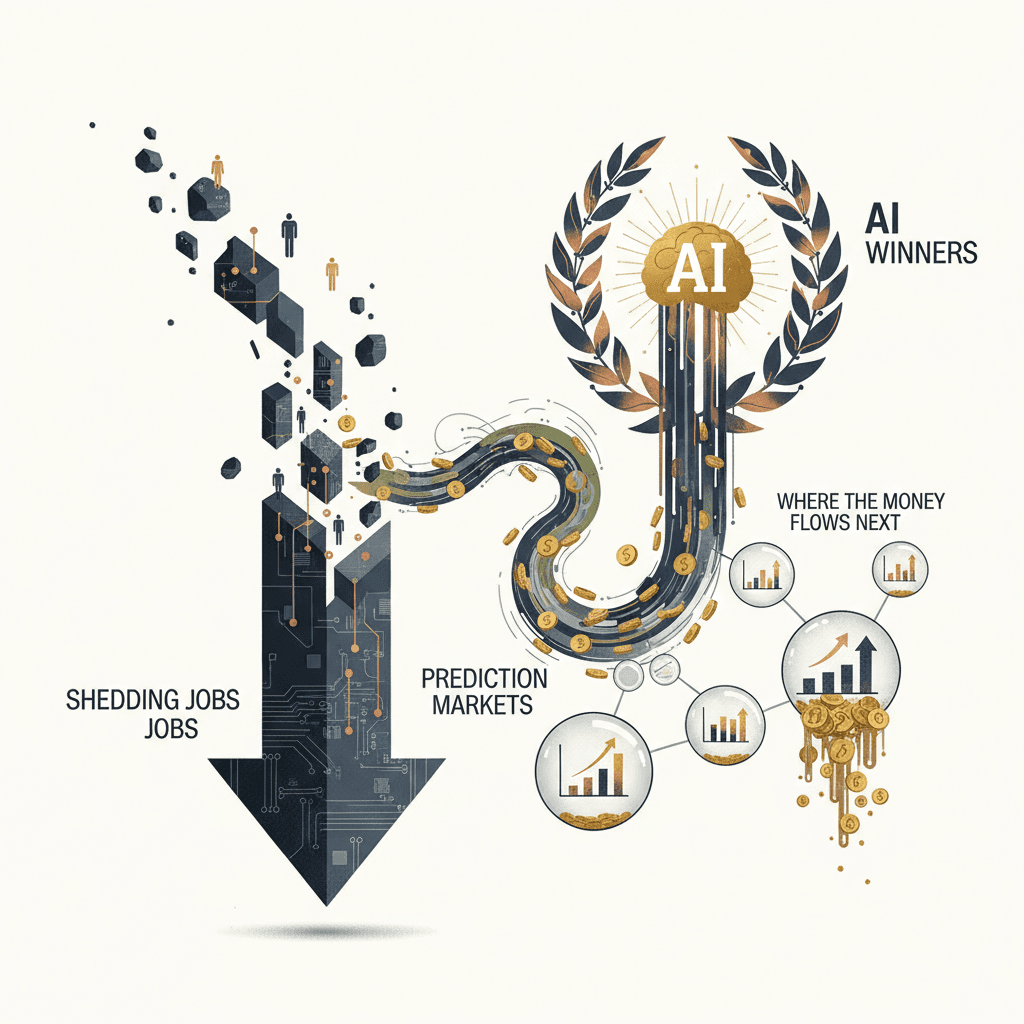
The K-Shaped Tech Economy: Prediction Markets Say Layoffs Are Accelerating While AI Winners Take Everything
Something strange is happening in tech right now. Companies are laying off workers at an accelerating pace, and at the same time, a small handful of AI leaders are absorbing almost all the investment dollars. Prediction markets are putting hard numbers on this split, and the picture they paint is one of a sector reshaping itself in real time.
Think of it like a river hitting a fork. Most of the water is rushing toward a narrow channel on one side, while the other channel is drying up. That narrow channel is AI. The drying one is everyone else.
The Numbers Behind the Split
Bettors are putting an 84.5% probability on 2026 having more tech layoffs than 2025, a year that was already elevated by historical standards. This isn't a blip. It signals a structural contraction in the tech labor market, driven by companies either replacing workers with AI tools or cutting costs to fund AI investments.
Meanwhile, the race for the best AI model by December 2026 looks like a coronation. Anthropic, the company behind Claude, sits at a 57% probability of being recognized as the best AI. Google comes in second at 25.3%. OpenAI, the company that kicked off the entire AI boom with ChatGPT, has fallen to just 10.6%. Elon Musk's xAI trails at 7.9%.
And then there's the SpaceX IPO, which prediction markets give a 73% chance of happening by July 2026 and a 21% chance by June 2026. When the biggest private tech company in the world rushes toward a public listing, it often means private capital is looking for an exit. That kind of massive liquidity event can pull investment dollars away from existing public tech stocks.
Perhaps most telling: there's a 17.5% chance the Nasdaq 100 finishes 2026 below 19,000. That might sound low, but a roughly one-in-six chance of that kind of drop represents meaningful tail risk for anyone with a heavy tech allocation. It's like driving down the highway knowing there's a one-in-six chance of a major traffic jam ahead. You don't panic, but you keep your eyes open.
How the Cycle Feeds Itself
This pattern creates a self-reinforcing loop that's worth understanding:
- AI tools get better, enabling companies to do more with fewer people.
- Companies lay off workers and redirect savings toward AI infrastructure spending.
- That spending flows to a shrinking list of AI leaders and their suppliers.
- Laid-off tech workers reduce spending in their local economies, from Seattle restaurants to Bay Area housing.
- Reduced consumer spending pressures companies further, pushing even more toward AI-driven efficiency.
- Return to step one.
This is what economists call a K-shaped economy within tech itself. The top of the K goes up (AI winners and their infrastructure providers), and the bottom goes down (everyone else in the sector).
Where the Money Flows: AI Winners You Can Actually Buy
The tricky part is that the biggest predicted AI winner, Anthropic, is private. You can't buy shares on any exchange. But several public companies sit squarely in the path of this trend.
GOOGL is the most direct public bet on an AI frontier winner. Google/DeepMind holds that 25.3% probability for best AI, second only to Anthropic. What makes Google especially interesting is that they own the entire stack. They design their own AI training chips called TPUs, run one of the three major cloud platforms, operate DeepMind as a world-class research lab, and distribute AI through Search and Android, which reach billions of people. In a world where AI winners absorb investment and everyone else shrinks, Google is both an AI leader and an infrastructure provider. Their balance sheet is strong enough to weather the consumer weakness that tech layoffs will cause. Confidence: 74%.
AMZN plays a different angle. AWS, Amazon Web Services, is the largest cloud provider in the world and a critical layer for AI deployment. Even if Anthropic wins the model race, guess where those models get hosted? Amazon is also a major Anthropic investor with over $4 billion at stake. They benefit from both sides of the AI equation: deploying AI internally for warehouse automation and logistics while selling AI infrastructure to everyone else. The layoff trend actually helps Amazon by easing the tight labor market and reducing wage pressure. The headwind is their retail business, which could suffer if thousands of well-paid tech workers lose their jobs and close their wallets. Confidence: 70%.
META is a more cautious play. Meta has been aggressive about both AI deployment and headcount reduction, which aligns perfectly with the layoff acceleration trend. Their AI-powered ad targeting is getting better, which helps revenue efficiency. But Meta is conspicuously absent from the top of the "best AI" predictions. The market sees their efforts as application-level AI rather than frontier research. In the K-shaped outcome, Meta sits somewhere in the middle: not a pure winner, not a loser, but not the company absorbing the lion's share of AI investment either. Their Reality Labs division continues to burn cash with unclear payoff. Confidence: 60%.
The Shovels-and-Pickaxes Plays
During the California Gold Rush, the people who reliably made money weren't the miners. They were the ones selling shovels, pickaxes, and denim pants. The same logic applies to AI.
NVDA is the ultimate shovel seller. Every AI frontier lab, whether it's Anthropic, Google, OpenAI, or xAI, needs NVIDIA's GPUs to train their models. It doesn't matter who wins the AI race. NVIDIA sells the equipment to all of them. Their data center segment is now the dominant revenue driver, and they hold a near-monopoly in AI training chips thanks to their CUDA software ecosystem, which creates massive switching costs. The layoff-driven efficiency narrative actually reinforces demand for their products, since companies replacing workers with AI need more computing power. Infrastructure relevance score: 92 out of 100. Confidence: 78%.
VRT, Vertiv Holdings, is the company that keeps data centers from overheating and losing power. They provide thermal management and power distribution systems. AI chips generate enormous amounts of heat, and every new data center needs cooling and electrical infrastructure no matter which AI company is renting the space. Energy bottlenecks actually make efficient power management more valuable, not less. Infrastructure relevance: 85. Confidence: 75%.
ANET, Arista Networks, makes the high-speed networking equipment that connects servers inside AI training clusters. These clusters need ultra-low-latency, high-bandwidth connections, and Arista is the leader in cloud-scale networking. The concentration dynamic actually helps them, since fewer, larger AI players mean bigger networking orders per customer. Infrastructure relevance: 80. Confidence: 73%.
ASML is the shovel seller one level deeper than NVIDIA. They make the extreme ultraviolet lithography machines that are physically required to manufacture advanced AI chips. There is no alternative supplier on the planet for this technology. It's the closest thing to a true monopoly in the entire semiconductor supply chain. Their market position score is a perfect 30 out of 30. The limitation is that their revenue serves the entire semiconductor industry, not just AI chips, and semiconductor cycles can be brutal. Infrastructure relevance: 78. Confidence: 70%.
EQIX, Equinix, is the world's largest data center REIT, a real estate investment trust that owns and operates the physical buildings where servers live. Every tech company needs physical space for their computers, and Equinix's interconnection services create network effects that are hard to replicate. Their REIT structure provides some downside protection through dividends. The risk is that the biggest cloud companies are increasingly building their own facilities rather than renting from Equinix. Infrastructure relevance: 72. Confidence: 68%.
ETN, Eaton Corporation, makes transformers, uninterruptible power supplies, and switchgear for data centers. AI facilities are incredibly power-hungry, and Eaton supplies the electrical distribution equipment. They're more diversified than the other infrastructure plays, serving aerospace and utilities too, which limits the upside from AI but also provides a cushion if AI spending disappoints. Infrastructure relevance: 58. Confidence: 67%.
The Risks Are Real
This pattern has genuine vulnerabilities, and ignoring them would be dishonest.
For the AI winners: antitrust regulators could force structural changes at Google. Anthropic's dominant 57% probability suggests Google may actually be losing the frontier model race, not winning it. The massive capital expenditures on AI infrastructure have an unclear timeline for generating returns. If the AI spending wave pauses, even briefly, the stocks most exposed to it would get hit hard.
For the infrastructure plays: NVIDIA's valuation leaves zero margin for error, and custom chips from Google (TPUs), Amazon (Trainium), and Microsoft (Maia) are slowly chipping away at their monopoly. Vertiv and Arista have seen their valuations expand dramatically, pricing in perfection. ASML faces export restrictions to China that shrink its addressable market. Data center buildouts could decelerate if companies can't demonstrate clear returns on their AI investments.
For the broader thesis: the 17.5% chance of the Nasdaq falling below 19,000 means a significant drawdown is plausible. A SpaceX IPO could absorb capital that might otherwise flow into existing public tech stocks. Tech layoffs reduce consumer spending, which hits advertising revenue at Google and Meta and retail revenue at Amazon. And the entire trade is, at its core, a bet that AI adoption continues accelerating. If that assumption breaks, the whole thesis breaks with it.
Why This Matters for Your Money
You don't need to own individual tech stocks for this to affect you. If you have a 401(k) or index fund, you almost certainly have significant tech exposure. The S&P 500 is roughly 30% technology companies. A K-shaped outcome in tech means your broad index fund returns will depend heavily on whether the AI winners at the top of the K can outweigh the companies shrinking at the bottom.
The layoff acceleration has ripple effects too. Tech workers are among the highest-paid in the country. When they lose jobs, they spend less at restaurants, delay home purchases, and pull back on discretionary spending. If you live in or near a tech hub, or work in industries that serve tech workers, this trend touches your daily life.
The rotation happening inside tech, from broad-based growth to concentrated AI investment, is not a collapse. It's a reshuffling. But reshufflings create winners and losers, and the prediction markets are telling us, with over $35 million in combined trading volume across these contracts, that the reshuffling is well underway.
Analysis based on prediction market data as of April 14, 2026. This is not investment advice.
How This Story Evolved
First detected Mar 20 · Updated daily
The article swapped out a river metaphor for a tree metaphor to explain the tech industry's split. The new version also adds more emphasis on why everyday people — not just investors — should care about which side of the divide they're on.
Read latest →The article swapped out a technical finance term ("K-shaped") in the intro for a simpler explanation of the tech industry split, and added a river analogy to help readers visualize how money is flowing toward AI winners while leaving others behind. The core story about layoffs and AI investment concentration stayed the same.
The article was updated to add SpaceX's upcoming IPO as a major theme alongside the layoffs and AI investment storylines. The opening was also rewritten to be more direct and punchy, and the body now uses headers and specific statistics to organize the information.
Read this version →The article's opening was rewritten to lead with the K-shaped economy idea in plain, direct language instead of starting with the letter K visual metaphor. The new version jumps straight into explaining the split between layoffs and AI winners before introducing the term.
Read this version →The article's opening was rewritten to frame the story as a "fracturing" economy that affects everyday investors and workers, rather than focusing on contradictory industry trends. The headline also softened the phrase "Layoff Losers" to "Mass Layoffs" and changed "Shovel Sellers" to "Where the Money Goes Next."
Read this version →The article was rewritten to open more simply and directly, leading with the core contradiction of layoffs and AI spending right away instead of building up to it. It also added a specific statistic — an 84.5% predicted chance that 2026 tech layoffs will exceed 2025 — to make the opening more concrete.
Read this version →The article was rewritten to open with a simpler, more direct description of what's happening in tech before introducing prediction markets, rather than leading with the prediction markets themselves. It also added a specific statistic early on — an 84.5% chance that 2026 tech layoffs will exceed 2025 levels — which wasn't in the previous version.
Read this version →