Tech Is Cutting Jobs and Crowning AI Kings. Here's Where the Money Flows Next.
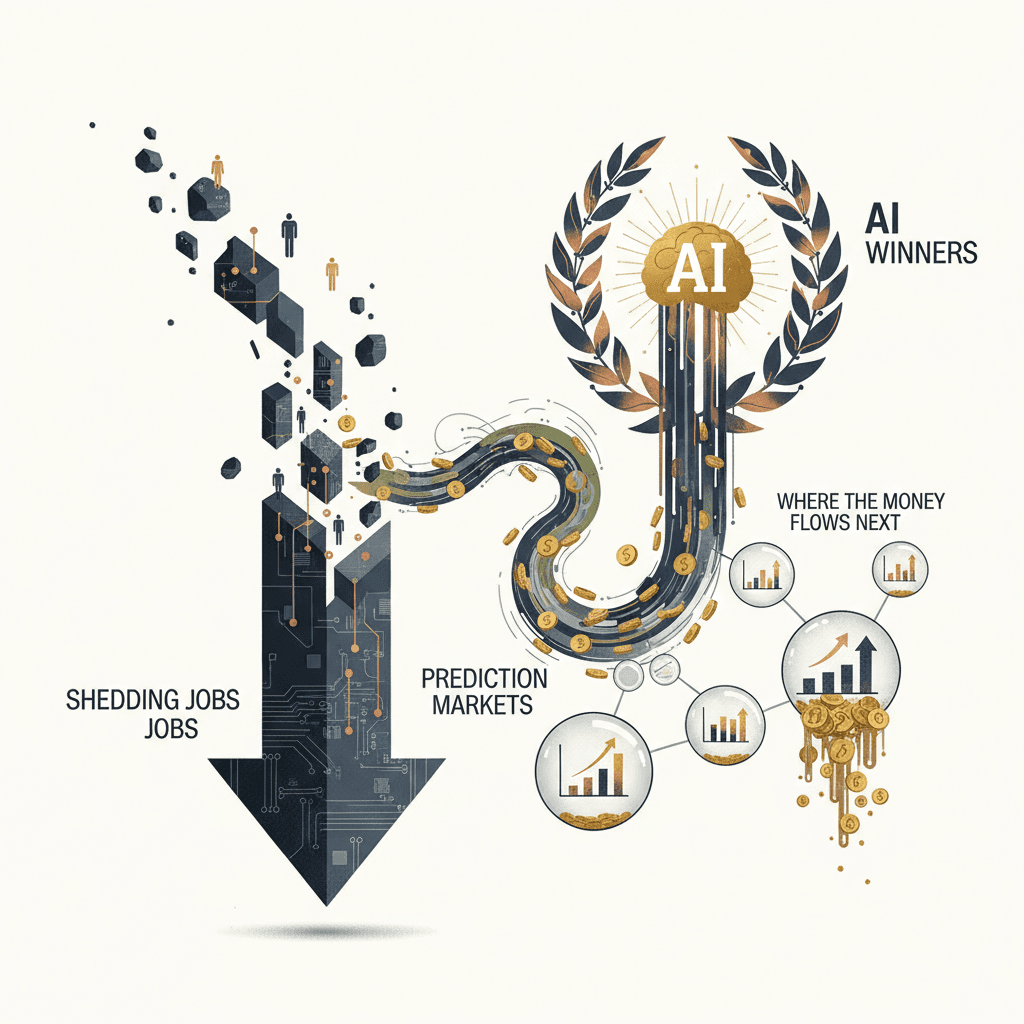
Prediction markets are painting a striking picture of the tech sector right now, and it doesn't look like the rising-tide-lifts-all-boats story we got used to in the 2010s. Instead, it looks more like a split screen. On one side, mass layoffs are accelerating. On the other, a small handful of AI companies are absorbing an enormous share of investment and talent. This is a K-shaped tech economy, where the winners pull further ahead and everyone else gets leaner, and the betting data gives us real numbers to work with.
Let's start with the layoffs. Prediction markets currently give an 84.5% probability that tech layoffs in 2026 will exceed those in 2025, a year that was already elevated. That's not a coin flip or a soft signal. That's the market saying, with high conviction, that the tech workforce is structurally shrinking. Companies aren't just trimming fat from pandemic-era over-hiring anymore. They're using AI to do more with fewer people, and the data says that trend is speeding up, not slowing down.
At the same time, the race for the best AI model by December 2026 is remarkably concentrated. Anthropic, the company behind Claude, sits at a 57% probability of having the best AI. Google DeepMind comes in second at 25%. OpenAI, which dominated the conversation just two years ago, has fallen to 10%. And Elon Musk's xAI trails at roughly 8%. The market is essentially saying the frontier AI race has narrowed to two serious contenders, with Anthropic as the clear favorite.
Meanwhile, SpaceX has a 71% chance of going public by July 2026 (and a 21% chance it happens by June). When a private company worth hundreds of billions starts looking for an IPO, that's a signal that private capital wants liquidity. An IPO that large could pull investment dollars away from other public tech stocks as investors rotate into the shiny new listing.
And about that downside risk: betting markets give a 17.5% probability that the Nasdaq-100 finishes 2026 below 19,000. That might sound low, but 17.5% is roughly the same odds as rolling a six on a single die. For a sector supposedly powered by the most transformative technology in decades, that's a meaningful tail risk.
The Cycle That's Feeding Itself
These data points aren't isolated. They form a self-reinforcing loop that explains where the tech economy is headed:
- AI gets better, fast. Frontier labs like Anthropic and Google DeepMind pour billions into compute and talent.
- Companies across tech adopt AI tools that let them do the same work with fewer employees.
- Layoffs accelerate, pushing the 84.5% probability higher.
- Displaced engineers and reduced headcount mean lower costs and higher margins for the companies doing the cutting.
- Those savings get reinvested into more AI, which makes step one happen again, faster.
- The AI winners attract more capital, the rest of tech sheds more workers, and the gap widens.
This is the K-shape. A small group of companies at the top of the AI stack absorbs a disproportionate share of value while the broader tech labor market contracts. It's not a collapse. It's a rotation.
The Gold Rush Playbook: Sell the Shovels
During the California Gold Rush, most prospectors went broke. The people who got rich were the ones selling pickaxes, shovels, and blue jeans. The same logic applies to AI. We don't know for certain whether Anthropic or Google will end up on top (and Anthropic is private, so you can't buy it on the stock market anyway). But we do know that whoever wins will need massive amounts of computing power, networking equipment, cooling systems, and electricity. The infrastructure providers win regardless of which AI lab takes the crown.
With that framework, here are the trade signals coming out of this pattern.
AI Frontier Plays (the prospectors)
GOOGL gets a BUY signal at 74% confidence. Google is the most direct public equity exposure to a top-tier AI frontier winner. At 25% probability for best AI by December 2026, they're the strongest publicly traded contender. They own the full stack: TPU chips for training, Google Cloud for deployment, DeepMind for research, and distribution through Search and Android reaching billions of users. In a K-shaped tech economy, Google is uniquely positioned as both an AI leader and an infrastructure provider. They benefit from the AI spending boom while having the balance sheet to weather broader consumer weakness caused by tech layoffs.
AMZN gets a BUY signal at 70% confidence. AWS remains the leading cloud provider and a critical infrastructure layer for AI deployment. Even if Anthropic wins the model race (and remember, Amazon holds a $4 billion-plus stake in Anthropic), AWS benefits from hosting those AI workloads. Amazon also benefits from the efficiency wave on the operational side through warehouse automation and logistics optimization. The layoff trend across tech actually helps Amazon by reducing labor cost pressure. The headwind is on the retail side, where consumer spending from newly unemployed tech workers could soften.
META gets a WEAK BUY at 60% confidence. Meta is aggressively deploying AI across its products with its Llama models, AI assistants, and recommendation engines, and the company has shown a willingness to cut headcount aggressively, aligning with the layoff acceleration trend. AI-driven ad targeting is making their core business more efficient. But Meta is conspicuously absent from the prediction market's top AI contenders, suggesting the market views their AI efforts as application-layer rather than frontier research. In a K-shaped outcome, Meta lands somewhere in the middle.
Infrastructure Plays (the shovel sellers)
NVDA gets a BUY signal at 78% confidence with an infrastructure relevance score of 92 out of 100. This is the quintessential shovel seller of the AI gold rush. Every frontier AI lab, whether it's Anthropic, Google, OpenAI, or xAI, needs NVIDIA GPUs to train their models. Data center and AI revenue is now NVIDIA's dominant revenue driver, and they hold a near-monopoly in AI training accelerators thanks to the CUDA software ecosystem that locks developers in. The layoff-driven efficiency narrative actually reinforces AI adoption, which means more GPU demand.
VRT (Vertiv) gets a BUY at 75% confidence with an infrastructure score of 85. Vertiv provides the power management, thermal management, and IT infrastructure that every data center needs. AI workloads generate enormous amounts of heat and consume staggering amounts of electricity. Every data center needs cooling and power distribution regardless of which AI company wins the model race. Energy bottlenecks actually make efficient power management more valuable, not less.
ANET (Arista Networks) gets a BUY at 73% confidence with an infrastructure score of 80. AI training clusters require ultra-low-latency, high-bandwidth networking, and Arista is the leader in cloud-scale networking equipment. They're a major supplier to the hyperscalers (the giant cloud companies), and the concentration dynamic, where fewer but larger AI players dominate, actually means bigger networking orders for Arista.
EQIX (Equinix) gets a WEAK BUY at 68% confidence with an infrastructure score of 72. Equinix is the world's largest data center REIT (a real estate investment trust, meaning it owns and operates data center buildings and pays out most of its income as dividends). Every tech company needs physical space for servers, and Equinix provides colocation and interconnection services globally. The REIT structure provides some downside protection via that dividend. The risk is that hyperscalers are increasingly building their own facilities rather than renting from Equinix.
ETN (Eaton) gets a WEAK BUY at 67% confidence with an infrastructure score of 58. Eaton sells the electrical distribution equipment that data centers run on: transformers, uninterruptible power supply systems, and switchgear. The company is more diversified than pure AI plays, with exposure to aerospace, vehicles, and utilities, which limits the upside but also provides a cushion if AI spending disappoints.
ASML gets a WEAK BUY at 70% confidence with an infrastructure score of 78. If NVIDIA is selling pickaxes to the gold miners, ASML is the only company in the world that makes the machines that forge those pickaxes. ASML manufactures the extreme ultraviolet (EUV) lithography equipment required to produce the most advanced semiconductor chips. There is literally no alternative supplier. It's an absolute monopoly. But the stock is expensive, semiconductor spending is cyclical, and export restrictions to China reduce the addressable market.
The Risks You Need to Know
This pattern is compelling, but it comes with serious risks that deserve honest treatment.
For the AI frontier plays, antitrust action could force structural changes at Google. Anthropic's 57% dominance in the prediction markets suggests Google may actually be losing the frontier model race despite massive spending. Ad revenue at both Google and Meta is vulnerable if tech layoffs reduce digital marketing budgets. And the sheer scale of capital expenditure on AI infrastructure across all these companies has an unclear ROI timeline. If returns disappoint, spending could pull back hard.
For the infrastructure plays, the biggest risk is an AI spending pause. If companies collectively decide the return on AI investment isn't materializing fast enough, demand for GPUs, networking gear, cooling systems, and data center space could drop simultaneously. NVIDIA faces growing competition from custom silicon as Google builds TPUs, Amazon develops Trainium chips, and Microsoft works on its Maia accelerators. Valuations across the infrastructure space are already stretched, leaving little margin for error. Export restrictions, tariff uncertainty, and semiconductor cyclicality add layers of risk.
For the broader market, a 17.5% chance the Nasdaq-100 ends below 19,000 is a real tail risk. A SpaceX IPO could absorb capital from existing public tech holdings. And the layoff acceleration has second-order effects: reduced consumer spending from tech workers flows through to housing markets in places like the Bay Area and Seattle, hits discretionary spending, and could weigh on the broader economy.
Why This Matters for Your Money
If you have a 401(k) or index fund with tech exposure (and most people do), this pattern matters to you directly. The broad tech sector is not moving as one. Owning "tech" through an index means you own the AI winners and the companies shedding workers and struggling to find their footing. The signal from prediction markets is that differentiation within tech is more important now than it has been in years.
The layoff acceleration also has everyday implications. If you work in tech or know people who do, 84.5% odds of worsening layoffs is a planning signal, not a headline to scroll past. For everyone else, the AI infrastructure buildout is showing up in your electric bill (data centers consume enormous power), in your grocery store (AI-optimized supply chains), and eventually in your job, whatever industry you're in.
The bottom line from prediction markets is that tech is not crashing. It's splitting. The money is flowing toward AI infrastructure and the handful of companies building frontier models, while the rest of the sector gets leaner. If you're investing in this space, the shovel sellers, the companies that win regardless of which AI lab comes out on top, look like the most durable bet.
Analysis based on prediction market data as of April 9, 2026. This is not investment advice.
How This Story Evolved
First detected Mar 20 · Updated daily
The article swapped out a river metaphor for a tree metaphor to explain the tech industry's split. The new version also adds more emphasis on why everyday people — not just investors — should care about which side of the divide they're on.
Read latest →The article swapped out a technical finance term ("K-shaped") in the intro for a simpler explanation of the tech industry split, and added a river analogy to help readers visualize how money is flowing toward AI winners while leaving others behind. The core story about layoffs and AI investment concentration stayed the same.
Read this version →The article was updated to add SpaceX's upcoming IPO as a major theme alongside the layoffs and AI investment storylines. The opening was also rewritten to be more direct and punchy, and the body now uses headers and specific statistics to organize the information.
Read this version →The article's opening was rewritten to lead with the K-shaped economy idea in plain, direct language instead of starting with the letter K visual metaphor. The new version jumps straight into explaining the split between layoffs and AI winners before introducing the term.
The article's opening was rewritten to frame the story as a "fracturing" economy that affects everyday investors and workers, rather than focusing on contradictory industry trends. The headline also softened the phrase "Layoff Losers" to "Mass Layoffs" and changed "Shovel Sellers" to "Where the Money Goes Next."
Read this version →The article was rewritten to open more simply and directly, leading with the core contradiction of layoffs and AI spending right away instead of building up to it. It also added a specific statistic — an 84.5% predicted chance that 2026 tech layoffs will exceed 2025 — to make the opening more concrete.
Read this version →The article was rewritten to open with a simpler, more direct description of what's happening in tech before introducing prediction markets, rather than leading with the prediction markets themselves. It also added a specific statistic early on — an 84.5% chance that 2026 tech layoffs will exceed 2025 levels — which wasn't in the previous version.
Read this version →