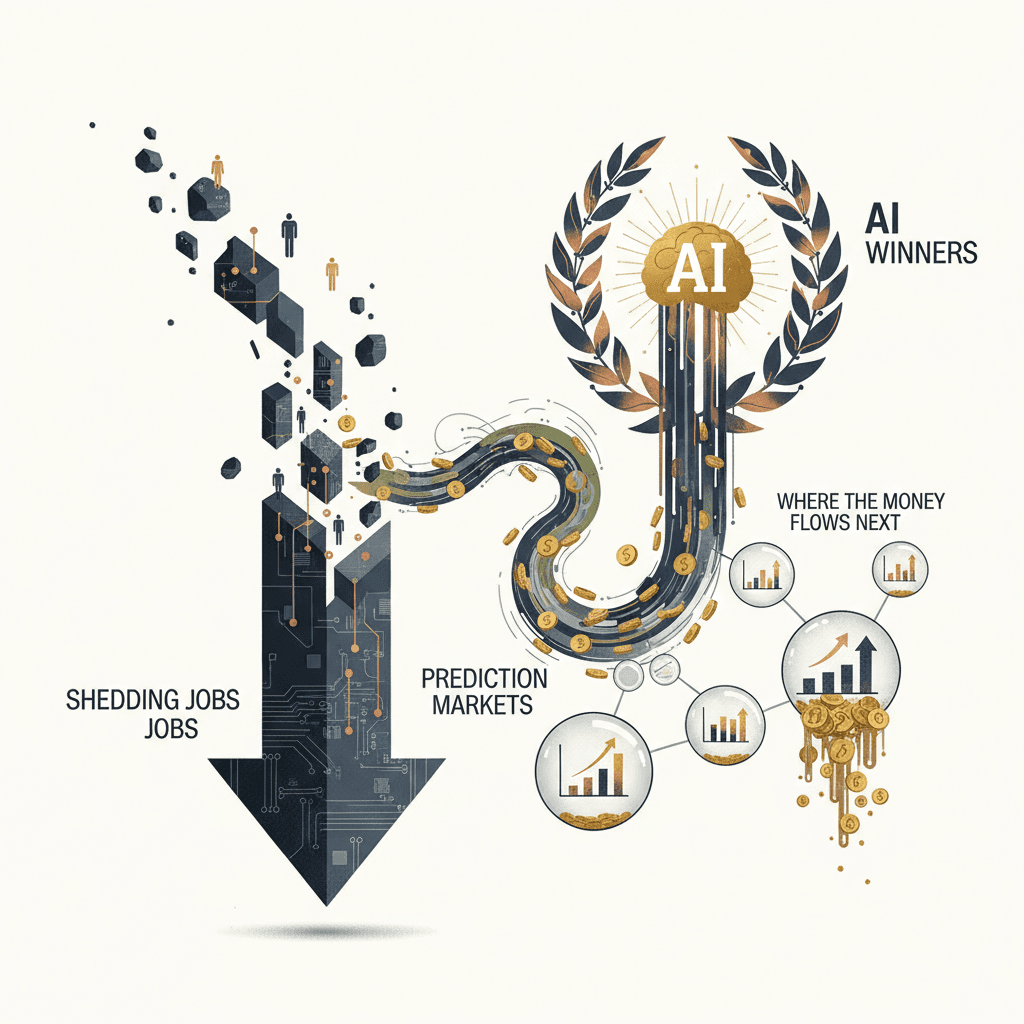
Tech Is Splitting in Two: What Prediction Markets Say About the AI Winners, Mass Layoffs, and Where the Money Goes Next
The tech sector is fracturing. Not collapsing, not booming, but splitting into two very different economies that are running at very different speeds. Prediction markets are painting a picture that should matter to anyone with a 401(k), a tech job, or shares in a major tech company.
The numbers tell a story of simultaneous expansion and contraction that sounds contradictory until you understand the pattern.
The Three Signals
First, prediction markets put an 84.5% probability on 2026 having more tech layoffs than 2025, a year that was already brutal for headcount. This isn't a blip. It signals a structural shrinking of tech's labor force, driven partly by companies replacing human workers with AI tools and partly by a sector-wide focus on efficiency over growth.
Second, the AI leadership race has become incredibly concentrated. Bettors give Anthropic a 58.1% chance of having the best AI model by December 2026. Google trails at 25.3%. OpenAI, the company that kicked off the entire AI frenzy, has fallen to just 10.6%. Elon Musk's xAI sits at 7.9%. The market is saying that the AI revolution, the single most important technology trend in a generation, will likely be dominated by one or two companies.
Third, there's a 73% chance SpaceX goes public by July 2026 (with a 21% chance it happens by June). When a massive private company rushes toward an IPO, it typically means private investors are looking for an exit. That IPO could suck billions of dollars out of public tech markets as investors rotate capital into the new shiny thing.
Tying it all together, prediction markets see a 17.5% chance the Nasdaq falls below 19,000 by year-end. That's significant tail risk for the index most heavily weighted toward tech companies.
The K-Shaped Tech Economy
Think of the letter K. One line goes up, one line goes down, and they start from the same point. That's what's happening in tech right now.
The upward line is AI. Companies at the frontier of artificial intelligence are absorbing massive investment, talent, and attention. The downward line is everyone else. Companies that aren't winning the AI race are cutting costs, shedding workers, and watching their competitive moats erode.
This creates a self-reinforcing cycle:
- AI tools get better, allowing companies to do more with fewer people.
- Companies lay off workers and redirect those savings into AI spending.
- That AI spending flows to a small number of winners (Anthropic, Google, NVIDIA).
- Those winners use the money to make even better AI tools.
- Back to step one.
The result isn't a tech collapse. It's a tech rotation. Money doesn't disappear; it moves from broad-based tech employment into concentrated AI infrastructure. The implications ripple out: fewer tech paychecks means less spending at Bay Area restaurants, weaker Seattle real estate, and softer demand for the kinds of discretionary goods and services that well-paid engineers tend to buy.
But AI infrastructure spending on chips, cloud computing, and energy stays robust, possibly even accelerates.
Selling Shovels in a Gold Rush
During the California Gold Rush, most prospectors went broke. The people who reliably made money were the ones selling shovels, pickaxes, and denim jeans. The same logic applies to AI.
We don't know for certain whether Anthropic or Google or someone else will ultimately win the AI race. But we know that all of them need the same basic infrastructure: advanced chips, data center cooling, high-speed networking, power management, and the ultra-precise machines that manufacture those chips in the first place.
This is the infrastructure thesis, and it shapes the most compelling investment ideas coming out of this pattern.
The Trade Signals
NVDA — Buy (Confidence: 78%)
NVIDIA is the quintessential shovel seller. Every frontier AI lab, whether it's Anthropic, Google DeepMind, OpenAI, or xAI, needs NVIDIA's GPUs (the specialized chips that train AI models). Data center and AI revenue is now NVIDIA's dominant revenue driver, and the company holds a near-monopoly in AI training hardware thanks to its CUDA software ecosystem, which locks developers into NVIDIA's platform the way iOS locks people into iPhones. The layoff-driven efficiency narrative actually reinforces AI adoption, which means more GPU demand. The infrastructure relevance score here is 92 out of 100.
VRT — Buy (Confidence: 75%)
Vertiv provides the less glamorous but absolutely critical physical infrastructure for data centers: power management, thermal cooling, and IT infrastructure. AI workloads generate enormous heat and consume staggering amounts of electricity. Every new AI data center, regardless of which company builds it, needs Vertiv's equipment to keep the lights on and the servers from overheating. Power constraints and energy bottlenecks actually make efficient power management more valuable, not less. Infrastructure relevance score: 85 out of 100.
GOOGL — Buy (Confidence: 74%)
Google is the most direct public equity exposure to a top-tier AI frontier winner. At 25.3% probability for best AI by December 2026, Google/DeepMind trails only Anthropic, which is private and can't be bought on any stock exchange. Google owns the full stack: TPU chips (their custom AI processors), Google Cloud infrastructure, DeepMind's research lab, and distribution through Search and Android. In a K-shaped tech economy where AI winners absorb investment, Google is uniquely positioned as both an AI leader and an infrastructure provider.
ANET — Buy (Confidence: 73%)
Arista Networks makes the high-performance networking equipment that connects servers inside data centers. AI training clusters require ultra-low-latency, high-bandwidth networking, think of it as building the highway system that lets AI chips talk to each other at maximum speed. Arista is the leader in cloud-scale networking and a major supplier to hyperscalers (the massive cloud companies like Google, Microsoft, and Meta). The concentration dynamic actually helps Arista because fewer, larger AI players means bigger networking orders. Infrastructure relevance score: 80 out of 100.
ASML — Weak Buy (Confidence: 70%)
ASML is the shovel seller's shovel seller. They make the extreme ultraviolet (EUV) lithography machines that are physically required to manufacture the advanced chips powering AI. There is literally no alternative supplier on Earth for cutting-edge EUV equipment. Their market position score is a perfect 30 out of 30 because they have an absolute monopoly. The catch is that the stock is already expensive and semiconductor cycles can be brutal, with demand turning on a dime.
AMZN — Buy (Confidence: 70%)
AWS (Amazon Web Services) is the leading cloud provider and a critical infrastructure layer for AI deployment. Even if Anthropic wins the model race, and Amazon is a major Anthropic investor with a $4 billion-plus stake, AWS benefits from hosting those AI workloads. Amazon also benefits from the AI-driven efficiency wave through warehouse automation and logistics optimization. The layoff trend across tech helps Amazon by reducing labor cost pressure. However, consumer spending weakness from all those laid-off tech workers is a real headwind for the retail side of the business.
EQIX — Weak Buy (Confidence: 68%)
Equinix is the world's largest data center REIT (a real estate investment trust, meaning a company that owns and operates properties and passes rental income to shareholders as dividends). As AI drives data center demand, Equinix benefits from the physical space that all tech companies need. The REIT structure provides some downside protection through its dividend. The risk is that big tech companies are increasingly building their own data centers rather than renting from Equinix.
ETN — Weak Buy (Confidence: 67%)
Eaton is a diversified power management company that sells transformers, backup power systems, and switchgear for data centers. AI data centers are extremely power-hungry, and Eaton sells the electrical distribution equipment needed regardless of which AI company wins. The diversification into aerospace, vehicles, and utilities limits the AI upside but also provides a cushion if AI spending slows. Data center and AI work is growing to roughly 25% or more of their electrical segment, which is about half the company.
META — Weak Buy (Confidence: 60%)
Meta is aggressively deploying AI across its products through Llama models, AI assistants, and recommendation engines. They've also shown willingness to cut headcount aggressively, which aligns with the layoff acceleration trend. The concern is that Meta is conspicuously absent from the top of the "best AI" prediction market. Bettors view their AI efforts as application-layer, meaning they use AI well, rather than frontier, meaning they build the best AI. In a K-shaped outcome, Meta lands somewhere in the middle.
The Risks You Need to Know
This pattern has an overall confidence of 82%, which is high but far from certain. The risks are real and worth taking seriously.
For the AI winners like Google, antitrust regulators could force structural changes or even a breakup. The entire AI investment boom could deflate if companies can't demonstrate clear returns on their massive spending, which would compress valuations even for the leaders. Google's ad revenue is also vulnerable if tech layoffs reduce digital marketing budgets across the industry.
For the infrastructure plays, the biggest risk is an AI spending pause. If companies collectively decide that AI isn't delivering enough return on investment, capital expenditure on data centers, chips, and networking could slow dramatically. NVIDIA faces the additional threat of custom silicon from Google (TPUs), Amazon (Trainium), and Microsoft (Maia) gradually eroding its monopoly. Export restrictions to China shrink the addressable market for both NVIDIA and ASML.
For Amazon, tariff uncertainty could disrupt e-commerce supply chains, and the consumer spending weakness from tech layoffs hits the retail business directly. Meta faces regulatory risk in both the EU and US around using data to train AI models, and their massive Reality Labs spending on the metaverse continues to burn cash with unclear payoff.
Across the board, many of these stocks already have elevated valuations that price in significant AI growth. If that growth disappoints even modestly, the downside could be sharp. The 17.5% chance of the Nasdaq falling below 19,000 is a reminder that tail risks are not trivial.
And the SpaceX IPO at 73% probability by July 2026 could act as a capital vacuum, pulling institutional money away from existing public tech holdings right when the sector is already under pressure from layoffs and concentration.
Why This Matters for Your Money
Even if you don't own individual tech stocks, this pattern affects you. Most 401(k) plans and target-date retirement funds are heavily weighted toward the S&P 500 and Nasdaq, which means they're heavily weighted toward the same tech giants discussed here. A K-shaped tech economy means your retirement portfolio's performance increasingly depends on whether it's tilted toward the AI winners or the broader tech sector that's shedding jobs.
The layoff wave also has second-order effects on everyday life. Hundreds of thousands of well-paid tech workers spending less means softer demand for everything from restaurants to housing to consumer electronics. If you live in a tech hub or work in an industry that depends on tech worker spending, the 84.5% probability of accelerating layoffs is worth paying attention to.
The bottom line from prediction markets is that tech isn't dying. It's reorganizing around AI, violently and unevenly. The money is flowing toward a shrinking number of winners and the infrastructure companies that serve all of them. Understanding which side of the K you're on, as an investor, a worker, or a consumer, is the most important financial question in tech right now.
Analysis based on prediction market data as of April 6, 2026. This is not investment advice.
How This Story Evolved
First detected Mar 20 · Updated daily
The article swapped out a river metaphor for a tree metaphor to explain the tech industry's split. The new version also adds more emphasis on why everyday people — not just investors — should care about which side of the divide they're on.
Read latest →The article swapped out a technical finance term ("K-shaped") in the intro for a simpler explanation of the tech industry split, and added a river analogy to help readers visualize how money is flowing toward AI winners while leaving others behind. The core story about layoffs and AI investment concentration stayed the same.
Read this version →The article was updated to add SpaceX's upcoming IPO as a major theme alongside the layoffs and AI investment storylines. The opening was also rewritten to be more direct and punchy, and the body now uses headers and specific statistics to organize the information.
Read this version →The article's opening was rewritten to lead with the K-shaped economy idea in plain, direct language instead of starting with the letter K visual metaphor. The new version jumps straight into explaining the split between layoffs and AI winners before introducing the term.
Read this version →The article's opening was rewritten to frame the story as a "fracturing" economy that affects everyday investors and workers, rather than focusing on contradictory industry trends. The headline also softened the phrase "Layoff Losers" to "Mass Layoffs" and changed "Shovel Sellers" to "Where the Money Goes Next."
The article was rewritten to open more simply and directly, leading with the core contradiction of layoffs and AI spending right away instead of building up to it. It also added a specific statistic — an 84.5% predicted chance that 2026 tech layoffs will exceed 2025 — to make the opening more concrete.
Read this version →The article was rewritten to open with a simpler, more direct description of what's happening in tech before introducing prediction markets, rather than leading with the prediction markets themselves. It also added a specific statistic early on — an 84.5% chance that 2026 tech layoffs will exceed 2025 levels — which wasn't in the previous version.
Read this version →