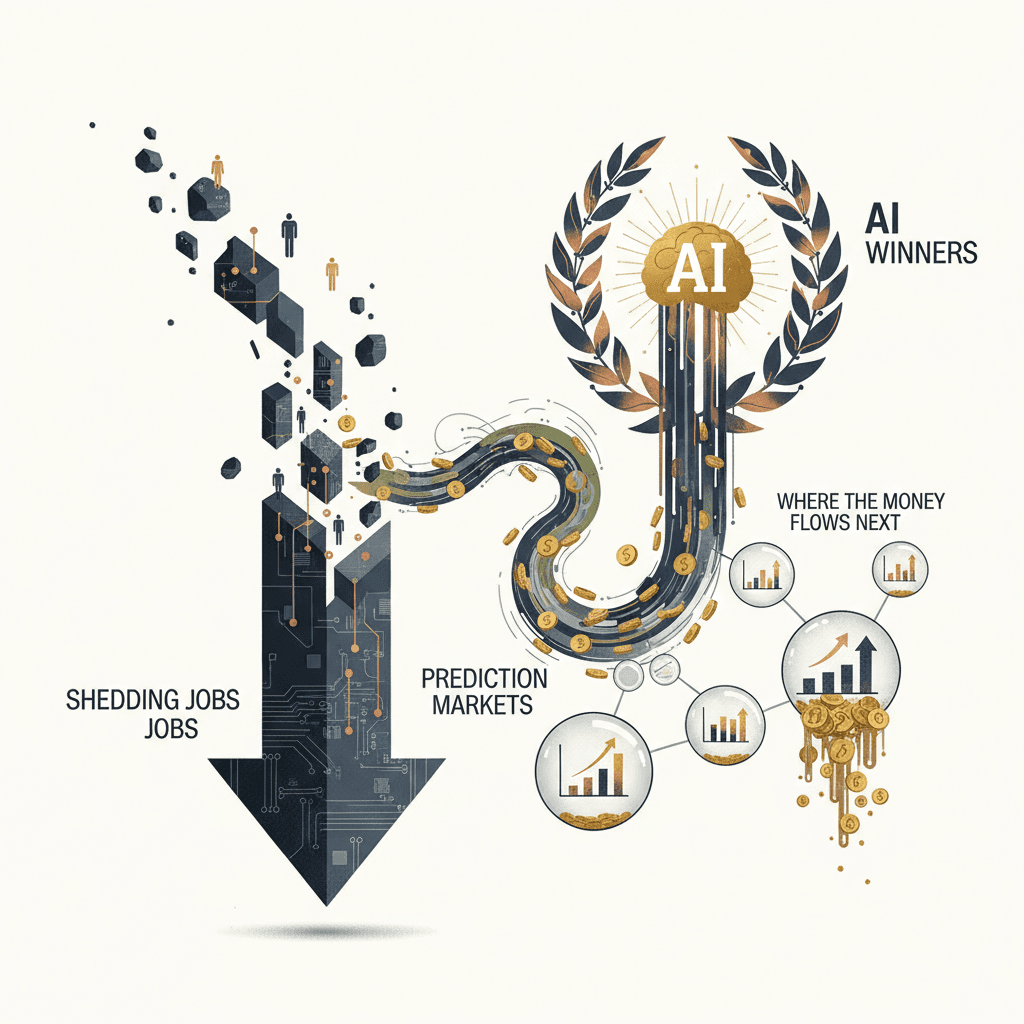
Tech Is Splitting in Two: What Prediction Markets Say About the AI Winners, the Layoff Losers, and the Shovel Sellers
Something unusual is happening in the tech sector right now. The industry is simultaneously firing people at an accelerating rate and pouring record amounts of money into artificial intelligence. These two trends aren't contradictory. They're two sides of the same coin, and prediction markets are putting sharp numbers on exactly how this plays out.
Prediction markets, where people bet real money on future outcomes, currently show an 84.5% chance that tech layoffs in 2026 will exceed 2025 levels, which were already historically elevated. At the same time, the race for AI dominance has narrowed to a startlingly small number of players. Anthropic sits at a 57% probability of having the best AI model by December 2026. Google trails at 24%, OpenAI has fallen to just 10%, and Elon Musk's xAI sits at 7%. Meanwhile, there's a 71% chance SpaceX goes public by July 2026, suggesting that private tech giants are looking to cash out while the window is open.
And just to keep things interesting, bettors are pricing in a 17.5% probability that the Nasdaq-100, the index that tracks the 100 largest non-financial companies on the Nasdaq exchange, finishes 2026 below 19,000. That's a meaningful chunk of downside risk for a sector in the middle of a structural overhaul.
Put all of this together and you get a picture of a tech economy splitting into two lanes, what economists call a K-shaped outcome. The companies at the frontier of AI are absorbing investment and talent. Everyone else is cutting headcount, tightening budgets, and bracing for a leaner future.
The K-Shaped Tech Economy
Think of the tech sector like a neighborhood going through rapid gentrification. A few gleaming new buildings go up while the older structures around them deteriorate. The money isn't disappearing from the neighborhood. It's just concentrating into fewer and fewer addresses.
This dynamic creates a self-reinforcing cycle that's worth understanding:
- AI tools make companies more productive with fewer workers, which accelerates layoffs.
- Layoffs free up budget that companies redirect toward AI infrastructure spending.
- More AI spending benefits the small group of companies building frontier models and the infrastructure underneath them.
- Those winners attract even more investment capital, while the rest of tech struggles to compete for funding.
- A potential SpaceX IPO absorbs billions in capital that might otherwise flow into public tech stocks, adding another headwind for the broader market.
The result is not a tech collapse. It's a tech rotation. The total dollars flowing through the sector may not shrink dramatically, but where those dollars land is changing fast.
Why This Matters for Your Portfolio and Your Life
If you have a 401(k) or any index fund exposure, you own tech stocks, probably a lot of them. The Nasdaq-100 and the S&P 500 are both heavily weighted toward the same handful of tech giants. A K-shaped tech economy means your returns depend heavily on which side of the split your holdings land on.
Beyond portfolios, the layoff wave ripples into everyday life. Tech workers are among the highest-paid employees in the country. When tens of thousands of them lose their jobs, they cut spending. That hits restaurants, real estate markets in places like the Bay Area and Seattle, and discretionary purchases across the board. If you're selling a home in Austin or a condo in San Francisco, this trend is very relevant to you.
On the flip side, AI infrastructure spending remains robust, which means demand for energy, data center space, and specialized chips keeps climbing. Your electricity bill may reflect this eventually, as data centers compete for power generation capacity.
The Plays: AI Winners and Infrastructure
Given the K-shaped setup, the trade signals break into two categories: companies positioned to win the AI race directly, and the "shovel sellers" providing essential infrastructure to everyone competing.
Direct AI Exposure
GOOGL gets a BUY signal at 74% confidence. Google, through DeepMind, holds the 24% probability for best AI, making it the highest-rated publicly traded company in the race (Anthropic, the leader at 57%, is private). Google owns the full stack: TPU chips for AI training, Google Cloud for distribution, DeepMind for frontier research, and Search and Android for reaching billions of users. In a world where AI winners absorb investment, Google plays both offense as an AI leader and defense as an infrastructure provider.
AMZN gets a BUY signal at 70% confidence. Amazon Web Services remains the largest cloud provider and the critical hosting layer for AI deployment. Amazon also happens to be a major investor in Anthropic with a $4 billion-plus stake, giving it indirect exposure to the prediction market favorite. The efficiency-driven layoff trend actually helps Amazon by easing the labor cost pressure that squeezed margins in recent years. The catch is that Amazon's retail business faces headwinds if tech layoffs reduce consumer spending.
META gets a WEAK BUY at 60% confidence. Meta is deploying AI aggressively across its products through its Llama models and AI assistants, and it has already shown a willingness to cut headcount hard, fitting the layoff acceleration pattern. But Meta is notably absent from the top tier of the "best AI" prediction market, which suggests bettors view its AI efforts as application-layer work rather than frontier research. Meta sits in the middle of the K-shape: not a pure winner, but not a loser either.
The Shovel Sellers
During the California Gold Rush, the people who got reliably rich weren't the miners. They were the ones selling pickaxes, shovels, and blue jeans. The same principle applies to AI. Regardless of whether Anthropic, Google, or someone else wins the model race, certain companies sell the essential equipment.
NVDA is the signature shovel seller, earning a BUY at 78% confidence, the highest of any signal in this pattern. Every frontier AI lab needs NVIDIA's GPUs for training. The company has a near-monopoly in AI training accelerators, protected by its CUDA software ecosystem. Data center and AI revenue now dominates NVIDIA's top line. The layoff-driven efficiency narrative actually reinforces AI adoption, which means more GPU demand. The risk, of course, is that the valuation leaves zero margin for error.
VRT (Vertiv) gets a BUY at 75% confidence. Vertiv makes the power management and cooling systems that every data center requires. AI workloads generate enormous amounts of heat, and the growing concern about energy bottlenecks makes efficient power management more valuable, not less. Vertiv is a top-two-or-three player globally in data center power and cooling.
ANET (Arista Networks) gets a BUY at 73% confidence. AI training clusters require ultra-low-latency, high-bandwidth networking, and Arista is the dominant supplier of cloud-scale networking equipment. The concentration dynamic in AI, fewer but larger players, actually benefits Arista because bigger AI clusters mean bigger networking orders.
ASML earns a WEAK BUY at 70% confidence. If NVIDIA sells the shovels, ASML makes the machine that forges the shovels. ASML is the sole manufacturer of the extreme ultraviolet (EUV) lithography machines required to produce the most advanced AI chips on the planet. There is literally no alternative supplier. That monopoly is unparalleled in the technology world. The concern is that ASML's stock already reflects this dominance in its price, and semiconductor spending cycles can turn sharply.
EQIX (Equinix), the world's largest data center REIT (a real estate investment trust focused on data center properties), gets a WEAK BUY at 68% confidence. Every tech company needs physical space for servers, and Equinix provides colocation and interconnection services globally. Its REIT structure offers some downside protection through dividends. The risk is that hyperscale companies like Google and Amazon are increasingly building their own facilities.
ETN (Eaton) rounds out the infrastructure picks with a WEAK BUY at 67% confidence. Eaton manufactures transformers, UPS systems, and switchgear, the electrical distribution backbone of data centers. It's more diversified than the pure infrastructure plays, with exposure to aerospace and utilities, which limits the upside from AI but also provides a cushion if the data center buildout slows.
The Risks You Need to Know
No pattern comes without risks, and this one has several that are worth taking seriously.
For the AI winners directly, antitrust action is a real concern. Google faces ongoing regulatory pressure that could force structural changes. An AI bubble deflation could compress valuations even for the leaders if investors decide the return on AI spending is taking too long to materialize. Anthropic's 57% dominance in prediction markets suggests Google may actually be losing the frontier model race, not winning it. And the massive capital expenditure required for AI infrastructure has an unclear ROI timeline, meaning companies are spending tens of billions before knowing what they'll earn back.
For the shovel sellers, the primary risk is that AI spending could plateau or pull back. If companies collectively decide the payoff isn't worth the investment, demand for GPUs, networking gear, and cooling systems could fall fast. Custom silicon from Google (TPUs), Amazon (Trainium), and Microsoft (Maia) is gradually eroding NVIDIA's monopoly position. Export restrictions to China shrink the addressable market for both NVIDIA and ASML. And nearly every infrastructure name mentioned here carries stretched valuations that leave little room for disappointing quarters.
For the broader market, the SpaceX IPO could pull significant capital away from existing public tech stocks. The 17.5% chance of the Nasdaq falling below 19,000 is not a base case, but it represents meaningful tail risk. Tariff uncertainty creates supply chain headaches across the board. And the consumer spending drag from widespread tech layoffs could hurt companies with retail exposure, Amazon included.
The Bottom Line
The tech sector isn't dying. It's reorganizing around AI, and the prediction markets are putting concrete probabilities on the shape of that reorganization. The pattern points toward a narrow group of winners absorbing investment while the broader industry shrinks headcount and tightens belts. For investors, the playbook favors the AI frontier leaders you can actually buy in public markets, and more importantly, the infrastructure companies selling essential tools to all of them. The gold rush metaphor isn't perfect, because unlike the original, AI will likely produce enormous real value. But the principle holds: in a race with uncertain winners, owning the equipment everyone needs is often the smarter bet.
Analysis based on prediction market data as of April 6, 2026. This is not investment advice.
How This Story Evolved
First detected Mar 20 · Updated daily
The article swapped out a river metaphor for a tree metaphor to explain the tech industry's split. The new version also adds more emphasis on why everyday people — not just investors — should care about which side of the divide they're on.
Read latest →The article swapped out a technical finance term ("K-shaped") in the intro for a simpler explanation of the tech industry split, and added a river analogy to help readers visualize how money is flowing toward AI winners while leaving others behind. The core story about layoffs and AI investment concentration stayed the same.
Read this version →The article was updated to add SpaceX's upcoming IPO as a major theme alongside the layoffs and AI investment storylines. The opening was also rewritten to be more direct and punchy, and the body now uses headers and specific statistics to organize the information.
Read this version →The article's opening was rewritten to lead with the K-shaped economy idea in plain, direct language instead of starting with the letter K visual metaphor. The new version jumps straight into explaining the split between layoffs and AI winners before introducing the term.
Read this version →The article's opening was rewritten to frame the story as a "fracturing" economy that affects everyday investors and workers, rather than focusing on contradictory industry trends. The headline also softened the phrase "Layoff Losers" to "Mass Layoffs" and changed "Shovel Sellers" to "Where the Money Goes Next."
Read this version →The article was rewritten to open more simply and directly, leading with the core contradiction of layoffs and AI spending right away instead of building up to it. It also added a specific statistic — an 84.5% predicted chance that 2026 tech layoffs will exceed 2025 — to make the opening more concrete.
The article was rewritten to open with a simpler, more direct description of what's happening in tech before introducing prediction markets, rather than leading with the prediction markets themselves. It also added a specific statistic early on — an 84.5% chance that 2026 tech layoffs will exceed 2025 levels — which wasn't in the previous version.
Read this version →